First Cousin Three Times Removed
Your first cousin three times removed is someone who shares grandparents with a relative three generations away from you — and that description hides an important detail: the relationship works in both directions. It could be your first cousin's great-grandchild, or it could be your great-grandparent's first cousin. Both carry the identical label, because the removal system counts generational distance without recording which way. This page explains who fits the description, how to work it out from any starting point, and what the label does and doesn't tell you. For any relationship you're unsure of, the what do I call them tool gives the answer immediately.
Who Is a First Cousin Three Times Removed?
Two people fit the label, and they're at opposite ends of your tree.
Going down: your first cousin's great-grandchild. You share grandparents with your first cousin; their great-grandchild is three generations below them, and therefore three generations below you.
Going up: your great-grandparent's first cousin. That person shared grandparents with your great-grandparent, and sits three generations above you.
The relationship is the same in both cases because the naming system records only two things: the cousin degree, fixed by the shared ancestor of the original cousin pair, and the number of generations separating you. It doesn't record who's older.
Which means the label alone is ambiguous. In a written tree that's usually fine, because the tree shows the direction. In conversation, or in a bare DNA match label, it isn't — "first cousin three times removed" could be a six-year-old or someone born in 1850.
A quick way to sanity-check either version: the "first cousin" part always traces back to a pair of siblings — two people who shared parents. Your first cousin and you descend from those siblings' parents, and so does everyone further down the line. If you can identify the sibling pair at the top, the rest of the label follows mechanically from counting.
Other people at the same distance, for orientation: your first cousin's great-grandchild, your great-grandparent's first cousin, and — from a different starting point — your grandparent's first cousin once removed. All are three generational steps away along a first-cousin line.
How Do You Work It Out?
The same method that handles every cousin relationship.
Step 1: Find the most recent common ancestor — the nearest person or couple you both descend from.
Step 2: Count your generations back to them.
Step 3: Count their generations back to the same ancestor.
Step 4: Smaller number minus one gives the cousin degree.
Step 5: The difference between the two numbers gives the removal.
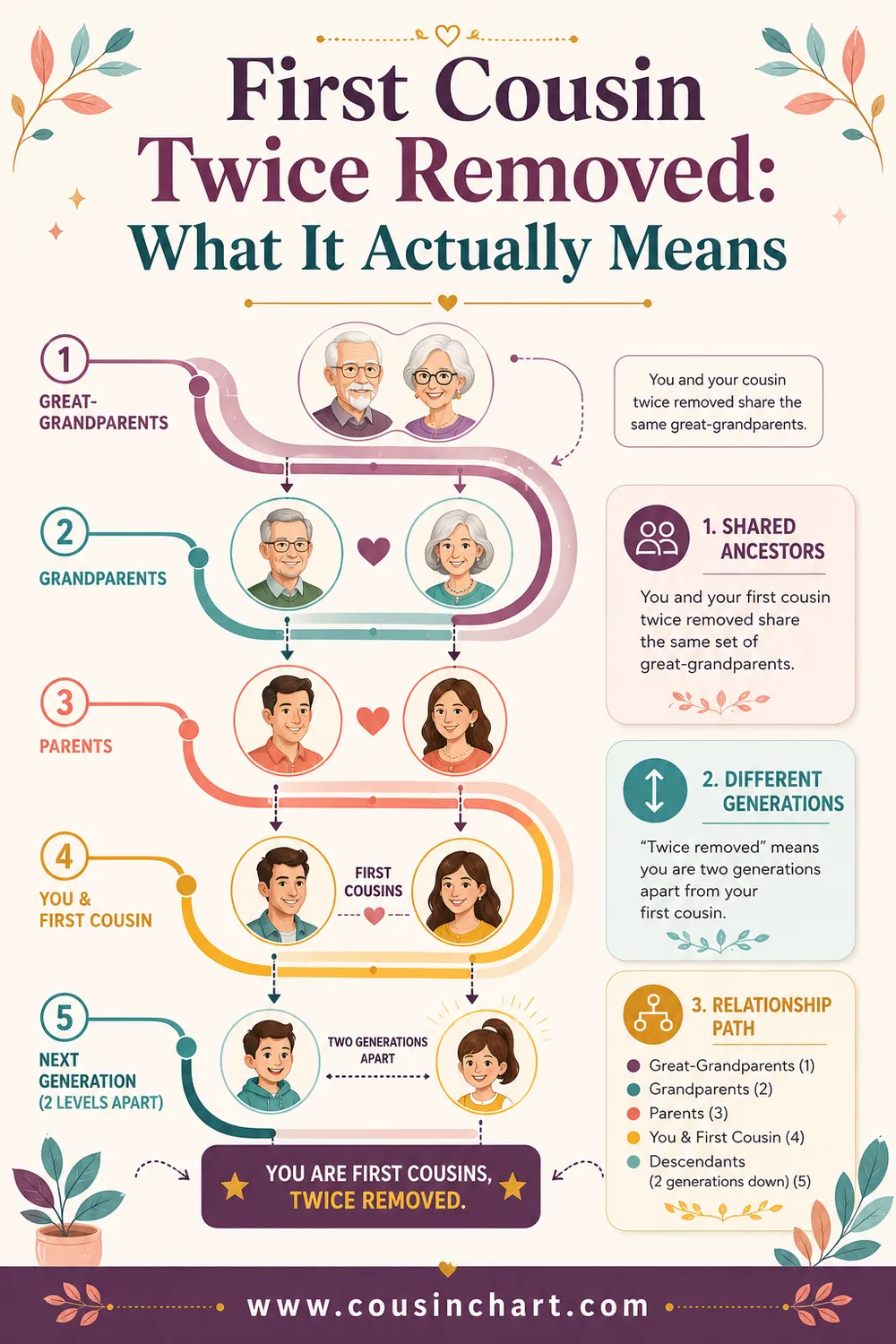
Worked downward. Your first cousin's great-grandchild: you are 2 generations from your shared grandparents. They are 5 — parent, grandparent (your cousin), and up through great-grandparent and great-great-grandparent. Smaller number 2 minus 1 gives first cousin. Difference 5 − 2 = 3, so three times removed.
Worked upward. Your great-grandparent's first cousin: your great-grandparent is 2 generations from their shared grandparents, so you are 5. Their cousin is 2 generations from the same ancestors. Smaller number 2 minus 1 gives first cousin; difference 5 − 2 = 3 gives three times removed. Identical label, opposite direction.
The full progression down one line:
| Relative | Their relationship to you |
|---|---|
| Your first cousin | First cousin |
| Their child | First cousin once removed |
| Their grandchild | First cousin twice removed |
| Their great-grandchild | First cousin three times removed |
| Their great-great-grandchild | First cousin four times removed |
One removal per generation, degree unchanged. The rule is covered from the other end in what is my cousin's grandchild to me, and the intermediate steps in first cousin once removed and first cousin twice removed.
How Much DNA Would You Share?
Low enough that it's genuinely uncertain territory.
| Relationship | Average cM | Typical range |
|---|---|---|
| First cousin | 866 | 396–1,397 |
| First cousin once removed | 433 | 102–980 |
| First cousin twice removed | 221 | 43–531 |
| First cousin three times removed | 123 | 14–353 |
| First cousin four times removed | 71 | 0–261 |
| Second cousin | 229 | 41–592 |
| Second cousin once removed | 122 | 14–353 |
Each removal roughly halves the expected amount, the same pattern as adding a cousin degree.
The identical rows are the point. A first cousin three times removed and a second cousin once removed have essentially the same statistics — 123 cM against 122, with identical ranges. Shared DNA cannot distinguish them. Only ages, shared matches and a documented tree can.
The range is wide relative to the average. Anywhere from 14 to 353 cM is normal, which is a factor of twenty-five. Recombination is random, and at this distance the variation dominates.
Some pairs share nothing at all. By this point in a tree, it's entirely possible for two genuine relatives to have inherited non-overlapping DNA and show no match whatsoever. That's expected rather than evidence of an error.
The practical implication: at three removals, DNA is supporting evidence at best. A documented paper trail does the work, and the genetic result either agrees or is silent — and silence means very little at this distance.
Who Would You Actually Meet at This Distance?
Worth picturing, because the label is abstract and the people aren't.
Downward, they're probably young. If you're fifty and your first cousin is a similar age, their great-grandchild is likely a small child — assuming reasonably conventional generation lengths of twenty-five to thirty years. You may well have met them at a family gathering without registering the connection.
Upward, they're almost certainly long dead. Your great-grandparent's first cousin was born around the same time as your great-grandparent, typically in the nineteenth century. You'll meet them only in a census return or a parish register.
Generation lengths vary enormously, which muddies this. A family with children at twenty produces a very different alignment from one with children at forty, and after three or four generations the drift is substantial. It's entirely possible for a first cousin three times removed to be older than you rather than younger, if the lines ran at different speeds.
That drift is why age is such useful evidence and also why it isn't conclusive. A DNA match twenty years older than you is probably on an upward path, and probably isn't certainly.
In practice most people encounter this relationship in one of two ways: as an unfamiliar name in a DNA match list, or as a distant cousin who got in touch after researching the same surname. Rarely as someone they grew up knowing.
Does the Label Actually Matter?
Depends entirely on what you're doing.
In everyday conversation, no. Nobody says "this is my first cousin three times removed." "Cousin" covers it, and most families wouldn't have tracked the connection at all.
In a family tree, yes. A tree that labels relationships loosely becomes unusable, because a reader can't reconstruct who descends from whom. Precision here isn't pedantry; it's what makes the record work.
In DNA research, very much so. Placing a match in the wrong generation cascades — every conclusion built on that placement inherits the error. And since several relationships share near-identical cM statistics, getting the label right depends on evidence beyond the number.
In legal and medical contexts, occasionally. Inheritance rules, some marriage restrictions and family medical histories all care about the degree of relatedness between two people, though the rules rarely reach as far out as three removals in practice.
Where it genuinely helps is in describing distant connections precisely to another researcher. "We're first cousins three times removed through the Barlows of Blackburn" tells a fellow genealogist exactly where to look. "We're distant cousins" tells them nothing.
One notational shortcut worth knowing. Genealogists frequently abbreviate these relationships: 1C3R for first cousin three times removed, 2C1R for second cousin once removed, and so on. You'll see it constantly in DNA forums and match notes, and it's considerably faster to write. The number before the C is the cousin degree; the number before the R is the removal.
Where you can safely relax: anything social. A relative you meet at a funeral, a cousin who gets in touch after a DNA match, a name in a Christmas card list. "Cousin" is the right word, and using the technical term makes an ordinary conversation slightly strange.
What Are the Related Terms at This Distance?
Once you're several generations out, the labels start to blur into one another.
Terms that describe roughly comparable distances:
- First cousin three times removed — 123 cM average
- Second cousin once removed — 122 cM average
- Third cousin — 73 cM average
- Half first cousin twice removed — around 110 cM
Any of these could be sitting behind a 120 cM match, along with several others. This is exactly why match identification depends on clustering and trees rather than on the number alone.
Half versions halve the amount. A half first cousin three times removed shares roughly 60 cM on average, which drops it into the range where non-matches become common and where small-segment noise starts to matter.
Further out still, the numbered cousins take over entirely and removals become less useful as a description — what is a fifth cousin covers the far end of the scale, where most genuine relatives share no detectable DNA at all.
And on the other side of the family, the aunt-and-uncle vocabulary handles the equivalent distances: your great-great-grandparent's brother is your great-great-great-uncle, described in what is a great uncle. Two systems, roughly the same territory, and English uses both.
A last observation. At three removals you're describing a relationship most families would never have named. These terms exist because genealogy needed a precise vocabulary, not because anyone historically thought of their great-grandparent's cousin as a specific kind of relative — which is worth remembering when the terminology feels unnecessarily elaborate. It's a tool for records, and it's very good at that job.
Frequently Asked Questions
Who is my first cousin three times removed?
Either your first cousin's great-grandchild, or your great-grandparent's first cousin. Both carry the same label, because the removal system counts generational distance without recording direction.
How do I calculate a cousin relationship?
Find your most recent common ancestor, count generations from each of you back to them, subtract one from the smaller number for the cousin degree, and take the difference between the two numbers as the removal.
How much DNA do you share with a first cousin three times removed?
Around 123 cM on average, ranging from about 14 to 353. Some pairs share nothing detectable at all. That average is nearly identical to a second cousin once removed, so DNA alone can't distinguish the two.
Why does removed not tell you the direction?
Because the naming system only records the shared ancestor and the number of generations between you. It's a description of distance, not of who is older, so an ancestor's cousin and a cousin's descendant get the same label.
Do people actually use this term?
Rarely in conversation — most families just say "cousin". The precise terms exist for family trees, DNA interpretation, and describing connections accurately to other researchers, where ambiguity would make the record unusable.
What's the difference from a second cousin once removed?
They're different relationships with almost identical DNA statistics. A first cousin three times removed connects through a first-cousin pair three generations apart; a second cousin once removed connects through a second-cousin pair one generation apart.
If the whole system still feels arbitrary, there's a reason: it was designed to describe descent precisely for legal and inheritance purposes, not to reflect how families actually think about each other. That's why it captures generational distance meticulously and ignores whether you've ever met. Used as a filing system rather than a social vocabulary, it works extremely well.
Two numbers do all the work: the cousin degree comes from the shared ancestor and never changes, and the removal counts the generation gap in either direction. Three times removed means three generations — a cousin's great-grandchild, or a great-grandparent's cousin, and the label won't tell you which. Get any relationship in seconds with the what do I call them tool.