What Is a Fifth Cousin?
A fifth cousin is someone who shares fourth-great-grandparents with you — six generations back on both sides. You almost certainly have tens of thousands of them, you've probably met several without knowing, and around 85% of them share no detectable DNA with you at all. That combination makes fifth cousins an odd category: numerous, genealogically real, and largely invisible to both memory and testing. This page covers the definition, the arithmetic of how many you have, what the DNA looks like, and whether the relationship means anything in practice. For any relationship you're unsure of, the what do I call them tool has the answer.
How Is a Fifth Cousin Defined?
The pattern is completely regular once you see it.
| Relationship | Shared ancestor | Generations back |
|---|---|---|
| Siblings | Parents | 1 |
| First cousins | Grandparents | 2 |
| Second cousins | Great-grandparents | 3 |
| Third cousins | 2×-great-grandparents | 4 |
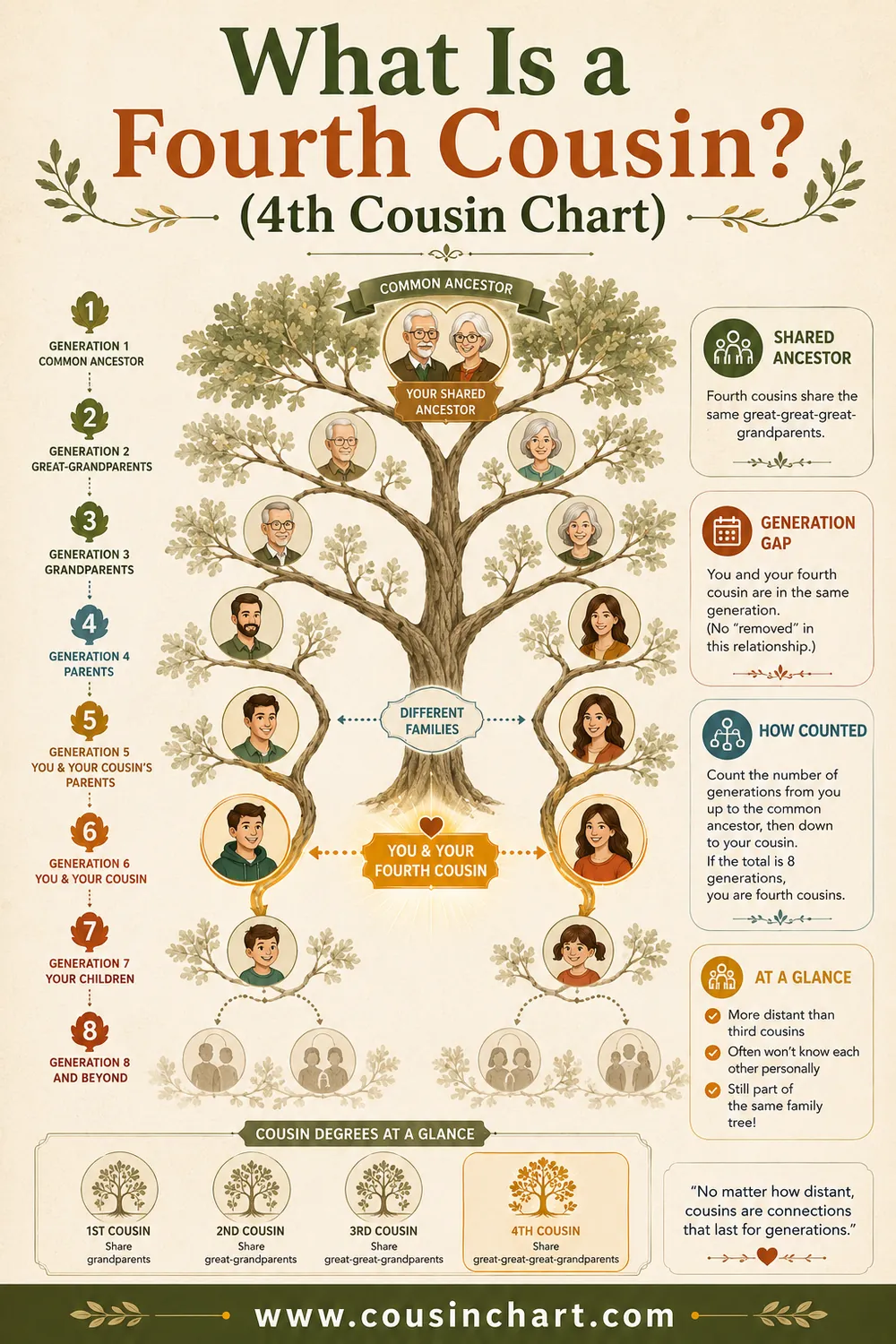
| Fourth cousins | 3×-great-grandparents | 5 |
| Fifth cousins | 4×-great-grandparents | 6 |
| Sixth cousins | 5×-great-grandparents | 7 |
The rule: the cousin degree is one less than the number of generations back to the shared ancestor. Fifth cousins are six generations from their common ancestors — you go back six, they go back six, and you meet at the same couple.
In years, that's a long way. At roughly 25 to 30 years per generation, six generations covers about 150 to 180 years. Your fourth-great-grandparents were probably born somewhere in the early 1800s or late 1700s.
Both people must be the same number of generations from the ancestor. If one is six generations away and the other seven, it's a fifth cousin once removed rather than a sixth cousin — the removal system covered in first cousin three times removed.
Compared with the nearer degrees, the difference is mostly in how much shared history remains: third cousins often know of each other's branch, and fifth cousins essentially never do — see what is a third cousin and what is a fourth cousin.
How Many Fifth Cousins Do You Have?
The number is genuinely startling.
Start with the ancestors. Six generations back you have 64 fourth-great-grandparents, which is 32 couples. Every descendant of any of those couples, six generations down and not descended through your own line, is a fifth cousin.
Then multiply. If each couple had four children who survived to have children, and that continued for six generations, each ancestral couple produces thousands of descendants. Across 32 couples, estimates commonly land somewhere between 10,000 and 100,000 fifth cousins for a typical person, depending on family sizes and how much intermarriage occurred.
| Relationship | Roughly how many you have |
|---|---|
| First cousins | 5–15 |
| Second cousins | 20–50 |
| Third cousins | 150–500 |
| Fourth cousins | 1,000–5,000 |
| Fifth cousins | 10,000–100,000 |
| Sixth cousins | 100,000+ |
Which means you've met some. In a town of any size, particularly one your family has lived in for generations, a meaningful proportion of people around you are fifth or sixth cousins. Nobody knows, because nobody tracks connections that far.
The numbers also explain something about DNA testing. Your match list is dominated by distant cousins precisely because there are so many of them — a few close relatives and thousands of fourth to sixth cousins, most sharing very little.
And a caveat on the arithmetic. These figures assume no repeated ancestry, which is unrealistic. In practice everyone has pedigree collapse — the same ancestors appearing more than once in a tree, because distant cousins married. That reduces the true number of distinct ancestors and increases how closely related people in the same population are.
How Much DNA Do Fifth Cousins Share?
Very little, and usually nothing at all.
| Relationship | Average cM | Chance of no match |
|---|---|---|
| Third cousin | 73 | About 10% |
| Fourth cousin | 35 | About 50% |
| Fifth cousin | 25 | About 85% |
| Sixth cousin | 18 | Over 95% |
Roughly 85% of fifth cousins share no detectable DNA whatsoever. That's not a testing failure — it's how inheritance works. Each generation halves the expected contribution, and by six generations most ancestral lines have dropped out of a given descendant's genome entirely.
When they do match, the segments are small. A 25 cM total might be one modest segment or several tiny ones, and small segments are exactly where false matches cluster. A 10 cM match with a supposed fifth cousin is as likely to be population-level noise as genuine recent inheritance.
Which makes fifth cousins poor DNA evidence on their own. You can't confirm a documented fifth-cousin relationship by testing, because a non-match proves nothing and a small match proves little. What works is the pattern: several matches clustering consistently on the same ancestral line, ideally triangulated on shared segments.
Your match list still contains thousands of them, because sheer numbers overcome low probability. Of 50,000 fifth cousins, even 15% matching gives 7,500 people — and that's why distant matches dominate every match list.
The practical upshot: treat individual fifth-cousin matches as weak signals and groups of them as potentially useful. A cluster of small matches all descending from one couple is meaningful; any single one of them is not.
How Would You Ever Prove a Fifth-Cousin Link?
Almost entirely on paper, with DNA offering support at best.
The documentary route is the real one. You trace your line back six generations to a couple, your supposed cousin traces theirs back six generations to the same couple, and every step in both lines is sourced. That's twelve generations of research between you, and any weak link anywhere breaks the chain.
Which is why fifth-cousin claims are frequently wrong. Six generations back, most trees rely on at least one unsourced assumption — a baptism assigned to the right-looking family, a marriage inferred from proximity, a parent copied from someone else's tree. The relationship is only as solid as the shakiest link in either direction.
DNA can support but not establish it. A single match at this distance proves nothing. What carries weight is a group of matches, all descending from the same ancestral couple through different documented children, ideally triangulating on the same segment. That pattern is difficult to explain any other way.
Test the older generation if you can. A parent or a great-aunt is one or two generations closer to the shared ancestors, so their match list reaches further and their shared amounts are larger. At fifth-cousin distance that difference is often what makes a match visible at all.
Be honest about confidence. "Documented fifth cousins, both lines sourced to original records" is a very different claim from "probable fifth cousins based on matching surnames in the same county". Both are worth recording; only one is worth building on.
And accept that some connections stay probable. At six generations, "we almost certainly connect through this family, and I can't prove which child" is a perfectly respectable conclusion.
Does the Relationship Mean Anything?
Depends entirely on the context, and mostly it doesn't.
Legally, almost never. No jurisdiction anywhere restricts marriage at fifth-cousin distance, and inheritance laws rarely extend beyond much closer relatives. In most legal senses, a fifth cousin is a stranger.
Medically, negligibly. Shared genetic risk at this distance is close to the population baseline. Family medical history matters for close relatives, not sixth-generation ones.
Socially, not at all in most cultures. Very few people know their fifth cousins, and fewer still would treat the connection as meaningful if they discovered it.
Genealogically, sometimes usefully. A documented fifth-cousin relationship confirms that two family trees connect at a specific couple, which is real information — particularly if one researcher has records the other doesn't. Distant cousins are frequently the people who solve each other's brick walls.
Where it genuinely matters:
- Confirming a line through a cluster of consistent matches
- Finding other researchers working the same families, who may hold photographs, documents and local knowledge
- One-name studies and surname projects, where distant cousins are the entire point
- Reconstructing a family where your own direct line's records are lost but a cousin branch's survive
And there's a perspective worth holding onto. Go back far enough and everyone with shared regional ancestry is related somehow. Fifth cousins aren't rare or special — they're the ordinary texture of any settled population, and the interesting thing is usually not the relationship itself but what the other person's research contains.
What About Removed Versions and Halves?
The same modifiers apply, with the same effects.
Fifth cousin once removed — one of you is six generations from the shared ancestors and the other seven. Averages around 21 cM, with the great majority sharing nothing.
Fifth cousin twice removed — a two-generation gap. Lower still, and effectively undetectable for most pairs.
Half fifth cousins share one fourth-great-grandparent rather than a couple, halving the already tiny expected amount to somewhere around 12 cM. In practice, that means almost none of them match.
Double fifth cousins — related through two separate ancestral lines, which happens frequently in communities where families intermarried over generations. They share roughly twice the usual amount, which can make a fifth cousin look like a fourth or even a third.
Endogamy changes everything at this distance. In populations that intermarried heavily, people are related through dozens of distant paths simultaneously, and the shared DNA totals bear little relation to the nominal relationship. Standard cousin charts simply don't apply.
And the terminology gives out eventually. Past about sixth or seventh cousin, most researchers stop naming the relationship and describe the connection instead — "we both descend from the Barlows of Blackburn" is more useful than counting removals nobody can verify. The aunt-and-uncle vocabulary covered in what is a great uncle reaches its limits at a similar distance, and the removal system in what is my cousin's grandchild to me is what fills the gaps in between.
Frequently Asked Questions
What is a fifth cousin?
Someone who shares fourth-great-grandparents with you — six generations back on both sides. The rule is that the cousin degree is one less than the number of generations to the shared ancestor.
How many fifth cousins do I have?
Somewhere between 10,000 and 100,000, depending on family sizes and how much intermarriage occurred in your ancestry. You have 64 fourth-great-grandparents, and their descendants multiply enormously over six generations.
Do fifth cousins share DNA?
Usually not. Around 85% of fifth cousins share no detectable DNA at all, and those who do typically share about 25 cM in small segments. That makes any individual fifth-cousin match weak evidence on its own.
Is a fifth cousin a close relative?
No. Legally, medically and socially the relationship carries essentially no weight — no marriage restrictions, negligible shared genetic risk, and almost nobody knows their fifth cousins. It matters mainly in genealogical research.
What is a fifth cousin once removed?
Someone where one of you is six generations from the shared ancestors and the other is seven. They share around 21 cM on average, and the great majority share nothing detectable.
Why do I have so many distant cousin matches?
Because there are so many distant cousins. You have tens of thousands of fifth cousins, and even a small proportion matching produces thousands of entries. Close relatives are rare; distant ones dominate every match list.
There's a pleasing consequence of the arithmetic worth ending on. Because everyone has tens of thousands of fifth cousins and the number keeps multiplying further back, go back far enough and any two people from the same region share ancestors. Distant cousinhood isn't a curiosity — it's the default condition of any long-settled population, and the surprising thing is not that you're related to someone but that anyone can document exactly how.
Fifth cousins share your fourth-great-grandparents, you have tens of thousands of them, and most are genetically invisible to you. The relationship is real and rarely consequential — where it earns attention is when a cluster of them confirms a line, or when one of them turns out to be researching the same family and has the document you've been missing. Check any relationship in seconds with the what do I call them tool.