How to Explain Cousins to Kids (Simple Chart)
The simplest way to explain cousins to a child: "Your cousins are the kids of your aunts and uncles. Your parent and their parent are brother and sister — so you're cousins." Start there, with first cousins, and only add second cousins or "removed" once the basic idea has landed. Kids grasp cousins best through their own family, not abstract charts.
This guide gives you the exact words, a kid-friendly chart, and a gentle order for introducing each idea — plus fun ways to make it stick. Whether it's for a curious 6-year-old or a family-tree school project, you'll find a script that works. And when a child asks a tricky one ("what's my cousin's baby to me?"), the free relationship calculator gives a quick, visual answer you can show them.
Kid-friendly quick-check. Tap a question a child might ask to see a simple answer:
The answer will appear here.
Start With One Sentence
Don't open with charts or the word "generation." Open with a single, concrete sentence about the child's own family:
"Your cousins are the children of your aunts and uncles. Your mom (or dad) and their parent are brothers and sisters — so you're cousins!"
That's the entire concept of a first cousin, in words a 5- or 6-year-old can follow. Use real names the child knows: "Aunt Sara is Daddy's sister. Sara's kids — Leo and Mia — are your cousins, because Daddy and Aunt Sara are brother and sister." Concrete names beat abstract rules every time.
Then pause. Let that land before adding anything else. Most kids only need the first-cousin idea, and piling on "second cousins" and "removed" too soon just muddies it.
The Grandparent "Aha"
Once the aunt-and-uncle version clicks, there's one beautiful follow-up that locks it in: the shared grandparents.
"You and your cousins all have the same grandma and grandpa. That's your special connection!"
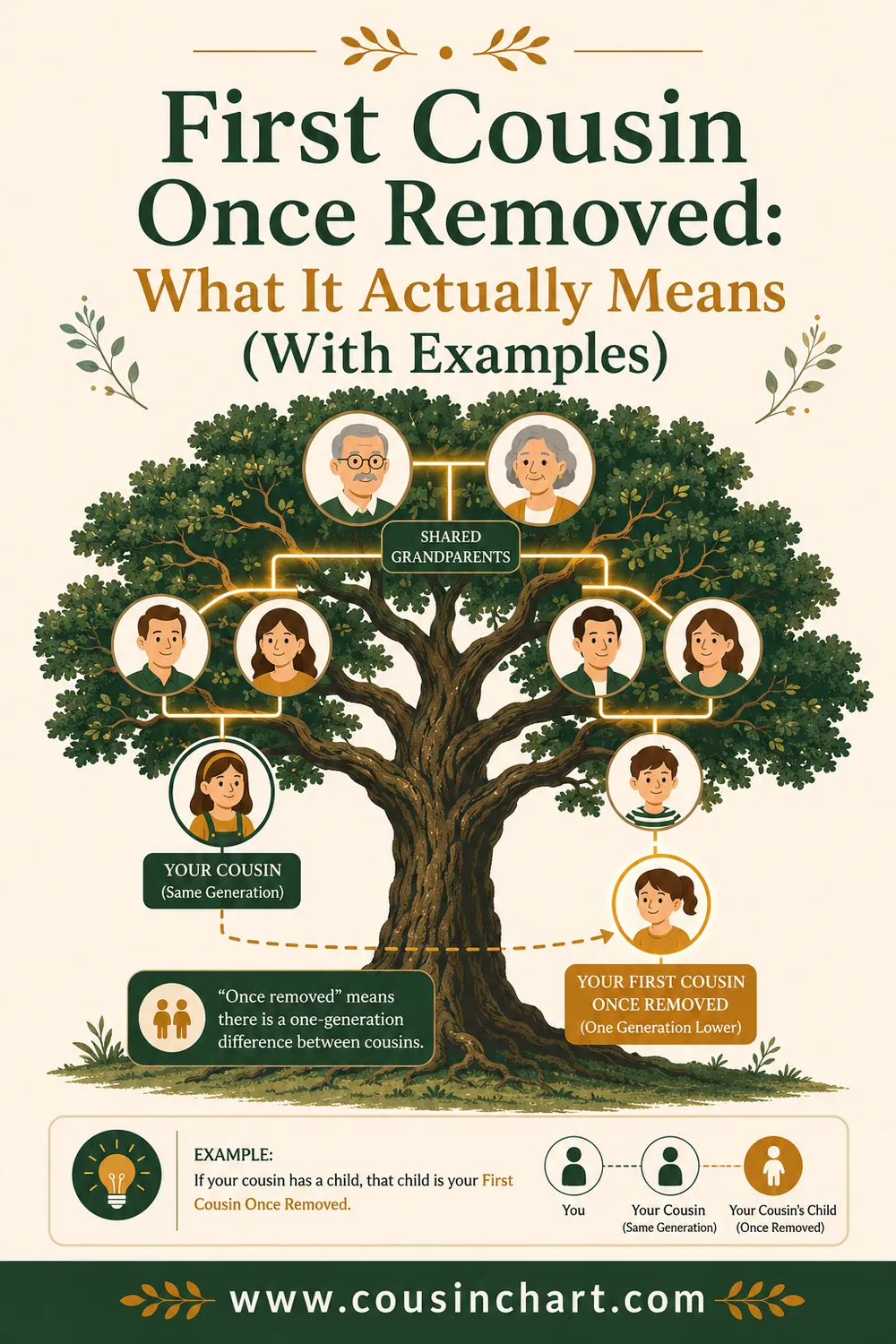
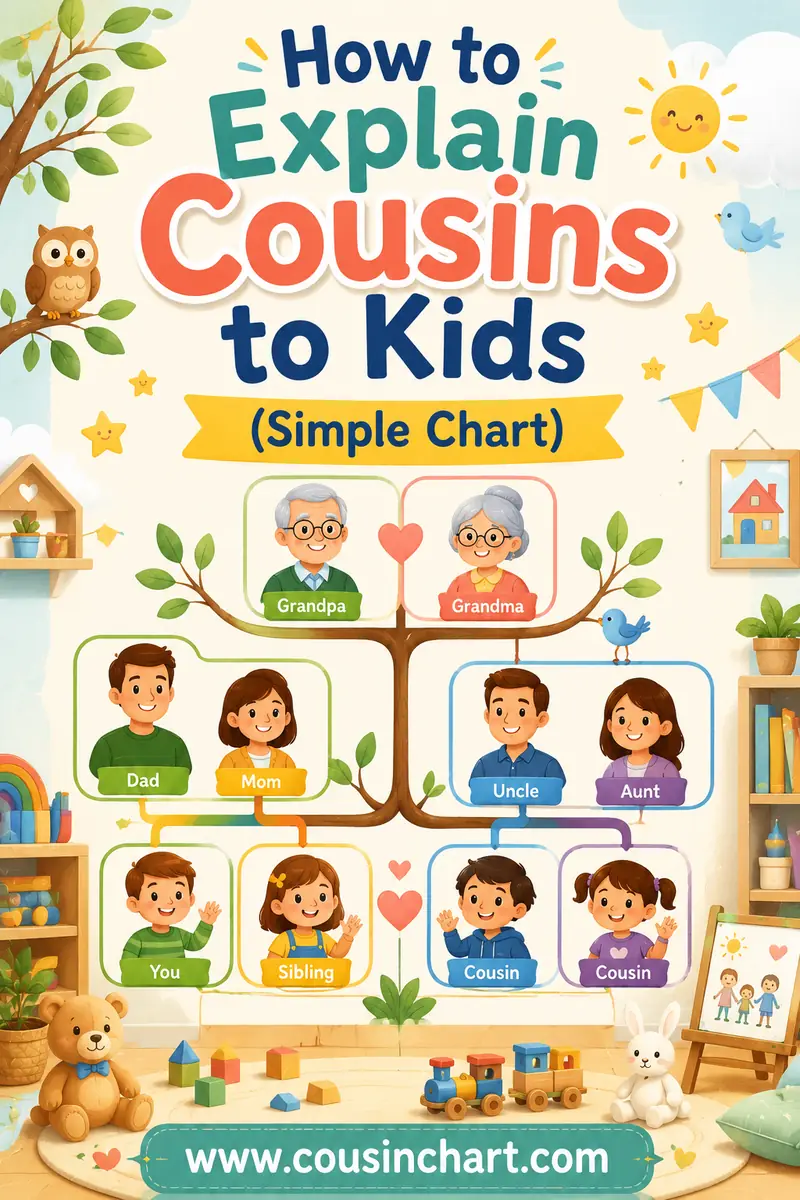
Kids love this because grandparents are already central figures in their lives. Pointing out that cousins are "the other grandchildren" makes the relationship instantly visual: Grandma and Grandpa at the top, then the aunts and uncles, then all the cousins spread out at the bottom. This single image — one set of grandparents with a row of cousins beneath — is the mental model that carries a child through every cousin question later. We build the same picture for grown-ups in first cousin once removed.
A Simple Chart Kids Can Follow
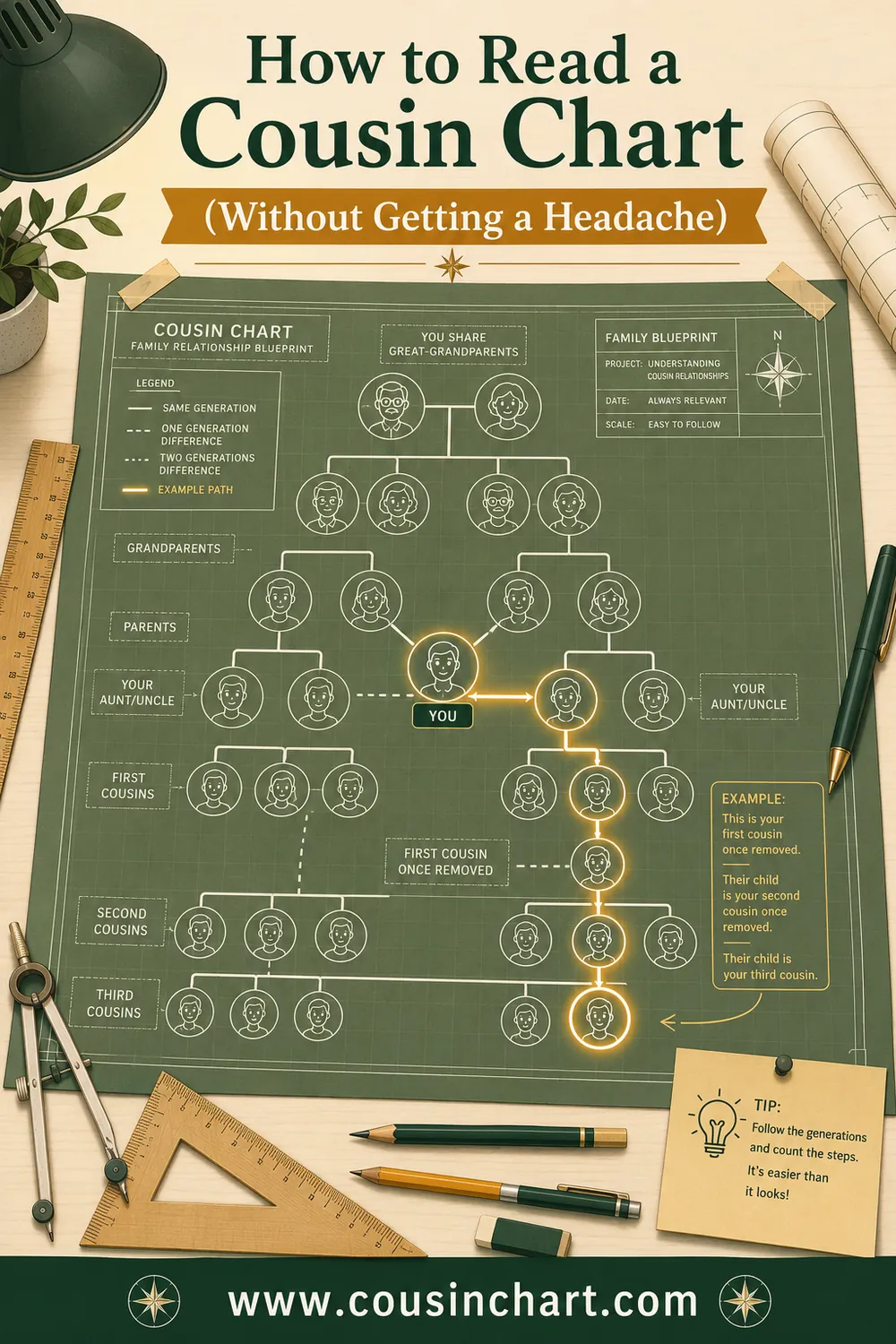
When you're ready for a visual, keep it tiny. A three-row chart is plenty:
| Top | Grandma & Grandpa |
|---|---|
| Middle | Your parent + their brother/sister (your aunt/uncle) |
| Bottom | You + your cousins |
Walk the child up and down it with a finger: "Start at you. Go up to your mom. Go up again to Grandma. Now come down the other side to Aunt Sara, then down to Leo. You and Leo are cousins!" Tracing the path with a finger turns an abstract idea into a little journey. For a fuller version they can grow into, how to read a cousin chart has the grid layout.
Introducing Second Cousins (Only When Ready)
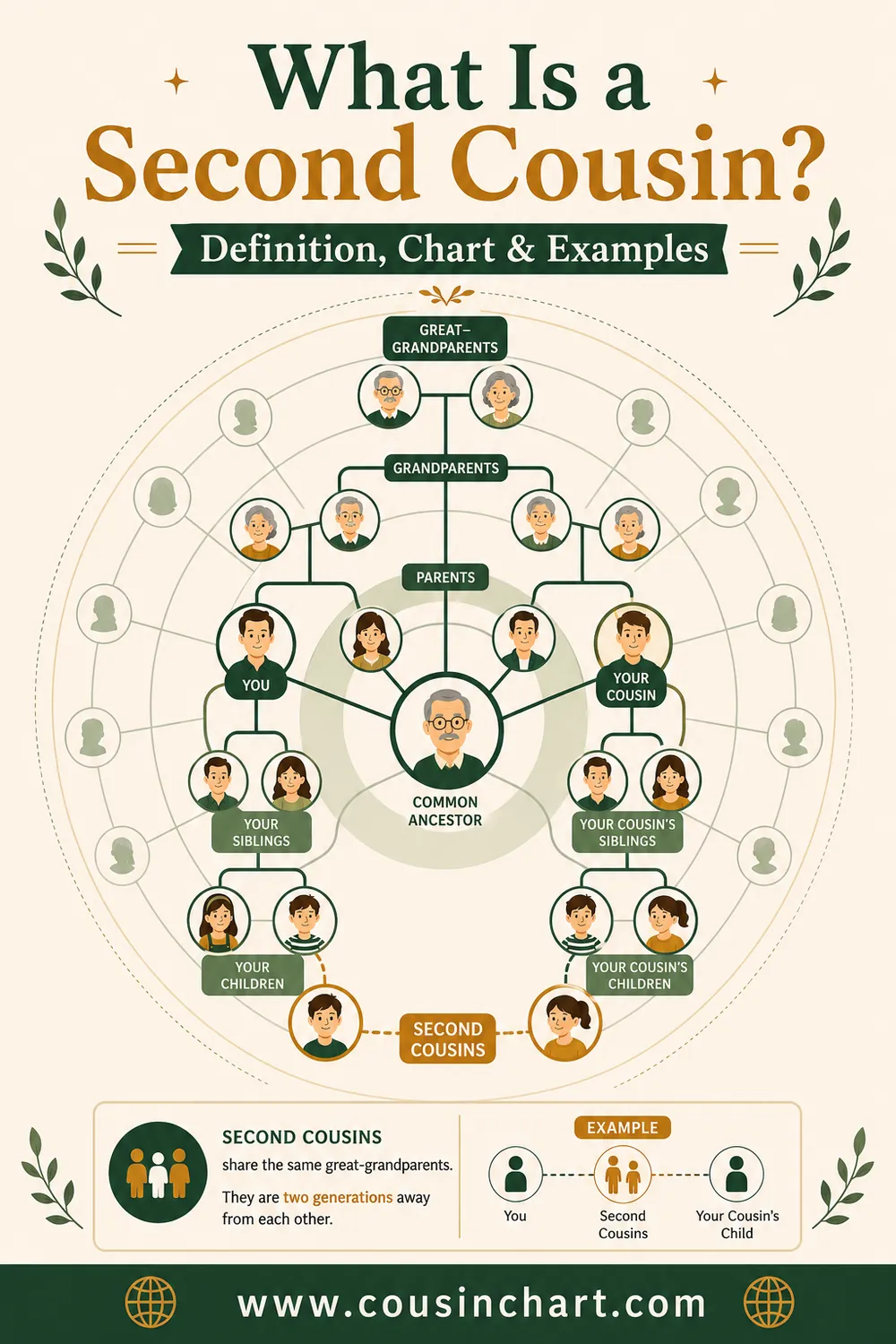
For an older child (say 8+) who's curious for more, second cousins are the natural next step. Keep the same shared-ancestor logic, just move it up one level:
**"First cousins share grandparents. Second cousins share great-grandparents — your grandparents' parents. Your second cousin is your parent's cousin's kid."**
The trick is to always anchor it to who you share at the top. First cousins → same grandparents. Second cousins → same great-grandparents. That one rule ("who's the ancestor we both come from?") answers every cousin-number question a child will ever ask. Our what is a second cousin explainer keeps it simple enough to read together.
Explaining "Removed" to a Curious Kid
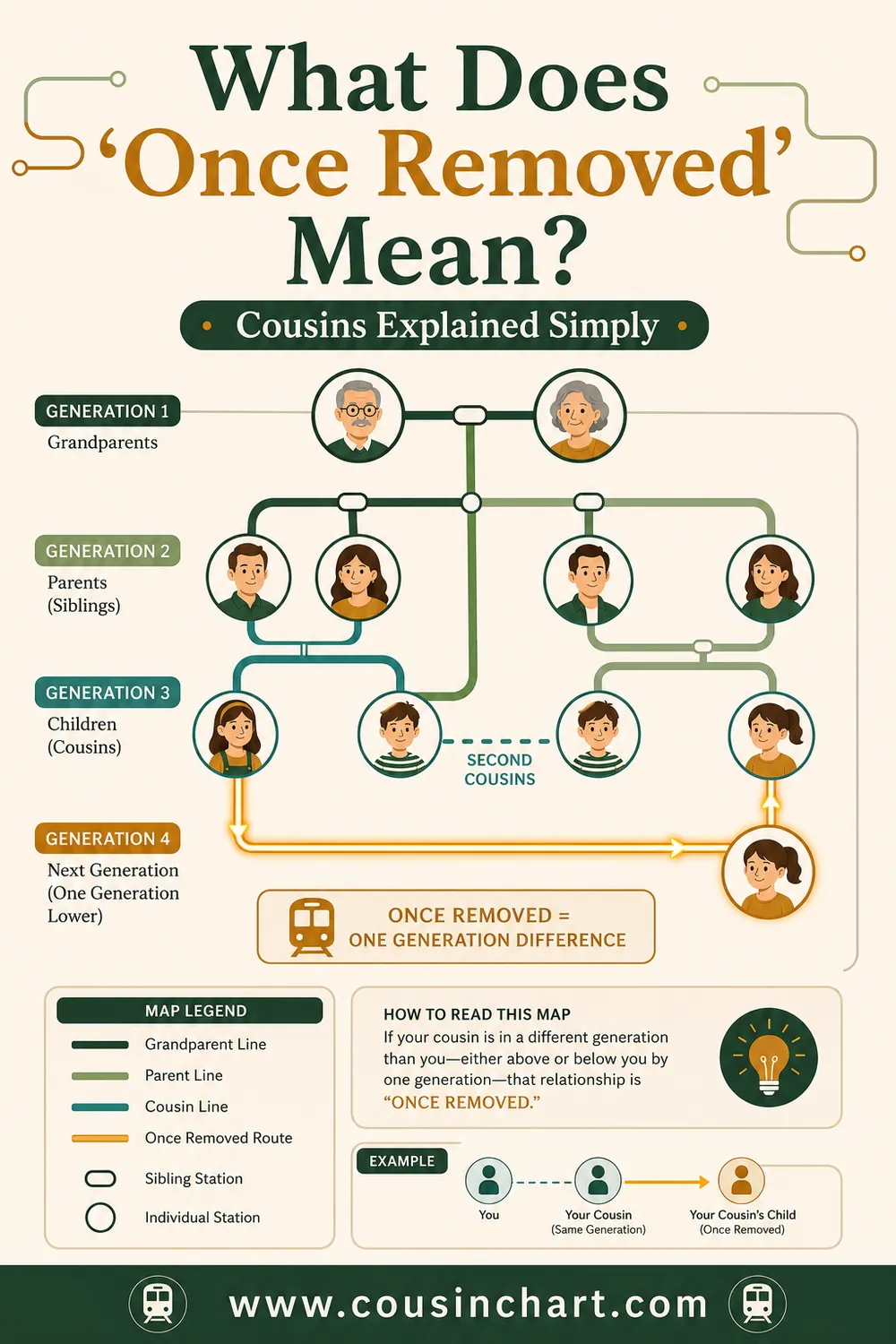
"Removed" sounds scary but has a friendly meaning: it just means two cousins are on different floors of the family tree — one older generation, one younger.
"When your cousin has a baby, that baby is one 'step' below you on the family tree. We call that your cousin 'once removed.' It just means you're on different floors — like an elevator!"
The elevator or "floors of a building" image is gold for kids. Same floor = plain cousins. One floor apart = once removed. Two floors = twice removed. You don't need to go further than that — the picture does the work. A child who understands "removed = different floors" understands more than most adults do.
Fun Ways to Make It Stick
Kids remember what they do, not what they're told. A few playful approaches:
- Draw it together. Make a big paper tree with photos or stick figures — Grandma and Grandpa at the top, cousins along the bottom. Let the child add the connecting lines.
- Play "who is this?" Point to relatives at a gathering: "That's your cousin! How are you connected?" Turn it into a guessing game.
- Use a favorite show or book. Many kids' stories have cousins — spotting them in fiction reinforces the real-life idea.
- Let them use the tool. Older kids enjoy typing in "my cousin's baby" and watching the calculator name it. It feels like a game and quietly teaches the logic.
School family-tree projects are a perfect excuse to do this. Building the tree branch by branch, with the child placing each cousin, teaches the concept far better than any lecture.
Common Questions Kids Actually Ask (and Simple Answers)
Once a child gets the basic idea, the questions come fast — and they're often the exact ones that stump adults. Here are quick, kid-sized answers you can give on the spot:
- "Is my cousin my brother or sister?" No — brothers and sisters have the same mom and dad as you. Cousins have different parents, but your parents are brothers and sisters to each other.
- "Why do I have so many cousins?" Because each of your aunts and uncles can have their own kids, and they're all your cousins. The bigger the family, the more cousins you get.
- "Can a grown-up be my cousin?" Yes! Cousins can be any age. If your aunt is much older, her kids might be grown-ups — but they're still your cousins.
- "Is my best friend my cousin?" Only if you're related through family. A friend who feels like family is wonderful, but "cousin" means you share grandparents or other ancestors.
- "What do I call my cousin's mom?" That's your aunt (or your uncle's wife). She's the sister — or married to the brother — of one of your parents.
Answering in the child's own words, with their real relatives named, beats any textbook definition. If a question goes past what you can explain in a sentence, that's the perfect moment to open the calculator together and let the picture do the talking.
What to Skip (For Now)
Part of explaining cousins well is knowing what not to say yet. A few things reliably overwhelm a young child, so save them for later:
- The word "generation." It's abstract and slows kids down. Say "floors of the tree" or "older and younger" instead.
- Half-cousins, step-cousins, and in-laws. These are real but confusing add-ons. Introduce them only if the child's own family includes them and asks.
- The "minus one" math. Adults love the rule that the cousin number is one less than the generations to the shared ancestor. Kids don't need it — "who do we share at the top?" gets them the right answer without arithmetic.
- DNA percentages. Fascinating for teens, baffling for little ones. Keep the focus on people and connections, not numbers.
The goal isn't to teach the whole system in one sitting — it's to give the child a solid, happy grip on first cousins and the shared-grandparent picture. Everything else can grow from that seed whenever they're ready.
FAQ
How do you explain cousins to a young child?
Start with one concrete sentence: "Your cousins are the children of your aunts and uncles, because your parent and their parent are brother and sister." Use real names the child knows, then point out that cousins all share the same grandparents. Keep it to first cousins until that idea lands.
What age can kids understand cousins?
Most children can grasp first cousins around ages 5 to 7, especially when you use their own family and real names. Second cousins and "removed" usually make sense a bit later, around 8 and up, once they're comfortable with the basic idea and the shared-grandparent picture.
What's the easiest way to explain "removed" to a kid?
Use the "different floors" image: cousins on the same floor of the family tree are just cousins, and cousins one floor apart (like your cousin's new baby) are "once removed." Comparing it to floors in a building or an elevator makes the generation gap easy to picture.
How do I explain the difference between first and second cousins?
Anchor it to the shared ancestor. First cousins share grandparents; second cousins share great-grandparents (your grandparents' parents). A second cousin is your parent's cousin's child. Always asking "who do we both come from at the top?" answers every cousin-number question.
What's a good activity to teach kids about cousins?
Draw a family tree together with photos or stick figures — grandparents at the top, cousins along the bottom, and lines connecting them. Let the child add the connections. Family gatherings are also great for a "how are we related?" guessing game that makes the idea real.
Make Family Make Sense
Explaining cousins to kids works best from the inside out: start with their own aunts, uncles, and grandparents, add the shared-grandparent "aha," and only reach for second cousins or "removed" when they're curious for more. Keep it concrete, keep it playful. And when a child stumps you with "what's my cousin's baby to me?", the free family relationship calculator gives a clear, visual answer you can explore together — turning a tricky question into a fun little discovery.