What Is My Spouse's Cousin to Me? (And What Are Their Kids?)
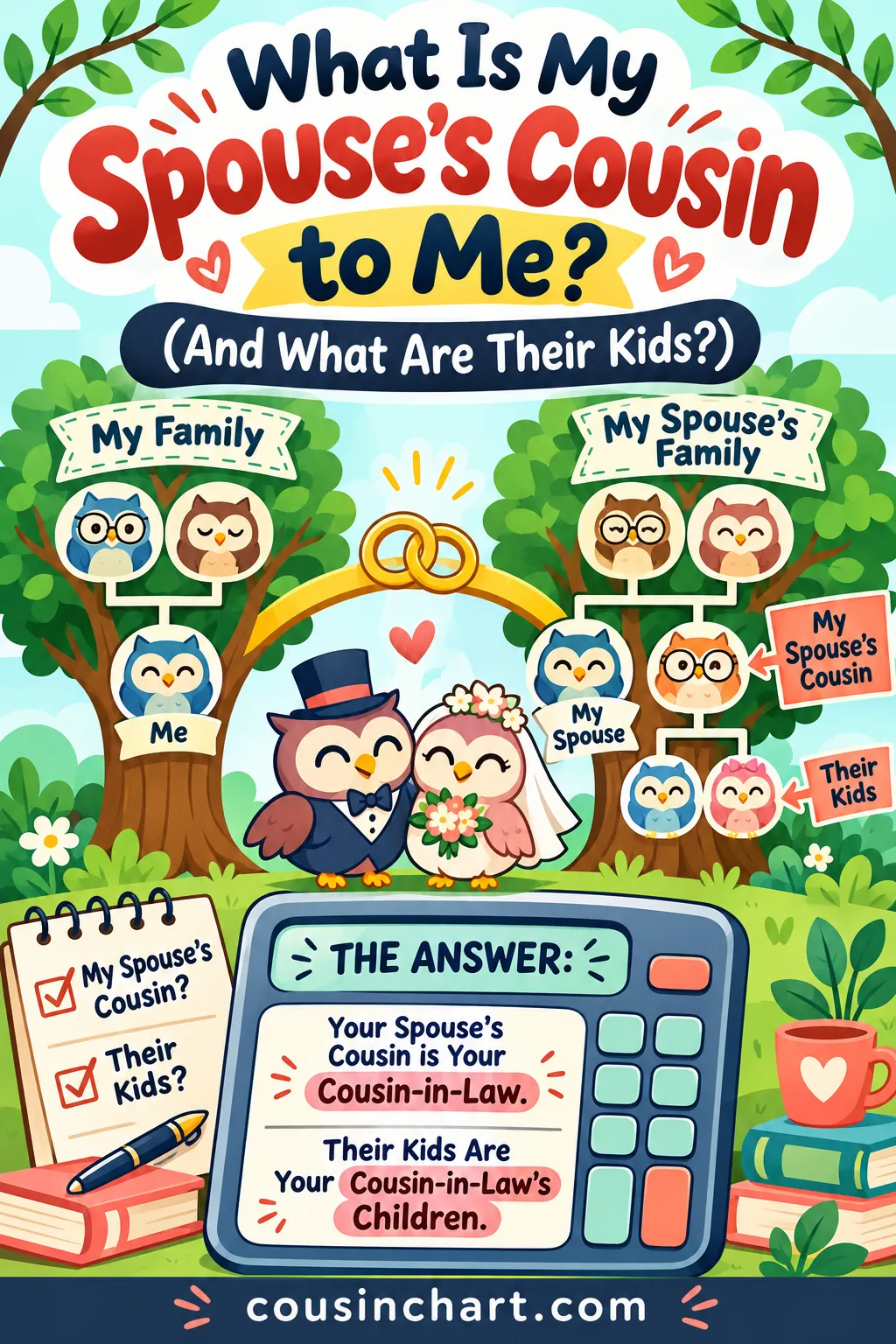
Your spouse's cousin is your cousin-in-law, also called your cousin by marriage. You don't share any blood or DNA with them, but you share a family, so most people simply call them "cousin." Their kids are your spouse's first cousins once removed, which makes them your cousins once removed by marriage.
If you've just married into a big family, the names can pile up fast. The free Cousin Chart relationship calculator can sort out any of them in a couple of seconds, including the "by marriage" version. This guide walks through the most common in-law cousin questions, with the math behind each answer.
▶ Work it out in the free calculator
The Short Answer: You Borrow Your Spouse's Label
Here's the rule that solves almost every in-law question. Find what the person is to your spouse, then add "by marriage" or "-in-law."
- Your husband's first cousin is your first cousin by marriage.
- Your wife's second cousin is your second cousin by marriage.
- Your spouse's aunt is your aunt by marriage. Many people just say "aunt."
That's it. You don't need a separate system for in-laws. The blood relationship runs between your spouse and their cousin. You're attached to it through your marriage.
"Cousin-in-law" isn't an official legal or genealogy term. It's a friendly, everyday one. Some families use it. Plenty of others skip it and just say "my cousin," and nobody blinks.
Three phrases, one meaning
You'll hear three versions of the same idea, and they all point to the same person:
- Cousin-in-law. The casual one. Handy in conversation and on a group chat.
- Cousin by marriage. A little more formal. Common in family trees, obituaries and wedding programs.
- My husband's cousin / my wife's cousin. The clearest of all. It tells the listener exactly how the link runs.
If you're ever unsure which to use, the third option never confuses anyone. "This is Jenna, Mark's cousin" works at every party, in every family.
Why the label doesn't depend on you
Notice that you never count your own generations for an in-law cousin. That's because you aren't on the family tree line at all. You sit beside your spouse, joined by a marriage line, and you inherit their position. If your spouse is two generations down from the shared grandparents, so are you, for naming purposes. That's why the rule "borrow your spouse's label" always works.
What Is My Husband's Cousin to Me, Exactly?
Let's do the actual math, because it helps with the trickier cases later.
Say your husband is Mark. Mark's mom and his cousin Jenna's mom are sisters. That means Mark and Jenna share a set of grandparents.
- From those grandparents down to Mark: 2 generations (grandparents, then Mark's mom, then Mark).
- From those grandparents down to Jenna: 2 generations.
Two generations on each side means first cousins. So Jenna is Mark's first cousin, and she's your cousin-in-law, or first cousin by marriage.
The same math works if you ask "what is my wife's cousin to me." The answer doesn't change with gender. Your wife's cousin is your cousin-in-law too.
Is Jenna related to you by blood? No. Unless your own family happens to connect to Mark's somewhere further back, you and Jenna share no DNA. That's the core difference between blood relatives and relatives by marriage.
In-Law Cousin Cheat Sheet
This table covers the people you're most likely to meet at your spouse's family gatherings. The "Generations" column shows how many steps down each person is from the shared ancestor, counting your spouse first.
| Person | Generations (spouse / them) | What they are to your spouse | What they are to you | Typical shared cM with your spouse |
|---|---|---|---|---|
| Spouse's first cousin | 2 / 2 | First cousin | Cousin-in-law (first cousin by marriage) | ~866 |
| Spouse's first cousin's child | 2 / 3 | First cousin once removed | Cousin once removed by marriage | ~433 |
| Spouse's second cousin | 3 / 3 | Second cousin | Second cousin by marriage | ~229 |
| Spouse's third cousin | 4 / 4 | Third cousin | Third cousin by marriage | ~73 |
| Spouse's parent's cousin | 3 / 2 | First cousin once removed | Cousin once removed by marriage | ~433 |
| Their cousin's spouse | none | Cousin-in-law | Informally, cousin-in-law | 0 |
You share 0 cM with every person on that list (unless the two families are already connected). The cM numbers are averages for your spouse, and real ranges vary a lot and overlap. The DNA match calculator shows the possible relationships for any shared cM number.
What each person is to your kids
Your children sit one generation below your spouse, and they're blood relatives of your spouse's whole family. So their labels shift. Here's the same list from your child's seat:
| Person | Generations (your child / them) | What they are to your child | Blood tie? |
|---|---|---|---|
| Spouse's first cousin | 3 / 2 | First cousin once removed | Yes |
| Spouse's first cousin's child | 3 / 3 | Second cousin | Yes |
| Spouse's first cousin's grandchild | 3 / 4 | Second cousin once removed | Yes |
| Spouse's second cousin | 4 / 3 | Second cousin once removed | Yes |
| Spouse's second cousin's child | 4 / 4 | Third cousin | Yes |
| Spouse's cousin's husband or wife | none | Cousin by marriage, often "aunt" or "uncle" | No |
The pattern is simple. Your kids are always one generation further down than your spouse. So anyone who was "even" with your spouse is once removed from your kids, and anyone one level below your spouse is "even" with your kids.
What Are My Spouse's Cousin's Kids to Me?
This is the question that trips up most people, so let's go slowly.
Your spouse's cousin Jenna has a son, Leo. Leo sits one generation lower than Mark and Jenna. Cousins who are on different generation levels get the word "removed." One step apart is "once removed."
- Grandparents down to Mark: 2 generations.
- Grandparents down to Leo: 3 generations.
The smaller number (2) tells you the cousin degree, which is first cousin. The difference (3 − 2 = 1) tells you how many times removed. So Leo is Mark's first cousin once removed. To you, he's your first cousin once removed by marriage.
In everyday talk, though, nobody says that at a birthday party. Most families call Leo "your cousin" or "Jenna's boy." That's fine. The formal term is there when you need it, like when you're filling in a family tree. If "once removed" still feels slippery, the next sections walk through more examples.
What are they to my kids?
Now it gets interesting, because your children are related by blood.
Your child descends from Mark, so your child shares Mark's grandparents as great-grandparents.
- Shared ancestors (Mark's grandparents) down to your child: 3 generations.
- Shared ancestors down to Leo: 3 generations.
Three and three makes second cousins. So your kids and Jenna's kids are second cousins. That's a real blood relationship. On average, second cousins share around 229 cM of DNA, though the range is wide.
And Jenna herself? To your child she's a first cousin once removed (2 generations on her side, 3 on your child's). Many kids just call her "Aunt Jenna" or "Cousin Jenna," and that's a sweet, normal choice.
What Is My Cousin's Spouse to Me? (The Other Direction)
The same logic runs the other way. If your own cousin gets married, that new spouse is your cousin-in-law. Mark, from Jenna's side, would call Jenna's husband his cousin-in-law.
What about Jenna's husband and you? He's married to your spouse's cousin. There's no real term for that. You're two people who each married into the same cousin pair. Most families file it under "cousin-in-law" or just "cousin," and that works. The article on what your cousin's wife is to you covers this side in more detail.
Other Relatives on Your Spouse's Side
Once you've got cousins down, the same "borrow your spouse's label" rule handles everyone else. Here's a quick list of the people you'll meet most often and what they're called.
| Person | To your spouse | To you | Everyday name |
|---|---|---|---|
| Spouse's aunt or uncle | Aunt or uncle | Aunt or uncle by marriage | Aunt Rita, Uncle Joe |
| Spouse's aunt's husband | Uncle by marriage | Uncle by marriage | Uncle |
| Spouse's grandparent | Grandparent | Grandparent-in-law | Grandma, Grandpa, or their family nickname |
| Spouse's great-aunt | Great-aunt | Great-aunt by marriage | Aunt or Great-aunt |
| Spouse's sibling's spouse | Sibling-in-law | Often called co-sibling-in-law | Usually first names |
| Spouse's niece or nephew | Niece or nephew | Niece or nephew by marriage | Niece or nephew |
That fifth row has its own name in some families. If your husband's brother is married, you and his wife are sometimes called co-sisters-in-law. It's an old term that's still common in many families and cultures.
You don't need to memorize the formal versions. Most families switch to first names or simple "aunt," "uncle" and "cousin" within a year or two, and they'll follow your lead.
How to Check It With the Calculator
The relationship calculator on the homepage handles in-law cousins directly. Here's how to use it for your spouse's family.
- Pick the shared ancestor. For your spouse and their first cousin, that's the grandparents they share.
- Set the generations to your spouse. Count down from that ancestor to your spouse. For a first cousin, set it to 2.
- Set the generations to the other person. For the cousin, also 2. For the cousin's child, 3.
- Choose the relation type. Set it to "marriage." That tells the tool you're linked through your spouse.
- Read the result. You'll see the relationship name and a chart. For 2 and 2 with "marriage," expect a first cousin by marriage. For 2 and 3, expect a first cousin once removed by marriage.
You can also start from a quick-pick button. "My cousin's child" gets you to the once-removed answer fast, then you switch the relation type to marriage. Once you have the result, use Copy result to paste it into a family group chat, or Download my chart to save it.
A full walkthrough: your husband's cousin's grandchild
Let's run one longer example from start to finish, the way you'd do it on your phone at a family party.
Your husband, Mark, introduces you to little Ava. She's the granddaughter of his cousin Jenna. You'd like to know what she is to Mark, to you and to your son.
- Find the shared ancestor. Mark and Jenna share grandparents. Ava descends from them too, through Jenna.
- Count Mark's steps. Grandparents, Mark's mom, Mark. That's 2.
- Count Ava's steps. Grandparents, Jenna's mom, Jenna, Jenna's son Leo, Ava. That's 4.
- Enter it. Set the first person at 2 and the other person at 4. Leave half relationship off. Leave relation type on blood for now.
- Read the result. The calculator shows first cousin twice removed. That's Ava to Mark.
- Switch to marriage. Change relation type to marriage. Now the result reads as Ava's link to you: first cousin twice removed by marriage.
- Check your son. Your son is 3 steps down from the same grandparents. Set the first person at 3 and Ava at 4, relation type blood. The result: second cousin once removed.
So one toddler gets three answers: first cousin twice removed to Mark, the same "by marriage" to you, and second cousin once removed to your son. Tap Copy result for each one if you'd like to write them on the back of a family photo.
Picking the other options
- Other person's sex. Leave it on "either" for cousins, since cousin terms don't change by sex. Set it to female or male when you're checking an aunt, uncle, niece or nephew by marriage.
- Half relationship. Turn it on only if the two lines meet at a single shared parent, such as a grandparent who remarried.
- Relation type, step. Use it when a cousin joined your spouse's family through a parent's remarriage, not by birth or adoption.
If you want names for in-laws in general, like your spouse's aunt or your sibling's in-laws, the What do I call…? tool is built for exactly that.
Worked Examples
Here are three real-life setups and how to solve each one.
Example 1: Your wife's mom's cousin
Your wife, Ana, has a great-aunt Rosa. Rosa's daughter Teresa is Ana's mom's first cousin.
- Shared ancestors: Ana's great-grandparents (Rosa's parents).
- Down to Teresa: 2 generations.
- Down to Ana: 3 generations.
Smaller number 2 = first cousin. Difference 1 = once removed. So Teresa is Ana's first cousin once removed, and your first cousin once removed by marriage.
Example 2: Your husband's second cousin's baby
Your husband's second cousin just had a baby. Second cousins share great-grandparents.
- Down to your husband: 3 generations.
- Down to the baby: 4 generations.
Smaller number 3 = second cousin. Difference 1 = once removed. The baby is your husband's second cousin once removed, and your second cousin once removed by marriage. To your own kids (also 4 generations down), the baby is a third cousin.
Example 3: Your spouse's half-cousin
Your spouse's dad and his cousin's mom are half-siblings. They share one parent, not two. That makes your spouse and the cousin half first cousins. In the calculator, turn on the half relationship option. To you, they're still your cousin-in-law. Most families don't use "half" in daily talk at all.
Example 4: Your wife's cousin's husband
Your wife, Ana, has a first cousin named Luis. Luis is married to Kim. What's Kim to you?
- Luis is Ana's first cousin, so he's your cousin-in-law.
- Kim is Luis's wife, so she's Ana's cousin-in-law.
- Kim to you: no blood, and two marriages away.
There's no formal name for that link. You and Kim each married into the same set of cousins. In practice, families call this "cousin" or just use first names. On a family tree, Kim appears beside Luis with a marriage line, and you appear beside Ana. Don't expect a tidy name from any chart, because there isn't a standard one.
Example 5: Your husband's step-cousin
Your husband's aunt married a man with a daughter from a previous marriage, Bree. Bree grew up going to the same holidays as your husband.
- Bree isn't descended from your husband's grandparents. She joined the family through her dad's marriage.
- So Bree is your husband's step-cousin.
- To you, she's a step-cousin by marriage. Day to day, she's "cousin Bree."
In the calculator, set the generations as if she were a cousin (2 and 2), then switch relation type to step. The result shows a step-cousin. To read more about how step ties work, see what a step-cousin is.
Example 6: Your spouse's adopted cousin
Your wife's uncle adopted a son, Sam. Sam is your wife's first cousin, full stop. Adopted children hold the same place on the family tree as birth children. So Sam is your cousin-in-law, and to your kids he's a first cousin once removed.
The only difference shows up with DNA. Sam won't share DNA with your wife's side unless he's also related by birth. That doesn't change what anyone calls him. In the calculator, enter him exactly like any first cousin.
Real-Life Scenario: Your First Big Family Reunion
Picture your first summer reunion on your husband's side. Mark's grandparents had three daughters, and almost everyone descends from them. Here are five people you meet in one afternoon, and how to place each one in under a minute.
| Person you meet | How they connect | Calculator setting (Mark / them) | To Mark | To you |
|---|---|---|---|---|
| Aunt Rita | Mark's mom's sister | 2 / 1, sex female | Aunt | Aunt by marriage |
| Jenna | Rita's daughter | 2 / 2 | First cousin | Cousin-in-law |
| Leo | Jenna's son | 2 / 3 | First cousin once removed | Cousin once removed by marriage |
| Great-aunt Pearl | Mark's grandma's sister | 3 / 1, counted from Mark's great-grandparents, sex female | Great-aunt | Great-aunt by marriage |
| Pearl's grandson Nate | Pearl's line | 3 / 3, counted from Mark's great-grandparents | Second cousin | Second cousin by marriage |
Notice what happened with Pearl and Nate. They don't descend from Mark's grandparents. They descend from Mark's great-grandparents, Pearl's parents. So you count from that older couple instead: Mark is 3 steps down, and so is Nate. That's why Nate comes out as a second cousin.
The three questions to ask at any gathering
When someone new walks up, these three questions place them fast:
- "Whose side are you on?" This tells you which grandparent or great-grandparent the line comes from.
- "Who was your grandma or grandpa?" This finds the shared ancestor.
- "How many kids down are you from them?" This gives you the generation number for the calculator.
You don't have to ask in that exact way, of course. A warm "How do you know Mark's family?" usually gets the story told for you, and the numbers fall out of it.
Writing it down afterward
When you get home, sketch the five people on a page under the shared ancestors, with Mark and you at the bottom. Next year's reunion will feel much easier, and your kids will have a head start on knowing their own cousins.
Edge Cases: Divorce, Loss, Remarriage and Double Ties
Real families aren't always tidy. Here's how the labels hold up in the situations people ask about most.
| Situation | What changes | What stays the same |
|---|---|---|
| You and your spouse divorce | The "by marriage" link to their cousins usually ends | Your kids' blood ties to those cousins never change |
| Your spouse passes away | Nothing official changes | Many families keep calling you cousin for life |
| Your spouse's cousin divorces | Their ex is no longer a cousin-in-law to your spouse | Their kids stay your spouse's first cousins once removed |
| You remarry | Your new spouse's cousins become your new cousins-in-law | Your kids keep their blood cousins from your first marriage |
| Your spouse has double cousins | Some cousins are related through both of your spouse's parents | You still borrow the label: cousin by marriage |
| Same-sex marriage | Nothing | The rule is identical: your spouse's cousin is your cousin-in-law |
After a divorce or a death
Blood ties don't end, but marriage ties can fade. After a divorce, whether you stay "cousin" to your ex's family is up to the people involved. Plenty of people stay close, especially when kids are in the picture, since the kids remain blood relatives of that whole side.
After a spouse dies, most families hold on tight. A widow or widower is often still "Aunt Carol" or "Cousin Mike" at every holiday. The guide to in-laws after divorce or death talks through both situations gently.
Double cousins on your spouse's side
If two brothers in your spouse's family married two sisters, their kids are double first cousins, related through both parents. On average they share more DNA than regular first cousins. For you, though, nothing changes. A double cousin of your spouse is still your cousin by marriage. The label you borrow is just "cousin."
What to Say: Introductions and Kid Names
Knowing the formal term is one thing. Knowing what to say out loud is another. Here are some easy lines for common moments.
Introducing your spouse's cousin
- "This is Jenna, Mark's cousin. They grew up next door to each other."
- "Meet my cousin-in-law, Jenna. She's on Mark's mom's side."
- "Jenna's family, so she's family. She's Mark's first cousin."
Adding which side ("on his mom's side") helps people place her right away.
When someone asks how you're related
Keep it to one sentence: "I'm married to her cousin Mark." That answers the question without a family tree lecture. If they want more, show them the chart you downloaded from the calculator.
What your kids can call them
Kids don't need formal terms. Most families pick one of these:
- Cousin plus first name. "Cousin Jenna." Simple and accurate enough.
- Aunt or Uncle plus first name. Many families use these for any older relative, cousin or not, as a sign of respect.
- First name only. Common for younger cousins or close family friends.
Ask your spouse what their family already does and match it. If your kids call one cousin "Aunt" and another just "Mike," that's normal. Families settle on whatever feels warm.
On wedding programs, cards and family trees
Written places call for a bit more precision:
- Wedding programs: "Jenna Ruiz, cousin of the groom."
- Holiday cards: first names are fine.
- Family trees: draw Jenna on your spouse's side of the tree. Put yourself beside your spouse with a marriage line, not under any of their ancestors.
- Obituaries: cousins are usually listed by name, and a spouse's cousin might appear as a cousin or as a cousin by marriage, depending on the family's wishes.
Common Mix-Ups and How to Fix Them
These are the mistakes people make most often with in-law cousins.
- Counting your own generations. You don't sit on your spouse's family line, so you can't count steps down from their grandparents. Fix: count your spouse's steps, then borrow the label.
- Calling your spouse's cousin's kids your nieces and nephews. Lots of families do this out of affection, and that's fine. Formally, though, they're first cousins once removed by marriage. Fix: use the warm name in conversation and the formal one on a tree.
- Thinking your kids and your spouse's cousin's kids are first cousins. They're second cousins, because they share great-grandparents, not grandparents. Fix: remember that first cousins share grandparents.
- Expecting to share DNA. You won't share DNA with a cousin by marriage unless your families connect further back. Fix: if a DNA test shows a match on your spouse's side, investigate it as a separate line.
- Using "removed" for the same generation. "Removed" only applies when two people sit on different generation levels. Your spouse and their cousin are never "removed" if they're both grandchildren of the same couple. Fix: compare generation numbers. Same number, no "removed."
When Your Families Are Already Connected
Once in a while, a spouse's cousin turns out to be your relative too. This happens more in small towns, close-knit communities and families that have lived in one area for generations.
If you ever see a DNA match on your own test who's also on your spouse's side, that's the clue. Run both paths through the calculator separately. You might find that your spouse's cousin is also, say, your fourth cousin on a completely different line. Both relationships are true at once. You'd be cousins by marriage and distant cousins by blood.
For most people, though, the answer stays simple. Your spouse's cousin is family because you married into it, and that's the whole story.
Keep a simple chart
Marrying into a large family means learning a lot of names at once. A one-page chart helps. Sketch your spouse's grandparents at the top, their kids underneath, and the cousins at the bottom. Add yourself next to your spouse with a marriage line. A printable cousin chart gives you the grid of names so you can check each one.
When a new question comes up, like your spouse's cousin's new grandbaby, plug it into the free relationship calculator and you'll have the name before the conversation moves on.
▶ Work it out in the free calculator
Frequently Asked Questions
Is my husband's cousin my cousin too?
Not by blood. Your husband's cousin is your cousin-in-law, or cousin by marriage. In everyday talk, though, most families just say "cousin," and that's perfectly normal.
What do I call my wife's cousin's children?
Formally, they're your wife's first cousins once removed, so they're your first cousins once removed by marriage. In daily life, most people just say "cousin." Your own kids and theirs are second cousins.
Do I share DNA with my spouse's cousin?
No, unless your two families are already connected further back. You share DNA with your blood relatives, and your spouse's cousin is related to you through marriage only. Your children, however, do share DNA with that cousin.
Is "cousin-in-law" a real term?
It's a common, informal term rather than an official one. People use it for a spouse's cousin and for a cousin's spouse. Genealogists usually write "first cousin by marriage" or describe the link through the spouse instead.
What happens to the relationship after a divorce?
Blood relationships never change, but relationships by marriage can. After a divorce, many people stop using in-law terms, while others stay close and keep calling each other cousin. There's no rule, so it depends on your family.
What are my spouse's cousin's kids to my kids?
They're second cousins. Your kids and your spouse's cousin's kids are both three generations down from the same great-grandparents. That's a blood relationship, so they'll usually share some DNA.
What is my spouse's cousin's husband or wife to me?
There's no formal term, since you're linked through two marriages. Most families just say cousin or cousin-in-law, or use first names. Either choice is normal.
Is my spouse's step-cousin related to me?
Not by blood, and not by any formal tie beyond marriage. A step-cousin joins your spouse's family through a parent's or aunt's remarriage, so to you they're a step-cousin by marriage. In everyday life, most families simply call them cousin.