Printable Cousin Chart (Free PDF)
A cousin chart is a grid that turns a question people find genuinely confusing — what do I call my mother's cousin's daughter? — into a single word you can read off in about thirty seconds. You find each person's relationship to the common ancestor you both share, follow the row and the column, and the answer sits where they meet. This page explains how to read one properly, how to print it so it is actually usable, and the handful of cases where a chart is the wrong tool. If you would rather skip the grid entirely, the cousin calculator gives you the answer from two dropdowns.
Free printables for this page
Download a blank PDF (US Letter or A4) — free, no sign-up — or customize it in the maker above before printing.
 Cousin Relationship ChartThe classic cousin grid: 1st cousin, 2nd cousin, times removed.
 Kinship Chart (Fill-In)
How do I use a cousin chart? Tap the situation that matches yours.
Tap an option above. Every cousin relationship is measured from the ancestor you share.
What a cousin chart actually shows
The whole grid rests on one idea, and it is worth getting straight before anything else.
Every cousin relationship is defined by a shared ancestor. You and your first cousin share a set of grandparents. You and your second cousin share a set of great-grandparents. There is no cousin relationship without a common ancestor somewhere.
The two axes are generation counts from that ancestor. One axis is how many generations separate the ancestor from you; the other is how many separate the same ancestor from the other person.
The cell where they meet is the relationship. That is the entire mechanism.
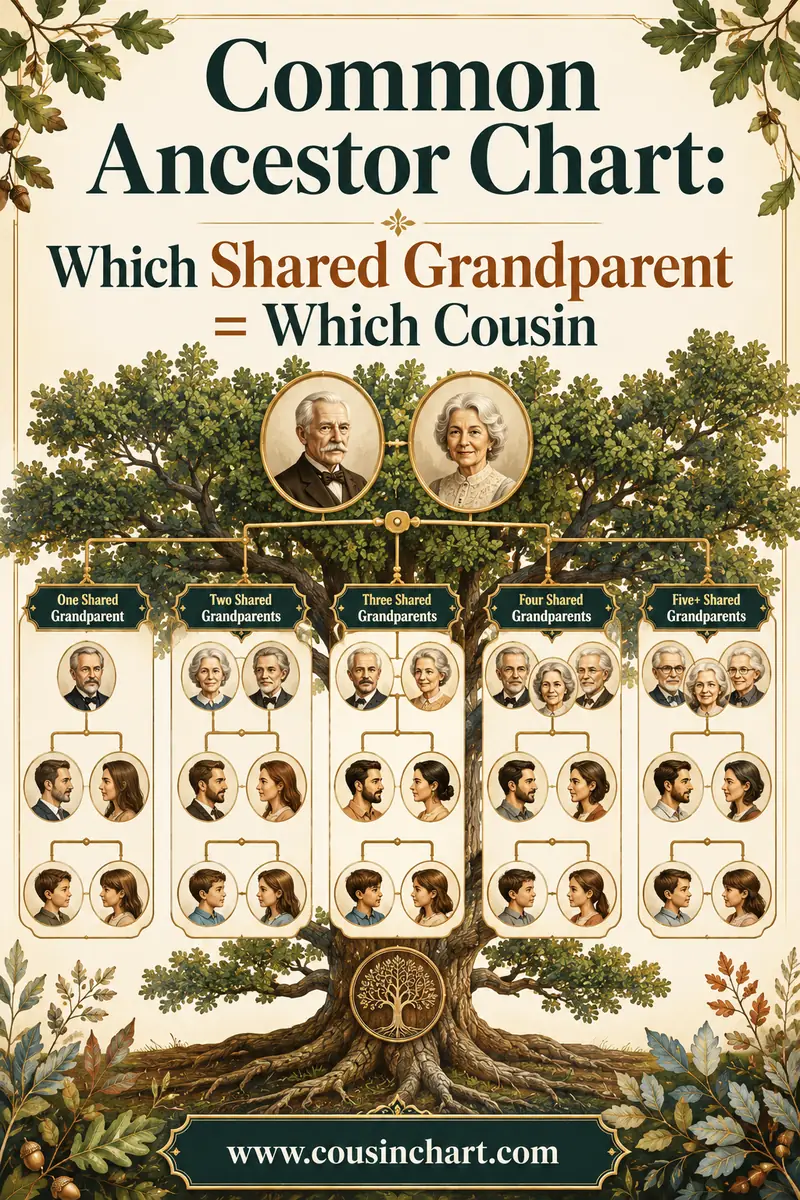
Which is why the chart cannot help you until you have identified the common ancestor. That is the step people skip, and it is why the grid so often seems not to work — the common ancestor chart covers finding it.
How to read the chart in four steps
Step one: find the common ancestor. The most recent person you both descend from. For two people who share grandparents, it is the grandparents; for two who share great-grandparents, it is those.
Step two: count your generations from that ancestor. Parent is 1, grandparent is 2, great-grandparent is 3, great-great-grandparent is 4. Count the steps, not the people.
Step three: count the other person's generations from the same ancestor, the same way.
Step four: read across and down. Find your number on one axis, theirs on the other, and take the cell where they meet.
Worked example. Your great-grandmother is also her grandmother. You are 3 generations down; she is 2. Three and two meet at first cousin once removed — first because the smaller number is 2 (grandparent level), once removed because the difference is 1.
The two numbers that decide everything
Once you see this, you no longer need the grid.
**The cousin number comes from the smaller generation count, minus one.**
- Both share grandparents (2 generations each) → 2 − 1 = first cousins
- Both share great-grandparents (3 each) → 3 − 1 = second cousins
- Both share great-great-grandparents (4 each) → 4 − 1 = third cousins
**The removal number is the difference between the two counts.**
- Same number of generations → not removed at all
- One apart → once removed
- Two apart → twice removed
Worked example. You are 4 generations from the common ancestor; he is 2. The smaller number is 2, so 2 − 1 = first cousins. The difference is 2, so first cousins twice removed.
That is the whole system. The chart is a lookup table for those two small sums, and knowing them means you can work out any relationship without printing anything. The removal idea specifically is unpacked in what does once removed mean.
The chart in table form
| Your generations ↓ / Theirs → | 2 (grandparent) | 3 (great-grandparent) | 4 (2× great) |
|---|---|---|---|
| 2 (grandparent) | First cousins | First cousins once removed | First cousins twice removed |
| 3 (great-grandparent) | First cousins once removed | Second cousins | Second cousins once removed |
| 4 (2× great) | First cousins twice removed | Second cousins once removed | Third cousins |
Notice the diagonal. Where both counts match, you get plain cousins with no removal — first, second, third. Everything off the diagonal is removed by the difference.
Notice the symmetry. The relationship is the same in both directions. If she is your first cousin once removed, you are hers. Removal does not say which of you is older or younger, only that you sit a generation apart — a point covered in first cousin once removed.
Printing it so it is actually usable
Small details that decide whether the printout gets used or thrown away.
Print at 100% scale, not "fit to page" or "shrink to fit". Those options reduce the label text, and a cousin chart lives or dies on legible labels.
Landscape beats portrait for a wide grid. If the chart is taller than it is wide, portrait is fine.
A4 or US Letter both work — the grid is not size-critical, only legibility is.
Print in black and white if color is not available. Check first that the chart does not rely on color to distinguish cells; a well-made one uses labels, not shading.
Consider printing two. One for the folder and one for the fridge, since this is the sort of thing that gets consulted at family gatherings rather than at a desk.
Laminate or use card if it is going to a reunion. Paper charts do not survive being passed round a table.
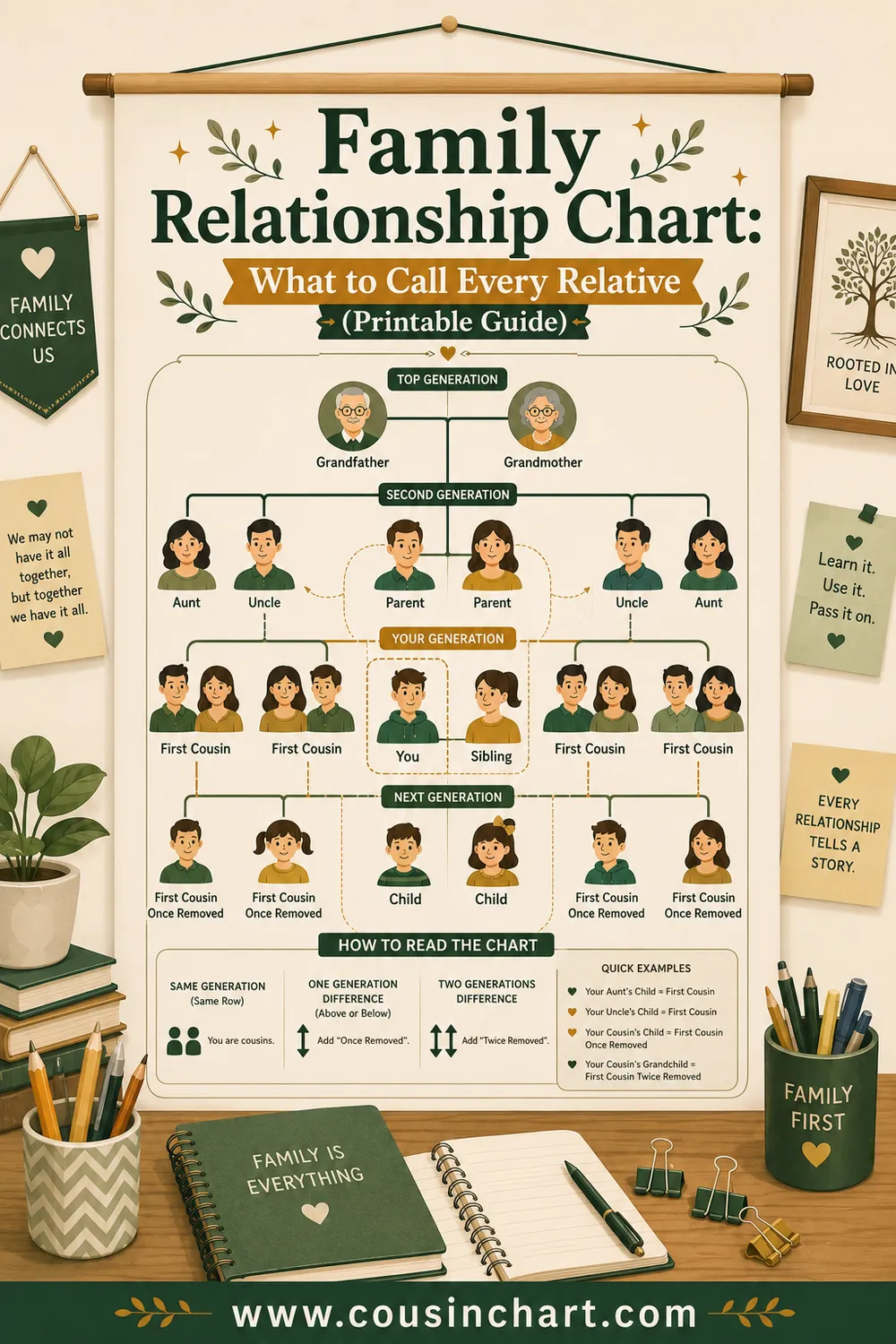
For the names themselves rather than the grid, the full system is set out in family relationship chart.
And write your own family's names in the margin once you have worked a relationship out. A chart annotated with real names is far more useful next time than a blank grid.
When a chart is the wrong tool
Grids handle the standard cases well and cannot handle several common real ones.
Half-relationships. Half-siblings, half-cousins and half-aunts sit outside a standard grid, because the grid assumes a full set of shared ancestors.
Step-relations. Step-cousins are related by marriage rather than descent, so there is no common ancestor to measure from. The grid has nothing to work with.
Adoption. Legally and socially the relationship is straightforward; genealogically the chart is measuring descent, which may or may not be what you mean. Both can be true at once, and which one matters depends on why you are asking.
Double cousins, where two siblings from one family marry two siblings from another. Their children share both sets of grandparents rather than one, which the grid cannot express.
Blended families, where the same two people may be related through more than one line.
In all of these, a blank family tree drawn out by hand is more use than a grid — the printable family tree gives you the space to map it.
The relationships people actually look up
Six that account for most of the searching, worked out in full.
Your parent's first cousin. They are 2 generations from your shared great-grandparents; you are 3. Smaller number 2, so first cousins; difference 1, so your first cousin once removed.
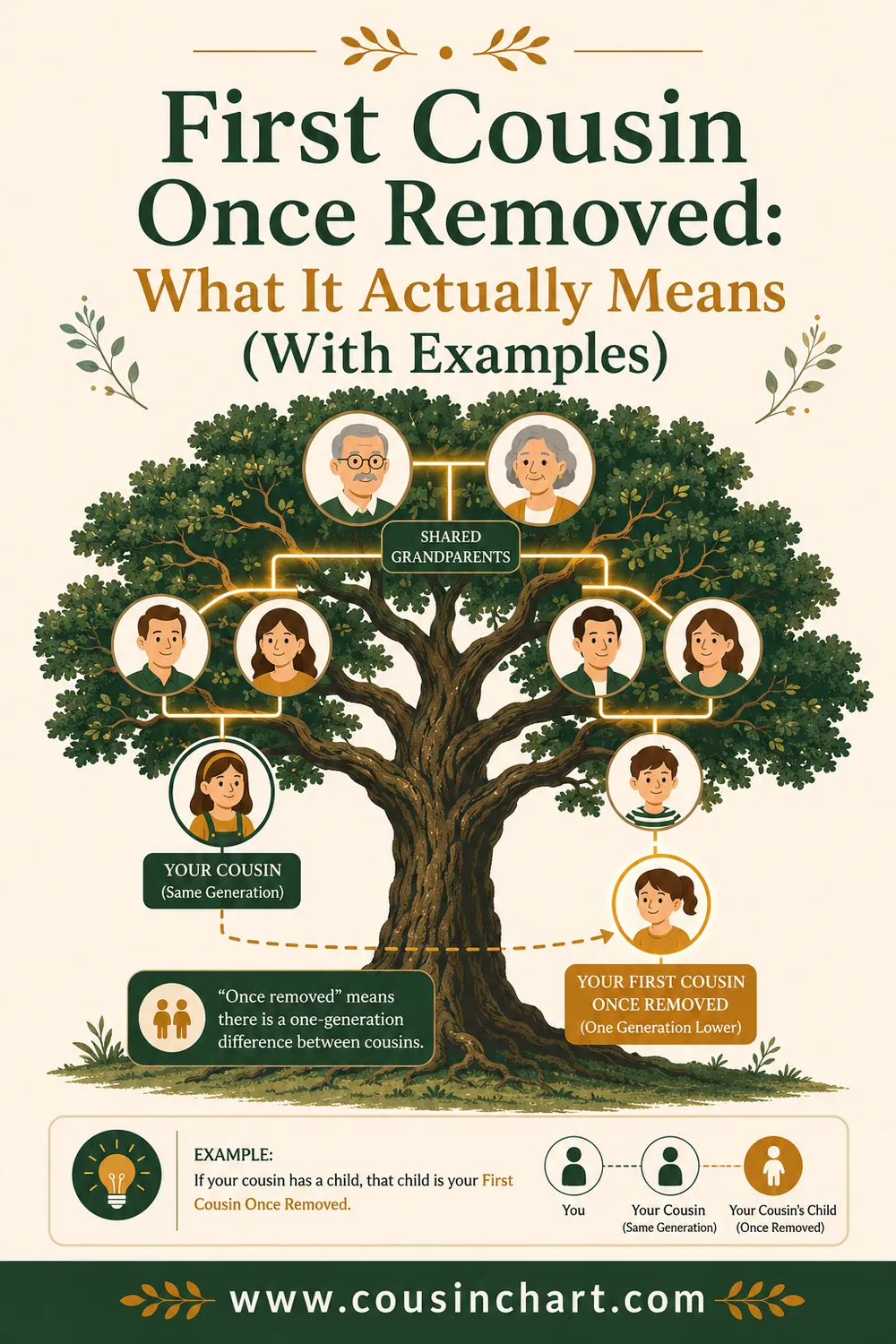
Your first cousin's child. The mirror image of the same relationship — they are 3 generations from the grandparents you share, you are 2. Also first cousin once removed. Both directions carry the same name, which is exactly why people find it confusing.
Your grandparent's sibling's grandchild. You are both 3 generations from the shared great-grandparents, so second cousins.
Your second cousin's child. You are 3 from the common great-grandparents, they are 4. Smaller number 3, so second cousins; difference 1, so second cousin once removed.
Your great-grandparent's sibling's great-grandchild. Both 4 generations down, so third cousins.
Your parent's first cousin's child. You are both 3 generations from the same great-grandparents, so plain second cousins — which surprises people, because the previous generation were first cousins.
That last one is the pattern worth internalising: each generation moves the cousin number up by one. First cousins' children are second cousins; second cousins' children are third cousins.
Chart, calculator, or tree?
Three tools for the same problem, each better at something different.
| Tool | Best for | Weakness |
|---|---|---|
| Printable chart | Reunions, quick reference, no device needed | Cannot show half, step or double relations |
| Cousin calculator | Any relationship, including awkward ones | Needs a device |
| Family tree | Seeing the whole picture, unusual structures | Slower; needs drawing out |
Use the chart when you want something on paper, at a gathering, or to explain the system to someone.
Use the cousin calculator when you want a fast, definite answer, particularly for removed relationships where the counting gets fiddly.
Use a tree when the family structure is unusual, or when you need to see how several people connect rather than just two.
Most people end up using two of the three — a chart for reference and the calculator for the awkward cases.
Common mistakes reading a cousin chart
Not identifying the common ancestor first. The grid is meaningless without it, and this accounts for most confusion.
Counting people instead of generations. Parent is 1, grandparent is 2. Do not count yourself.
Using different ancestors for each side. Both counts must be measured from the same common ancestor.
Assuming "removed" means age. It means a generational difference, not that one person is older. A first cousin once removed can easily be older than you.
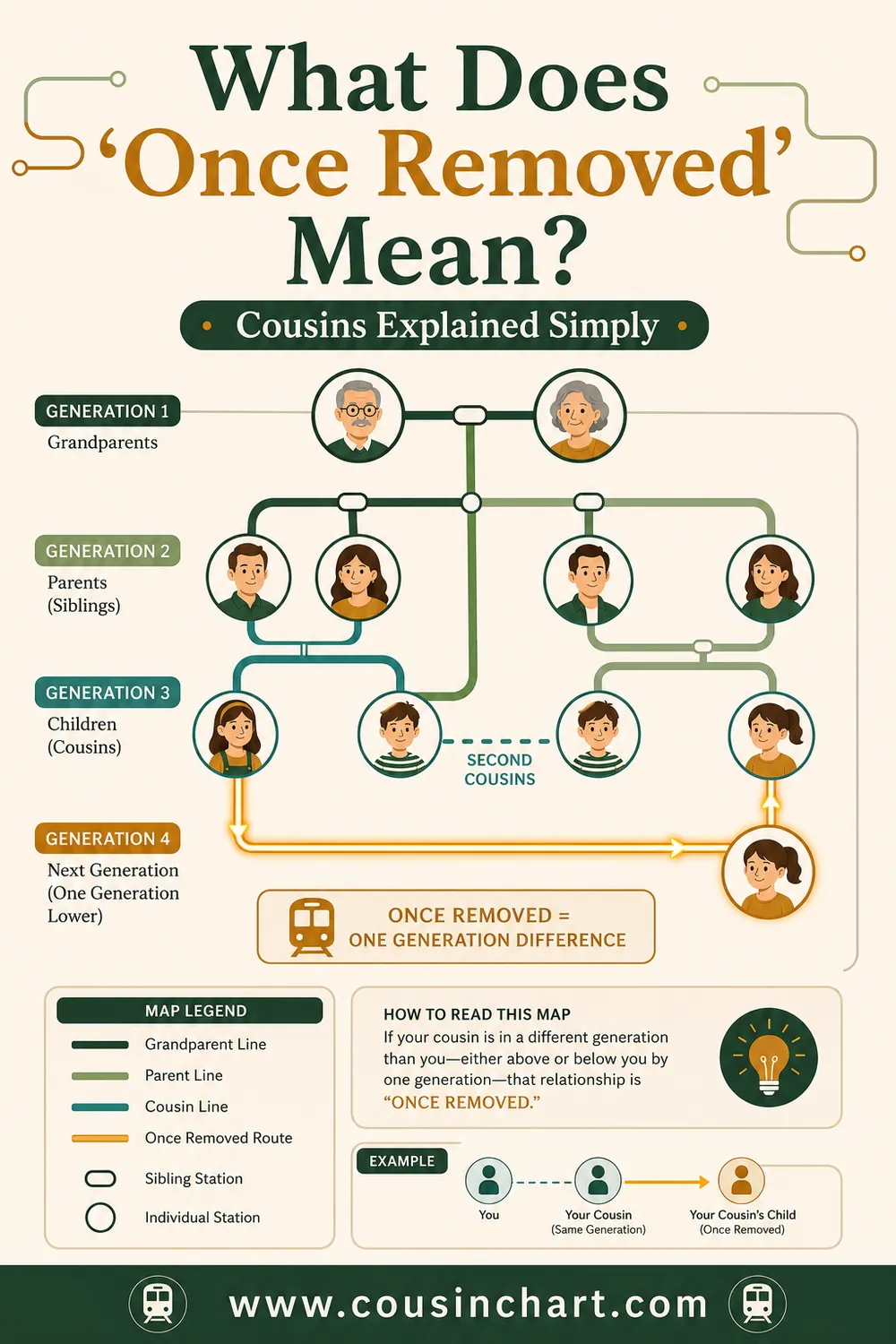
Confusing "second cousin" with "first cousin once removed". These are genuinely different: second cousins share great-grandparents and sit in the same generation; first cousins once removed share grandparents but sit a generation apart. It is the single most common mix-up — cousins on a family tree lays out where each sits.
Trying to force half or step relations onto the grid.
And reading the chart in one direction only. The relationship is symmetrical — it reads the same from either person's side.
FAQ
How do you read a cousin chart?
Find the common ancestor you both share, count how many generations separate that ancestor from each of you, then find where those two numbers meet on the grid. The cell gives the relationship.
What makes someone a first cousin once removed?
Sharing grandparents with someone who sits one generation away from you — typically your parent's first cousin, or your first cousin's child. "Once removed" means one generation apart, not a difference in age.
Is a second cousin the same as a first cousin once removed?
No. Second cousins share great-grandparents and are in the same generation. First cousins once removed share grandparents but sit one generation apart. They are frequently confused.
How do I print a cousin chart properly?
Print at 100% scale rather than "fit to page", which shrinks the labels. Landscape suits a wide grid, and card or lamination is worth it if the chart is going to a family gathering.
Can a cousin chart show step-cousins or half-cousins?
No. A standard grid assumes descent from a shared ancestor, so step-relations have nothing to measure from and half-relations fall outside it. Map those on a blank family tree instead.
Do I count myself when counting generations?
No — count the steps between you and the common ancestor. Your parent is 1, your grandparent is 2, your great-grandparent is 3.
Two small sums, then the grid is optional
A cousin chart looks like a lookup table and is really a shortcut for two pieces of arithmetic: the smaller generation count minus one gives the cousin number, and the difference between the two counts gives the removal. Identify the common ancestor, count the generations from them to each person, and the grid confirms what those sums already told you. Print it at 100% scale on card if it is going to a reunion — and for half, step, double or adopted relationships, reach for a family tree or the cousin calculator instead.