What Is My Aunt's Sister to Me? (And the "Aunt's Sister's Daughter" Riddle)
What is my aunt's sister to me? It depends on how your aunt is your aunt. If she's your mom's sister, her sister is either your mother or another aunt. If she's your dad's sister, her sister is another aunt on your dad's side. And if she married into the family (she's your uncle's wife), her sister usually isn't related to you at all. She's just your aunt's sister.
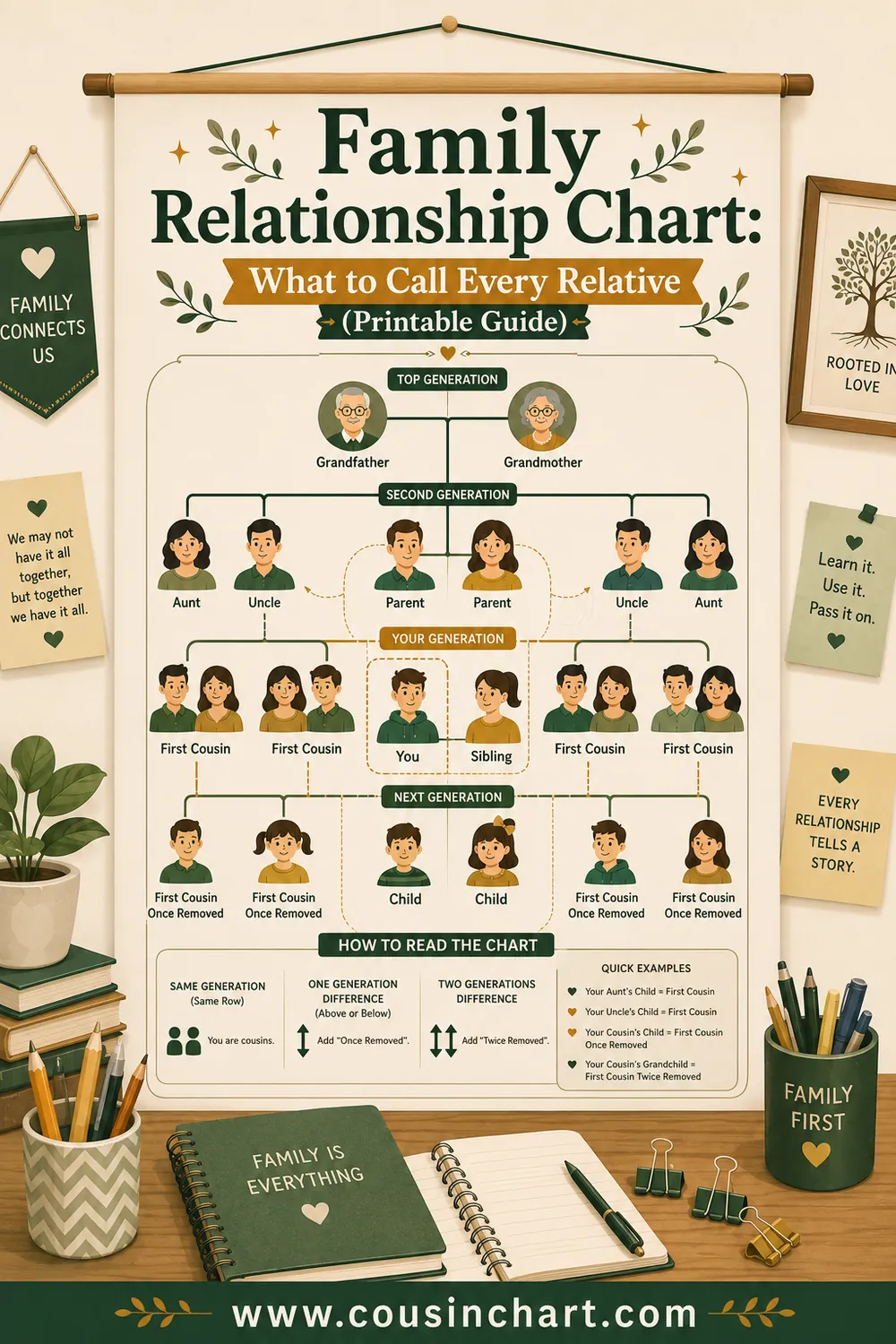
That's the whole answer in four sentences, but real families add twists: half-sisters, stepsisters, two sisters who married two brothers, and "aunts" who are really close family friends. This guide walks through every case, one at a time, with tables you can scan, DNA figures for each answer, and the famous riddle that trips people up: "I am my aunt's sister's daughter. Who am I?" If you'd like the big picture of how every relative fits together first, our family relationship chart lays out the whole family on one page. This article zooms in on one tricky corner of it.
Quick check. Tap a question for the short answer:
What is my aunt's sister to me? The quick answer
Here's the short version you can give someone at a family party. Everything below explains why.
- Your mom's sister's sister is your mother or another maternal aunt.
- Your dad's sister's sister is another paternal aunt. She isn't your mother (unless your parents are related in some unusual way, which we cover later).
- Your uncle's wife's sister is not related to you by blood or by marriage. Many families still treat her warmly, and some kids even call her "Aunt," but on a family tree she isn't on your branch.
- Your half-aunt's sister could be your parent, a full aunt, a half-aunt, or a stranger to your bloodline, depending on which parent the two sisters share.
- Your step-aunt's sister is usually your step-aunt too, or no relation, depending on how the stepfamily formed.
The trick is that "aunt" is a loose word in English. The American Heritage Dictionary defines an aunt as "the sister of one's father or mother," and also as "the wife of a sibling of one's mother or father." It adds a third, informal use: a polite form of address for an older woman, especially by children. So one word covers a blood relative, a relative by marriage, and a family friend. Before you can answer the question about her sister, you need to know which of those your aunt is.
First, figure out which kind of aunt she is
Ask yourself one question: how is your aunt connected to your parent? There are really only six possibilities.
- She's your parent's full sister. They have the same mother and the same father. This is a blood aunt, sometimes called a "full aunt."
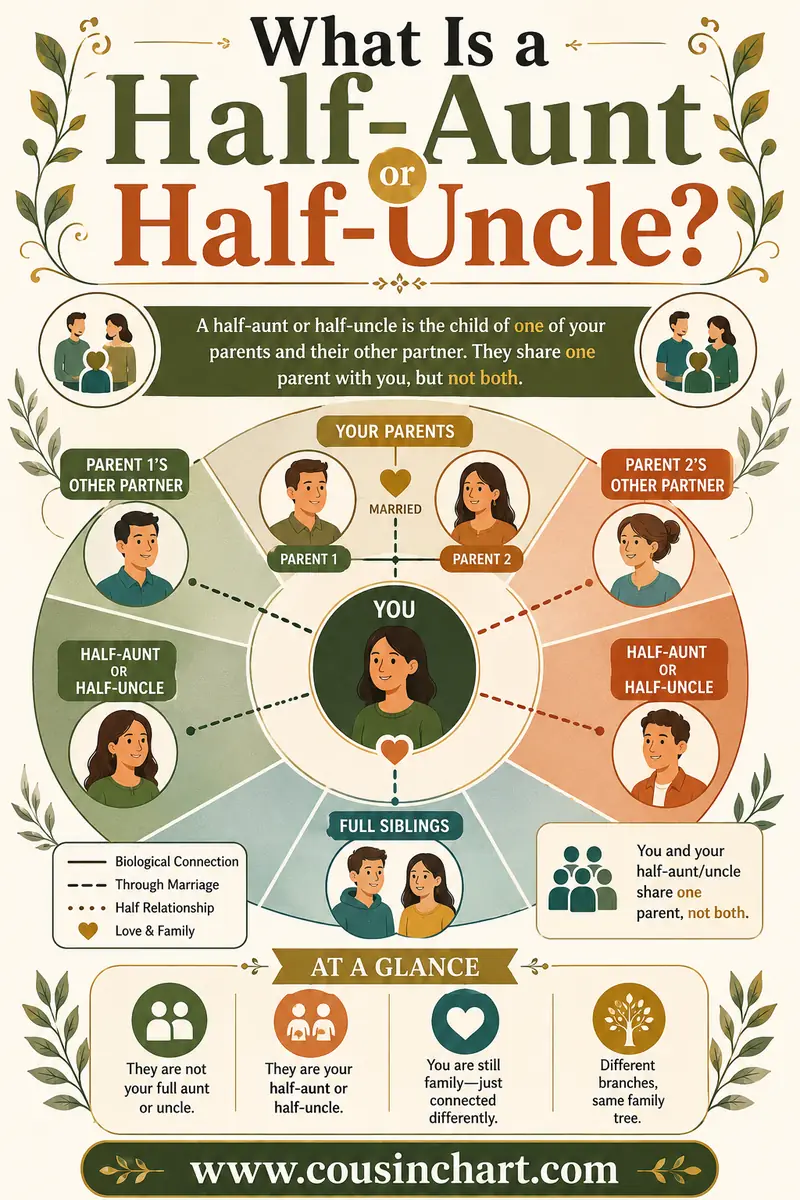
- She's your parent's half-sister. They share one parent only. This is a half-aunt, still a blood relative.
- She's your parent's stepsister. Your grandparent married her parent. You don't share any ancestors. This is a step-aunt.
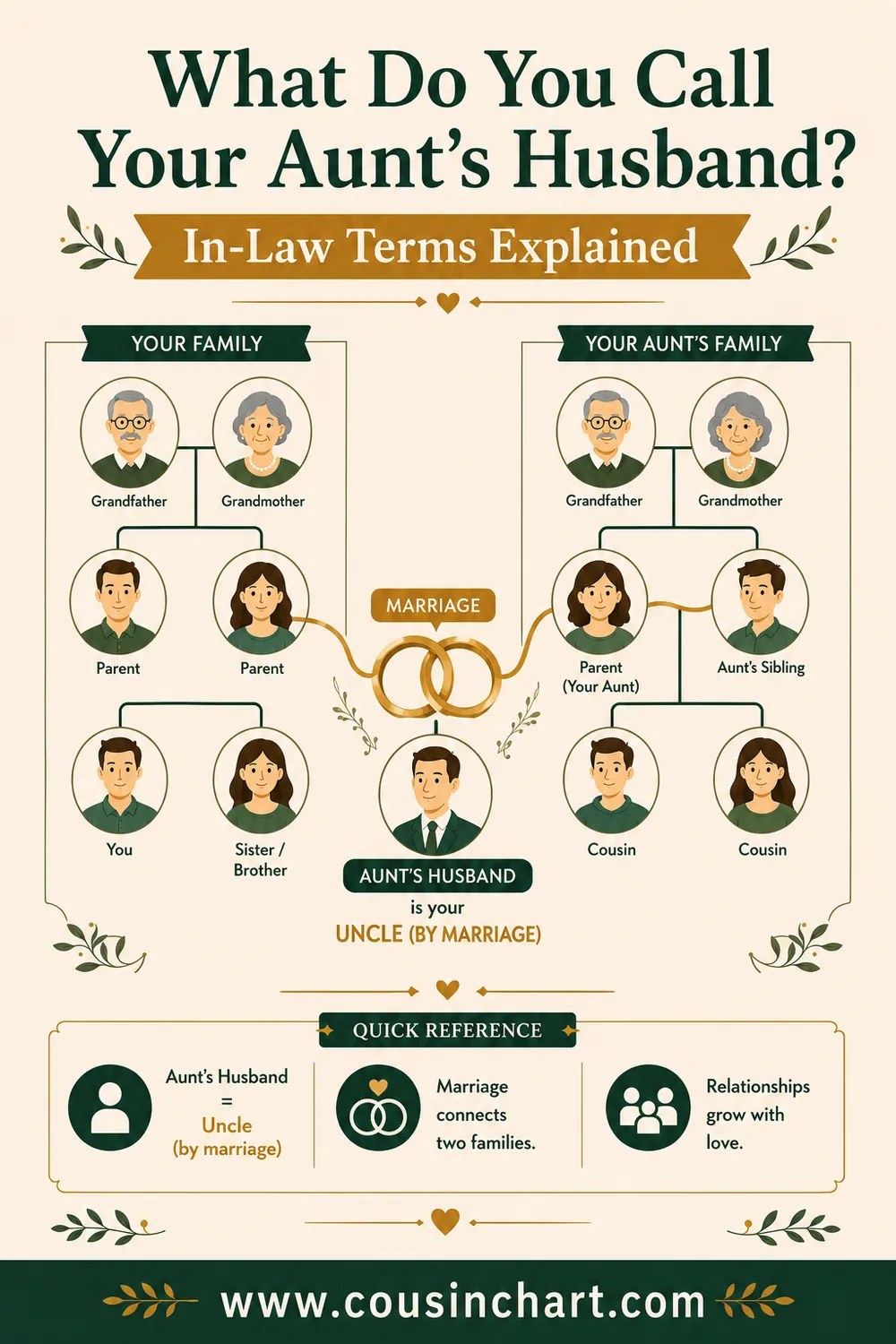
- She married your parent's brother. This is an aunt by marriage. Her husband is your uncle by blood.
- She married your parent's sister. In a family where your aunt has a wife, that wife is also an aunt by marriage.
- She's an honorary aunt. A close family friend, a godmother, or a neighbor who has always been "Aunt Jo." There's no family tie on paper at all.
Once you know which box your aunt sits in, finding her sister's place is mostly mechanical. The rule that does all the work is simple: two people are blood relatives only if they share at least one ancestor. So for any "aunt's sister," ask: do she and I have a grandparent (or great-grandparent) in common? If yes, she's a blood relative, and the shared ancestor tells you exactly what to call her. If no, she isn't related to you by blood, no matter how close the families are.
Case 1: Your aunt is your mom's sister
Let's use an illustrative family. These people are made up to show the pattern. Your mom, Rachel, has two sisters, Dana and Kim. All three share the same parents, your maternal grandparents.
Now pick Dana as "your aunt." Who are Dana's sisters? Rachel and Kim. Rachel is your mother. Kim is your aunt. That's it. There's no one else it could be, because Dana's only sisters are the other daughters of her parents, and those are exactly the women your mom grew up with.
This is why the question can sound silly at first. In the simplest family, "my aunt's sister" is just your mom or another aunt. But it's not a silly question, because the answer flips completely when the aunt is on your dad's side or married in.
A few points worth knowing about this case:
- Your mother counts. If you have only one maternal aunt, then "my aunt's sister" can only mean your mom. That's the key to the riddle later in this article.
- Every sister of your mom is your aunt. That includes sisters you've never met, sisters who live far away, and sisters who are much younger than you.
- Their children are your first cousins. If Kim has a daughter, that daughter is your first cousin, because you share a set of grandparents.
Case 2: Your aunt is your dad's sister
Now switch sides. Your dad, Mark, has two sisters, Ellen and Grace. Pick Ellen as "your aunt." Her sisters are Grace and nobody else. Grace is also your aunt, on your dad's side.
Notice what's different. Your mother is not Ellen's sister. Your mom joined your dad's family by marriage, so she's Ellen's sister-in-law. That means on your dad's side, "my aunt's sister" can never be your mother in an ordinary family tree. It can only be another of your dad's sisters.
People sometimes mix this up when they hear the phrase "my aunt's sister" out of context. If a friend says "my aunt's sister is coming to visit," she might mean her own mom, said in a playful way, or another aunt, or someone unrelated. The phrase alone doesn't tell you. You need to know which side the aunt is on.
There's one tidy rule that covers Cases 1 and 2 together:
A blood aunt's sisters are your parent's sisters. On your mom's side, that list includes your mom. On your dad's side, it doesn't.
Case 3: Half-aunts and step-aunts
Blended families make the question more interesting. Here the answer depends on which parent two sisters share, so it helps to draw it out.
Your aunt is your parent's half-sister
Say your mom, Rachel, and your aunt, Tess, share a mother (your grandma) but have different fathers. Tess is your half-aunt. Now ask who Tess's sisters are. There are three kinds:
- Sisters through your grandma. Any other daughter of your grandma is your mom's sister or half-sister too. So she's your aunt or half-aunt. Your mom is one of these.
- Sisters through Tess's father only. Suppose Tess's father had another daughter, Vera, with a different woman. Vera is Tess's half-sister. But Vera shares no parent with your mom, so she shares no ancestor with you. Vera is not related to you by blood, even though she's your aunt's sister.
- Stepsisters. Daughters Tess gained when her father remarried aren't related to Tess by blood, and they aren't related to you either.
That middle case surprises people. It's the most common way to end up with an "aunt's sister" who is a total stranger to your bloodline, even though your aunt herself is a blood relative.
Your aunt is your parent's stepsister
Say your grandpa married a woman who already had two daughters, Paula and June. Paula is your dad's stepsister, so you might call her your step-aunt. Her sister June is also your dad's stepsister, so June is your step-aunt too. Neither shares DNA with you. If Paula has a half-sister through her own father, that half-sister has no link to your family at all.
Step relationships come from marriage, not ancestry, so they don't carry through to the next set of relatives the way blood ties do. Our step-family relationship chart lays out every step title side by side if you need the full set.
Case 4: Your aunt married into the family
This is the case behind most of the searches on this topic, so it gets the most space. Your uncle (your parent's brother) married a woman named Monica. You've called her Aunt Monica your whole life. Monica has a sister, Laura. What is Laura to you?
Laura is not related to you. Here's why, step by step:
- You and your uncle share ancestors: your grandparents.
- Monica doesn't share those ancestors. She joined the family by marrying your uncle. She's your aunt by marriage. (Our guide on what to call your aunt's husband covers the mirror image: an uncle by marriage.)
- Laura shares ancestors with Monica, but not with you or your uncle.
- So you and Laura have no common ancestor and no marriage directly connecting you. You're connected only through two links in a chain: your uncle's marriage, then Monica's family.
In plain English, Laura is "my aunt's sister" or "my uncle's sister-in-law." Both are accurate. Some people use the old American phrase "shirttail relative" for exactly this sort of loose connection: someone attached to your family through somebody else's marriage.
What about Laura's kids?
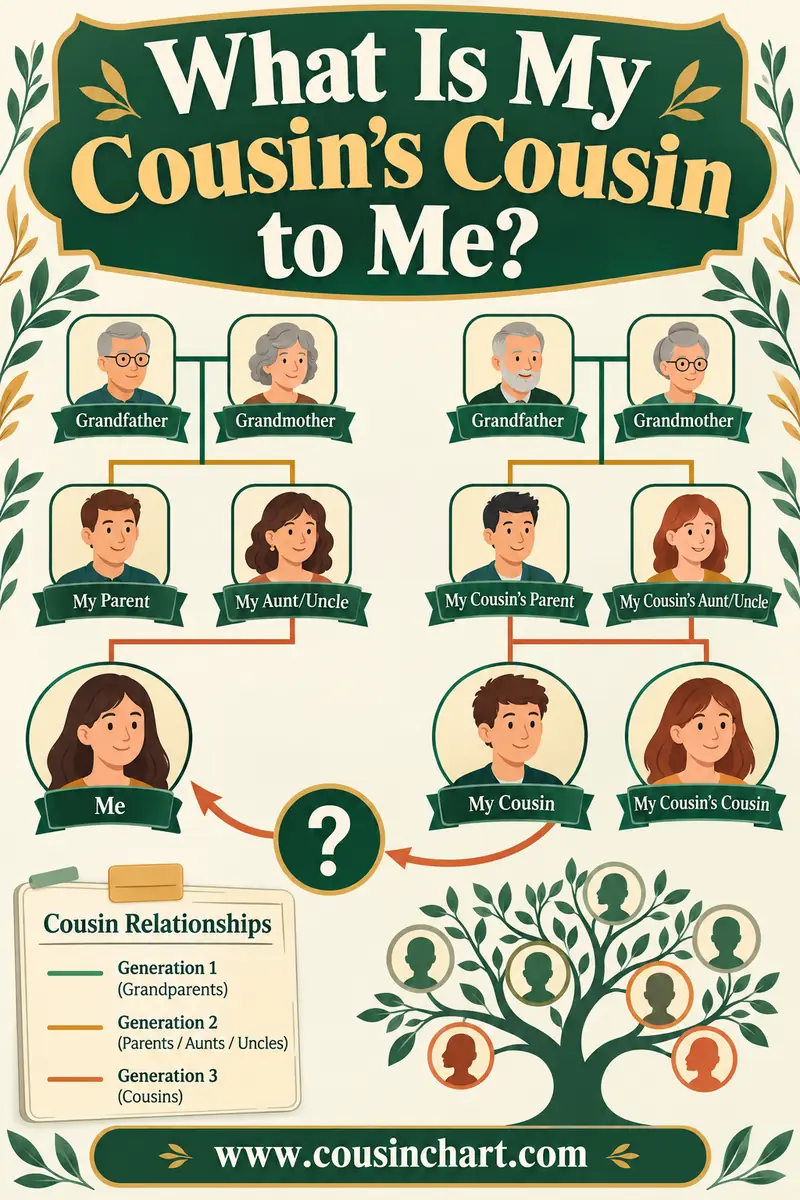
This is where it gets fun. Suppose your uncle and Monica have a son, Leo. Leo is your first cousin, through your uncle. Laura's daughter, Zoe, is also Leo's first cousin, through Monica. So Leo has cousins on both sides, and you and Zoe are each his cousin. But you and Zoe aren't related to each other. You're each your cousin's cousin, from opposite sides. Our article on what your cousin's cousin is to you explains that "which side?" test in full.
Can you call her "Aunt Laura"?
Sure, if your family likes it. Lots of families extend "aunt" to any woman of your parents' generation who's part of family life. The dictionary even recognizes "aunt" as a form of address for an older woman, so you're not breaking any rule. Just know that on a family tree or a DNA test, she won't show up as a relative.
Is she an in-law?
Not to you. In-law titles describe your own spouse's family and your blood relatives' spouses. Laura is your uncle's sister-in-law, because she's his wife's sister. The in-law label stops there and doesn't pass along to you. If you want to see where in-law titles begin and end, the in-law relationship chart sets out the full list.
Every case at a glance
Here's every combination in one table. Find your aunt in the first column, then read across to see who her sister could be.
| Your aunt is... | Her sister could be... | Related to you by blood? |
|---|---|---|
| Your mom's full sister | Your mother, or another aunt on your mom's side | Yes |
| Your dad's full sister | Another aunt on your dad's side | Yes |
| Your parent's half-sister (shared parent is your grandparent) | Your parent, an aunt, or a half-aunt, if they share your grandparent | Yes |
| Your parent's half-sister (sister through her other parent) | A woman with no ancestor in common with you | No |
| Your parent's stepsister | Another step-aunt, or someone with no tie to you | No |
| Your uncle's wife (aunt by marriage) | Your uncle's sister-in-law; no relation to you | No |
| Your aunt's wife (aunt by marriage) | Your aunt's sister-in-law; no relation to you | No |
| An honorary aunt (family friend) | Your family friend's sister | No |
If you only remember one thing from this table, make it this: the sister of a blood aunt who shares your grandparent is always family. The sister of an aunt who married in is not.
The "aunt's sister's daughter" riddle
A riddle floats around online and in classrooms: "I am my aunt's sister's daughter. Who am I?" It sounds like a trick, and it is, a little. The answer is usually just: you're you.
Here's the logic. Take a girl whose mother has a sister. That sister is the girl's aunt. The aunt's sister is the girl's mother. And the mother's daughter is the girl herself. So "my aunt's sister's daughter" can describe the speaker. The riddle works because people expect the answer to be a new person, and they go looking for a cousin.
But it isn't always the speaker. The real answer to "What is my aunt's sister's daughter to me?" depends on the same cases as before. Here's the full list.
| Who "my aunt's sister" turns out to be | Her daughter is... |
|---|---|
| Your mother | You (if you're her daughter), or your sister |
| Your mother, but the daughter has a different father than you | Your half-sister through your mom |
| Another aunt on the same side | Your first cousin |
| A half-aunt who shares your grandparent | Your half first cousin |
| Your step-aunt | Your step-cousin, if your family uses that term |
| The sister of an aunt by marriage | Not related to you, but she is a first cousin to your cousins on that side |
| A stranger to your bloodline (the half-sister case) | Not related to you |
Notice how the answer for a son changes slightly. A boy can't be his mother's daughter, so for him, "my aunt's sister's daughter" is never himself. On his mom's side it could be his sister or half-sister, and on either side it could be a first cousin.
A second version of the riddle
You'll also see: "My aunt's sister is not my aunt. Who is she?" The two strongest answers are your mother (if the aunt is your mom's sister) and an unrelated woman (if the aunt married in). Both are correct, which is why riddles like this make good dinner-table puzzles.
What DNA says about each answer
If you've taken a consumer DNA test, your aunt's sister may or may not show up on your match list. That's a quick way to check which case you're in. DNA testing companies measure shared DNA in centimorgans (cM), a unit that roughly tracks how long a shared stretch of DNA is. The more cM you share, the closer the relationship.
Why do relatives share DNA at all? Because, as the National Human Genome Research Institute explains, humans have 23 pairs of chromosomes, and one copy of each chromosome comes from the mother and the other from the father. Each generation passes on a shuffled half, so the amount you share with a relative drops the further back your shared ancestors are.
The best public reference for real-world numbers is the Shared cM Project, Version 4.0, compiled by genetic genealogist Blaine Bettinger from about 60,000 submitted results. Here are its figures for each possible "aunt's sister," with ranges trimmed of the most extreme outliers as the project describes.
| Who the aunt's sister is | Average shared cM | Range in the project |
|---|---|---|
| Your mother | 3,485 | 2,376 to 3,720 |
| Your full aunt | 1,741 | 1,201 to 2,282 |
| Your half-aunt | 871 | 492 to 1,315 |
| Step-aunt, aunt by marriage's sister, or unrelated half-sister | 0 expected | No shared ancestor, so none expected |
And for the riddle's daughters:
- Full sister: average 2,613 cM, range 1,613 to 3,488.
- Half-sister: average 1,759 cM, range 1,160 to 2,436.
- First cousin: average 866 cM, range 396 to 1,397.
- Half first cousin: average 449 cM, range 156 to 979.
You can type any of these numbers into the Shared cM Project tool at DNA Painter, which shows the same data as an interactive chart and highlights which relationships fit a given amount.
Checking the arithmetic
Those averages line up with simple halving. The project notes that its "expected" values assume perfect 50% inheritance each generation, and gives 1,700 cM as the expected figure for half-siblings, who share 25%. That means the project is working from a genome total of 1,700 ÷ 0.25 = 6,800 cM. From there:
- A full aunt shares about 25% with you: 6,800 × 0.25 = 1,700 cM expected. The observed average is 1,741.
- A half-aunt shares about half of that, 12.5%: 6,800 × 0.125 = 850 cM expected. The observed average is 871.
- A first cousin also shares about 12.5%, which is why the first cousin average (866) and the half-aunt average (871) are so close.
That last point matters if you're trying to tell a half-aunt from a first cousin on a match list. The numbers alone often can't separate them. Ages, shared matches and family records do that job.
If the aunt by marriage's sister shows up as a match
Occasionally someone finds that their aunt by marriage's sister does share a little DNA with them. That doesn't break the rules above. It means there's a second, separate connection: the two families share a distant ancestor, or come from a small community where many people are related several ways. A small match like that points to a distant cousin link, not to the marriage.
Special cases that change the answer
Most families fit the four main cases. A few don't, and they're worth knowing because they're the ones that cause arguments.
Two sisters married two brothers
Say your mom, Ann, married your dad, Carl. Ann's sister Beth married Carl's brother Dan. Now Beth is your aunt twice over: she's your mom's sister (blood aunt) and your uncle Dan's wife (aunt by marriage). Her sister Ann is your mother, by Case 1. And Beth's kids are your double cousins, sharing all four of your grandparents. In families like this, "my aunt's sister" really can be your mother even though the aunt also married your dad's brother.
Your aunt married your dad's brother, and your mom is her sister
That's the same situation as above, seen from a different angle, and it's the only ordinary way for "my dad's side aunt's sister" to be your mother. If someone insists their paternal aunt's sister is their mom, this is almost always the reason.
Same-sex marriages
If your mom's sister has a wife, that wife is your aunt by marriage. Her sister is not related to you, exactly as in Case 4. If your parents are two moms, then each of your moms' sisters is your aunt, and "my aunt's sister" could be either of your moms, depending on whose sister the aunt is.
Adoption
An adopted aunt is your aunt, full stop, and her sisters are your aunts or your parent in the usual way. Families and the law treat adoptive ties as real family ties. The only place the difference shows up is a DNA test, where an adopted relative won't appear as a genetic match.
Honorary aunts
If "Aunt Jo" is your mom's best friend from college, her sister is your mom's best friend's sister. Many people grow up with honorary aunts and uncles, and the warmth is completely real. On a family tree, though, neither woman is placed on your branches.
What the law and paperwork say
Most of the time the label "aunt's sister" only matters for what you call someone. But a few official settings do care whether a person is related to you, and they draw the same line this article does.
Relatives by marriage stop at one step
Lawyers use the word affinity for relationships created by marriage. Texas spells out a typical rule in its Government Code, Section 573.024: two people are related by affinity if they're married to each other, or if "the spouse of one of the individuals is related by consanguinity" (by blood) to the other. Apply that to Case 4. Aunt Monica is related to you by affinity, because her spouse (your uncle) is your blood relative. Her sister Laura isn't, because Laura's spouse isn't your blood relative and your spouse isn't hers. That's the legal version of "she's not related to you."
Texas uses those rules mainly for nepotism limits on public officials. Other states and agencies have their own definitions, so laws vary by place.
Taxes
The IRS has its own list. In Publication 501, the relatives who can count as a "qualifying relative" without living with you include "a brother or sister of your father or mother." That covers a blood aunt. It also lists in-laws, but only your own in-laws. Your uncle's wife's sister isn't on the list. If you're working on a tax question, check the current publication or ask a tax professional, since the details have several conditions.
Federal hiring rules
The federal anti-nepotism law, 5 U.S.C. § 3110, keeps public officials from hiring or promoting relatives. Its definition of "relative" lists "aunt" along with parents, siblings, first cousins, in-laws, step-relatives and half-siblings. It doesn't list an aunt's sister, because unless she's also your mother or your aunt, she isn't one of your relatives.
How to place your aunt's sister on a family tree
Family trees are where the difference between these cases really shows. Drawing the people in the right spot keeps the tree readable, and it keeps anyone who looks at it later from assuming a blood tie that isn't there. Here's a simple method that works on paper or in any genealogy program.
- Start from your grandparents. Draw your parent's parents and all of their children underneath. Every woman in that row is your parent's sister or half-sister, so every one of them is your mother or your aunt. If your aunt's sister appears in this row, you're done: she's family by blood.
- Add spouses beside each sibling. Your uncle's wife goes next to your uncle, joined by a marriage line. She sits in the same row as your blood aunts, but she's attached by marriage, not by a line down from your grandparents.
- Hang her family off her, not off you. If you want to include Aunt Monica's sister Laura, draw Monica's parents above Monica, then put Laura beside her as a sibling. Laura now connects to your tree only through Monica, which is exactly right.
- Mark half and step ties. For a half-aunt, draw the line from the one shared grandparent only. For a step-aunt, connect her to her own parent, who's linked by marriage to your grandparent. Many programs let you mark a link as "step" or "half," and it's worth doing.
- Label the shared ancestor. When in doubt, write the name of the grandparent you and the woman share. If you can't fill that in, she isn't a blood relative.
This method also answers the DNA question at a glance. Anyone whose line runs up to your grandparents can appear on your match list. Anyone who only hangs off a spouse can't, unless there's a separate connection somewhere else in the tree.
Why it's worth getting right
Getting the placement right isn't just tidiness. Family trees get shared, copied into online databases and passed to the next generation. If an aunt by marriage's sister gets drawn as a blood aunt, a future researcher may spend hours hunting for a shared grandparent who doesn't exist, or misread a DNA match list because of it. A few extra lines today save a lot of confusion later.
Common mix-ups
These are the slips people make most often when they work through this question.
- Assuming the answer is always "aunt." On your mom's side it can be your mother. In a married-in family it can be no relation at all.
- Thinking your mother is your paternal aunt's sister. She's your aunt's sister-in-law, unless the two-sisters-married-two-brothers situation applies.
- Calling an aunt by marriage's sister a "sister-in-law." She's your uncle's sister-in-law, not yours.
- Calling her kids your cousins. They're your cousin's cousins from the other side. You don't share grandparents with them.
- Forgetting half-sisters cut both ways. A half-aunt's half-sister through the other parent isn't related to you.
- Reading too much into a small DNA match. If an unrelated "aunt's sister" shares a few cM with you, look for a separate distant connection rather than assuming the marriage created it.
For a broader look at where blood ties end and marriage ties begin, our guide to blood relatives vs. relatives by marriage walks through the same idea for every kind of relative.
Try it yourself
Here are four quick puzzles. The families are illustrative. Work each one out, then check the answer underneath.
- Puzzle: Your dad and his sister Nina have the same two parents. Your dad has no other full sisters, yet Nina says she has a sister, Ruth. Who could Ruth be? Answer: Ruth can't be Nina's full sister, or she'd be your dad's full sister too. If Ruth shares one parent with Nina, that parent is also your dad's parent, so Ruth is your dad's half-sister and your half-aunt. If Ruth is Nina's stepsister, she's your step-aunt, with no shared ancestor.
- Puzzle: Your uncle Sam's wife, Rosa, has a sister, Ines. Ines has a son, Marco. What is Marco to you? Answer: No relation. Marco is a first cousin to Sam and Rosa's children, but not to you.
- Puzzle: Your mom and her half-sister Kate share a mother. Kate's father also has a daughter, Joy, with his second wife. Joy has a daughter, Ivy. What is Ivy to you? Answer: No relation. Joy is Kate's half-sister through Kate's father, who isn't your grandparent. You and Ivy share no ancestor, even though Ivy is your half-aunt's niece.
- Puzzle: Your aunt Beth is your mom's sister and also married to your dad's brother. What are Beth's kids to you? Answer: Double first cousins. You share all four grandparents.
Wrap-up: how to answer it for your own family
So, what is your aunt's sister to you? Start with the aunt. If she's your parent's full sister, her sister is your mother or another aunt on that side. If she's a half-aunt, check which parent the sisters share. If she married into the family, her sister isn't related to you, though her sister's kids are your cousins' cousins. Ask "do we share a grandparent?" and the answer falls into place. For the whole family laid out in one view, keep our family relationship chart handy, and when you hit a tangle, try the free calculator on our homepage: you pick how two people connect, and it names the relationship for you.
Frequently Asked Questions
What is my aunt's sister to me?
It depends on how your aunt is related to you. If she's your mom's sister, her sister is either your mother or another aunt on your mom's side. If she's your dad's sister, her sister is another aunt on your dad's side. If your aunt married into the family, because she's your uncle's wife, her sister isn't related to you by blood or by marriage. She's simply your aunt's sister, or your uncle's sister-in-law. Half and step relationships add a few more possibilities, so check which parent the sisters share.
Is my aunt's sister my aunt?
Often, yes. When your aunt is your parent's full sister, all of her sisters are your parent's sisters too, which makes them your aunts, except for the one who is your mother. When your aunt is your uncle's wife, though, her sister isn't your aunt in any family-tree sense. Some families still call her Aunt as a friendly title, and that's perfectly fine. It just won't show up on a family chart or a DNA test as a relationship.
Is my uncle's wife's sister related to me?
No. Your uncle's wife is your aunt by marriage, and her sister shares no ancestors with you. There's also no marriage directly linking you to her. She's your uncle's sister-in-law, not yours. Her children are first cousins to your uncle's kids, since they share grandparents on their mother's side, but they aren't your cousins. If a DNA test ever shows you sharing a little DNA with her, it points to a separate, distant connection between the two families.
What is my aunt's sister's daughter to me?
If your aunt's sister is your mother, her daughter is you or your sister, or a half-sister if the daughter has a different father. If your aunt's sister is another aunt, her daughter is your first cousin. If the sister is a half-aunt who shares your grandparent, her daughter is your half first cousin. And if your aunt married into the family, her sister's daughter isn't related to you at all, though she is a cousin to your cousins on that side.
What's the answer to the riddle 'I am my aunt's sister's daughter'?
The usual answer is that the speaker is describing herself. Picture a girl whose mother has a sister. That sister is the girl's aunt, the aunt's sister is the girl's mother, and the mother's daughter is the girl. The riddle works because people expect a new person, usually a cousin, and overlook the simplest reading. It can also describe a sister or a first cousin, depending on which sister the speaker has in mind, so it's a fun family puzzle.
Can my aunt's sister be my mom if the aunt is on my dad's side?
Not in an ordinary family tree. Your dad's sister's sisters are your dad's other sisters, and your mom is their sister-in-law. The one common exception is when two sisters married two brothers. If your mom's sister married your dad's brother, that aunt is your mom's sister and also your dad's brother's wife. In that family, a woman who is both your maternal aunt and your aunt by marriage on your dad's side has your mom as her sister.
Do I share DNA with my aunt's sister?
Only if she shares an ancestor with you. Using the Shared cM Project figures, your mother shares about 3,485 centimorgans with you on average, a full aunt about 1,741, and a half-aunt about 871. A step-aunt, an aunt by marriage's sister, or a half-sister of your aunt through a parent you don't descend from has no shared ancestor with you, so no DNA is expected. Endogamy or an unknown distant link can create a small exception.
Is my uncle's wife's sister my aunt-in-law?
Not really. Aunt-in-law is an informal phrase people sometimes use for an aunt by marriage, meaning your uncle's wife, or for your spouse's aunt. Your uncle's wife's sister is one more step away. She's your uncle's sister-in-law, because she's his wife's sister, but that in-law tie belongs to your uncle and doesn't pass along to you. Most dictionaries and family charts don't have a single word for her, so a plain description like my aunt Monica's sister works best.
What do I call my aunt's sister if she's not related to me?
Use whatever feels natural for your family. Many people use her first name. Some say Aunt plus her first name as a sign of warmth, especially if she's at every holiday. If you need a precise description, say my aunt's sister or my uncle's sister-in-law. For a family tree, record her on your aunt's side of the family, connected through your aunt rather than through you, so the chart stays accurate for anyone who reads it later.
Sources
We checked every source below while writing this guide. Last reviewed October 30, 2026, by Joan Ramos.
- aunt (The American Heritage Dictionary of the English Language, Fifth Edition) (HarperCollins / American Heritage Dictionary)
- Chromosomes Fact Sheet (National Human Genome Research Institute)
- The Shared cM Project, Version 4.0 (March 2020) (Blaine T. Bettinger, The Genetic Genealogist)
- The Shared cM Project 4.0 tool v4 (DNA Painter)
- Texas Government Code Section 573.024, Determination of Affinity (Texas Legislature, via Texas.Public.Law)
- Publication 501 (2025), Dependents, Standard Deduction, and Filing Information (Internal Revenue Service)
- 5 U.S. Code § 3110, Employment of relatives; restrictions (Legal Information Institute, Cornell Law School)