Thanksgiving Table Relationship Cheat Sheet: Who Is Everyone to the Host?
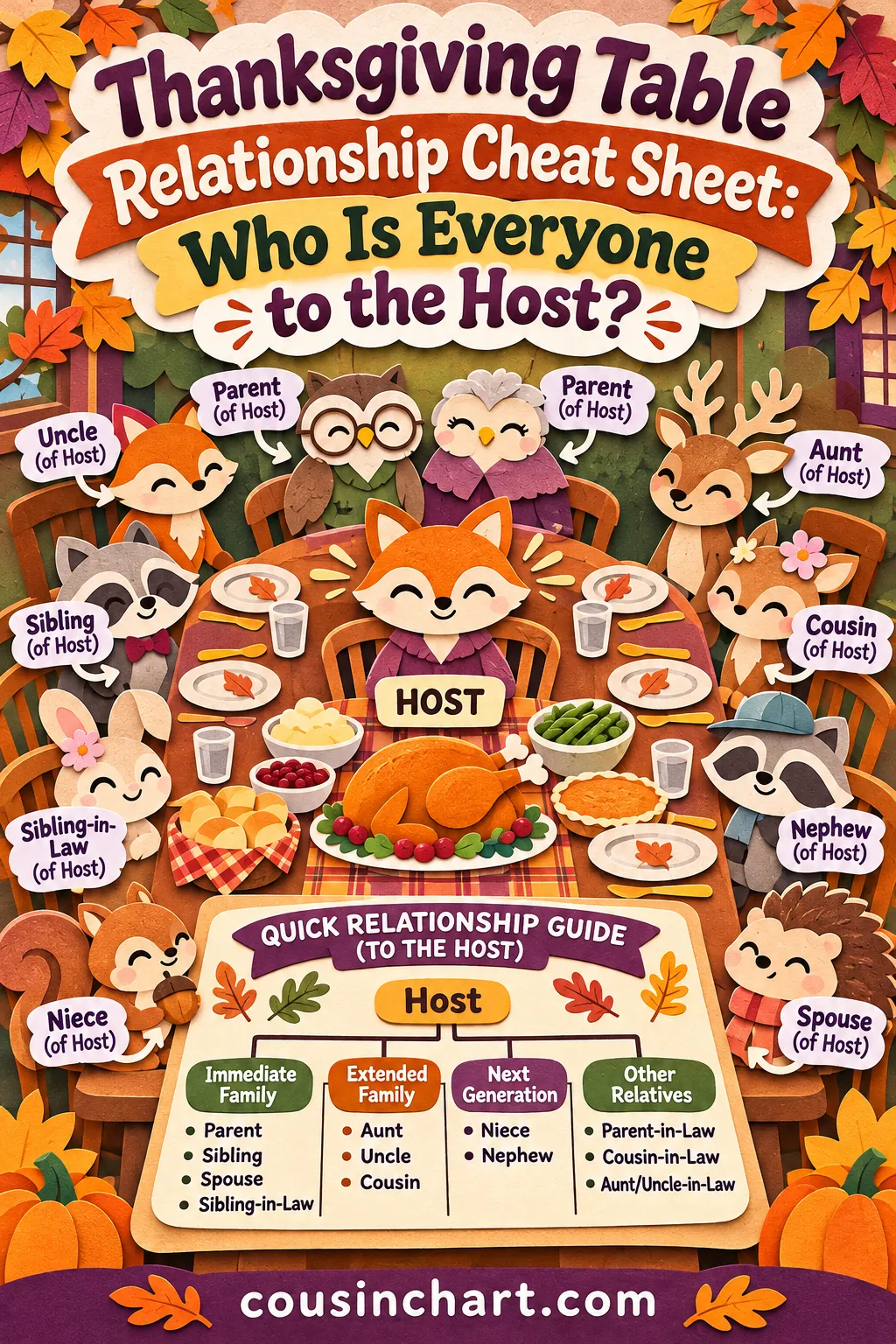
The easiest way to sort out a big Thanksgiving table is to label every guest by what they are to the host: sibling, niece, first cousin, cousin once removed, in-law. One anchor person makes every relationship easy to read. Then you can put those labels on place cards or a simple chart for the kids.
You don't have to work out the tricky ones by hand. The free Cousin Chart relationship calculator names any relative in a couple of seconds. This guide gives you a ready family relationship chart for Thanksgiving, shows the math behind it, walks through two full sample tables, and offers plenty of ways to use the labels at dinner without turning the meal into a quiz.
▶ Work it out in the free calculator
Why Anchor Everything to the Host
At a big gathering, every guest is related to every other guest in a different way. Your aunt's grandson is your first cousin once removed, but he's your mom's great-nephew and your daughter's second cousin. Trying to list every pair gets messy fast.
So pick one person, the host, and label everyone from their point of view. It doesn't matter if the host is the oldest person in the room or not. What matters is that everyone uses the same anchor.
A quick example shows why. Ask three people what cousin Sam is, and you might hear "my nephew," "my cousin" and "my second cousin." All three are right, from their own seat. Put "Sam, Grandma's great-nephew" on the card, and suddenly everyone is reading from the same map. It's a common trick for family reunions too. Kids get one simple question, "Who is this to Grandma?", and the answers stay consistent all day.
If the host is a grandparent, most guests will be children, grandchildren, siblings, nieces and nephews. If the host is someone in the middle generation, you'll see more cousins and once-removed relatives. Either way works.
When the host isn't the best anchor
Sometimes the person cooking the turkey isn't the person everyone connects through. Say your sister-in-law hosts, but most guests are from your mom's side. Anchoring to her would turn half the table into "husband's cousin's kid" and similar mouthfuls.
In that case, anchor to the person at the center of the family instead, usually the oldest grandparent who's there, or the one whose descendants make up most of the room. Write "Who is everyone to Grandpa Lou?" at the top of the sheet so nobody wonders why the host is listed as a granddaughter-in-law. The rule is simple: pick the anchor that gives the shortest labels for the most people.
The Thanksgiving Relationship Chart
Here are the guests who show up at most big family dinners. The "Generations" column counts down from the shared ancestor, first to the host and then to the guest.
| Guest | Shared ancestor | Generations (host / guest) | What they are to the host | Typical shared cM with host |
|---|---|---|---|---|
| Host's brother or sister | Parents | 1 / 1 | Sibling | ~2,613 |
| Sibling's child | Parents | 1 / 2 | Niece or nephew | ~1,740 |
| Sibling's grandchild | Parents | 1 / 3 | Grandniece or grandnephew | ~880 |
| Parent's sibling | Grandparents | 2 / 1 | Aunt or uncle | ~1,740 |
| Aunt's or uncle's child | Grandparents | 2 / 2 | First cousin | ~866 |
| First cousin's child | Grandparents | 2 / 3 | First cousin once removed | ~433 |
| First cousin's grandchild | Grandparents | 2 / 4 | First cousin twice removed | ~220 |
| Parent's first cousin | Great-grandparents | 3 / 2 | First cousin once removed | ~433 |
| Parent's cousin's child | Great-grandparents | 3 / 3 | Second cousin | ~229 |
| Cousin's spouse, sibling's spouse | none | none | Cousin-in-law, sibling-in-law | 0 |
The cM column is there for the DNA fans at the table. These are rough averages. Real numbers vary and the ranges overlap, so never use one number alone to decide a relationship.
The same guest from three seats
The anchor matters because one person carries a different label for everyone at the table. Here's how three guests look from the host (Grandma), her son and her granddaughter.
| Guest | To Grandma (host) | To Grandma's son | To Grandma's granddaughter |
|---|---|---|---|
| Grandma's sister's son | Nephew | First cousin | First cousin once removed |
| That nephew's daughter | Grandniece | First cousin once removed | Second cousin |
| Grandma's first cousin | First cousin | First cousin once removed | First cousin twice removed |
Every one of those labels is correct. That's exactly why the cheat sheet picks one column and sticks to it. Kids can work out their own column later, once they know the host's.
How to Read the Cousin Names
Two rules cover every row of that chart.
Rule 1: The cousin number comes from the shorter side. Find the shared ancestor. Count generations down to each person. Take the smaller number and subtract one. Two generations down means first cousins. Three means second cousins. Four means third cousins.
Rule 2: "Removed" is the gap between the two sides. Subtract the smaller number from the larger one. A gap of one is "once removed." A gap of two is "twice removed."
Let's try it. The host's cousin Rachel brought her son, Owen.
- Shared ancestors: the host's grandparents.
- Down to the host: 2.
- Down to Owen: 3.
Smaller number is 2, so it's a first cousin. The gap is 1, so it's once removed. Owen is the host's first cousin once removed.
Now the host's own daughter and Owen:
- Down to the host's daughter: 3.
- Down to Owen: 3.
Three and three, no gap. They're second cousins. For a longer look at the gap rule, see what "once removed" means.
When one side counts only 1
If either person is just one generation below the shared ancestor, it isn't a cousin relationship at all. It's an aunt, uncle, niece or nephew line. One down and two down is aunt and niece. One down and three down is great-aunt and grandniece. Many people stumble here at the table, calling Grandma's sister a cousin. She's a great-aunt to the grandkids, because she's only one step below the parents she shares with Grandma.
How to Check It With the Calculator
When a guest stumps you, the relationship calculator settles it fast.
- Use a quick-pick if one fits. Buttons like "My cousin's child," "My dad's cousin" and "My cousin's grandchild" cover a lot of Thanksgiving guests in one tap.
- Or set the generations yourself. Count down from the shared ancestor to the host and set that number. Then do the same for the guest.
- Set the options. Turn on half relationship if the link runs through a half-sibling. Pick the guest's sex if you want "niece" instead of "niece or nephew." Choose blood, step or marriage.
- Read the result. For 2 and 3, you'll see first cousin once removed, with a chart showing the path.
- Save it. Use Print this result for a quick handout, or Download my chart to drop into your cheat sheet.
Run each tricky guest once and you've built your whole chart in a few minutes.
Exact settings for the guests people ask about most
When you use the generation controls, "you" is the host. Here are the settings and results for the usual head-scratchers.
| Guest | Quick-pick or settings | Options | Result you'll see |
|---|---|---|---|
| Host's cousin's daughter | "My cousin's child," or host 2, guest 3 | Sex: female | First cousin once removed |
| Host's dad's cousin | "My dad's cousin," or host 3, guest 2 | none | First cousin once removed |
| Host's cousin's grandson | "My cousin's grandchild," or host 2, guest 4 | Sex: male | First cousin twice removed |
| Host's second cousin | "My second cousin," or host 3, guest 3 | none | Second cousin |
| Host's half-brother's son | Host 1, guest 2 | Half on, sex: male | Half nephew |
| Host's mom's cousin's son | Host 3, guest 3 | Sex: male | Second cousin |
That last row surprises people. The host's mom's cousin's son is in the host's own generation, three steps below the great-grandparents on both sides, so he's a plain second cousin. No "removed" at all.
Saving results for the sheet
If you're building the cheat sheet on a laptop, keep a simple list open next to the calculator. Run one guest, tap Copy result, and paste it beside the name. It takes about as long as typing the name. When the list is done, you have every label in one place and you know each one has been checked.
Worked Example: Grandma June's Table
Here's a sample table, all labeled from Grandma June, the host.
- June's sister Peggy. Same parents. Sibling.
- Peggy's son Mike. One generation below June's sibling. Nephew.
- Mike's daughter Lily. Two generations below June's sibling. Grandniece.
- June's son Tom. Son.
- Tom's wife Priya. Daughter-in-law.
- Tom's kids, Ava and Ben. Grandchildren.
- June's cousin Ruth. They share grandparents. First cousin.
- Ruth's grandson Eli. Shared ancestors down to June: 2. Down to Eli: 4. First cousin twice removed.
Now look at the kids from their side. Ava and Lily are both three generations below June's parents. That makes them second cousins. Ava and Eli? Eli is 4 generations below June's grandparents, and Ava is 4 too. That's third cousins. The host's chart gives you the anchor, and the kids can work out their own links from there.
Worked Example 2: A Middle-Generation Host
Grandparent hosts are easy, because almost everyone descends from them. A host in the middle of the tree gets more cousins and more half and step links. Here's Marcus, 42, hosting at his house.
The guest list:
- Marcus's mom, Denise, and his stepdad, Carl. Mother and stepfather. No calculator needed.
- Carl's daughter from his first marriage, Jenna, and her two kids. Jenna is Marcus's stepsister. Her kids are his step-niece and step-nephew. In the calculator, set the relation type to step to see step labels.
- Marcus's half-sister, Tasha, from his dad's second marriage, and her son, Andre. Tasha shares only their dad, so she's a half-sister. For Andre: host 1, guest 2, half on, sex male. Result: half nephew.
- Denise's first cousin, Linda. Linda and Denise share grandparents, so Linda is 2 down. Marcus is 3 down. Set host 3, guest 2, or use the "My dad's cousin" quick-pick, since the result is the same on either parent's side. Result: first cousin once removed.
- Linda's daughter, Kim. Kim is 3 down, same as Marcus. Host 3, guest 3. Result: second cousin.
- Kim's baby, Noah. Noah is 4 down. Host 3, guest 4. Result: second cousin once removed.
- Marcus's wife's brother, Sam. Brother-in-law. No blood tie to Marcus, so no generation math.
- Marcus's college roommate, Dev. Not related. He gets the "honorary uncle" card.
What goes on the sheet:
| Name | To Marcus | Branch |
|---|---|---|
| Denise | Mom | Mom's side |
| Carl | Stepdad | Mom's side |
| Jenna | Stepsister | Carl's family |
| Jenna's kids | Step-niece, step-nephew | Carl's family |
| Tasha | Half-sister | Dad's side |
| Andre | Half nephew | Dad's side |
| Linda | First cousin once removed (Mom's cousin) | Mom's side |
| Kim | Second cousin | Mom's side |
| Noah | Second cousin once removed | Mom's side |
| Sam | Brother-in-law | Wife's side |
| Dev | Honorary uncle | Friends |
Notice the parentheses on Linda's row. "First cousin once removed" is accurate, but "Mom's cousin" is what people actually understand. Putting both on the card works well.
Also notice that Andre and Jenna's kids aren't related to each other at all, by blood or by step. Andre is from Marcus's dad's side, and Jenna's kids are from his stepdad's side. They might still be best friends by dessert. The sheet just keeps the grown-ups from guessing.
Making the Cheat Sheet: Six Easy Formats
Once you have the labels, there are lots of ways to share them. Pick whatever suits your crowd.
1. Relationship place cards
Write the guest's name big and the relationship small underneath. "Owen, Grandma's great-grandnephew" or "Rachel, Mom's first cousin." Kids love finding their own card. Adults will quietly read everyone else's.
2. A fridge chart
Print one page with three columns: name, relationship to the host, and which branch they come from. Stick it on the fridge or near the drinks table. It answers questions before anybody has to ask.
3. A mini family tree by the door
Sketch the host's parents at the top, then their children, then grandchildren. Add guests in the right row. A big drawn tree is easy to follow, even for small kids. Color each branch so cousins can find their side.
4. Name tags with a branch color
For really big gatherings, use stickers in one color per branch. "Everyone in green comes from Great-Aunt May." Then write the relationship to the host on each tag. It's handy for the in-laws who are meeting everyone for the first time.
5. A kids' matching game
Give kids a list of relationships and send them off to find a match. "Find your second cousin." "Find someone who's Grandpa's niece." It keeps them busy before dinner, and they actually learn the family. For more ideas like this, see these family reunion games.
6. A who's-who slideshow
If the TV is on anyway, run a few old photos with a caption under each one: the name, the relationship to the host and the year. "Grandma June and her sister Peggy, 1962." People gather around old pictures without being asked, and the captions do the teaching for you. Older relatives will usually jump in with the story behind each shot, which is half the fun.
Which format fits your gathering
| Gathering | Guests | Best format | Why |
|---|---|---|---|
| Small sit-down dinner | Under 12 | Place cards | Everyone sees every card from their seat |
| Medium family dinner | 12 to 25 | Fridge chart plus place cards | Cards at the table, the chart for anyone who wanders in |
| Big open house | 25 and up | Branch-color name tags | People move around, so the label goes with them |
| Lots of young kids | Any size | Matching game plus drawn tree | Kids learn by hunting, and the tree helps them check |
| Many first-time guests | Any size | Name tags plus slideshow | New partners can read a face and a label together |
Putting it together, step by step
If you're the organizer, here's a simple order of work that keeps it from eating your whole week.
- Get the guest list. Ask each household who's coming, including new partners and babies. Those are the people most likely to be missing from your mental map.
- Group by branch. Put everyone under the host's parent, sibling or child they connect through. Most guests will sort into three or four groups.
- Label the easy ones first. Siblings, children, nieces, nephews and in-laws take seconds.
- Run the hard ones through the calculator. Anyone on a cousin line, or anyone a generation off, gets checked once. Note the result next to their name.
- Pick your format. Place cards, a fridge chart, name tags or a game. One is plenty.
- Print a day early. Last-minute guests happen. Leave a few blank cards and a marker on the table.
Save the file when you're done. Next year you'll only need to add the new faces.
A pre-dinner checklist
- Every guest has a label, including babies and new partners.
- Every cousin-line label has been checked once.
- Half and step labels are only shown if the family already uses them.
- Each card has a plain-words version ("Mom's cousin") next to the formal one.
- Friends of the family have a warm label, not a blank.
- Spare blank cards and a marker are on the table.
- A copy of the sheet is saved for next year.
Explaining the Chart to Kids
Kids ask the best questions at Thanksgiving. "Is she my cousin? Then why is she so old?" Here's how to answer in plain words.
- Cousins are the kids of your aunts and uncles. You share grandparents.
- Second cousins are the kids of your parents' cousins. You share great-grandparents.
- "Removed" means a different generation. Your mom's cousin is your cousin, but one generation up, so she's "once removed."
- In-laws are family by marriage. Uncle Dave married Aunt Tina, so he's your uncle too, just not by blood.
You don't need perfect terms for little ones. Many families say "cousin" for anyone in a cousin role, and that's fine. Older kids often enjoy the precise names, especially if you turn it into a quiz. The guide on how to explain cousins to kids has more simple wording.
A two-minute script for the kids' table
Try this while the turkey rests:
- "Everyone here comes from Grandma June, or married someone who does."
- "Grandma's kids are your mom, your dad, your aunts and your uncles."
- "Their kids are you and your cousins. You're all on the same step."
- "Lily's grandma is Grandma June's sister. So Lily is on your step too, but from a different family. That makes her your second cousin."
- "Can you find someone who's on the step above you, but isn't your mom, dad, aunt or uncle?"
That last question sends them off hunting for a once-removed cousin, and they usually come back with the right person.
Handling In-Laws, Step-Relatives and Friends
Not every guest has a neat spot on the blood line.
In-laws. A sibling's spouse is a brother-in-law or sister-in-law. A cousin's spouse is a cousin-in-law. A child's spouse is a son-in-law or daughter-in-law. If you need names for the in-laws of in-laws, the in-law relationship chart has them laid out.
Step-relatives. A host's stepchild is a stepson or stepdaughter. A stepchild's kids are step-grandchildren. In the calculator, set the relation type to step to see the right term. The step-family relationship chart covers step-aunts, step-cousins and the rest.
Friends who come every year. Give them a fun label. "Honorary cousin" or "Friend of the family since 1998" goes over well on a place card. Nobody should feel left out of the chart.
Half relatives. If a guest is related through a half-sibling, they're a half niece, half cousin and so on. Most families skip "half" in daily talk, but the calculator will show it if you turn the option on.
More edge cases you'll meet at a big table
Adopted relatives. An adopted child is a full member of the family, and the label is the same one a birth child would get. The host's adopted grandson is a grandson. His kids will be the host's great-grandchildren. Don't write "adopted" on a place card unless the person has asked for it.
Double cousins. When two siblings marry two siblings from another family, their kids share both sets of grandparents. Those kids are double first cousins. On the sheet, you can just write "first cousin," or add "double" if the family likes the trivia. The page on double cousins explains how that happens.
Exes who still come. Plenty of families keep a former spouse at the table, especially when there are kids. "Jake's mom" or "Family since 2009" is kinder than a formal term that no longer fits. Let the person choose if you aren't sure.
New partners. A boyfriend or girlfriend isn't a legal in-law yet. "Tom's partner, Alex" is clear and friendly. If they're engaged, "Tom's fiancée" does the job.
Two people related two ways. In small towns, a guest can be the host's second cousin on one side and cousin-in-law on the other. Pick the closer link for the card, and save the second one for the story over pie.
What to Say When Labels Get Touchy
Most relationship mix-ups at Thanksgiving are funny. A few can sting, especially in blended families or after a loss. Some lines that help:
When someone corrects a label on their card: "Thanks for telling me. What would you like it to say?" Then fix it with the marker. It takes ten seconds and they'll remember you asked.
When a stepchild is worried about being left off: "You're on the chart because you're part of this family. Here's your card."
When a kid says, "He's not my real cousin": "He's your step-cousin. That's a real family word. He's at our table, so he's family today."
When an older relative insists on a different term: "In our house, we call her Aunt Ruthie too. The card just says how the family tree connects." Family nicknames and tree labels can live side by side.
When a relative has recently died: If the host's chart traces through someone who passed this year, ask the closest family member before printing. A small line like "In memory of Grandpa Lou" at the top of the sheet often means more than people expect.
Common Mistakes on Thanksgiving Cheat Sheets
Mixing anchors. One card says "Grandma's niece" and the next says "my cousin." Pick one anchor and check every card against it.
Calling a parent's cousin a second cousin. Your parent's first cousin is your first cousin once removed. Second cousins are in your own generation, the kids of your parent's cousins.
Counting the shared ancestor as one generation. The ancestor is zero. Their child is 1 down. If your counts come out one too high, this is usually why.
Calling a great-aunt a cousin. If the guest is the sibling of the host's parent or grandparent, it's an aunt or uncle line. Only people who are two or more steps down on both sides are cousins.
Forgetting the half. If the link runs through a half-sibling, the formal label is half niece, half cousin and so on. Whether you print the "half" is up to your family, but check the link so the generation math is right.
Leaving out the newest faces. Babies born since last year and partners who are new to the family are the easiest to forget. Ask each household for a head count before you print.
Keep It Light
The point of a Thanksgiving cheat sheet isn't to quiz people. It's to help everyone feel like they belong at the table. When an older relative explains how Great-Aunt May fits in, kids hear family stories they might never hear otherwise. Write those stories down too. They're worth more than any chart.
Seating by generation or by branch
Some hosts like to seat cousins of the same age together, so the second cousins actually get to know each other. Others seat by branch, so each family can catch up. A mix works well for big crowds: a kids' table that blends branches, and adult tables grouped loosely by branch. Your cheat sheet makes either plan easy, because you can see at a glance who's on which line and in which generation.
Turn the sheet into next year's starting point
After the holiday, add birth years and a line about each branch to your saved file. Next November, you'll start with most of the work done, and you'll have a record of who came each year. Some families keep these sheets for decades and end up with a quiet history of the gathering itself.
When the next "wait, who is that?" comes up over pie, pull up the free calculator and settle it in seconds.
▶ Work it out in the free calculator
Frequently Asked Questions
How do I figure out who everyone is at Thanksgiving?
Pick one anchor person, usually the host, and label every guest by their relationship to that person. Count generations down from the shared ancestor to each person, and use the cousin and "removed" rules. The relationship calculator does the counting for you.
What is my cousin's child to me?
Your cousin's child is your first cousin once removed. You share grandparents with your cousin, and their child is one generation further down. Many families just call them "cousin" at the table.
Are my kids and my cousin's kids cousins?
Yes. They're second cousins. Your kids and your cousin's kids are each three generations below the same great-grandparents, which makes them second cousins.
What should I write on relationship place cards?
Write the guest's name in large letters and their relationship to the host underneath, like "Rachel, Mom's first cousin." Keep it short and friendly. For friends of the family, a warm label like "honorary cousin" works well.
What is my mom's cousin to me?
Your mom's first cousin is your first cousin once removed. You and your mom's cousin are on different generation levels, one apart. Many kids call her "aunt" or "cousin," and either is fine in everyday talk.
How can kids learn the family relationships?
Make it a game. Hand out a list of relationships and ask kids to find a matching person at the gathering. A big drawn tree with color-coded branches also helps young kids see where everyone fits.
What is my mom's cousin's son to me?
He's your second cousin. Your mom's cousin and your mom share grandparents, which are your great-grandparents. You and her son are both three generations below that couple, so you're in the same generation and there's no "removed."
Should step-relatives and half-relatives go on the cheat sheet?
Yes, everyone at the table should be on it. Use the label the family already uses in daily life, and add "step" or "half" only if people are comfortable with it. The calculator can show the exact term if you set the relation type to step or turn on the half option.
Who should be the anchor if the host married into the family?
Use whoever most guests descend from, often the oldest grandparent who's there. Write that person's name at the top of the sheet so everyone knows whose point of view the labels use. The goal is the shortest, clearest labels for the most people.