Hindi Family Relationship Names: Chacha, Mama, Bua, Mausi and More
Hindi family relationship names tell you two things English leaves out: which side of the family a relative is on, and often whether they're older or younger than the parent or spouse they're linked to. Your father's younger brother is your chacha, his older brother is your tau, your mother's brother is your mama, and your mother's sister is your mausi. Where English says "uncle" or "aunt" once, Hindi gives you a separate word for almost every branch of the tree.
This guide walks through every common term, side by side: the father's side, the mother's side, siblings, cousins, nieces and nephews, and the large set of in-law words such as devar, jeth, nanad, saala, saali, jija and bhabhi. Each table gives the word in Devanagari (the script Hindi is written in), a simple English-letter spelling, the meaning, and which side of the family it belongs to. The spellings in English letters are a plain transliteration, so you'll see the same word written a few ways online (bua, bhua, buaa). That's normal, and we'll point out the common versions as we go.
Hindi family relationship names at a glance
If you only need the headline terms, here they are. The rest of the article explains each one, adds the less common words, and covers the mix-ups people make most often.
| Relative | Devanagari | Transliteration | Side |
|---|---|---|---|
| Father's father | दादा | dada | Father's side |
| Father's mother | दादी | dadi | Father's side |
| Mother's father | नाना | nana | Mother's side |
| Mother's mother | नानी | nani | Mother's side |
| Father's older brother | ताऊ | tau (also taya) | Father's side |
| Father's younger brother | चाचा | chacha | Father's side |
| Father's sister | बुआ | bua (also bhua, phuphi) | Father's side |
| Mother's brother | मामा | mama | Mother's side |
| Mother's sister | मौसी | mausi (also masi) | Mother's side |
| Older brother's wife | भाभी | bhabhi | Your generation, by marriage |
| Older sister's husband | जीजा | jija | Your generation, by marriage |
Notice the pattern. Grandparents split by side: dada and dadi on the father's side, nana and nani on the mother's side. Uncles and aunts split by side too, and the father's brothers split again by age. That's the core logic of the whole system, and once it clicks, the rest is easy to remember.
Why Hindi has so many words for relatives
English uses what anthropologists call a "lineal" system: it names your direct line carefully (mother, father, grandmother) and lumps most side relatives together (aunt, uncle, cousin). Hindi is much more specific. A 2021 study in the Russian Journal of Linguistics by Neelakshi Suryanarayan of Delhi University and Amr Khalil, comparing kinship terms in Hindi and Syrian Arabic, found that Hindi marks three things in its kinship words: the line (paternal or maternal), whether the tie is by blood or by marriage, and age.
Three ideas explain most of it:
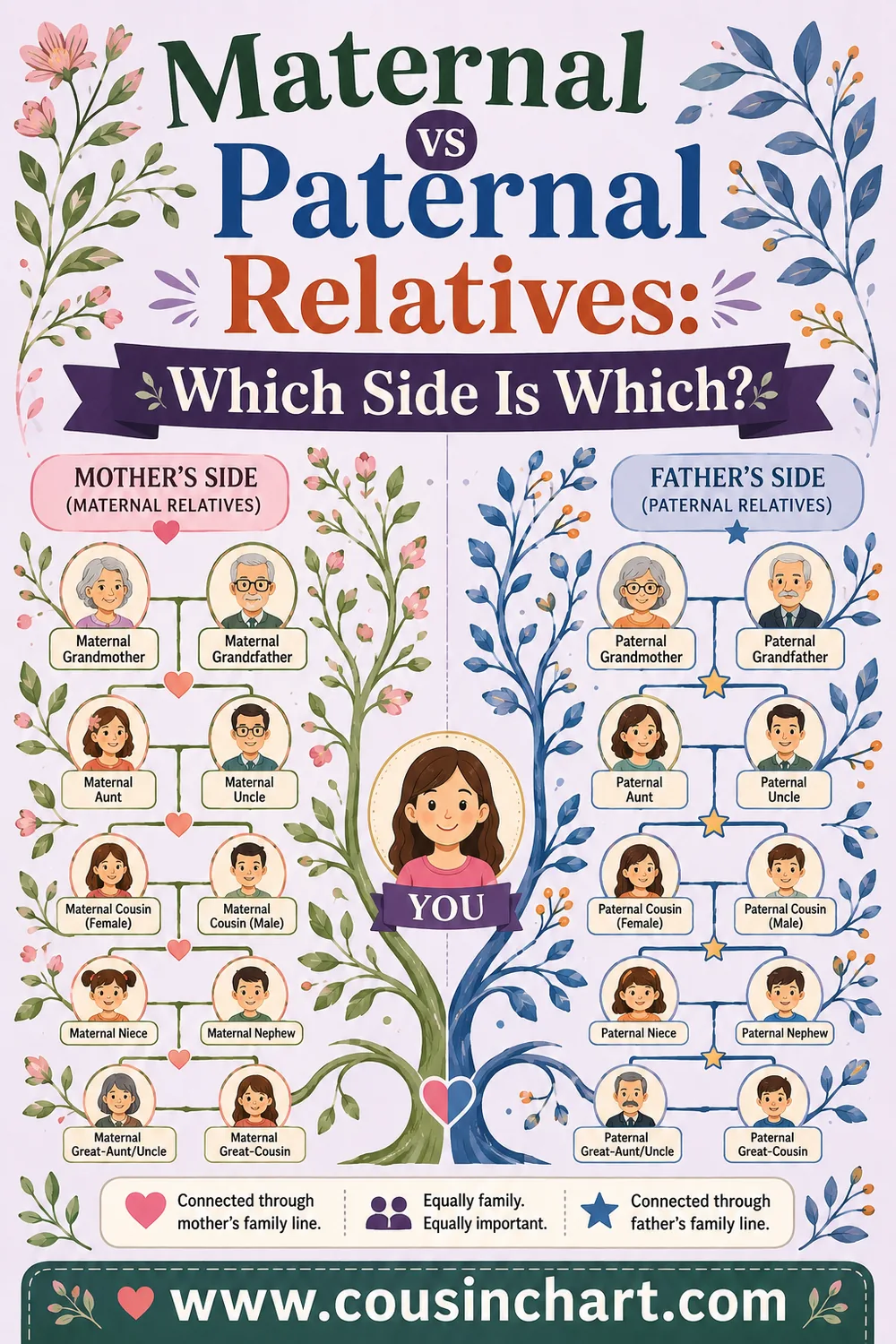
- The father's line and the mother's line are named separately. If you want the background on why that matters in many cultures, our guide to maternal vs. paternal relatives covers it in plain English.
- Age matters, especially among the father's brothers. The same study notes that Hindi has separate words for the father's older brother (tau or taya) and younger brother (chacha), but no built-in age words for the mother's brothers or for either parent's sisters. For those, speakers add bade (older, bigger) or chhote (younger, smaller).
- Families often live close together. Many North Indian families have traditionally lived as a joint family, with brothers, their wives and children under one roof or nearby. When you see your father's brothers and their wives every day, it helps to have a precise word for each of them.
Respect is built into the system as well. The honorific ji (जी) attaches to many relationship words, so you'll hear dadaji, naniji, mamaji, bhabhiji and jijaji. The Suryanarayan and Khalil paper points out that for some relatives, the term feels incomplete without ji. A child calling a grandparent just "dada" at home is fine; in front of guests, "dadaji" sounds more natural and respectful.
Father's side: chacha, chachi, tau, tai, bua, phupha, dada, dadi
The father's side has the most detailed vocabulary, because the father's older and younger brothers get different names.
| Devanagari | Transliteration | Meaning | Who uses it for whom |
|---|---|---|---|
| दादा | dada | Father's father | A grandchild for their paternal grandfather; often dadaji |
| दादी | dadi | Father's mother | A grandchild for their paternal grandmother; often dadiji |
| ताऊ | tau | Father's older brother | A niece or nephew for their father's elder brother; taya and tauji are common forms |
| ताई | tai | Wife of the father's older brother | A niece or nephew for their tau's wife; often taiji |
| चाचा | chacha | Father's younger brother | A niece or nephew for their father's younger brother; chachu is a fond, informal form |
| चाची | chachi | Wife of the father's younger brother | A niece or nephew for their chacha's wife |
| बुआ | bua | Father's sister | A niece or nephew for their paternal aunt; also bhua, phuphi, phupho |
| फूफा | phupha | Father's sister's husband | A niece or nephew for their bua's husband; also phuphaji |
Tau vs. chacha: the age rule
This is the single most important distinction on the father's side. The Oxford Hindi-English Dictionary, available through the University of Chicago's Digital Dictionaries of South Asia project, defines ताऊ (tau) as "father's elder brother". A chacha is the father's younger brother. The age comparison is always with your father, not with you.
Here's a worked example. Your father, Rajesh, is 50. His brothers are Suresh, 56, and Anil, 44. Suresh is older than your father, so he's your tau (Tauji, or Suresh Tauji). Anil is younger, so he's your chacha (Anil Chacha). Their wives follow their husbands: Suresh's wife is your tai and Anil's wife is your chachi, no matter how old the wives are themselves.
If your father has two younger brothers, both are chacha. Families separate them by adding the first name ("Vinod Chacha" and "Anil Chacha") or by using bade chacha (the older of the two) and chhote chacha (the younger).
Bua and phupha
Your father's sister is your bua, whether she's older or younger than your father. The 19th-century Platts dictionary of Urdu, Classical Hindi and English, also hosted by the University of Chicago, gives बूआ with the meaning "father's sister, aunt" and lists phuphu and phua as other forms. Modern Hindi usually writes it बुआ. Her husband is your phupha, sometimes written phuphaji or phupad.
Watch out for one trap: phuphi and phupho mean the same aunt as bua. They're more common in Urdu-speaking homes and in some Punjabi families. They aren't a different relative.
Dada and dadi
Your father's parents are dada (grandfather) and dadi (grandmother). The Suryanarayan and Khalil study lists dadu as an affectionate form for the grandfather. Great-grandparents add the prefix par-: pardada (परदादा) and pardadi (परदादी) are your father's grandparents.
One small confusion: in Bengali, and in some Hindi-speaking homes, dada also means "older brother." Context almost always makes it clear. If a 10-year-old says "Dada is picking me up from school," it could be either, so ask.
Mother's side: mama, mami, mausi, mausa, nana, nani
The mother's side is often called nanihal (ननिहाल), the home of your maternal grandparents. Summer visits to the nanihal are a classic part of growing up in North India. The vocabulary here is a little simpler, because Hindi doesn't split the mother's brothers by age.
| Devanagari | Transliteration | Meaning | Who uses it for whom |
|---|---|---|---|
| नाना | nana | Mother's father | A grandchild for their maternal grandfather; often nanaji, fondly nanu |
| नानी | nani | Mother's mother | A grandchild for their maternal grandmother; often naniji |
| मामा | mama | Mother's brother | A niece or nephew for any maternal uncle; also mamu, mamaji |
| मामी | mami | Mother's brother's wife | A niece or nephew for their mama's wife |
| मौसी | mausi | Mother's sister | A niece or nephew for any maternal aunt; also masi, mausiji |
| मौसा | mausa | Mother's sister's husband | A niece or nephew for their mausi's husband; also mausaji |
Mama: one word for every maternal uncle
All of your mother's brothers are mama, older or younger. To tell them apart, families say bade mama and chhote mama, or use the first name: "Ravi Mama." The research paper above gives a nice detail here: chhote mama means the younger of the brothers, and he may or may not be younger than your mother herself.
English speakers sometimes find mama confusing, because it sounds like "mama" for mother. In Hindi it's never your mother. Mother is maa, mummy, mata or ammi, depending on the family.
Mausi and mausa
Your mother's sister is your mausi. The word is built from the idea of "mother's sister," and many families treat a mausi as a second mother. The Oxford Hindi-English Dictionary lists her husband, मौसा (mausa), whose name comes from the same root. You'll also hear masi and masa, especially in Punjabi and Gujarati-influenced Hindi.
Nana and nani
Your mother's parents are nana and nani. Great-grandparents on this side use the same par- prefix: parnana and parnani. A neat memory trick: on the mother's side, the grandparents and the aunts and uncles mostly start with "n" or "m" (nana, nani, mama, mami, mausi, mausa). On the father's side they start with "d," "t," "ch" and "b/ph" (dada, dadi, tau, tai, chacha, chachi, bua, phupha).
Siblings, bhaiya, didi and the respect word ji
Sibling words in Hindi depend on age and on how formal you're being.
| Devanagari | Transliteration | Meaning | Notes |
|---|---|---|---|
| भाई | bhai | Brother | General word, any age |
| भैया | bhaiya | Older brother (term of address) | Warm and respectful; also used for older male cousins and even friendly strangers |
| बहन | bahan (also behen) | Sister | General word, any age |
| दीदी | didi | Older sister (term of address) | Used for older sisters, older female cousins and respected young women |
| छोटा भाई | chhota bhai | Younger brother | Literally "small brother" |
| छोटी बहन | chhoti bahan | Younger sister | Literally "small sister" |
You don't usually call a younger sibling by a kinship title. You use their name. Older siblings get a title: bhaiya or didi, sometimes with ji or with the first name ("Priya Didi"). The Suryanarayan and Khalil study also lists bhai saab for an older brother. It sounds more formal and is common when talking about him to others.
The words bhaiya and didi go well beyond the family. A shopkeeper, a rickshaw driver or an older student might be addressed as bhaiya, and a nurse or a neighbor as didi. It's polite and friendly, a way of treating people as if they were part of the family.
Cousins in Hindi: chachera, mamera, phuphera and mausera
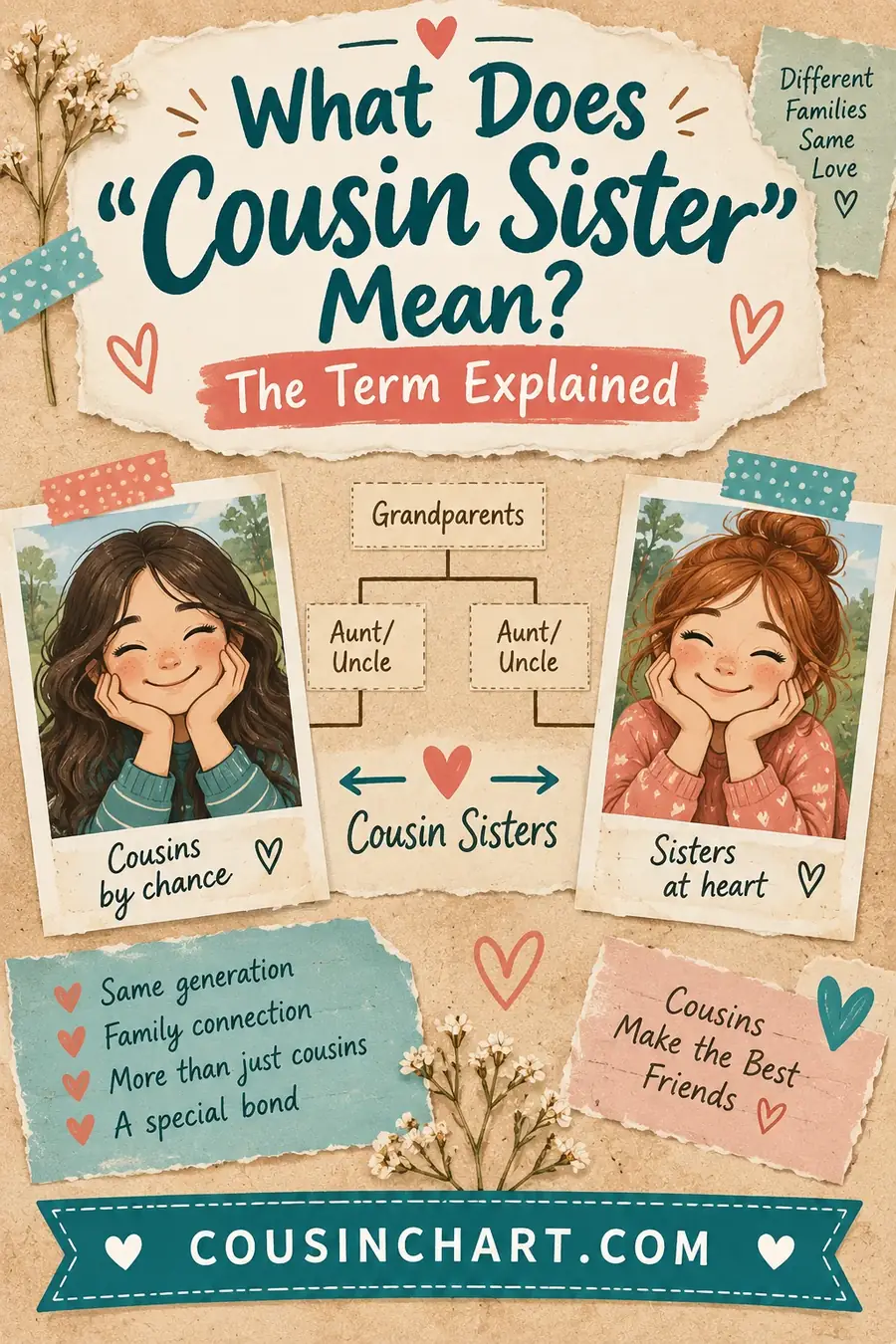
Here's something that surprises English speakers: everyday Hindi doesn't really have one word for "cousin." The 2021 study puts it plainly: there's no direct equivalent, so people either describe the link or simply call cousins bhai and bahan, brother and sister. That's why Indian English uses the phrase "cousin brother" or "cousin sister," which we explain in our guide to what "cousin sister" means.
When you do need to be specific, Hindi builds a cousin word from the parent's sibling. Take the uncle or aunt's title, turn it into an adjective ending in -era (for a male cousin) or -eri (for a female cousin), and add bhai or bahan. The Oxford Hindi-English Dictionary lists फुफेरा (phuphera) as "related through one's paternal aunt", with phuphera bhai and phupheri bahan as the cousin words.
| Cousin | Devanagari | Transliteration | Side |
|---|---|---|---|
| Father's brother's son | चचेरा भाई | chachera bhai | Father's side |
| Father's brother's daughter | चचेरी बहन | chacheri bahan | Father's side |
| Father's sister's son | फुफेरा भाई | phuphera bhai | Father's side |
| Father's sister's daughter | फुफेरी बहन | phupheri bahan | Father's side |
| Mother's brother's son | ममेरा भाई | mamera bhai | Mother's side |
| Mother's brother's daughter | ममेरी बहन | mameri bahan | Mother's side |
| Mother's sister's son | मौसेरा भाई | mausera bhai | Mother's side |
| Mother's sister's daughter | मौसेरी बहन | mauseri bahan | Mother's side |
That's eight cousin words, exactly as the 2021 study counts them: four on each side, split by which parent's sibling links you and by the cousin's gender. Note that chachera is used for the children of both your tau and your chacha. Hindi doesn't make a separate cousin word for a tau's children.
How this lines up with cross and parallel cousins
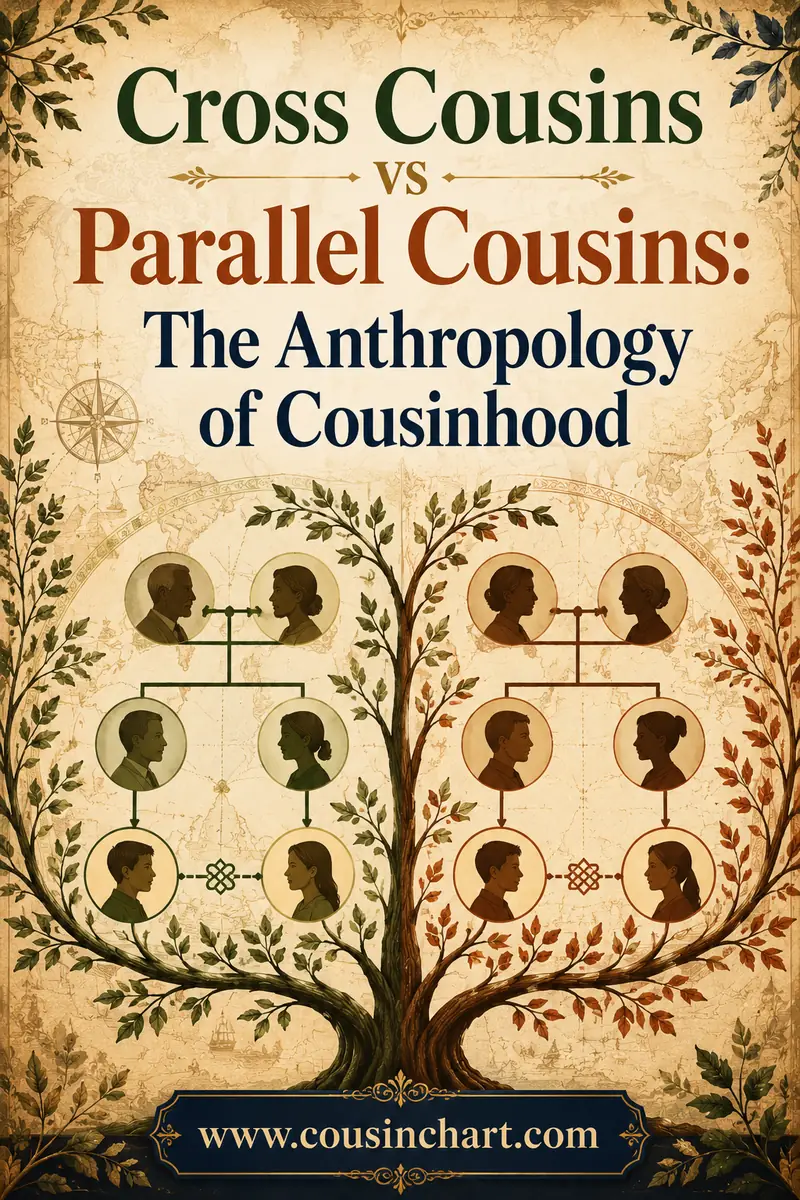
Anthropologists divide first cousins into parallel cousins (children of your father's brother or your mother's sister) and cross cousins (children of your father's sister or your mother's brother). In Hindi terms, chachera and mausera cousins are parallel cousins, while phuphera and mamera cousins are cross cousins. Hindi doesn't use those labels in daily speech, but the four-way split makes the difference easy to see. Our guide to cross cousins vs. parallel cousins explains why the distinction matters in many cultures.
Second cousins and beyond
There's no standard single word for a second cousin in Hindi. People describe the chain ("my dad's chachera bhai's son") or, more often, just say bhai or bahan. In English genealogy, a second cousin is someone who shares great-grandparents with you, and you can check any such link with the calculator at the end of this article.
Nieces, nephews and grandchildren
The same side-of-the-family logic carries down to the next generations. A brother's children and a sister's children get different words.
| Relative | Devanagari | Transliteration | Notes |
|---|---|---|---|
| Brother's son | भतीजा | bhatija | Used by both men and women for a brother's son |
| Brother's daughter | भतीजी | bhatiji | Brother's daughter |
| Sister's son | भांजा | bhanja | Also spelled bhaanja |
| Sister's daughter | भांजी | bhanji | Sister's daughter |
| Son's son | पोता | pota | Grandson through a son |
| Son's daughter | पोती | poti | Granddaughter through a son |
| Daughter's son | नाती | nati | Grandson through a daughter; navasa in Urdu |
| Daughter's daughter | नातिन | natin | Granddaughter through a daughter; navasi in Urdu |
Notice how the words mirror each other. Your chacha calls you his bhatija or bhatiji, because you're his brother's child. Your mama calls you his bhanja or bhanji, because you're his sister's child. Your dada calls you his pota or poti, and your nana calls you his nati or natin.
For a quick English refresher on niece, nephew and the gender-neutral word "nibling," see our niece and nephew relationship chart.
In-laws in Hindi: devar, jeth, nanad, saala, saali, jija, bhabhi
This is where Hindi family relationship names get really detailed. The words for a spouse's siblings depend on three things: whose sibling it is (the husband's or the wife's), the sibling's gender, and sometimes the sibling's age compared with the spouse. It's easiest to learn them from two points of view.
A woman's in-laws (her husband's family)
| Relative | Devanagari | Transliteration | Meaning |
|---|---|---|---|
| Husband's older brother | जेठ | jeth | Senior brother-in-law; often jethji |
| Jeth's wife | जेठानी | jethani | Wife of the husband's older brother |
| Husband's younger brother | देवर | devar | Junior brother-in-law |
| Devar's wife | देवरानी | devrani | Wife of the husband's younger brother |
| Husband's sister | ननद | nanad | Sister-in-law, older or younger |
| Nanad's husband | ननदोई | nandoi | Husband of the husband's sister |
| Husband's father | ससुर | sasur | Father-in-law; often sasurji or papaji |
| Husband's mother | सास | saas | Mother-in-law; often saasu maa or mummyji |
The dictionary sources are clear on the age split. The Oxford Hindi-English Dictionary defines देवर (devar) as "the husband's younger brother" and देवरानी (devrani) as his wife, and जेठ (jeth) as "a husband's elder brother," with जेठानी (jethani) as his wife. The word jeth is related to an adjective meaning "eldest" or "senior," which makes it easy to remember.
The devar-bhabhi relationship is famous in Hindi films and songs for being teasing and affectionate, while the relationship with a jeth has traditionally been more formal. In some conservative families a woman would cover her head in front of her jeth. Customs vary a lot by region, community and generation, so don't assume any particular family follows them.
A man's in-laws (his wife's family)
| Relative | Devanagari | Transliteration | Meaning |
|---|---|---|---|
| Wife's brother | साला | saala | Brother-in-law; an older one is often called bhai saab |
| Wife's brother's wife | सलहज | salhaj | Wife of the wife's brother |
| Wife's sister | साली | saali | Sister-in-law |
| Wife's sister's husband | साढ़ू | saadhu | Co-brother-in-law |
| Wife's father | ससुर | sasur | Father-in-law |
| Wife's mother | सास | saas | Mother-in-law |
Two of these deserve a note. The Oxford Hindi-English Dictionary records सलहज (salhaj) as a "brother-in-law's wife", the wife of your wife's brother, and साढ़ू (saadhu) as "wife's sister's husband". Two men married to sisters are each other's saadhu. English has no everyday word for that link; our guide to co-siblings-in-law covers the English options.
The word saala needs a polite warning. It's the normal kinship word for a wife's brother, but the same dictionary notes it's also used as a term of abuse. In a family context it's neutral. Outside one, it's an insult, so be careful using it as a learner. Many families avoid it in direct address and just say bhai saab or the brother's name.
Your siblings' spouses
| Relative | Devanagari | Transliteration | Notes |
|---|---|---|---|
| Older brother's wife | भाभी | bhabhi | Often bhabhiji; also used for an older cousin's wife |
| Older sister's husband | जीजा | jija | Often jijaji |
| Sister's husband (general) | बहनोई | bahnoi | The standard reference word for any sister's husband |
| Brother's wife (general) | भाभी / भौजाई | bhabhi / bhaujai | Younger brothers' wives are usually just called by name |
The Oxford Hindi-English Dictionary defines जीजा (jija) as "an elder sister's husband". For a younger sister's husband, people usually use his name or the general word bahnoi. As the 2021 study points out, with siblings' spouses it's the age of your own sibling that counts, not the age of the spouse. If your older sister marries a man younger than you, he's still your jija.
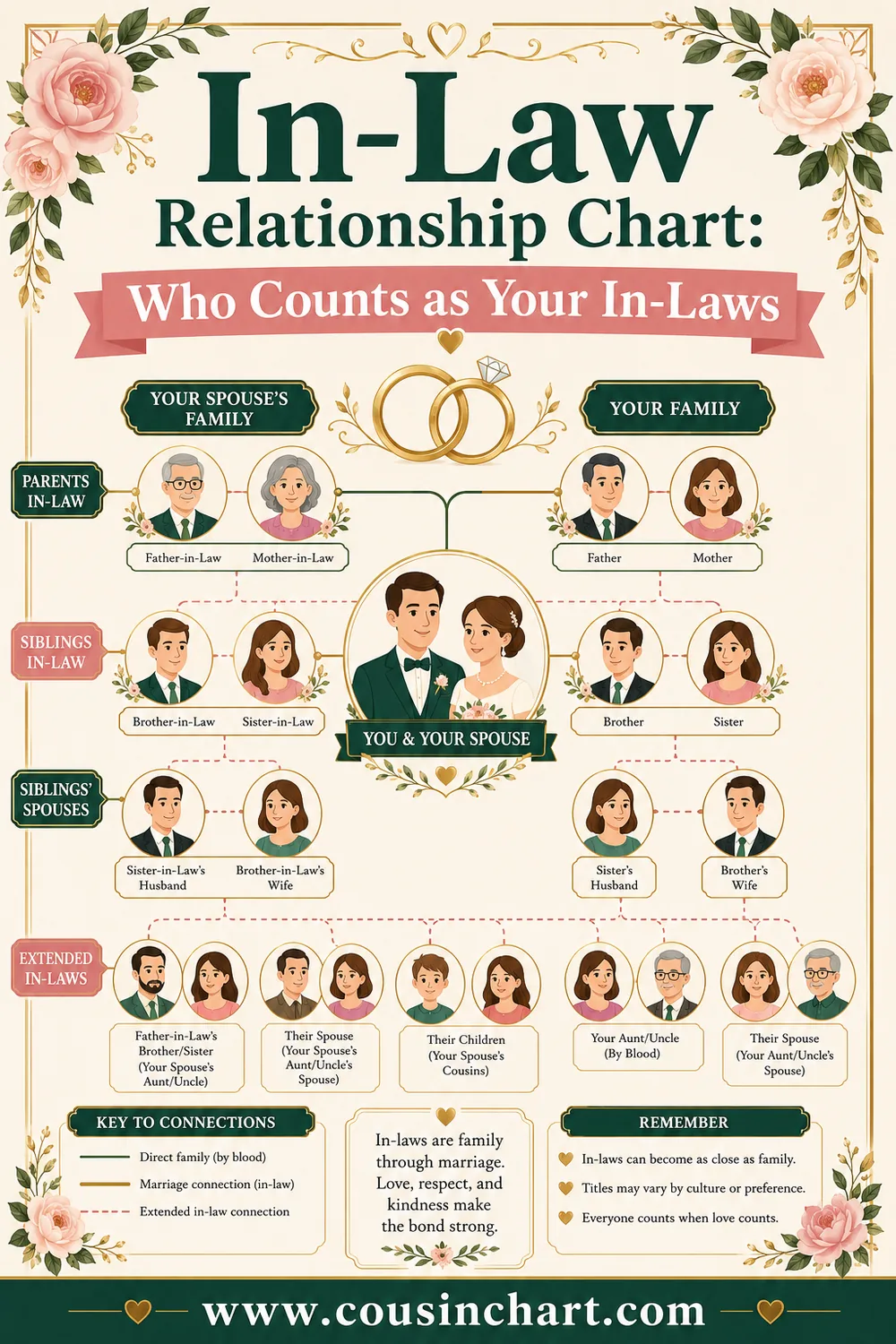
For a broader English chart of who's who by marriage, see our in-law relationship chart.
Parents-in-law, children-in-law and samdhi
Hindi uses the same words for parents-in-law whether you're the husband or the wife: sasur (father-in-law) and saas (mother-in-law). Going the other way, a son's wife is bahu (बहू) and a daughter's husband is damad (दामाद) or jamai (जमाई).
Hindi also has a word English lacks. The two sets of parents whose children marry each other are samdhi (समधी, male) and samdhan (समधन, female). The Oxford Hindi-English Dictionary defines समधी (samdhi) as "father of a son- or daughter-in-law". So if your daughter marries Arjun, Arjun's father is your samdhi, and the families together are samdhi to each other. The relationship carries real social weight at weddings and festivals.
| Relative | Devanagari | Transliteration | Who uses it |
|---|---|---|---|
| Spouse's father | ससुर | sasur | Husband and wife alike |
| Spouse's mother | सास | saas | Husband and wife alike |
| Son's wife | बहू | bahu | Her parents-in-law |
| Daughter's husband | दामाद / जमाई | damad / jamai | His parents-in-law |
| Child's father-in-law | समधी | samdhi | The other set of parents |
| Child's mother-in-law | समधन | samdhan | The other set of parents |
In English, the closest phrase is "co-in-laws." Our article on what your child's in-laws are to you covers the English side.
Married couples also borrow each other's family words. A wife calls her husband's chacha "Chachaji" too, and a husband calls his wife's mama "Mamaji." The research paper found that Hindi doesn't change these words for the spouse's side: a husband's father's sister and a wife's father's sister are both bua.
Regional and Urdu variants you'll hear
Hindi is spoken across a huge area of northern and central India, and it shares much of its everyday vocabulary with Urdu. Family words vary by region, by religion and by the language spoken at home. Here are the most common variants. None of them is wrong; they're just different family habits.
- Father: pita or pitaji (formal), papa, babuji, abba or abbu (common in Urdu-speaking homes).
- Mother: mata or mataji (formal), maa, mummy, ammi or amma.
- Father's older brother: tau, tauji, taya or tayaji, with tai or taiji for his wife.
- Father's sister: bua, bhua, phuphi, phupho.
- Mother's sister: mausi, masi, or khala in Urdu.
- Mother's brother: mama or mamu; mamu is especially common in Urdu.
- Daughter's children: nati and natin, or navasa and navasi in Urdu.
Neighboring languages have their own systems. In Marathi and Gujarati, for example, a father's younger brother is commonly called kaka, and Bengali uses kaka too. If your family speaks one of those at home, you may mix words from both languages. That's completely normal in multilingual India.
A note on spelling in English letters: there's no single official way to write Hindi in the Latin alphabet for everyday use. You'll see chacha and chaacha, bhabhi and bhabi, bahan and behen. Scholars use a system with accent marks (for example tāū), but families use whatever looks natural. The Devanagari spelling is the reliable reference.
Pronunciation tips for English speakers
- "ch" is always as in "church." Chacha sounds like "CHAH-chah," never with a "k" sound.
- "a" at the end is a full "ah." Mama is "MAH-mah," and dada is "DAH-dah." The final "a" isn't silent.
- "ph" is a breathy "p," not an "f." In careful Hindi, phupha starts with a puff of air after the "p." Many speakers do say it closer to "foo-fah," and you'll be understood either way.
- "au" in mausi and mausa sounds like the "o" in "more," roughly "MOH-see" and "MOH-sah," not like "mouse."
- "bh" in bhabhi and bhaiya is a breathy "b." If that's hard, a plain "b" sound is fine; people will still understand you.
- The "d" in devar and dada is soft, made with the tongue touching the back of the teeth, a little softer than an English "d."
Don't worry about getting every sound perfect. Families are usually delighted when someone makes the effort to use the right word, and the most important thing is picking the right relative, not perfect pronunciation.
Common mix-ups with Hindi family relationship names
These are the errors we see most often, along with an easy fix for each.
- Calling a father's older brother "chacha." If he's older than your father, he's tau or taya. Fix: compare his age with your father's, not yours.
- Calling a mother's brother "chacha." All maternal uncles are mama. Fix: on the mother's side, think "m" words: mama, mami, mausi, mausa.
- Calling a father's sister "mausi." She's bua. Mausi is only your mother's sister.
- Calling an aunt's husband by the uncle word on the other side. Your bua's husband is phupha, not chacha; your mausi's husband is mausa, not mama.
- Mixing up devar and jeth. Both are a woman's husband's brothers. Jeth is older than her husband; devar is younger.
- Thinking saali means any sister-in-law. Saali is a man's wife's sister. A woman's husband's sister is nanad, and a brother's wife is bhabhi.
- Thinking mama means mother. In Hindi, mama is always the mother's brother.
- Using "jija" for every brother-in-law. Jija is your older sister's husband. Your wife's brother is saala, and your husband's brothers are jeth or devar.
Try it yourself: worked examples
Work through these, then check the answers below each one. The trick is always the same: find the link person (the parent, sibling or spouse who connects you), then ask which side and, if needed, which age.
Example 1: Meera's uncles
Meera's father, Vikram, is 45. Vikram has an older brother, Ajay (52), a younger brother, Rohit (40), and a sister, Neha (48). Meera's mother, Kavita, has a brother, Sanjay (38), and a sister, Pooja (42).
- Ajay is older than Vikram, so he's Meera's tau. His wife is her tai.
- Rohit is younger than Vikram, so he's her chacha. His wife is her chachi.
- Neha is Vikram's sister, so she's Meera's bua, even though she's older than Vikram. Her husband is Meera's phupha.
- Sanjay is Kavita's brother: mama. His wife is mami.
- Pooja is Kavita's sister: mausi. Her husband is mausa.
Example 2: Meera's cousins
Ajay's son is Meera's chachera bhai (the same word as for Rohit's son, because both are her father's brothers' children). Neha's daughter is her phupheri bahan. Sanjay's son is her mamera bhai, and Pooja's daughter is her mauseri bahan. In daily speech, Meera would probably just call all four of them bhaiya or didi if they're older, and use their names if they're younger.
Example 3: Meera gets married
Meera marries Karan. Karan has an older brother, Dev, and a younger sister, Simran. Meera has an older brother, Amit.
- To Meera, Dev is her jeth (her husband's older brother), and Dev's wife is her jethani.
- Simran is Meera's nanad, and Simran's future husband will be Meera's nandoi.
- To Karan, Amit is his saala (his wife's brother), though Karan will likely call him bhai saab since Amit is older. Amit's wife is Karan's salhaj.
- To Amit, Karan is his younger sister's husband, so Amit refers to him as bahnoi or by name. To Amit's younger siblings, if he had any, Karan would be jija, since Meera is their older sister.
- Meera's parents and Karan's parents are now each other's samdhi and samdhan.
Example 4: One generation down
Amit has a son. To Meera, he's her bhatija (brother's son). To Meera's parents, he's their pota (son's son). Later, Meera and Karan have a daughter. To Amit, she's his bhanji (sister's daughter). To Meera's parents, she's their natin (daughter's daughter), and she'll call them nana and nani.
How Hindi terms compare with English ones
It can help to see how many English words collapse into one. This table counts the main Hindi terms behind each English word, using only the relatives covered above.
| English word | Hindi words that it covers | Count |
|---|---|---|
| Grandfather | dada, nana | 2 |
| Grandmother | dadi, nani | 2 |
| Uncle | tau, chacha, mama, phupha, mausa | 5 |
| Aunt | tai, chachi, bua, mami, mausi | 5 |
| First cousin | chachera, chacheri, phuphera, phupheri, mamera, mameri, mausera, mauseri (plus bhai or bahan) | 8 |
| Nephew | bhatija, bhanja | 2 |
| Niece | bhatiji, bhanji | 2 |
| Brother-in-law | jeth, devar, saala, jija, bahnoi, nandoi, saadhu | 7 |
| Sister-in-law | nanad, saali, bhabhi, jethani, devrani, salhaj | 6 |
Add those up and you get 39 Hindi words standing behind just 9 English ones. That's the clearest picture of why Hindi speakers sometimes find English vague ("Which aunt?"), and why English speakers find Hindi a lot to learn at first.
If you're building a family tree for a Hindi-speaking family, it's worth writing both the English label and the Hindi term next to each person. Our guide to what to call relatives covers the English names in detail.
Find any relationship with the calculator
Hindi gives you a precise word for most close relatives, but it gets vague for more distant ones, such as a parent's cousins or a second cousin's children. When that happens, work out the English relationship first and then describe it in Hindi through the link person. Pick the two people, find their closest shared ancestor, and our free family relationship calculator will tell you exactly how they're related, from first cousins to cousins several times removed.
Keep reading: Filipino Family Terms: Kuya, Ate, Lolo, Tita and What They Mean.
Frequently Asked Questions
What is the difference between chacha and mama in Hindi?
Both mean uncle, but on different sides of the family. A chacha is your father's younger brother, so he's on your father's side. A mama is your mother's brother, older or younger, so he's on your mother's side. Their wives have matching names: a chacha's wife is your chachi and a mama's wife is your mami. If your father's brother is older than your father, he isn't a chacha at all. He's your tau or taya, and his wife is your tai.
What do you call your father's older brother in Hindi?
Your father's older brother is your tau, often said with respect as tauji. In Punjabi-influenced Hindi and in many Delhi families you'll also hear taya or tayaji. His wife is your tai or taiji. The age comparison is with your father, not with you. So if your father is 50 and his brother is 53, that brother is your tau. If the brother is 47, he's your chacha instead, and his wife is your chachi.
Is bua the same as mausi?
No. Both mean aunt, but bua is your father's sister and mausi is your mother's sister. Bua's husband is phupha and mausi's husband is mausa. People mix these up because English uses aunt for both. A simple trick is that most mother's-side words start with m or n (mama, mami, mausi, mausa, nana, nani), while father's-side words use other sounds (dada, dadi, tau, chacha, bua, phupha). Phuphi and phupho are other names for bua, common in Urdu-speaking homes.
Is there a Hindi word for cousin?
Not a single everyday one. Hindi speakers usually call cousins bhai (brother) or bahan (sister), and older cousins bhaiya or didi. When they need to be precise, they add a side-of-the-family word: chachera bhai for a father's brother's son, phupheri bahan for a father's sister's daughter, mamera bhai for a mother's brother's son, and mauseri bahan for a mother's sister's daughter. That gives eight first-cousin words in all. This habit is also why Indian English uses the phrases cousin brother and cousin sister.
What is the difference between devar and jeth?
Both are a married woman's husband's brothers. A jeth is her husband's older brother, and a devar is her husband's younger brother. Their wives are her jethani and devrani. The Oxford Hindi-English Dictionary defines devar as the husband's younger brother and jeth as the husband's elder brother. Traditionally the relationship with a jeth is more formal and respectful, while the devar and bhabhi relationship is known for being friendly and playful, though customs vary a lot between families and regions.
What do you call your wife's brother and sister in Hindi?
A man's wife's brother is his saala, and that brother's wife is his salhaj. His wife's sister is his saali, and her husband is his saadhu, the word for two men married to sisters. Because saala can also be used as an insult outside the family, many people avoid it in direct address. They'll call an older brother-in-law bhai saab and a younger one by his first name. Saali is a normal, friendly word and is used freely.
What is jija and who uses it?
Jija means your older sister's husband, and it's usually said with respect as jijaji. Younger brothers and sisters of the bride use it for her husband. Your younger sister's husband is usually called by name or referred to with the general word bahnoi, which means any sister's husband. What matters is your sister's age compared with yours, not her husband's age. So if your older sister marries someone younger than you, he's still your jija.
What does samdhi mean in Hindi?
Samdhi is the father of your son-in-law or daughter-in-law, and samdhan is the mother. In other words, when two people marry, their parents become samdhi and samdhan to each other. English has no common single word for this, so people say co-in-laws or my child's in-laws. In Indian families the relationship is important and formal, especially around weddings, festivals and the birth of grandchildren, when the two families exchange visits and gifts.
Why do Hindi speakers add ji to family names?
Ji is an honorific that shows respect. You add it after a relationship word or a name, as in dadaji, naniji, mamaji, bhabhiji or Sharma ji. For some relatives, such as grandparents and parents-in-law, using the bare word can sound abrupt, so ji almost becomes part of the term. Children may drop it at home in casual moments. Adding ji is never wrong when you're unsure, and it's a safe choice for anyone older than you or anyone you've just met.
Sources
We checked every source below while writing this guide. Last reviewed October 30, 2026, by Joan Ramos.
- Kinship terms as indicators of identity and social reality: A case study of Syrian Arabic and Hindi (Russian Journal of Linguistics (Suryanarayan & Khalil, 2021))
- Oxford Hindi-English Dictionary (McGregor): entry for tau (Digital Dictionaries of South Asia, University of Chicago)
- A Dictionary of Urdu, Classical Hindi, and English (Platts): entry for bua (Digital Dictionaries of South Asia, University of Chicago)
- Oxford Hindi-English Dictionary (McGregor): entry for phuphera (Digital Dictionaries of South Asia, University of Chicago)
- Oxford Hindi-English Dictionary (McGregor): entries for devar and devrani (Digital Dictionaries of South Asia, University of Chicago)
- Oxford Hindi-English Dictionary (McGregor): entries for jeth and jethani (Digital Dictionaries of South Asia, University of Chicago)
- Oxford Hindi-English Dictionary (McGregor): entry for salhaj (Digital Dictionaries of South Asia, University of Chicago)
- Oxford Hindi-English Dictionary (McGregor): entry for saadhu (Digital Dictionaries of South Asia, University of Chicago)
- Oxford Hindi-English Dictionary (McGregor): entry for jija (Digital Dictionaries of South Asia, University of Chicago)
- Oxford Hindi-English Dictionary (McGregor): entry for samdhi (Digital Dictionaries of South Asia, University of Chicago)