What Do I Call My Relatives? A Plain-English Family Title Guide
Family titles fall into three buckets. Blood relatives follow strict rules — your aunt's daughter is your first cousin whether anyone likes it or not. In-laws follow loose conventions, with a handful of standard terms and a lot of gaps. Step-relatives and chosen family follow no rules at all, and whatever your family says is the right answer.
Knowing which bucket you're in tells you how much to worry. If it's blood, there's a correct term and our family relationship calculator will name it. If it's marriage or step, relax — you're picking a label, not solving a problem. The what do I call them tool walks through the in-law and step terms most people ask about.
What do I call them? Tap a relative to see the usual term:
Your answer will appear here.
Why Are Family Titles So Confusing?
Because English has a small vocabulary for a big problem.
Some languages assign a distinct word to nearly every position in a family — separate terms for your mother's older brother versus your father's younger brother, separate terms for maternal and paternal grandparents. English collapses all of that into a handful of words and then patches the gaps with "-in-law," "step-," "great-," and "once removed."
The result is a system that's precise in one area and vague everywhere else. Blood descent has an exact, mathematical naming system. Marriage has about six standard terms and then silence. Step-relationships have essentially nothing.
That mismatch is why you can confidently say "third cousin twice removed" but have no idea what to call your sister's husband's mother. It's not you. The vocabulary genuinely isn't there.
What Are the Three Ways Someone Becomes Family?
Sorting a relative into one of these three groups tells you immediately how much the naming is going to cooperate.
Blood relatives (consanguinity)
You and this person descend from a shared ancestor. Parents, siblings, grandparents, aunts, uncles, nieces, nephews, and every degree of cousin sit here. These titles follow rules, and the rules don't bend for preference. If your grandparents are the closest people you both descend from, you're first cousins — regardless of what anyone in the family calls it.
Relatives by marriage (affinity)
A wedding created the link. Spouses, in-laws, and everyone attached to your spouse's family land here. There are standard terms for the closest positions — mother-in-law, brother-in-law, daughter-in-law — and then the system thins out fast.
Step-relatives and chosen family
A parent's remarriage, a long-term partnership, a family friend who's been at every Christmas since you were four. No blood, and often no legal tie either. This category runs entirely on what the family actually uses, and there's no external authority to appeal to.
Our breakdown of blood relatives vs relatives by marriage goes deeper on why the legal and genealogical worlds treat these categories so differently.
What Are the Blood Relative Titles?
These are the ones with fixed answers. The core set:
- Parent, child, grandparent, grandchild — your direct line, up and down. Add a "great-" for each extra generation: great-grandparent, great-great-grandparent.
- Sibling — full siblings share both parents. Half-siblings share one.
- Aunt and uncle — your parent's sibling. Your parent's sibling's spouse is technically an aunt or uncle by marriage, though nobody says that out loud.
- Niece and nephew — your sibling's children. Nibling is the gender-neutral collective, handy when you're talking about all of them at once.
- Great-aunt and great-uncle — your grandparent's sibling. You'll also see grand-aunt and grand-uncle, which are arguably more accurate; both are accepted.
- Cousins — everyone who descends from a shared ancestor along a side branch.
Cousins are the only blood category with real complexity, and it comes down to two rules. The cousin number is set by how many generations each of you sits from the shared ancestor, using the smaller distance: grandparents means first cousins, great-grandparents means second cousins, great-great-grandparents means third. The removal is the difference between your two generation counts — so your first cousin's child and your parent's first cousin are both your first cousin once removed. Removal is about generations, never about age.
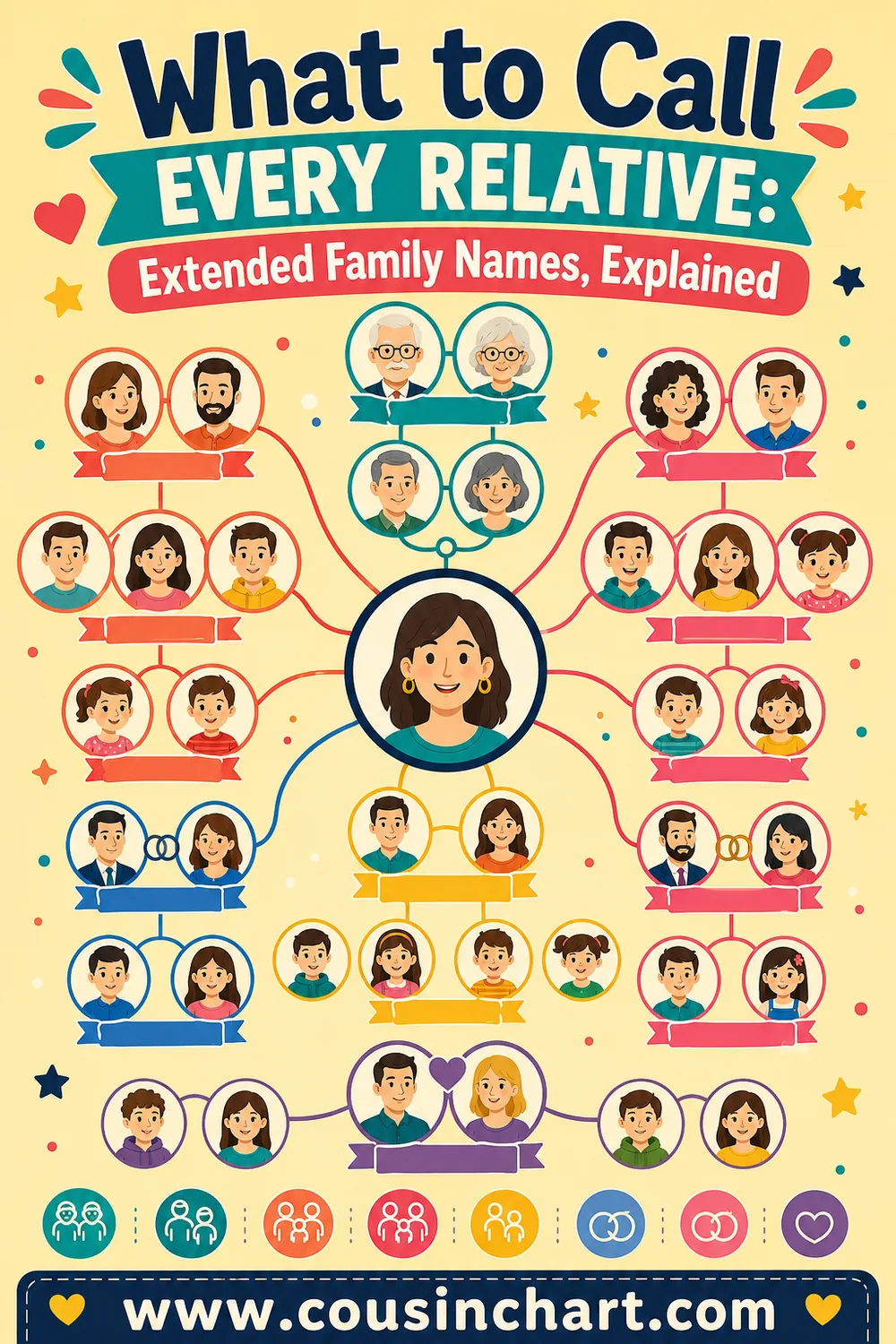
If you'd rather not count, the relationship calculator does it instantly. Our full guide to what to call every relative has the extended list.
What Are the In-Law Titles?
Marriage terms cover a small, well-defined core and then run out. Here's the core:
| Relationship | Standard term | How solid is it? |
|---|---|---|
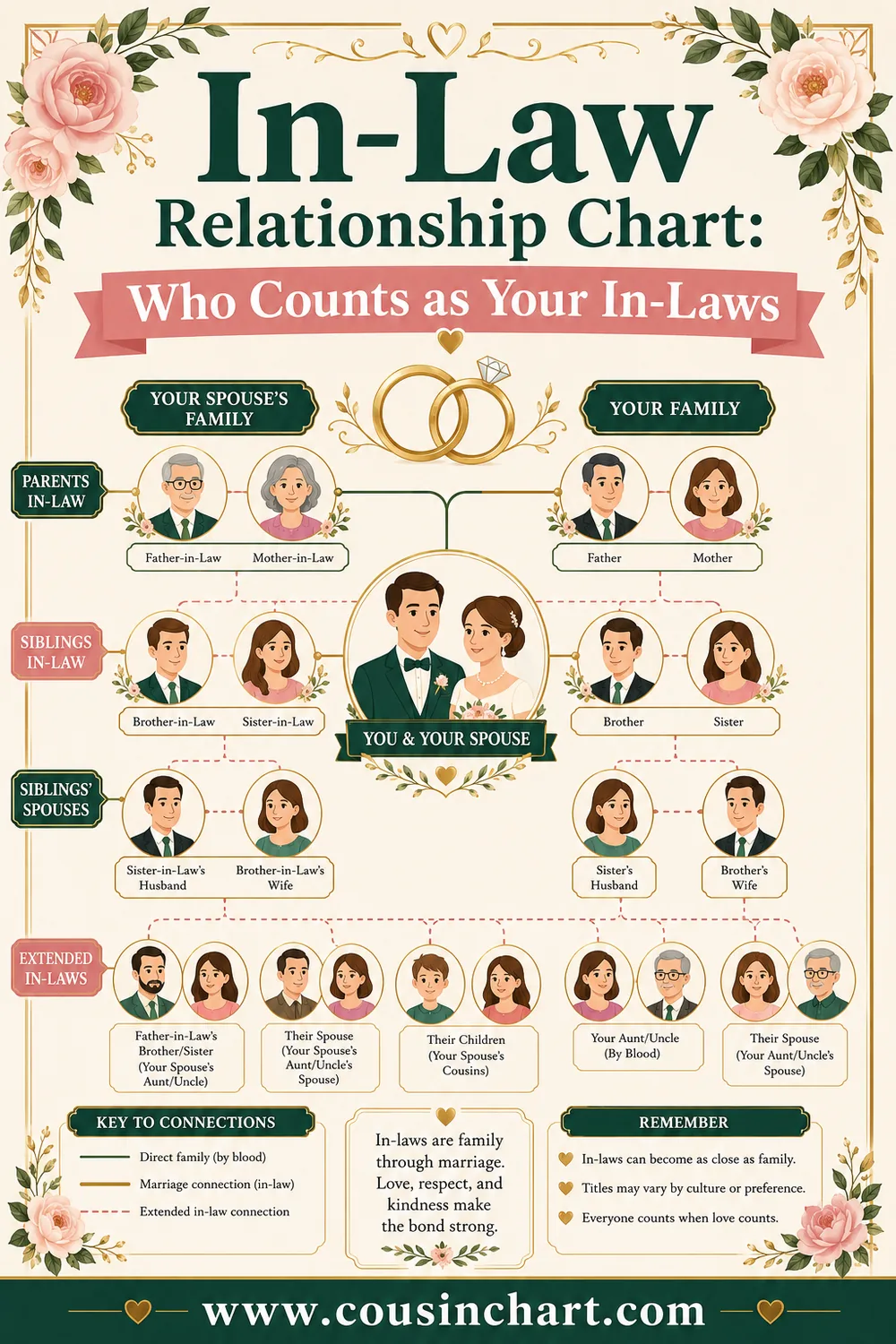
| Spouse's parent | Mother-in-law / father-in-law | Universal, also used legally |
| Spouse's sibling | Brother-in-law / sister-in-law | Universal |
| Sibling's spouse | Brother-in-law / sister-in-law | Universal |
| Child's spouse | Son-in-law / daughter-in-law | Universal |
| Spouse's grandparent | Grandmother-in-law / grandfather-in-law | Understood, rarely used |
| Spouse's aunt or uncle | Aunt / uncle | Usually just "aunt" or "uncle" |
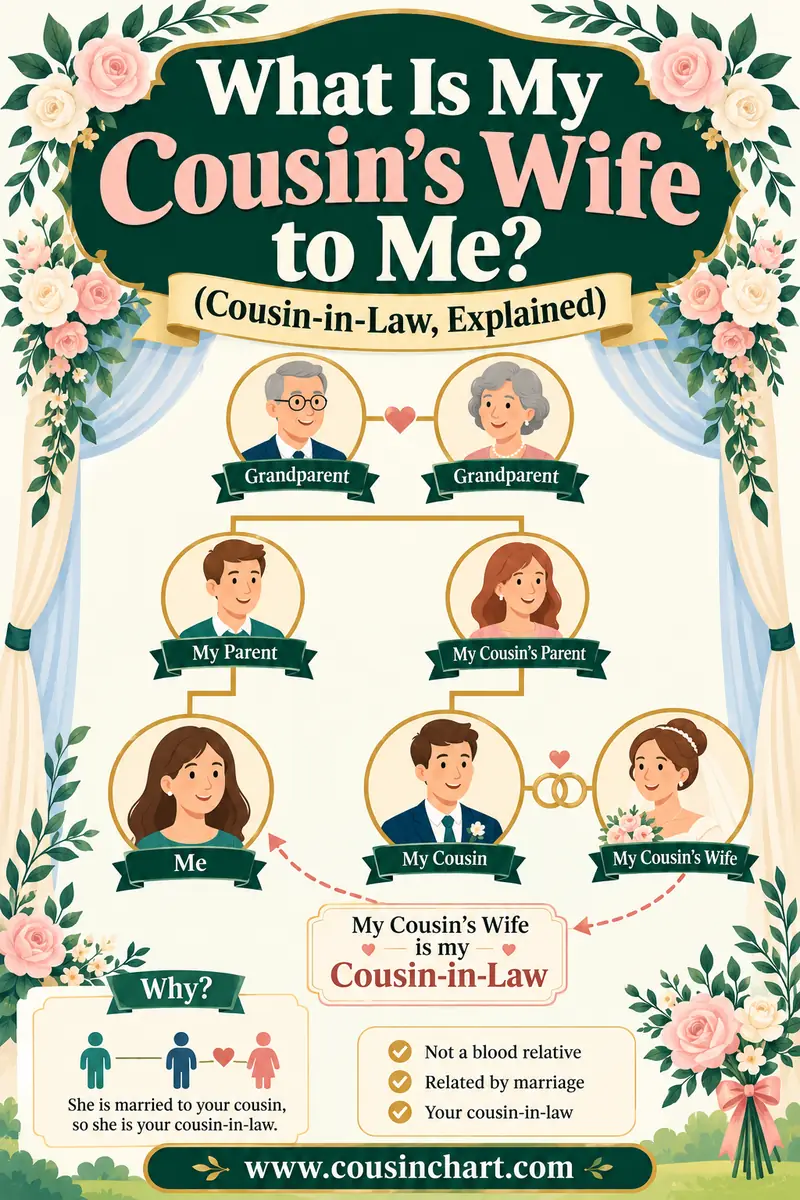
| Cousin's spouse | Cousin-in-law | Conversational, no formal standing |
| Spouse's cousin | Cousin-in-law | Conversational |
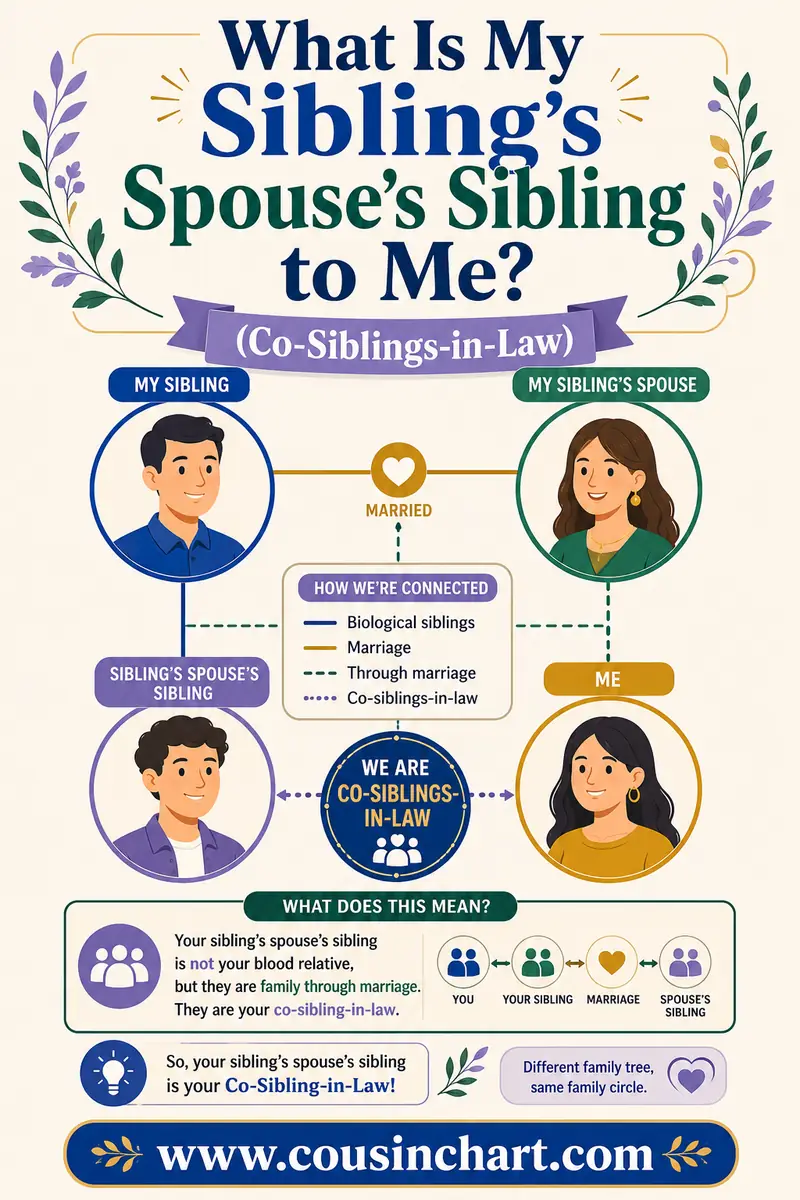
| Sibling's spouse's sibling | Co-sibling-in-law | Descriptive, not a real everyday word |
| Child's spouse's parents | Co-parents-in-law | Descriptive, not a real everyday word |
Notice how the "how solid" column degrades as you move down. The first four rows are genuinely standard — you'll see them on legal forms. By the bottom rows you're using descriptions rather than titles, because English never built words for those positions.
Our in-law relationship chart maps the whole set visually, and if you're specifically stuck on what your cousin's wife is to you, that one has its own guide.
Where in-law terms genuinely run out
Two positions come up constantly and have no natural English word:
Your sibling's spouse's sibling. Your brother marries someone; that someone has a sister. You'll see her at every family event for the next thirty years, and there is no word for her. "Co-sibling-in-law" is the descriptive term genealogists use, and nobody says it at a barbecue. Most people default to a first name, and that works fine — our piece on co-siblings-in-law covers the term and how other languages handle it.
Your child's spouse's parents. You'll co-host a wedding with these people and possibly share grandchildren. English gives you nothing. Spanish has consuegros, Yiddish has machatunim, Hindi has samdhi and samdhan. English speakers say "Ruby's parents" and move on.
What About Step-Relatives?
Step terms are the loosest category of all, because they describe a social arrangement rather than a biological or legal fact.
The basic vocabulary exists: stepmother, stepfather, stepson, stepdaughter, stepbrother, stepsister. Beyond that immediate circle it gets improvised. Step-grandparent, step-aunt, step-cousin — all understood, none standardized.
Here's the thing worth saying plainly: the "step" prefix carries emotional weight that the words don't deserve. A lot of families drop it entirely, and there's nothing wrong with that. A stepdaughter who's been in your life since she was six is your daughter in every way that matters day to day, and calling her that isn't a factual error — it's a different kind of statement.
Where the prefix does earn its keep is in genealogy records, legal paperwork, and medical history, where the distinction between biological and step relationships genuinely changes the answer. Our guide to step-cousins covers where the line typically falls.
A few practical patterns:
- Younger children usually adopt whatever the household uses. If everyone says "Grandma Jean," that's who she is.
- Adults blending families later often keep first names. Nothing wrong with that either.
- The person being named should get a vote. Some stepparents want "Mom," some very much don't.
What About Honorary Aunts, Uncles and Chosen Family?
Most families have at least one. The neighbor who's been at every birthday since you were born. Your mother's college roommate. The couple from church who drove you to school for three years. Everyone calls them Auntie or Uncle, and no one has ever thought twice about it.
These honorary titles aren't a mistake or a childish simplification. They're doing real work: signalling that this person occupies a family-shaped role, without claiming a biological connection that doesn't exist. In many communities — across West Africa, the Caribbean, South Asia, Black American families, and plenty of others — using "auntie" and "uncle" for respected adults is standard practice rather than a special case.
Two practical notes. First, honorary titles cause genuine confusion in genealogy research, so it's worth asking older relatives explicitly: "was Aunt Dot actually related to us?" A surprising number of family-tree dead ends turn out to be honorary aunts. Second, the title is a courtesy, not a claim — nobody using it is asserting inheritance rights or a place in a DNA match list.
If you're documenting a tree, note honorary relationships separately rather than deleting them. They're part of the real story of the family, even when they're not part of the descent chart.
What Are the Gender-Neutral Family Titles?
English has been slowly filling in the gaps here, which helps when you're referring to a group or when a relative doesn't use gendered terms.
- Sibling — the long-established neutral term for brother or sister.
- Nibling — a sibling's child, covering niece and nephew. Increasingly common, and genuinely useful when you mean all of them at once. Our nibling explainer covers how it caught on.
- Pibling — a parent's sibling, covering aunt and uncle. Newer and less established than nibling, but it fills an obvious hole.
- Parent, child, grandparent, grandchild, cousin, spouse, sibling-in-law — already neutral, and always have been.
Cousin deserves a mention here: it's the one major kinship word English never gendered, which is why the cousin system scales so cleanly and why nobody has ever needed a "cousiness."
How Much Does Culture Change the Answer?
A lot. Enough that "the correct term" is often a question about which culture you're asking.
- Many East Asian languages distinguish maternal from paternal relatives with entirely separate words, and often separate older siblings from younger ones. There's no single word for "uncle" — the word depends on which side and which birth order.
- Many South Asian languages do the same, with distinct terms for a father's brother, a mother's brother, a father's sister's husband, and so on.
- Arabic separates paternal and maternal aunts and uncles, and cousin terms are built descriptively from those.
- Hawaiian and several Indigenous kinship systems apply sibling terms across what English would call cousins, reflecting a genuinely different model of family, not a translation quirk.
- Even within English, usage varies. In parts of the American South, "cousin" is used generously across generations. In parts of the UK, "auntie" for a close family friend is completely standard.
None of these are wrong. Kinship terminology is a description of how a culture organizes family, and different cultures organize it differently. If you're marrying into a family with a different system, the useful move is to ask what they'd like to be called rather than translating from English.
What Do You Call Someone When There's No Right Answer?
Practical scripts for the awkward middle ground:
- Ask directly, early. "What would you like the kids to call you?" is a normal question and almost always lands well. Asking is far less awkward than guessing wrong for two years.
- Default to first names. They're never rude and they never overclaim a relationship that isn't there yet.
- Use a description instead of a title. "My brother's wife's sister" is clunky but perfectly clear, and clarity beats elegance.
- Follow the family's lead. If everyone else says "Uncle Rob," say Uncle Rob. Titles are partly a group habit.
- Let it change over time. A stepparent who started as "Dave" can become "Dad" ten years later. Nothing is locked in.
- Match the setting. "My aunt" at a party; "my first cousin once removed" on a genealogy form.
The overarching principle: a relationship calculator gives you the genealogically correct term, and that's genuinely useful for records and research. What a family actually calls someone is a separate thing, and it's just as valid.
When Does Getting the Exact Term Actually Matter?
Most of the time, precision is optional. Sometimes it isn't:
- Genealogy records and family trees. Software and archives need the exact relationship to link people correctly. "Aunt" won't do if she's actually a first cousin once removed.
- DNA match research. Working out how a match connects to you depends on precise relationship terms, because each one carries a different expected DNA range.
- Legal documents. Wills, intestacy, and next-of-kin determinations turn on blood versus marriage versus step, and the distinctions are enforced.
- Medical history forms. Doctors ask about first-degree and second-degree relatives because shared DNA predicts hereditary risk. A step-relative's history isn't relevant in the same way.
- Obituaries and wedding programs. These get read closely by people who will notice, and by people who'll be hurt by an omission.
- Immigration and benefits paperwork. Eligible relationships are defined by enumerated terms, and the exact wording matters.
Outside those situations, the friendly answer beats the precise one nearly every time.
How Do You Explain Family Titles to Kids?
Kids handle this better than adults, mostly because they don't assume it should be complicated.
What works:
- Anchor on the connection, not the label. "She's Grandma's sister" makes intuitive sense in a way "great-aunt" doesn't.
- Draw it. Three boxes and two lines beats any amount of explaining. A printable family tree is genuinely useful here.
- Skip removals until they ask. "Cousin" is enough for a seven-year-old. The once-removed conversation can wait.
- Let the honorary titles stand. If Mom's best friend is Auntie Kay, that's fine. Kids sort out the difference between honorary and genealogical family on their own timeline.
FAQ
What do I call my cousin's wife?
Cousin-in-law is the usual term, and it's widely understood — but it's conversational rather than formal, with no legal or genealogical standing. Most families skip the "-in-law" part entirely and just say cousin, which is completely normal.
Is there a correct term for my stepparent's niece?
Step-cousin is the descriptive term, though there's no formal standard for step relationships beyond the immediate ones. There's no blood connection, so a relationship calculator can't compute anything. Plenty of families simply say cousin, and that's a perfectly good answer.
What's the difference between a great-aunt and a grand-aunt?
They mean the same thing: your grandparent's sister. "Grand-aunt" is arguably more logically consistent, since she's on the same generational level as your grandparent. "Great-aunt" is far more common in everyday English, and both are accepted.
What do I call my child's spouse's parents?
English has no everyday word for it. "Co-parents-in-law" is the descriptive term, and many other languages have a real one — consuegros in Spanish, machatunim in Yiddish, samdhi and samdhan in Hindi. In practice, English speakers use first names.
Do I have to use "step" when I'm talking about my stepdaughter?
No. The prefix matters for genealogy records, legal paperwork, and medical history, where the biological distinction genuinely changes the answer. In everyday conversation, use whatever reflects the relationship you actually have. Many families drop the prefix entirely.
Why does my family use different terms than the official ones?
Because family titles are partly genealogy and partly habit. Regional usage, cultural background, and simple household tradition all shape what a family says. A calculator gives you the genealogically correct term for records and research; what your family calls someone is its own system, and it isn't wrong.
Get the Title Right (Or Decide It Doesn't Matter)
The honest summary: blood relationships have exact names and you can look them up. Everything else is convention, and convention is allowed to bend around the family you actually have.
When you need the precise term — for a record, a DNA match, a form — the what do I call them tool covers in-law and step titles, and the family relationship calculator handles anything traceable through a shared ancestor. And when you don't need precision, "this is my cousin Jess" has never once needed a footnote.