Which Cousins Should I Invite to My Wedding? Cut-Off by Cousin Degree
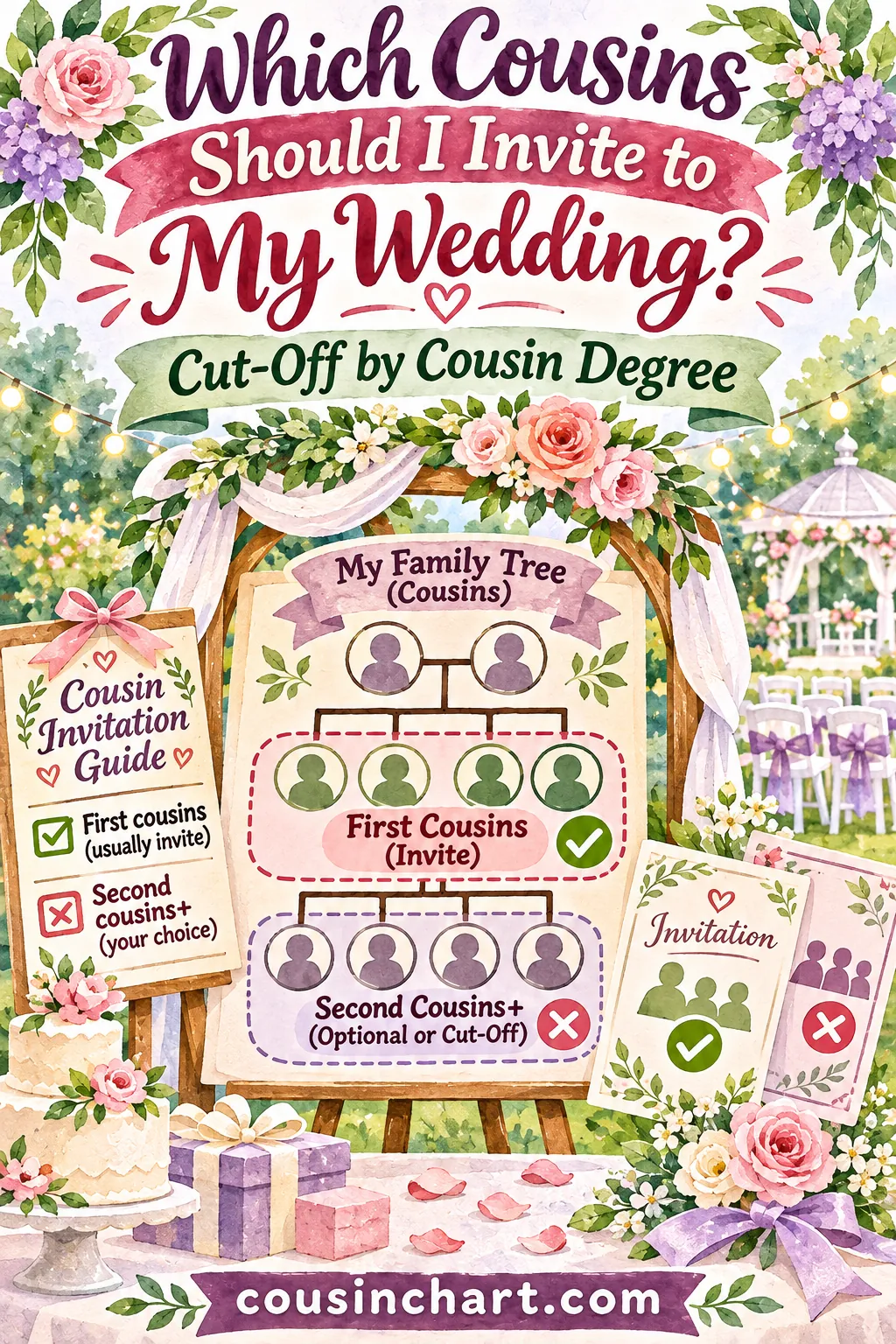
The fairest way to decide which cousins to invite to your wedding is to set one line by cousin degree, such as "all first cousins and their partners," and apply it to every branch on both sides. One clear rule beats a dozen case-by-case decisions. It's easy to explain, and nobody can say you played favorites.
The hard part is knowing exactly who's a first cousin, who's a second cousin and who's "once removed." The free Cousin Chart relationship calculator sorts that out in a couple of seconds. This guide walks through the common cut-offs, the math behind each cousin label and how to handle the awkward edge cases.
▶ Work it out in the free calculator
Why Cousins Are the Hardest Part of the Guest List
Parents, siblings and grandparents are easy. They're in. Friends are your call. Cousins sit in the middle, and that's where guest lists blow up.
Here's why. One family might have three first cousins. Another might have thirty. Add partners, kids, your parents' cousins and the second cousins you met once at a reunion, and the cousin list alone can outgrow your venue.
Cousins also talk to each other. If you invite one second cousin because you like her and skip her brother, word gets around. A cut-off based on the family tree takes the personal sting out of it. It's not "we didn't want you." It's "we drew the line at first cousins."
Family traditions add another layer. In some families, everyone down to second cousins comes to every wedding, and leaving them out would surprise people. In others, first cousins are already the outer edge. If your two families have different traditions, talk about it together early. You don't have to follow either one, but you'll know where the questions will come from.
Know Your Cousin Degrees First
Before you pick a line, get the labels right. Every cousin relationship comes down to two numbers: how many generations down from the shared ancestor to you, and how many down to the cousin.
| Relative | Shared ancestor | Generations (you / them) | Relationship | Typical shared cM |
|---|---|---|---|---|
| Aunt's or uncle's child | Grandparents | 2 / 2 | First cousin | ~866 |
| First cousin's child | Grandparents | 2 / 3 | First cousin once removed | ~433 |
| Parent's first cousin | Great-grandparents | 3 / 2 | First cousin once removed | ~433 |
| Parent's cousin's child | Great-grandparents | 3 / 3 | Second cousin | ~229 |
| Second cousin's child | Great-grandparents | 3 / 4 | Second cousin once removed | ~122 |
| Grandparent's cousin's grandchild | Great-great-grandparents | 4 / 4 | Third cousin | ~73 |
| Half-aunt's child | One grandparent | 2 / 2 (half) | Half first cousin | ~433 |
You don't need the cM column to plan a wedding. It's there because many families now test their DNA, and it helps show how quickly the connection fades. Real numbers vary a lot, and the ranges overlap.
The rule behind the names is short. Take the smaller generation number and subtract one to get the cousin degree. Subtract the smaller number from the larger to get how many times removed. If those two "once removed" rows confuse you, the guide to second cousins vs. first cousins once removed explains why people mix them up.
Talk It Through Before You Pick a Line
The cut-off works best when you and your partner choose it together, before either family starts making suggestions. Sit down with both family lists and work through these questions:
- What's our total headcount? Venue size and budget set the ceiling. Subtract parents, siblings, grandparents, wedding party and close friends first. What's left is your cousin room.
- How many cousins does each side have? Count first cousins on both sides before you talk about anyone further out. The numbers often decide the rule for you.
- What does each family expect? If one family always invites second cousins and the other stops at first cousins, name that difference out loud.
- Kids or no kids? Decide this before you count, because cousins' kids can be the biggest single group.
- Plus-ones for whom? Married only, engaged too or any serious partner? Agree on one definition.
- Do our parents get their own spots? A handful of parent guest spots solves most "my cousin is like a sister to me" requests.
Once you agree, write the rule in one sentence, such as "first cousins on both sides, with spouses and fiancés, and no kids under 12." Keep that sentence handy. You'll repeat it more than once.
A timeline that heads off hurt feelings
| When | What to do |
|---|---|
| Right after booking the venue | Pick your cousin rule together |
| The same week | Share the rule with both sets of parents |
| Before save-the-dates | Finish the spreadsheet and check every label |
| With save-the-dates | Send only to people inside the rule |
| With invitations | Name only invited guests on each envelope |
Telling parents early matters most. Save-the-dates are the moment relatives notice who's on the list, so the rule should already be in the family before they go out.
The Five Common Cousin Cut-Offs
Here are the lines couples use most, from smallest to biggest.
1. No cousins
Immediate family only: parents, siblings, grandparents, and maybe aunts and uncles. This works for tiny weddings, elopements with a dinner afterward and courthouse ceremonies. It's the cleanest rule of all, because nobody's being singled out.
2. First cousins only
Every first cousin on both sides, no kids, maybe no plus-ones. This is a very common line for mid-size weddings. Your first cousins share your grandparents, so they're the cousins you grew up with at holidays.
3. First cousins plus partners
Same as above, but spouses, fiancés and long-term partners come too. Most couples find this fairer than splitting couples. If your cousin has been with someone for five years, leaving them out stings more than leaving the whole couple off.
4. First cousins, partners and their kids
Now you add your first cousins once removed, meaning your cousins' children. For family-friendly weddings, this is the natural line. For adults-only weddings, you can set an age cut-off instead, like "kids 16 and up."
5. Second cousins and parents' cousins
This is the wide net. It includes your parents' first cousins and their kids, your second cousins. Big families with a tradition of huge weddings often go this far. It can double the guest list in a hurry, so it works best with a large venue and a flexible budget.
The five cut-offs side by side
| Cut-off | Who's in | Who's out | Works best for |
|---|---|---|---|
| 1. No cousins | Parents, siblings, grandparents, maybe aunts and uncles | Every cousin | Tiny weddings, elopements, courthouse ceremonies |
| 2. First cousins only | All first cousins, both sides | Partners, kids, anyone further out | Mid-size weddings with a tight headcount |
| 3. First cousins plus partners | First cousins and their spouses or partners | Kids, second cousins, parents' cousins | Most mid-size weddings |
| 4. Plus their kids | Add first cousins once removed (your cousins' children) | Second cousins, parents' cousins | Family-friendly weddings |
| 5. Wide net | Add parents' first cousins and second cousins | Third cousins and beyond | Big families with a big-wedding tradition |
Notice that each step adds a whole category, never a single person. That's what makes the rule easy to defend. If anyone asks, you can point to the category, not to a choice about them.
Mixing rules the fair way
You can combine pieces of different cut-offs, as long as each piece is a category. "First cousins plus partners, and cousins' kids 13 and older" is a clear, fair rule. "First cousins plus partners, and Jen's kids because they're cute" isn't. If you can't write the rule in one sentence, it's probably hiding an exception.
How to Check It With the Calculator
Not sure where someone lands? The relationship calculator settles it.
- Name the shared ancestor. For a first cousin, it's your shared grandparents. For a second cousin, your great-grandparents.
- Set generations down to you. Use the − and + buttons. Grandparents = 2. Great-grandparents = 3.
- Set generations down to the cousin. Your aunt's daughter is 2. Her son is 3.
- Turn on options if needed. Check half relationship for half cousins. Pick step or marriage for relatives who aren't blood kin.
- Read the result and save it. For 2 and 2, you'll see first cousin. For 3 and 3, second cousin. Use Copy result to paste it into your guest-list spreadsheet.
Quick-pick buttons like "My cousin's child," "My dad's cousin" and "My second cousin" cover most of the tricky guests in one tap.
A full walkthrough: your dad's cousin's daughter
Say your dad mentions "Kelly," and you aren't sure where she falls. Your dad explains that Kelly's mom is his first cousin. Here's how to place her and see whether she's inside your rule.
- Find the shared ancestor. Your dad and Kelly's mom are first cousins, so they share grandparents. Those are your great-grandparents.
- Count your steps. Great-grandparents, then your grandparent, then your dad, then you. That's 3.
- Count Kelly's steps. Great-grandparents, then her grandparent, then her mom, then Kelly. Also 3.
- Enter it. Set yourself at 3 and the other person at 3. Leave half relationship off unless the two grandparents were half-siblings.
- Read the result. It shows second cousin, with a chart of both lines.
- Apply the rule. Under cut-offs 1 through 4, Kelly is outside the line. Under cut-off 5, she's in.
Now try Kelly's mom. You're at 3, she's at 2. The result is first cousin once removed, one generation up. Under most rules, she's one of your parents' cousins, so she'd only be invited under the wide net or as one of your parents' personal guests.
Which settings to use for which guest
| Guest | Quick-pick or generations (you / them) | Option to turn on | Result |
|---|---|---|---|
| Aunt's son | 2 / 2 | none | First cousin |
| Cousin's daughter | "My cousin's child" or 2 / 3 | none | First cousin once removed |
| Dad's cousin | "My dad's cousin" or 3 / 2 | none | First cousin once removed |
| Half-uncle's daughter | 2 / 2 | Half relationship | Half first cousin |
| Stepmom's niece | 2 / 2 | Relation type: step | Step-cousin |
| Cousin's husband | 2 / 2 | Relation type: marriage | Cousin by marriage |
Paste each result into a "label" column in your spreadsheet. When you sort by that column, every guest in a category lines up together, which makes counting each cut-off much faster.
Worked Example: Two Families, One Rule
Let's see how a cut-off plays out for a real-world-style couple, Maya and Chris.
Maya's side. Her mom has two sisters. Her dad has one brother. Between them, they have six kids, Maya's first cousins. Four are married, and three of those couples have kids.
Chris's side. His mom is one of six children. His dad has three siblings. Chris has twenty-one first cousins. Fourteen are married or partnered, and many have kids.
Under cut-off 3 (first cousins plus partners):
- Maya's side: 6 cousins + 4 partners = 10 guests.
- Chris's side: 21 cousins + 14 partners = 35 guests.
That's lopsided, and that's okay. The rule is the same for both families. Chris's side is just bigger. What feels unfair is applying different rules to each side, like "all of Chris's first cousins, but only Maya's cousins she's close to."
What if 45 cousin guests is too many? Maya and Chris have three fair options:
- Drop partners (cut-off 2). That's 27 guests instead of 45.
- Keep cut-off 3, but trim the friend list instead.
- Give each family a guest count and let parents fill it using the same rule.
They chose to keep partners and cut their own friend list. The cousin rule stayed clean.
What would cut-off 5 have looked like? Chris's grandmother was one of five siblings, and each of them had several kids. Those kids are Chris's parents' first cousins, and their children are Chris's second cousins. Just on that one grandparent's line, the list would have grown by dozens of people. Multiply that across all four of Chris's grandparents and both of Maya's, and a wide net could easily triple the cousin count. That's why so few couples go past first cousins unless the family already expects it.
Worked Example: A Blended Family and a Kids Rule
Every family has its own shape. Here's a second couple, Dani and Sam, with a blended family and a lot of little kids.
Dani's side. Dani's mom has one full sister and one half-brother, from Dani's grandfather's second marriage. Dani's dad remarried when Dani was ten, and her stepmom has two siblings with kids Dani grew up spending holidays with.
- Mom's sister's kids: 3 first cousins.
- Mom's half-brother's kids: 2 half first cousins. They share one grandparent with Dani, not two. In the calculator, set 2 and 2 and turn on half relationship.
- Stepmom's siblings' kids: 4 step-cousins. Set 2 and 2 with relation type step.
Sam's side. Sam's parents each have two siblings. Sam has 9 first cousins, and 6 of them have young kids, 11 children in all.
Dani and Sam chose first cousins plus partners, including half and step cousins Dani grew up with, and no kids under 12. Here's how it counts:
| Group | People | Partners | Kids 12 and up | Total |
|---|---|---|---|---|
| Dani's first cousins | 3 | 2 | 0 | 5 |
| Dani's half first cousins | 2 | 1 | 1 | 4 |
| Dani's step-cousins | 4 | 3 | 0 | 7 |
| Sam's first cousins | 9 | 7 | 2 | 18 |
| Total | 18 | 13 | 3 | 34 |
Including the step-cousins was a choice, and it's a fair one because it's a category. Dani grew up with all four, so the rule says "step-cousins I grew up with," which covers every one of them. Sam has no step-cousins, so the rule doesn't create a gap on his side.
The kids rule cut 9 young children from Sam's side. That's the part most likely to bring a phone call, so they made sure it applied to Dani's own niece too. A rule that spares the couple's own family won't feel like a rule to anyone else.
Worked Example: The Small Wedding With a Later Party
Third couple: Ruth and Ken want 40 guests total. With parents, siblings, grandparents and close friends, they're already at 34.
- Ruth has 7 first cousins. Ken has 12.
- Inviting first cousins alone would add 19 people, putting them at 53.
They chose cut-off 1, no cousins, and planned a casual open-house party three weeks later for all cousins, partners and kids, plus parents' cousins. Because the line was "no cousins at all," nobody could feel singled out. The later party gave everyone a way to celebrate, and the wide-net crowd got invited to something.
This setup works well when the venue, not the relationship, is the real limit. It also helps when the two sides are very different in size, since "no cousins" lands the same way on three cousins as on thirty.
Handling the Awkward Edge Cases
No rule covers every family perfectly. Here's how most couples handle the gray areas.
The second cousin you're actually close to
Maybe you and your second cousin were college roommates. Invite her as a friend, not as a cousin. Put her in the friend count. If anyone asks, "Why was Jess invited?" the honest answer is "She's one of my closest friends." That doesn't open the door to every second cousin.
Your parent's cousin who's like an aunt
Some families are close across a generation. If your mom's cousin babysat you every summer, you may want her there. Treat her the way you'd treat a close friend, or count her among your parents' personal guests. Many couples give each set of parents a few spots for exactly this.
Half cousins and step-cousins
A half first cousin shares one grandparent with you, not two. The guide to half cousins explains the details. They're still on the first-cousin level, so most couples treat them exactly like full first cousins. Step-cousins are family by marriage. If you grew up together, include them with your cousins. If you've barely met, they're more like extended family, and your rule can say so.
Cousins you've never met
A first cousin is a first cousin, even if you haven't seen them since you were six. If your rule is "all first cousins," that includes the ones you don't know well. You can decide that's fine, or adjust the rule. Just don't make exceptions for one person.
Divorced or estranged branches
Families split. An aunt remarries, an uncle hasn't spoken to anyone in years, a cousin had a falling-out with your parents. Your rule still sets the starting list. From there, you're allowed to make a quiet personal decision about one household, especially if inviting them would cause real conflict on the day. Keep that call private and don't build a new rule around it.
Cousins in the wedding party
If a cousin is a bridesmaid or groomsman, they're in no matter what your cut-off says. That's a role, not a relationship level, so it doesn't open the door for their siblings. Most families understand this right away, because everyone knows the wedding party is chosen by closeness.
Adopted cousins
An adopted cousin is a cousin, full stop. They sit in the same place on the family tree as any birth cousin, so whatever your rule says about first cousins applies to them exactly the same way. Don't treat this as a gray area at all.
Double cousins
If your mom's sister married your dad's brother, their kids are your double first cousins. They're related through both of your parents. For the guest list, they're simply first cousins. Count them once, not twice. The guide to double cousins explains how that relationship works.
A cousin's new partner or ex
If your rule includes partners, decide early what counts: married, engaged, living together or a set amount of time together. Then apply it to everyone. A cousin's ex-spouse is usually off the list unless they're still close to the family, and that's a personal call to keep quiet. If the ex is the parent of invited kids, a short conversation with your cousin can head off surprises.
Nursing babies
Many couples with an adults-only rule make one exception: babies young enough to need a parent nearby. If you do this, phrase it as a category ("babes in arms are welcome") and apply it to every branch.
Cousins with kids at an adults-only wedding
Say so early, kindly and in writing. Address the invitation only to the adults, and add a line on your wedding website. Apply it to every branch, including your own siblings, so no parent feels singled out.
How to Explain Your Cut-Off Without Hurt Feelings
You'll probably get a phone call or two. Have a short, kind answer ready.
Keep it about the rule. "We kept it to first cousins on both sides" is hard to argue with. It's not about anyone personally.
Keep it about the space. "Our venue holds 120, and we had to draw a line somewhere" is honest and relatable.
Don't over-explain. Long explanations invite debate. One or two sentences is enough.
Offer something else. A casual backyard party after the honeymoon is a nice way to celebrate with the wider family. Second cousins and parents' cousins who didn't make the main list can still share the day.
A sample message
If a relative asks directly, a short text or note works better than a long phone call. Something like this keeps it warm and simple:
"We'd love to celebrate with everyone, but our venue is small, so we kept the wedding to first cousins on both sides. We're planning a casual get-together later in the summer, and we really hope you can come to that."
Change the details to fit your plan. Keep the tone kind and the reason short.
Let your parents know the rule early, too. They're the ones most likely to hear "Why wasn't my daughter invited?" If they can explain it in one line, the whole family hears the same answer.
More scripts for common moments
When a parent pushes for their own cousin:
"We'd love to have Aunt Pat there too, and we know she's close to you. We can give you and Dad four spots for your own guests. Would you like her to be one of them?"
This keeps the cousin rule clean and gives your parent a way to say yes.
When a cousin asks to bring a date:
"We'd love to meet him someday! Our plus-ones are for married and engaged couples only, so we can keep the numbers where they need to be. We hope you understand."
When a cousin asks if their kids are invited:
"We've kept the whole wedding adults-only, including our own nieces and nephews. We hope you can enjoy a night out. Let us know if you'd like names of sitters near the venue."
When a second cousin hears others were invited:
"We kept it to first cousins, and a couple of people are there as close friends of ours. We'd really love to see you at the party later in the summer."
Each script does three things: it names the rule, it doesn't blame the person and it offers something warm.
Building the Cousin Guest List
Here's a simple process that keeps the list fair from start to finish.
- List every cousin on both sides. Ask each parent to name their siblings' kids. Then ask about their own cousins, in case you go wider.
- Label each one. First cousin, first cousin once removed, second cousin and so on. Use the calculator for anyone you're unsure about.
- Mark partners and kids. Add columns so you can see what each rule would add.
- Count each cut-off. Total the guests for rules 2, 3, 4 and 5. Compare to your venue size.
- Pick one rule. Write it down, and share it with both sets of parents.
- Apply it to everyone. No exceptions inside the rule. Close friends who happen to be cousins go on the friend list.
What about a B-list?
Some couples send a second wave of invitations as early decliners free up seats. If you do this with cousins, keep it inside the rule's logic. For example, your A-list is first cousins plus partners, and your B-list is first cousins' adult kids. Don't put one second cousin on the B-list and skip the rest. Send B-list invitations early enough that nobody can tell they went out later, and use the same wording as the first round.
A one-page chart helps keep it straight. The printable cousin chart shows every cousin level from first cousin down, so you can see where each relative sits. If someone in the family still swears your mom's cousin is your second cousin, the guide to first cousins vs. second cousins lays out the difference.
A simple spreadsheet layout
Set up one row per person and these columns. Sorting and filtering does most of the work for you.
| Column | Example entry | Why it helps |
|---|---|---|
| Name | Kelly Ruiz | One person per row, never one row per household |
| Side | Groom, dad's side | Shows balance between families |
| Branch | Grandpa Joe's line | Groups siblings together |
| Label | Second cousin | Comes straight from the calculator |
| Type | Cousin, partner, kid | Lets you count each cut-off |
| Age if under 18 | 9 | Needed for any kids rule |
| Cut-off number | 5 | The smallest rule that includes them |
| Invited? | No | Your final call |
The "cut-off number" column is the secret. Give each person the smallest cut-off that includes them: 2 for a first cousin, 3 for their partner, 4 for their kids and 5 for second cousins and parents' cousins. Then filter for 3 or lower and you've got your cut-off 3 list in one click.
Common Mistakes and How to Fix Them
- Calling your parent's cousin a second cousin. It's a first cousin once removed. Fix: count generations from the shared ancestor, or tap the "My dad's cousin" quick-pick.
- Calling your cousin's child a second cousin. Also a first cousin once removed. Fix: remember that your second cousins are your parents' cousins' kids, not your cousins' kids.
- Making one exception "just this once." One exception becomes three, and the rule stops working. Fix: move close cousins to the friend list or give parents a few spots of their own.
- Applying the rule to one side only. A rule that's strict for one family and loose for the other feels personal. Fix: write the rule down and run both lists through it.
- Forgetting half and step cousins. They often get left out by accident, which hurts. Fix: ask each parent directly about half-siblings and stepfamily when you build the list.
- Telling people too late. A guest who finds out from social media feels worse than one who heard it from you. Fix: tell parents the rule as soon as you pick it, and have them share it early.
- Counting households instead of people. "Twelve cousins" can mean thirty seats. Fix: one spreadsheet row per person.
Final Guest-List Checklist
Before invitations go out, run through this list:
- Every first cousin on both sides is on the spreadsheet, including half, step and adopted cousins
- Each person has a label, checked with the calculator if anyone was unsure
- The rule is written in one sentence and both sets of parents have it
- Partners follow one clear plus-one rule
- Kids follow one clear age rule, including your own nieces and nephews
- Close cousins outside the rule are counted as friends, not as cousins
- Parents' personal guests are counted separately
- Any later party or open house has a date, so you can mention it kindly
When the last "wait, what is he to me?" pops up, run it through the free relationship calculator and keep moving.
▶ Work it out in the free calculator
Frequently Asked Questions
Do I have to invite all my first cousins to my wedding?
You don't have to, but it's the most common and fairest line. If you invite some first cousins, inviting all of them avoids hurt feelings. If your family is very large, you can choose "no cousins" instead and apply it to everyone.
Should I invite second cousins to my wedding?
Only if your cut-off is wide enough to include everyone who descends from your great-grandparents. Most couples don't invite second cousins as a group. If you're close to one in particular, invite them as a friend.
Are my cousin's children my first cousins?
No. Your cousin's children are your first cousins once removed. You share grandparents with your cousin, and their kids are one generation further down. Most people just call them cousins in everyday talk.
Should my cousin's partner get an invitation?
Most couples include married partners, fiancés and long-term partners. Splitting a couple often causes more hurt than leaving the whole couple off. If your budget is tight, you can set a clear plus-one rule, like married or engaged couples only.
Is it rude to invite cousins from one side but not the other?
It can feel unfair if the rule is different for each side. A family size difference is fine, as long as the rule is the same. "All first cousins on both sides" works even when one side has three cousins and the other has thirty.
What is my parent's cousin to me?
Your parent's first cousin is your first cousin once removed. They're on your parent's generation level, one step above you, and you share great-grandparents. Your parents may want to invite them as their own guests.
Do half, step and adopted cousins count under a first-cousins rule?
Adopted cousins always count, since they're full first cousins. Half first cousins sit on the same level, so most couples include them too. Step-cousins are a choice, and the fairest approach is to set a category, such as step-cousins you grew up with, and apply it to all of them.
How do I tell my parents their cousins aren't invited?
Tell them early and keep it about the rule and the space. Saying you kept it to first cousins on both sides is clear and kind. If they're close to a cousin, you can offer them a few personal guest spots and let them decide.
Should cousins' kids be invited if my nieces and nephews are?
If your rule includes kids, apply it to everyone at the same level or by the same age line. Nieces and nephews are closer relatives, so some couples invite them and not cousins' kids, but say so clearly. An age rule that applies to every child is the easiest to explain.