Just Met Birth Family: What Do I Call My Birth Mother's Siblings and Their Kids?
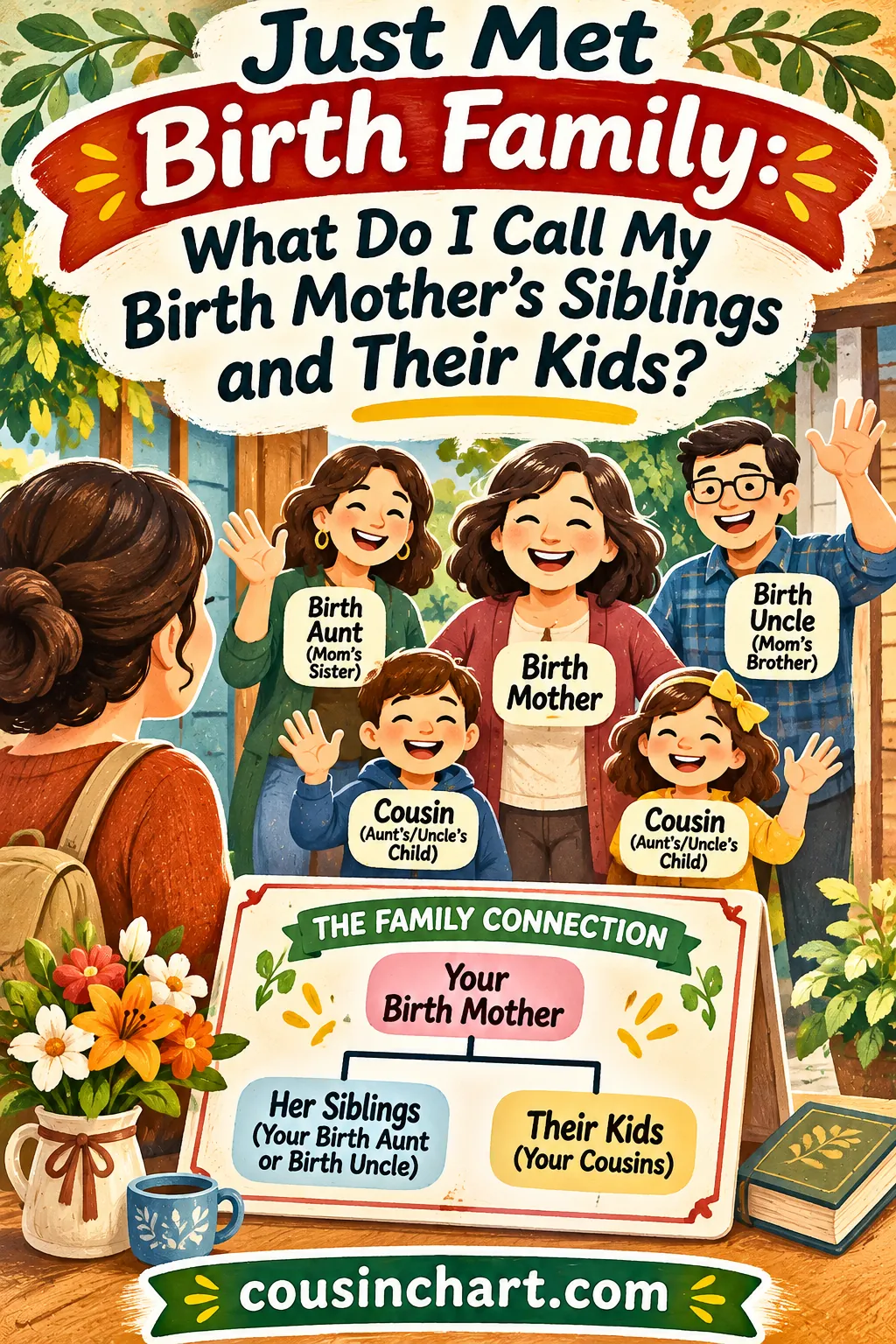
Your birth mother's siblings are your biological aunts and uncles, and their children are your biological first cousins. Her other children are your half-siblings or full siblings, and her parents are your biological grandparents. If you need to work out someone further out, the free Cousin Chart relationship calculator gives you the exact name in a couple of seconds.
The genealogy part is the easy half. The harder half is what you actually say when you're standing in someone's kitchen for the first time. This guide covers both, gently, and you get to decide what fits.
▶ Work it out in the free calculator
What Your Birth Relatives Are, Side by Side
Adoption doesn't change biology, and it doesn't erase the family who raised you. Many adoptees find it helpful to keep the two sets of names separate in their head: "Mom" for the parent who raised you, "birth mother" or her first name for the woman who gave birth to you. The rest of the birth family follows from her.
Here's the map for your birth mother's side. It works the same way for your birth father's side.
| Birth relative | Generations from shared ancestor (you / them) | What they are to you | Typical shared DNA |
|---|---|---|---|
| Birth mother's full sibling | 2 / 1 from her parents | Biological aunt or uncle | Similar range to a grandparent |
| Their children | 2 / 2 from her parents | Biological first cousin | ~866 cM average |
| Birth mother's child, different father | 1 / 1 from birth mother | Half-sibling | Similar range to an aunt or grandparent |
| Birth mother's child, same father | Both birth parents | Full sibling | ~2,613 cM average |
| Birth mother's parents | 2 generations up | Biological grandparents | Grandparent range |
| Birth mother's first cousin | 3 / 2 from great-grandparents | First cousin once removed | About half of a first cousin |
| Your first cousin's child | 2 / 3 from her parents | First cousin once removed | About half of a first cousin |
| Second cousin | 3 / 3 from great-grandparents | Second cousin | ~229 cM average |
DNA amounts are averages. Real matches spread out, and the ranges for different relationships overlap. That's why a match's cM number points you toward a few possibilities, not one sure answer.
Aunts, Uncles and First Cousins
Let's say your birth mother is Rachel. Rachel has a sister, Dana, and a brother, Luis.
Dana and Luis are your biological aunt and uncle. You share Rachel's parents as your closest common ancestors. You're 2 generations down from them, and Dana is 1. One step apart in generations, and that's the aunt or uncle pattern.
Dana's kids are your biological first cousins. They're 2 generations down from Rachel's parents, and so are you. Two and two is first cousins. You'd share about as much DNA as any first cousins who grew up together.
Luis's wife is your aunt by marriage. She isn't related to you by blood, but she's part of the family you're meeting. Many adoptees simply use her first name. If the cousins call her "Aunt Teresa," you may find yourself doing the same over time.
When an aunt is a half-aunt
If Dana is Rachel's half-sister, sharing only one parent, then Dana is your half-aunt and her kids are your half first cousins. The relationship is real, it's just through one grandparent instead of two. If that comes up, the guide to what a half-aunt is explains how it plays out on a tree and in DNA.
Siblings, Half-Siblings and Their Kids
Meeting siblings is often the most emotional part of a reunion. The labels are simpler than they feel.
- Same birth mother, different father: half-siblings.
- Same birth mother and same birth father: full siblings, even if they were raised together and you weren't.
- Your birth father's children with someone else: half-siblings on his side.
You might hear people say "biological sister" or "bio brother." Others just say "my sister." There's no wrong choice here, only what feels honest to you.
Their children
Your half-sister's children are your half-nieces and half-nephews. Your full brother's children are your full nieces and nephews. In conversation, almost everyone drops the "half" and just says niece or nephew.
Your own kids and your half-sibling's kids are half first cousins. They share one grandparent, your birth mother.
When your birth parents stayed together
Sometimes birth parents who placed a child for adoption later married each other and had more children. Those children are your full siblings, even though they grew up in a home you never lived in. That can be a lot to take in. The label is simple, but the feelings may not be, and it's okay to take time with it.
Your Birth Father's Side
Everything above works the same way for your birth father's family. Say your birth father is Mark.
- Mark's parents are your biological grandparents.
- Mark's siblings are your biological aunts and uncles.
- Their children are your biological first cousins.
- Mark's children with his wife are your half-siblings, unless Rachel is also their mother.
- Mark's wife isn't related to you by blood. She's your half-siblings' mother, and there's no standard family word for what she is to you. Most adoptees use her first name.
Some adoptees meet one side of the birth family years before the other, or only ever meet one side. That's common. You can fill in each branch on your own timeline.
Going Further Out: Cousins, Great-Aunts and "Removed"
As you meet more of the family, the names stretch. Here are the ones adoptees ask about most.
Your birth mother's aunt. She's your great-aunt, also called a grand-aunt. Her path: from your birth mother's grandparents, she's 1 generation down, and you're 3.
Your birth mother's first cousin. This person is your first cousin once removed. You share your birth mother's grandparents (your great-grandparents). They're 2 generations down from that couple, and you're 3. First cousins are 2 and 2, and that extra generation is the "once removed."
Your first cousin's child. Also a first cousin once removed, just in the other direction. Your cousin's kid is 3 generations down from your shared grandparents, and you're 2.
Your birth mother's first cousin's child. That's your second cousin. You're both 3 generations down from your great-grandparents.
If "removed" still feels slippery, the explainer on what once removed means breaks it down with pictures.
Quick Reference: The Label and What People Often Say
Here's a side-by-side list of the formal name and the everyday words adoptees often use. None of these are rules. They're just common choices.
| Birth relative | Formal relationship | What adoptees often say out loud |
|---|---|---|
| Birth mother | Biological mother | Her first name, "birth mom," or a name you choose together |
| Birth father | Biological father | His first name or "birth dad" |
| Birth mother's sister | Biological aunt | First name, or "Aunt Dana" if it feels right |
| Birth mother's brother | Biological uncle | First name, or "Uncle Luis" |
| Their children | Biological first cousins | First names, or "my cousin" |
| Birth mother's other children | Half or full siblings | First names, "my sister," "my bio brother" |
| Birth mother's parents | Biological grandparents | First names, "Grandma Ruth," or a name like "Nana" |
| Half-sibling's children | Half-nieces and half-nephews | First names, or "my niece" |
| Birth mother's first cousin | First cousin once removed | First name, or "my birth mom's cousin" |
| Birth mother's spouse (not your birth father) | No blood relationship | First name |
Worked Example: A First Family Dinner
Jenna, 34, was adopted as a baby. She's just met her birth mother, Rachel, and been invited to a family dinner. Here's who'll be there and what each person is to her.
- Rachel's mother, Ruth. Rachel is 1 generation down from Ruth, and Jenna is 2. Ruth is Jenna's biological grandmother.
- Rachel's sister, Dana. From Ruth, Dana is 1 down and Jenna is 2. Dana is Jenna's biological aunt.
- Dana's son, Kyle, 28. From Ruth, Kyle is 2 down and Jenna is 2. Kyle is Jenna's biological first cousin.
- Kyle's daughter, Mia, 3. From Ruth, Mia is 3 down and Jenna is 2. Mia is Jenna's first cousin once removed.
- Rachel's son, Ben, 26. Same mother as Jenna, different father. Ben is Jenna's half-brother.
- Rachel's husband, Tom. Not Jenna's birth father. Tom is Ben's dad, but no blood relation to Jenna.
Jenna decides before dinner to use first names for everyone. When Ruth says, "Please, call me Grandma," Jenna smiles and says, "I'd like that, it might take me a little while." That's an honest, kind answer, and it leaves room for both of them.
Worked Example: Found Through a DNA Match
Marcus, 41, takes a DNA test hoping to learn about his birth father. A woman named Alicia appears as a match at 870 cM. The match list suggests "first cousin."
At 870 cM, the possibilities include first cousin, half-aunt, great-aunt, half-niece and great-grandparent. Alicia is 38, close to Marcus's age, which makes first cousin or half-niece most likely.
Step 1: Ask how she connects. Marcus sends a short message. Alicia replies that her father, Greg, had a brother, Paul, who "had a baby before he was married."
Step 2: Count the generations. If Paul is Marcus's birth father, then Greg and Paul's parents are the shared ancestors. Marcus is 2 generations down, and so is Alicia.
Step 3: Name it. Two and two makes first cousins. That fits 870 cM well.
Step 4: Check it with the calculator. Set 2 and 2 with half off. The result reads first cousin.
Step 5: Check the half option too. If Greg and Paul turn out to be half brothers, Marcus and Alicia would be half first cousins. They'd expect to share roughly half as much, so 870 cM makes the full first-cousin link much more likely.
Marcus now knows Paul is very likely his birth father, and Alicia is his first cousin. What he does next, and how fast, is up to him.
Worked Example: Two Sets of Half-Siblings
Priya, 29, has found both birth parents. Her birth mother, Elena, later had two sons with her husband. Her birth father, Raj, later had a daughter with his wife. Elena and Raj never had other children together.
- Elena's sons, Leo and Max. They share Elena with Priya, but not Raj. They're Priya's half-brothers on her birth mother's side.
- Raj's daughter, Asha. She shares Raj with Priya, but not Elena. She's Priya's half-sister on her birth father's side.
- Leo and Asha. They don't share a parent. They aren't related to each other by blood at all, even though both are Priya's half-siblings.
- Leo's son, Owen. From Elena, Owen is 2 generations down and Priya is 1. With only one shared parent, Owen is Priya's half-nephew.
- Asha's daughter, Nina. From Raj, Nina is 2 down and Priya is 1. Nina is Priya's half-niece.
When Priya hosts a birthday party, she introduces everyone simply: "These are my brothers, Leo and Max, and this is my sister, Asha." Nobody needs the word "half" at a party. On her family tree, though, she marks each half link clearly, so the two sides stay easy to read.
Edge Cases That Change the Labels
Birth families aren't always simple. These situations come up often, and the labels still work if you count carefully.
Your birth mother was also adopted. If Rachel was adopted, her adoptive family raised her, but her biological parents are your biological grandparents. You may have two sets of "grandparents" on her side: the people who raised her and the people she descends from. Many adoptees call the first set by whatever name Rachel uses and treat the second as another branch to learn about.
Your birth mother has died. Her family is still your biological family. Her siblings are still your aunts and uncles, and their kids are still your cousins. Many adoptees in this situation find that an aunt or cousin becomes their bridge to stories about her.
Half-siblings on both sides. If your birth mother and birth father each had other children with other partners, you may have two separate groups of half-siblings who aren't related to each other at all.
Double relationships. If two siblings from your birth mother's family married two siblings from another family, some of your cousins may be double first cousins to each other. Your own relationship to them doesn't change, but their shared DNA with each other will be higher than usual.
Step relationships in the birth family. If your birth mother married someone with children, those children are your step-relatives through her, with no blood link. Families handle these titles in very different ways. A first name is always a safe start.
What to Actually Call Them Out Loud
The technical label and the name you use in person are two different things. Many adoptees use first names at the start, and that's almost always a safe, kind choice. Let things grow from there.
A few gentle guidelines:
- Ask what they'd like. "What would you like me to call you?" is a warm question. Many birth aunts will say "Aunt Dana is fine" or "Just Dana."
- Use what feels true to you. You don't owe anyone a title. "Aunt" can come later, or never, and both are okay.
- Respect your adoptive family too. Some adoptees save "Mom" and "Grandma" for the people who raised them. Others are comfortable using family titles on both sides. Neither is wrong.
- Kids often settle it for you. Younger cousins may call you "cousin" right away. Let them.
Words that help with introductions
When you're introducing birth relatives to friends or to your adoptive family, a descriptive phrase works well:
- "This is Dana, my birth mother's sister."
- "This is Sam, my biological brother."
- "These are my cousins on my birth mom's side."
These phrases are clear without asking anyone to feel a certain way about it. For more on respectful words in adoption, see the guide to foster and adoptive family terms.
Scripts for the Moments That Feel Awkward
It helps to have a few phrases ready. Change the words to fit your voice.
When someone asks you to use a title you're not ready for:
"That means a lot. Can I start with your first name and see how it feels?"
When you'd like to ask what to call someone:
"I'm not sure what you'd like me to call you. What feels right to you?"
When telling your adoptive parents about the birth family:
"I met my birth mother's sister, Dana. I'm calling her by her first name for now. You're still Mom and Dad, and that isn't changing."
When a cousin introduces you to their friends:
"Yep, we're cousins. We just met this year, so we're catching up."
When you need a break from a big gathering:
"This has been wonderful. I'm going to step outside for a few minutes."
You don't have to explain your adoption story to anyone just because they ask. "It's a long story, and a good one" is a complete answer.
Talking With Your Adoptive Family About Names
Many adoptees worry that using family titles with birth relatives will hurt the people who raised them. It helps to talk about it openly, before it comes up at a holiday table.
A few things that often ease the conversation:
- Say what isn't changing. "You're my mom. That's not up for grabs" can mean a lot to hear out loud.
- Explain the words you're using. If you call your birth mother by her first name, say so. If you call her sister "Aunt Dana," explain that it's a courtesy that grew over time.
- Invite questions. Some adoptive parents feel curious rather than worried. Let them ask.
- Keep the two families' titles distinct if that helps. "Grandma" for your adoptive grandmother and "Grandma Ruth" for your birth grandmother is a common way to keep things clear.
There's no single right answer here. Some adoptive families welcome the birth family to holidays. Others prefer to keep things separate for a while. Both can work with kindness on all sides.
When Relatives Want Different Things
Birth families aren't one voice. Your birth grandmother may be eager to be "Grandma," while your half-brother is shy and just says "Hey." A cousin may introduce you as "my cousin" on day one, while your birth aunt takes months to warm up.
That's normal. Each relationship has its own pace. You can:
- Match each person's comfort level. Use a title with the people who want one and first names with the rest.
- Let titles grow unevenly. It's fine if you call one aunt "Aunt Dana" and another by her first name, as long as you explain it kindly if anyone asks.
- Check in later. "I've been calling you Dana. Is that still okay, or would you like something else?" is a gentle question to ask after a few visits.
Group Chats, Cards and Holidays
Names show up in writing too, and that can feel bigger than saying them out loud.
- Group chats. Many birth families start a group text after a reunion. First names are the norm there, so you rarely need to decide on titles.
- Birthday and holiday cards. "Dear Dana" is always fine. If you'd like to add warmth without a title, try "Thinking of you, love Jenna."
- Gift tags for kids. If your children send cards, write what they call each person, for example "To Grandma Rachel."
- Holiday gatherings. If you're unsure how to introduce yourself to extended family, "I'm Jenna, Rachel's daughter" is clear and lets people respond in their own way.
Calculator Settings for Common Birth Relatives
Use these settings on the relationship calculator for the relatives adoptees ask about most. The shared ancestor is listed first, then the generation counts.
| Birth relative | Shared ancestor | Down to you | Down to them | Half | Result |
|---|---|---|---|---|---|
| Birth mother's full sister | Her parents | 2 | 1 | Off | Aunt |
| Birth mother's half-brother | Her one shared parent | 2 | 1 | On | Half-uncle |
| Birth aunt's child | Her parents | 2 | 2 | Off | First cousin |
| Half-sister | Your shared birth parent | 1 | 1 | On | Half-sister |
| Half-sister's son | Your shared birth parent | 1 | 2 | On | Half-nephew |
| Birth mother's aunt | Her grandparents | 3 | 1 | Off | Great-aunt |
| Birth mother's first cousin | Her grandparents | 3 | 2 | Off | First cousin once removed |
| Birth mother's cousin's child | Her grandparents | 3 | 3 | Off | Second cousin |
What Your Own Kids Can Call Birth Relatives
If you have children, they'll need names too. Count from the shared ancestor just as you would for yourself.
- Your birth mother is your child's biological grandmother. Some families use a special name, like "Grandma Rachel" or "Nana," to keep her distinct from the grandparents who raised you.
- Your birth mother's sister is your child's great-aunt.
- Your half-brother is your child's half-uncle. Most kids just say "Uncle Ben."
- Your first cousin is your child's first cousin once removed. Kids often call them by first name or "Cousin."
- Your half-sibling's children are your child's half first cousins.
Let your kids follow your lead. If you use first names, they'll likely do the same. If a birth grandparent asks to be called "Grandma," talk with your kids about it first so they know who's who.
If Some Birth Relatives Aren't Ready
Not every reunion opens every door at once. A birth parent may welcome you while a sibling holds back, or a cousin may reach out while the parent isn't ready. That can hurt, and it isn't a reflection of your worth.
The relationship names stay true either way. Your birth mother's brother is your biological uncle whether or not you've met him. You can write him on your tree, learn about him through other relatives, and leave room for contact later.
A few gentle ways to handle it:
- Keep one door open. A short note like "I'd be glad to hear from you whenever you're ready" lets the other person choose the timing.
- Lean on the people who are ready. A welcoming cousin or aunt can share stories and photos in the meantime.
- Find support for yourself. Adoptee support groups and counselors who work with adoption can help you sort through the feelings.
Common Mix-Ups and How to Fix Them
| Mix-up | What's actually true | Easy fix |
|---|---|---|
| Calling birth mother's husband your stepfather | He's only a step relative if he raised you or married your parent | Use his first name |
| Assuming all her children are half-siblings | If they share your birth father too, they're full siblings | Ask who their father is, gently |
| Calling your cousin's child your second cousin | Your first cousin's child is your first cousin once removed | Count generations from the grandparents |
| Treating the DNA label as final | A cM number fits several relationships | Ask how the match connects, then count |
| Feeling you must pick one family's titles | You can use titles on both sides, or neither | Choose what feels honest, and let it change |
Before Your First Meeting: A Short Checklist
- Write down the names you know and how each person connects.
- Count the generations and check any unclear ones on the calculator.
- Decide what you'll call people at first. First names are a safe default.
- Prepare one or two phrases for awkward moments.
- Bring a support person if you'd like one.
- Plan a time to leave, so the day doesn't stretch longer than you want.
- Give yourself a quiet evening afterward to rest.
How to Check It With the Calculator
The relationship calculator asks for one thing: the relative you and the other person both come from. Then you count generations down from that person to each of you.
Your birth mother's sister's child
- Your shared ancestors are your birth mother's parents.
- Set generations down to you: 2 (her parents → your birth mother → you).
- Set generations down to the other person: 2 (her parents → your birth aunt → her child).
- Leave half off if your birth mother and her sister share both parents.
- Result: first cousin.
Your birth mother's first cousin
- Your shared ancestors are your birth mother's grandparents.
- Generations down to you: 3.
- Generations down to the other person: 2.
- Result: first cousin once removed.
Your half-brother's daughter
- Your shared ancestor is your birth mother.
- Generations down to you: 1. Down to her: 2.
- Turn on the half relationship option.
- Set her sex to female if you'd like the word "niece."
- Result: half-niece.
Your birth mother's half-sister
- Your shared ancestor is the one parent your birth mother and her half-sister have in common.
- Generations down to you: 2. Down to her: 1.
- Turn on the half relationship option.
- Set her sex to female.
- Result: half-aunt.
Your birth mother's aunt
- Your shared ancestors are your birth mother's grandparents.
- Generations down to you: 3. Down to her: 1.
- Leave half off.
- Result: great-aunt.
You can copy the result, download the chart, or print it. Some adoptees keep these printouts together as a simple map of the family they're getting to know.
When You Found Them Through a DNA Match
Many reunions start with a DNA test rather than a letter or a phone call. If that's your story, the match list may already be guessing at labels for you. Those guesses are a starting point, not a final answer.
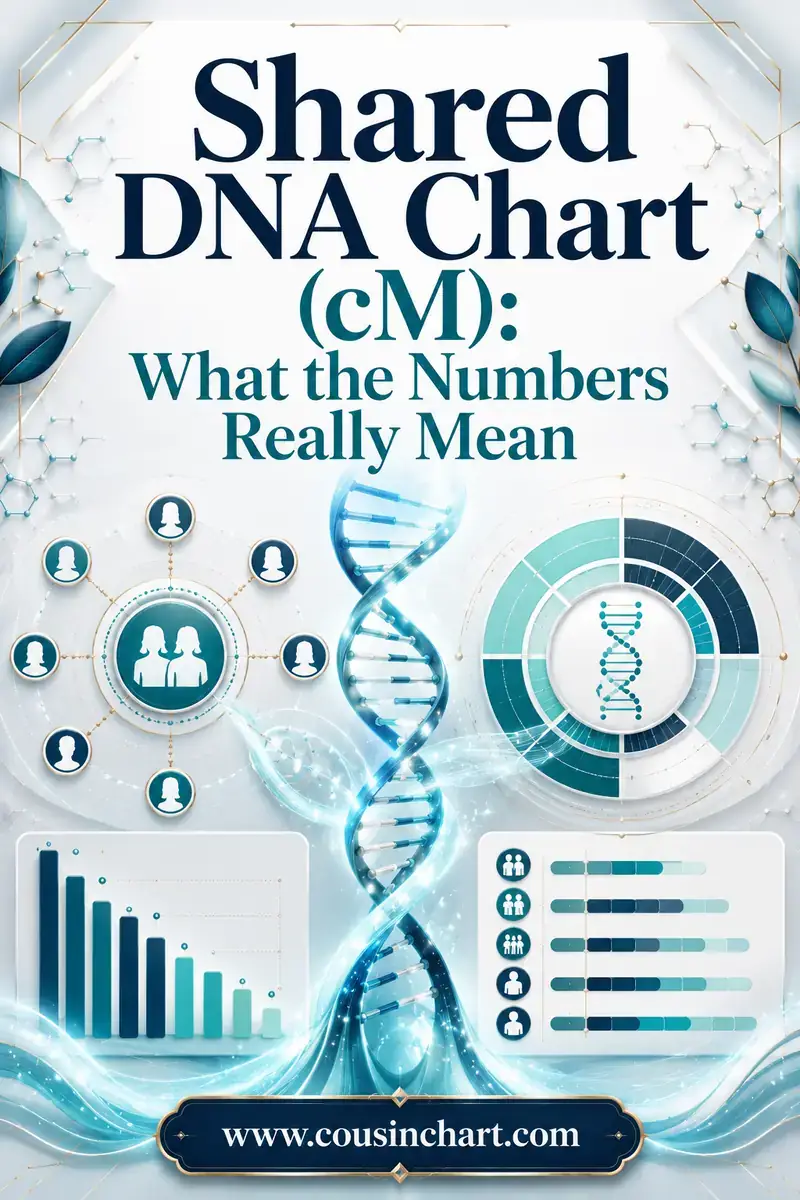
Here's why. A shared cM number fits several relationships at once. A match around 866 cM is typical for a first cousin, but the same amount can show up for a half-aunt, a great-aunt or a half-niece. Ranges vary and overlap.
The way to settle it is to find the ancestor you share. Once a birth relative tells you how they connect, for example "My mom and your birth mother are sisters," you can count the generations and get the exact name. The amount of DNA you share should then make sense for that label.
A few gentle reminders while you sort matches:
- Go at your own pace. You don't have to message every match at once.
- Let relatives share what they're comfortable sharing. Some may need time.
- Write down each match's stated connection next to their cM number, so you can see if they fit together.
For a fuller look at research methods, the guide to adoptee genealogy covers records, DNA and how to build out each birth line.
Putting Birth Family on a Family Tree
There's no single right way to draw both families. Some people keep one tree with both sets of parents and mark the links as "birth" and "adoptive." Others keep two trees side by side. Both work. Use whatever feels right and keeps the facts clear for anyone who reads it later.
A few practical tips:
- Write down names, dates and places as you learn them. Reunions move fast, and details get fuzzy.
- Note how you learned each fact, for example "Dana told me" or "DNA match."
- Mark half relationships clearly. It saves confusion when you're sorting DNA matches later.
The guide on how to show adoption on a family tree has layout ideas for both families on one page.
Whenever a new name comes up in your reunion, you can check where that person fits with the free Cousin Chart calculator. Count the generations from the ancestor you share, and it'll give you the label and a chart you can keep.
▶ Work it out in the free calculator
Frequently Asked Questions
What do I call my birth mother's sister?
Genealogically, she's your biological aunt. In person, many adoptees start with her first name and switch to "Aunt" only if it feels natural for both of you. Asking her what she'd like is a kind way to start.
Are my birth mother's sister's kids my real cousins?
Yes, they're your biological first cousins. You share a set of grandparents, your birth mother's parents. Whether you feel like cousins is a separate thing that grows with time.
What do I call my birth mother's other children?
They're your half-siblings if they have a different father, or full siblings if they share both of your birth parents. Many people simply say "brother" or "sister," with or without "half" or "bio."
What's my birth mother's cousin to me?
Your birth mother's first cousin is your first cousin once removed. Their children are your second cousins. The relationship calculator can confirm any of these if you enter the generations.
Do I have to call my birth relatives aunt, uncle or grandma?
No. Those titles are invitations, not obligations. First names are always fine, and you can adjust over time as the relationships settle.
What is my birth mother's husband to me?
If he isn't your birth father, he has no blood relationship to you. He's the parent of your half-siblings, and most adoptees simply use his first name. If he is your birth father, he's your biological father, and his children with your birth mother are your full siblings.
What do my children call my birth mother?
She's their biological grandmother. Many families pick a name that keeps her distinct, like "Grandma Rachel" or a nickname she likes. Talk it over with her and with your kids so everyone feels comfortable.
Can I call both my adoptive and birth relatives aunt and uncle?
Yes. Plenty of adoptees use family titles on both sides, and plenty use them on one side only. There's no rule, and what feels right can change as the relationships grow.
Is my birth mother's brother still my uncle if we've never met?
Yes. The biological relationship is the same whether or not you've met. You can list him on your family tree as your biological uncle and decide later, together, what you'll call each other.