Adoptee Genealogy: How to Find Your Birth Family
Adoptee genealogy runs on two tracks at once. The paper track means requesting whatever your adoption produced on file — non-identifying information, agency records, court records, and in some places your original birth certificate — through whatever process your own state or country currently uses. The DNA track means testing at AncestryDNA, uploading your raw file free to MyHeritage, FamilyTreeDNA and GEDmatch, sorting your matches into family lines, and building trees until two lines converge on one couple. Most people who find birth family today find them through the DNA track, with paper records used to confirm and fill in the story.
You can run both tracks at the same time, and it's usually worth doing. Records requests sit in a queue for weeks or months; DNA results take three to six weeks. Start both and you're not waiting on either. The first thing to get comfortable with is what your match list is actually telling you — the free DNA match calculator converts any shared centimorgan figure into the list of relationships it could represent, which is the piece of literacy the whole DNA track rests on.
Where are you in your search right now? Tap the one that fits and see the next practical step:
Tap whichever one is true today.
What Should You Do Before You Start Searching?
The searching part is a method. This part isn't, and it matters more.
People who search for birth family find all sorts of things. A warm welcome. A polite, permanent distance. A birth parent who died years ago. Half-siblings who had no idea they existed, and a family that has to reorganise itself around new information. Sometimes, a story about their origins that turns out not to be accurate.
None of that is an argument against searching. It's an argument for going in steady, with something underneath you.
Line up support before you line up records
Tell one person what you're doing — a partner, a friend, a sibling, a counsellor. Not for permission. For company. The hardest moments in these searches tend to arrive without warning, on an ordinary Tuesday, in the middle of reading an obituary.
If your adoption is a tender subject rather than a neutral fact, a therapist who has worked with adoptees is worth more than any database subscription. Adoption-competent counselling is a real specialism, and asking for it is not an overreaction.
Decide what you actually want
Different people want genuinely different things, and it helps to know which you are:
- Medical history. Complete as a goal on its own. Plenty of people want a family health picture and nothing more.
- Information. Names, faces, a place, an ethnicity, a story. Knowing without contacting is a legitimate ending.
- Contact. A conversation, an exchange of letters, an ongoing relationship.
- Reunion. A place in a family.
You're allowed to change your mind at every stage, and to stop at "I know now" without ever sending a message. That's not a failed search.
There's also no deadline. You can pause for six months, or find an answer and sit with it for a year before deciding what to do. Some of the calmest outcomes come from people who took their time between finding out and reaching out.
What Is the Paper Track, and What Can It Give You?
The paper track is everything that got written down when your adoption happened, and whatever process now exists for getting parts of it back.
Here's the honest framing: access rules vary enormously by state and by country, and they've changed a lot in recent years. Several states have restored adoptee access to original birth certificates; others require a court order; others use mutual-consent registries where both parties opt in. Rules also differ depending on when the adoption happened.
So this guide can't tell you what you're entitled to — only which doors exist, so you know what to ask about. For the specifics, check your own state's current process directly, or talk to a professional who works in adoption records in that jurisdiction. General internet advice ages badly here, and local, current information is worth the effort.
The four usual doors
| Door | What it typically holds | Usual route |
|---|---|---|
| Non-identifying information | Ages, occupations, education, ethnicity, physical descriptions, medical history, reason for placement — with names removed | Request from the state agency or the placing agency |
| Adoption agency records | Case file notes, correspondence, sometimes photographs or letters left for you | Written request to the agency (or its successor if it closed) |
| Original birth certificate | Birth parent name(s) as recorded at birth | Varies entirely by state — open access, court order, or registry-dependent |
| State reunion / mutual-consent registry | A match if the other party has also registered | Free or low-cost registration with the state |
Non-identifying information is the most underrated step
It's the request most adoptees skip, and it's often the most useful thing available. A good non-ID report can run to several pages: a birth mother's age and height, that she was a nursing student, that there were two younger sisters, that the birth father played in a band and worked at a factory.
That's not a name. But when you're later staring at three candidate families from your DNA work, "the birth mother was 19 and had two younger sisters" eliminates two of them in an afternoon.
Request it in writing and expect a wait measured in weeks or months. Quality varies wildly — some reports are rich, some are three sentences. Ask anyway.
If the agency closed
Agencies close, merge and get absorbed, but records usually go somewhere: a successor agency, a diocesan archive, a state department of social services, sometimes a state archive. Your state's adoption unit can tell you who inherited a given agency's files. It's a phone call, and people do this work every day.
What Is the DNA Track, and Why Does It Work?
The DNA track works because it doesn't need anyone's permission. It doesn't matter whether a file is sealed if a second cousin took a test for fun in 2019. Your biological relatives are in these databases whether or not they know your name — find enough of them, work out how they relate to each other, and the shape of the family that produced you becomes visible.
Step 1: Test at AncestryDNA
Database size is the whole game here. AncestryDNA has by far the largest consumer database, so your closest match is likely to be closer there than anywhere else. Take the standard autosomal test — the one that finds relatives across all your lines, not just a direct paternal or maternal line. Our rundown of the best DNA tests for ancestry covers what each company does well if you want to compare first.
Step 2: Upload your raw file everywhere free
Once your results land, download your raw DNA file and upload it — at no cost — to:
- MyHeritage DNA — free upload and free matching, with strong European coverage
- FamilyTreeDNA — free upload, free matching, a small one-off fee for some advanced tools
- GEDmatch — free upload with the best comparison tools, and the site search angels use most
Each upload drops you into a new pool of testers who never used Ancestry. It costs an hour and nothing else, and it's the highest-return hour of the entire search. 23andMe doesn't accept uploads, so testing there is a separate purchase — worth considering if your Ancestry match list turns out thin.
Step 3: Read your match list before you touch it
When results arrive, don't message anybody. Sort matches by shared centimorgans, highest first, and write down the top 20 with their cM totals, usernames, and whether they have a tree.
Your closest match tells you almost everything about how the search will go. Above 1,300 cM you're looking at a half-sibling, grandparent, aunt or uncle, and most of those cases resolve within days or weeks. Between 200 and 600 cM you have a workable project of weeks to months. Below 90 cM you're reconstructing a family from scratch — slow, but far from hopeless.
Run your own top number through the DNA match calculator to see every relationship that fits it. One number rarely means one relationship, and knowing the alternatives stops you building on a wrong assumption.
Step 4: Cluster your matches into family lines
Clustering sorts a chaotic list into branches. The principle: matches who share DNA with each other as well as with you probably belong to the same part of your family.
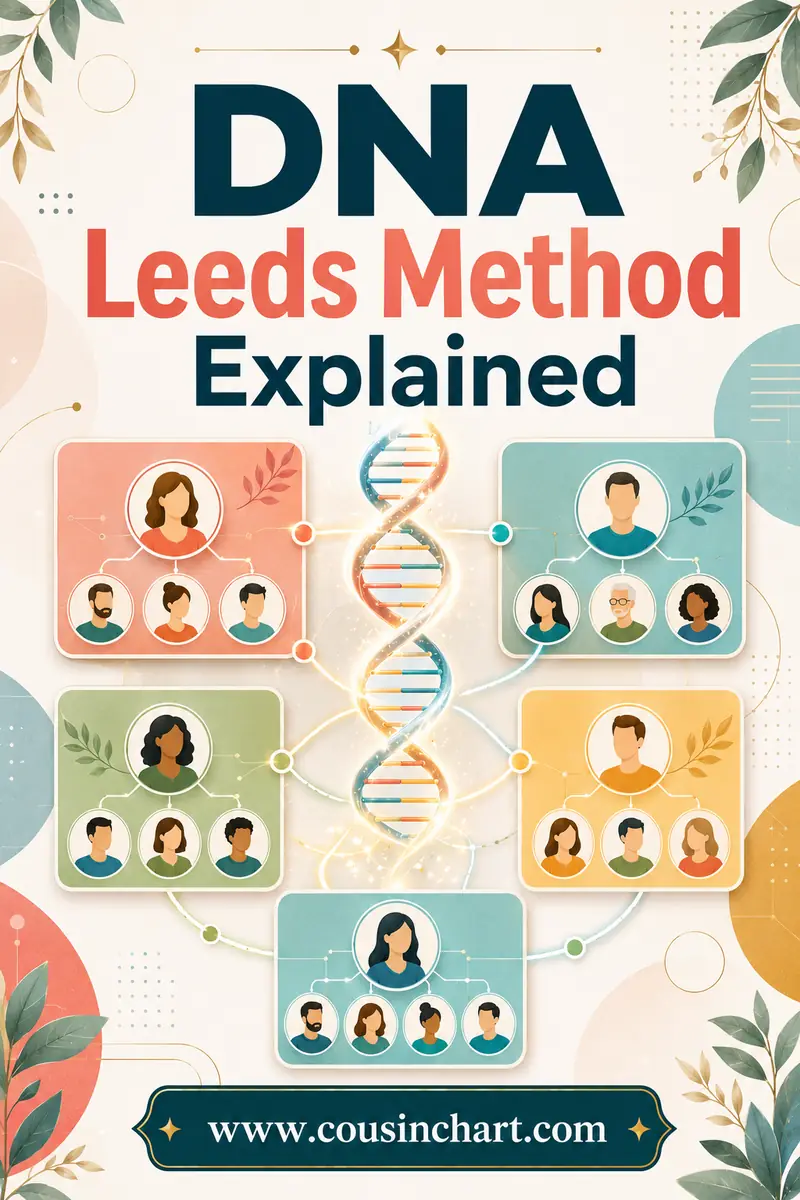
The Leeds Method is the standard approach and needs nothing but a spreadsheet and an afternoon. You list matches in roughly the 90–400 cM range, then use each one's shared-match list to assign colors. Matches that share with each other get the same color. Most people end up with four groups, corresponding to four grandparent lines. MyHeritage and GEDmatch both offer automated clustering that produces the same colored grid without the manual work — same logic, less spreadsheet.
Step 5: Build quick trees and look for convergence
For each of your closest matches in a cluster, build a fast, rough tree — a "quick and dirty" tree, which is the term the community genuinely uses. Obituaries are the fastest tool here, because one obituary names parents, siblings, children and grandchildren in a single paragraph. FamilySearch, FindAGrave, census records and newspaper archives fill in the rest.
Build three or four trees in the same cluster and watch for a couple who appears in all of them. That's your common ancestral couple for that line. Do the same in a second cluster and you get a second couple. Then the geometry finishes the job: your birth parent descends from both couples, so you work the descendants of each forward and look for a marriage joining the two lines. The children of that marriage are your candidate list. Our full walkthrough of an unknown parent DNA search covers this stage in detail.
Step 6: Confirm before you conclude
Ages, geography, cM consistency, shared matches and records all have to agree. The guide to confirming a DNA match sets out the standard. Contacting the wrong person is the worst available outcome, and one more evening of checking prevents it.
Where Can Adoptees Get Free Help?
There's a real volunteer infrastructure for this, built by people who did their own searches and stayed to help.
- Search angels. Experienced volunteers who help adoptees free of charge through dedicated Facebook groups and forums. Many have solved hundreds of cases and can see in twenty minutes what you've stared past for three weeks.
- DNAAdoption. A long-running non-profit offering free and low-cost classes, written methodology and volunteer support built specifically around unknown-parentage searches.
- DNA Detectives and similar communities. Large groups full of people at every stage of the same process, from first kit to first Thanksgiving.
- State reunion registries. Free or cheap to register, and occasionally they simply work.
- Professional genetic genealogists. Paid, but they work to a deadline and handle complicated cases — endogamy, missing records, anything needing formal documentation.
Two tips before you post in a volunteer group: bring your numbers, not your life story, and do the basics first — test, upload, cluster. Arrive prepared and help comes fast.
How Long Does an Adoptee Search Take?
Honest ranges, assuming steady evening-and-weekend effort rather than full-time work:
| Situation | Realistic timeline |
|---|---|
| Parent or sibling already in your match list | Immediate identification |
| Half-sibling, aunt/uncle or grandparent match | Days to a few weeks |
| First-cousin match with a public tree | One to three weeks |
| First-cousin match, no tree | Three weeks to a few months |
| Second-cousin-level matches only | Two to six months |
| Third cousin and beyond only | Six months to years, or until someone closer tests |
| Paper records requests | Weeks to many months, entirely dependent on the office |
The variable nobody controls is who tests next. Cases that look permanently stuck resolve the week a first cousin gets a kit as a birthday present. If you're in the distant-match category, set a monthly reminder to check for new matches — five minutes a month has cracked a lot of searches.
What makes some searches harder
Endogamy. In populations where families intermarried across generations — Ashkenazi Jewish, Acadian, Puerto Rican and Low German Mennonite communities among many others — everybody shares more DNA with everybody. Shared cM figures inflate, the usual ranges stop meaning what the charts say, and clustering can produce one giant group instead of four clean ones. Mention it up front when asking for help, because the whole approach shifts.
Thin databases and distant records. Consumer testing skews toward people with European ancestry in the US and UK, so if your birth family's origins lie elsewhere your closest match may simply be further out than average. Recent immigration adds the same drag from a different direction: the records you need may be overseas, in another language, and not digitised. Neither is a flaw in your method — they just add months.
How Should You Make First Contact?
You've identified someone and confirmed it properly. This part has nothing to do with genealogy.
Think about everyone in the room
A birth parent may have a spouse who doesn't know. There may be children who've never been told they have an older sibling. There may be a reason for the original privacy that's still painful decades later, and some of those reasons are very difficult ones.
That doesn't mean don't reach out. It means the first message should be a door, not a demand, and it should go to the person directly rather than through a relative who might tell others first.
What a good first message looks like
- Short. Four or five sentences. Not your life story — there's time for that later.
- Clear but gentle. "DNA testing suggests we're closely related, and I'm hoping to learn about my family background."
- Explicitly low-pressure. Say you're not looking to disrupt anything, and that they're welcome to take all the time they need.
- Private. A direct message or a letter. Never a public post, never a comment on a relative's photo.
- Free of demands or accusations. Whatever you've concluded about how you came to exist, the first message isn't the place.
- With a way to reply. An email address they can use quietly.
Then wait. Silence for several weeks is normal and isn't the same as rejection — people need time to absorb something like this, and often need to talk to someone else before they answer. One polite follow-up after a month or two is reasonable. More than that isn't.
If the answer is no
Some people say no, and that has to be allowed even though it hurts. Have your support in place before you send anything, precisely because of this possibility. A closed door isn't always permanently closed — people reconsider over years — but it can't be forced, and pushing tends to seal it.
Meanwhile, other relatives often say yes. Half-siblings, cousins, aunts and uncles are frequently delighted, and for plenty of adoptees the lasting relationships that come out of a search aren't with a birth parent at all.
If they've already died
It happens, and it's a real loss even for someone you never met. There's usually still a great deal to learn: siblings, cousins, obituaries, photographs, people who knew them. Many adoptees find that assembling a picture of who their birth parent actually was carries genuine weight, even without a conversation.
The words you use matter
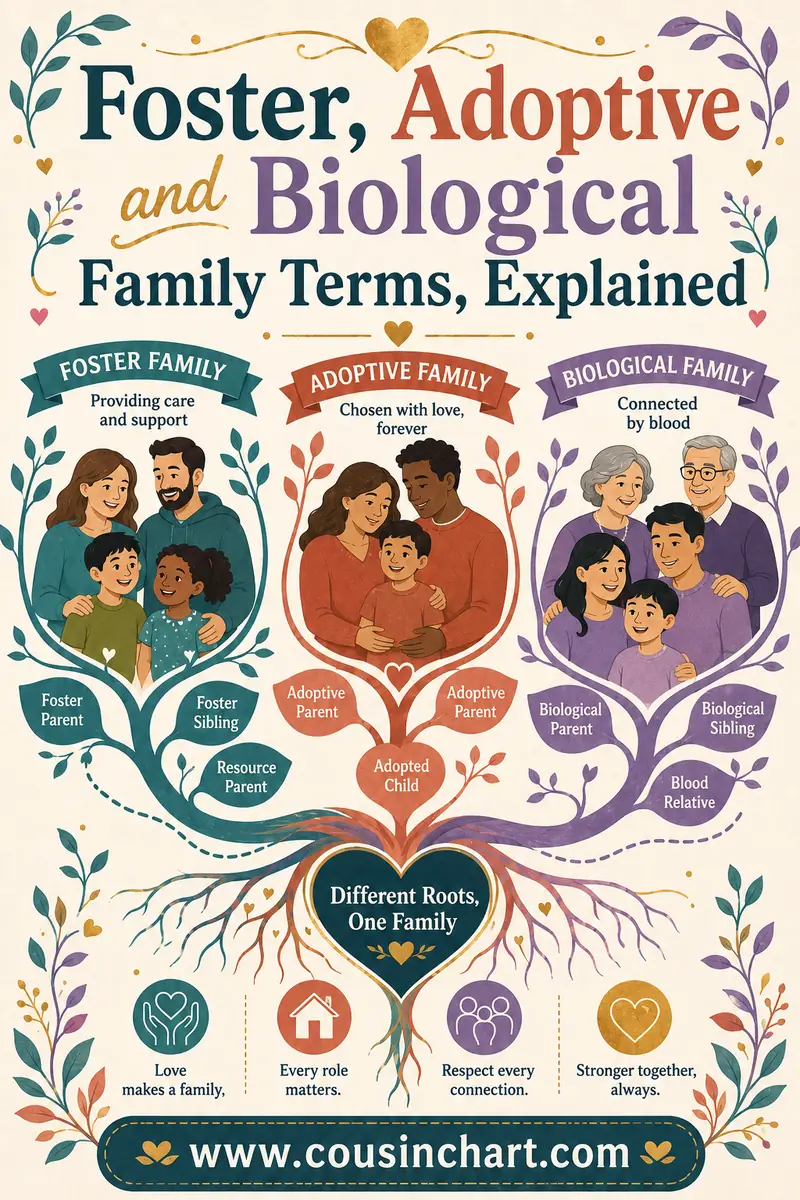
"Birth mother," "biological father," "first family," "natural parent" — different people feel differently about each of these, and getting it wrong can sting on both sides. Ask what someone prefers rather than assume. Our guide to foster and adoptive family terms walks through the vocabulary and why the choices carry weight.
How Do You Keep It All Organized?
Searches sprawl. Six months in you'll have match spreadsheets, half-built trees, screenshots, agency letters, and a note somewhere with the name of a hospital.
Keep a simple genealogy research log: what you searched, where, when, and what you found — including the dead ends. Keep one master spreadsheet of matches with cM totals and cluster colors, and screenshot match lists, because profiles get deleted and trees get set to private.
FAQ
Can adoptees find birth parents through DNA testing?
Yes, and it's now the most common route. Testing at AncestryDNA and uploading free to MyHeritage, FamilyTreeDNA and GEDmatch puts you in front of biological relatives regardless of what's in a sealed file. Cases with a close match often resolve within days; cases with only distant matches typically take months of steady tree-building.
What is non-identifying information and how do I get it?
It's a summary of your adoption file with names removed — often ages, occupations, education, ethnicity, physical descriptions, medical history and the circumstances of placement. Request it in writing from your state's adoption unit or the agency that handled the placement. Content and waiting times vary a lot, but it's free or cheap and frequently narrows a candidate list dramatically.
Can I get my original birth certificate as an adoptee?
That depends entirely on where and when the adoption took place, and the rules have changed considerably in recent years. Some places give adult adoptees direct access, some require a court order, and some work through mutual-consent registries. Check your own state or country's current process, or speak to a professional who handles adoption records there.
How much does an adoptee search cost?
The unavoidable cost is one DNA test, a modest one-off purchase that's frequently discounted. Uploads to MyHeritage, FamilyTreeDNA and GEDmatch are free, search angels and DNAAdoption are free, and records requests are usually free or a small administrative fee. A subscription or a professional researcher is optional.
Should I tell my adoptive family that I'm searching?
There's no rule, and both choices are common. Some adoptive families are supportive and even help; others hear it as rejection, which is worth anticipating and gently heading off. Plenty of adoptees wait until they have something concrete before saying anything. Whatever you decide, searching isn't disloyalty — wanting to know where you came from and loving the family who raised you aren't in competition.
What if my DNA results show something unexpected about my adoption story?
It's more common than people expect — a different birth father than the file suggests, siblings nobody mentioned, or a placement story that doesn't quite match the genetics. Verify carefully before acting, because early interpretations are often wrong. It's a good moment to bring in a search angel or an experienced genetic genealogist for a second opinion.
Take the Next Step, Not the Whole Journey
Adoptee genealogy is two tracks and a lot of patience: request whatever records your own state's process allows, test at the biggest DNA database, upload everywhere free, sort your matches into family lines, build rough trees until two lines meet at one couple, confirm it properly, and approach contact gently.
You don't have to do all of that this month. Pick the piece in front of you. If your results are already in, run your closest match's shared cM figure through the free DNA match calculator to see exactly which relationships fit, then work through the confirmation checklist before you conclude anything. If you haven't tested yet, the next step is simply ordering a kit and writing one letter.
Whatever you find, and whenever you find it, you get to decide what happens next.