How to Show Adoption on a Family Tree (Symbols, Layouts and Kind Wording)
If you're wondering how to show adoption on a family tree, the simplest answer is this: connect an adopted child to their adoptive parents just like any other child, and use a clear marker (a dashed line, a small label, or brackets around their name) to show the relationship is by adoption. If you know the birth family and want to include them, add them on a second line or a second tree. In a clinical-style chart called a pedigree, the standard is brackets around the adopted person and a dashed line to the adoptive parents.
There's no single "correct" way for every family. A genetic counselor needs a chart that shows biology. A family historian may want to record both families. A seven-year-old doing a school project mostly needs a tree that feels like theirs. This guide covers all three: the standard symbols, layout options that work on paper and in software, how genealogy programs store adoption behind the scenes, and kind, inclusive wording you can use with kids and relatives.
The quick answer: three ways to show adoption
Most approaches fall into one of three styles. Pick the one that fits your purpose, then add detail only where it helps.
| Style | How it looks | Best for |
|---|---|---|
| Simple family tree | The child sits under the adoptive parents like any sibling. A small note such as "adopted 2015" or a dashed connecting line marks the adoption, or nothing at all. | Wall art, gifts, reunions, young kids' projects |
| Two-family tree | The child is linked to adoptive parents with one line style and to birth parents with another, often in two branches or two side-by-side trees. | Genealogy research, open adoptions, adoptees who want both families shown |
| Pedigree or genogram | Brackets around the adopted person, a dashed line to adoptive parents, and biological parents shown if known. | Health history, genetic counseling, social work, school science units |
None of these is more "real" than the others. A simple tree that shows only the adoptive family is completely legitimate. So is a detailed chart that records both families. What matters is that the chart is accurate for its purpose and respectful of the people in it.
Standard adoption symbols in pedigrees and genograms
Two kinds of family diagrams have formal symbol sets, and both have conventions for adoption. A pedigree is a chart used in genetics and medicine to show how traits or health conditions pass through a family. A genogram is a related chart used in counseling and social work that also shows relationships, households and emotional ties. If you're new to them, our pedigree chart guide and genogram examples show the basics.
The NSGC pedigree convention
The National Society of Genetic Counselors (NSGC) published standard pedigree symbols in 1995. In their paper in the American Journal of Human Genetics, Bennett and colleagues noted that earlier surveys had found significant inconsistencies in how common symbols were used, including for adoption. Their recommendations became the reference most genetics courses and clinics still use, and the task force has updated them since, most recently in a 2022 revision focused on symbols and language that respect individual differences and identities.
The University of Iowa's human genetics program summarizes the adoption convention in its guide to how to draw a pedigree:
- Brackets go around the adopted person's symbol, like [ □ ] for a male or [ ○ ] for a female.
- A dashed line from the parents down to the child means the person was adopted into that family.
- A solid line to a bracketed child means the person was adopted out of that family, so the line connects them to their biological parents.
So a single adopted child may appear with two sets of lines: a dashed line up to the adoptive parents and, if the birth parents are known and included, a solid line up to them. The brackets tell anyone reading the chart, at a glance, that adoption is part of this person's story.
Why does a medical chart care? Because health conditions follow biology. If a doctor looks at a pedigree and sees heart disease in an adoptive grandparent, that doesn't affect the adopted grandchild's genetic risk. The brackets and line styles prevent that mix-up.
Genogram conventions
Genograms borrow many pedigree symbols but are used by therapists, social workers and child welfare agencies, and their conventions vary more. Many genogram guides draw adoption with a dashed or dotted line to the adoptive parents, sometimes with brackets or an "A" label. Some use a different line style for foster placements. Agencies often add their own rules. The Georgia Division of Family and Children Services, for example, describes the genogram as an information-gathering tool to show the family visually, and its genogram policy tells caseworkers to place a dotted line around household members and to embrace cultural differences when deciding who counts as family.
Because the styles differ, the single most useful habit is to include a legend: a small box that says what each line means. "Dashed line = adopted into family; dotted circle = lives in the same home" removes all guesswork.
Symbol cheat sheet
| Situation | Common pedigree or genogram notation | Plain family tree option |
|---|---|---|
| Adopted into this family | Brackets around symbol, dashed line to adoptive parents | Dashed line or "adopted" label |
| Adopted out of this family | Brackets around symbol, solid line to birth parents | Note under the birth parents: "child placed for adoption, 1988" |
| Birth parents known | Solid line to biological parents, plus dashed line to adoptive parents | Second branch or second tree for the birth family |
| Birth parents unknown | Bracketed person with no biological parents drawn, or a question mark | Leave that side blank or write "birth family" with no names |
| Step-parent adoption | Dashed line from the adopting step-parent; solid line from the biological parent | Same tree; note "adopted by stepfather, 2019" |
| Foster child, not adopted | Varies; often a dotted line, with the legend explaining it | Include with a "foster" note, or leave off if they prefer |
Layout options for showing adoption on a family tree
Symbols handle the lines. Layout handles the bigger question: where do the two families sit on the page? Here are the layouts that work best, with the trade-offs of each.
Option 1: One tree, adoptive family only
The adopted person sits in their adoptive family exactly like any biological child, with or without a marker. This is the most common layout for decorative trees, family reunion charts and young children's projects. It's clean and simple, and it reflects how the family actually lives.
The downside is that it says nothing about the person's birth family. That's fine for a living-room tree. It's a problem for genealogy research or health history, where it can lead relatives to assume biological ties that aren't there.
Option 2: One tree with a birth-family branch
The adopted person appears once, with lines going up to both sets of parents: adoptive parents on one side, birth parents on the other, each with a different line style. This mirrors what genealogy software does internally. It works well for open adoptions where the child knows and has contact with birth relatives.
It can get crowded, especially once you add grandparents on both sides. A good fix is to keep the birth-family branch short (birth parents and maybe birth siblings) and continue it on a separate page if needed.
Option 3: Dual trees side by side
Two complete trees share one person: the adoptee at the center, with the adoptive family tree growing on one side and the birth family tree on the other. Some families draw this as a tree with two sets of roots, or as two trees whose branches touch.
Dual trees are popular with adult adoptees who've found birth relatives, and with families who want to honor both sides equally. They also make health history clearer, because the biological side is easy to find.
Option 4: A "rooted tree" for kids
A common kid-friendly version puts the child in the trunk, birth family in the roots, and the family they live with in the branches. Writing for PBS KIDS for Parents, adoptive parent Nefertiti Austin also suggests a classroom "family forest," with different kinds of trees for birth, adoptive and blended families. A forest takes the spotlight off any one child, because every kind of family gets its own tree.
Choosing a layout
| Your goal | Suggested layout | Line style |
|---|---|---|
| Decorative tree or gift | One tree, adoptive family | Solid lines, optional "adopted" note |
| Family history research | One tree with birth-family branch, or dual trees | Dashed for adoptive, solid for biological, with a legend |
| Health history for a doctor | Pedigree with brackets | NSGC-style: dashed in, solid out |
| Young child's school project | Whatever the child chooses: one tree, rooted tree or family forest | Whatever feels comfortable; no labels required |
| Blended family with adoption and step relationships | One tree with a legend for each relationship type | Different styles for adoptive, step and biological ties |
If your family also includes stepparents, half-siblings or several households, our blended family tree template gives you a layout built for that.
Step-by-step: how to show adoption on a family tree you're drawing by hand
Here's a practical method for a paper or poster tree. It works for most families, and you can simplify any step.
- Decide the purpose first. Is it for display, research, a doctor or a class? The purpose decides how much detail you need.
- Ask the adopted person, if they're old enough. How they want to be shown matters more than any convention. Some want "adopted" written beside their name. Many don't.
- Draw the adoptive family as usual. Put the child in birth order with their siblings, connected to the parents who raised them.
- Choose a marker if you want one. A dashed line, brackets, a small heart, or a short note like "joined our family 2016." Keep it consistent.
- Add birth family only if it fits. If you include them, give them their own branch or tree and use a different line style.
- Add a legend. One line per symbol. Without a legend, a dashed line can be confused with other things (in some genograms, for example, a dashed line between partners means they live together without marriage).
- Check the generations. Adopted children are placed in the generation of the parents who adopted them. If a grandparent adopts a grandchild, the child is drawn as their child, in the same row as their aunts and uncles. More on that below.
If you're starting a tree from scratch, our guide on how to draw a family tree covers spacing, generations and lines in more detail.
Special cases and how to handle them
Real families don't always fit the textbook diagram. These are the situations that come up most often, with a clear way to draw each.
Step-parent adoption
When a stepparent legally adopts their spouse's child, the child has one biological parent and one adoptive parent in the same couple. Draw a solid line from the biological parent and a dashed line from the adopting stepparent, or put a short note on the couple's line: "Emma adopted by Mark, 2019." If the other biological parent is known and the family wants them included, they can appear in a separate branch.
Genealogy software handles this neatly, as you'll see in the software section. The GEDCOM standard even has a way to record that only one partner in a couple did the adopting.
Kinship adoption: grandparents, aunts and uncles
When a relative adopts a child, the same person can be two things at once. A grandmother who adopts her grandson is legally his mother and biologically his grandmother. His birth mother is legally his sister and biologically his mother.
There's no perfect drawing for this. Two good options:
- Draw the biology and note the adoption. Keep the child under his birth mother, then add a dashed line from the grandparents with the note "adopted by grandparents, 2012."
- Draw the legal family and note the biology. Put the child under his grandparents with a dashed line, and add a solid line to his birth mother.
Either way, the family itself should decide which relationship goes front and center. If you're dealing with relatives raising children without formal adoption, our guide to kinship care explains the terms.
Open adoption and ongoing contact
In an open adoption, the adoptee knows and may visit birth relatives. Many families want the tree to reflect that. The Child Welfare Information Gateway, a service of the US Department of Health and Human Services, says that adopted children can benefit significantly from maintaining relationships with their families of origin, including through less grief and loss and a stronger sense of identity. A tree that includes the birth family, with clear labels, can be one small, visible way of honoring those relationships.
Closed adoption or unknown birth parents
If the birth parents aren't known, leave that side of the chart empty or add a single box marked "birth family." Avoid "unknown" in big letters on a child's tree if it's likely to upset them. In a pedigree for a doctor, a bracketed person with no biological parents drawn is enough to show that the biological history isn't available, which is itself useful medical information.
Siblings adopted into different families
Birth siblings who were placed in different homes can be shown with a solid sibling line through their shared birth parents, then each linked by a dashed line to their own adoptive family. This works well on a dual-tree layout.
Foster children
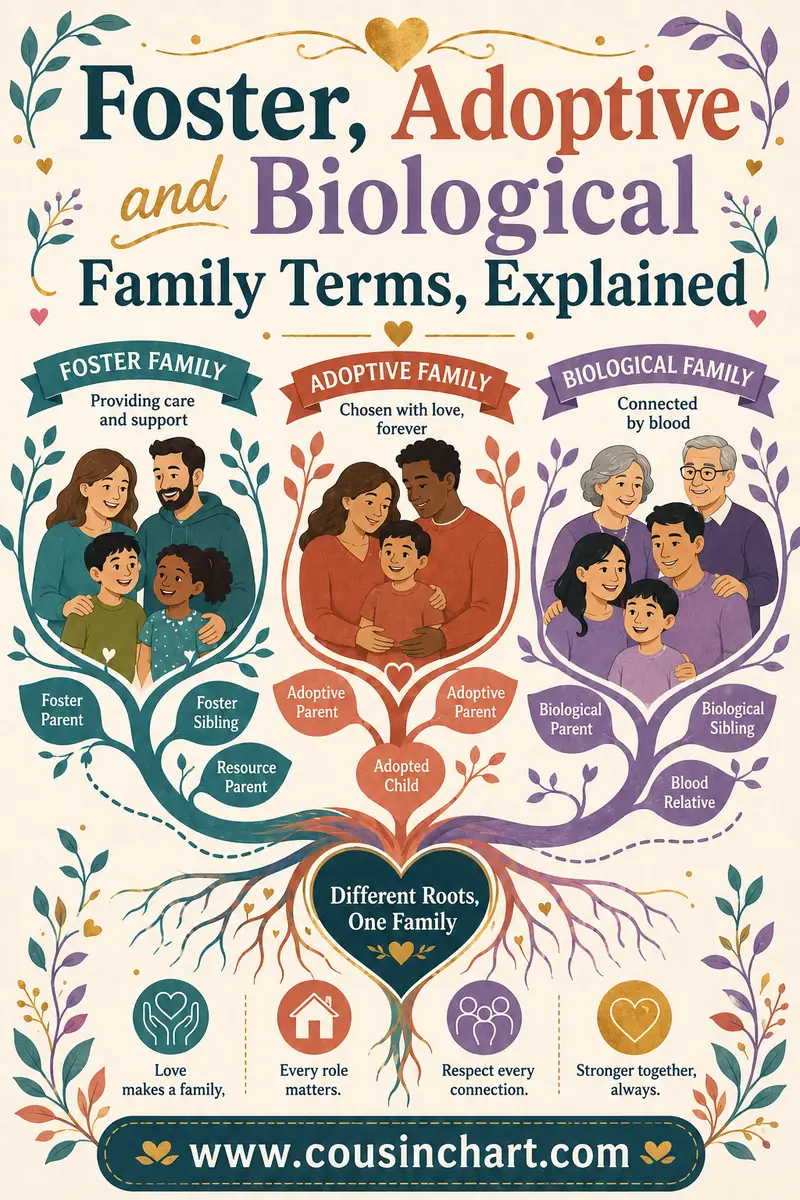
A foster child who hasn't been adopted isn't legally part of the family, but they may be very much part of family life. On a decorative or school tree, include them if they want to be included, and note "foster" only if it helps. On a genogram, use the agency's or legend's style. Our guide to foster and adoptive family terms explains the vocabulary.
Adult adoption
Some people are adopted as adults, often by a stepparent who raised them. Draw it the same way as any adoption, with a date note if it helps explain why the person's name changed partway through their life.
How genealogy software handles adoption
Most family tree programs, from desktop software to online trees, let a child have more than one set of parents and let you label each parent-child link. The details and menu names vary, but the idea is the same everywhere: the child is one person, linked to two families, with each link marked by type.
What GEDCOM says
GEDCOM is the standard file format for sharing family trees between programs, maintained by FamilySearch. The FamilySearch GEDCOM 7 specification builds adoption in at two levels:
- Several families per child. A person can have multiple links to families as a child. So one person can be the child of an adoptive couple and of a birth couple in the same file.
- A pedigree type on each link. Each child-to-family link can carry a type: ADOPTED (the adoptive parents), BIRTH, FOSTER (a foster or guardian family), SEALING (a religious ordinance used by some churches), or OTHER with a short explanation.
- An adoption event. GEDCOM also has an adoption event that can say which partner adopted: HUSB, WIFE or BOTH, using the spec's labels. That's how a file records a step-parent adoption where only one person in the couple adopted the child.
One interesting detail: the specification notes that people use BIRTH in two ways, either for genetic parents or for the family structure at the time of birth, so software shouldn't assume which one is meant. If you care about the difference, add a note to the record.
Practical software tips
- Set the relationship type on every link. Some programs treat an unlabeled parent link as biological. If you skip this step, the program, and any DNA tools connected to it, may assume a biological tie.
- Choose a "preferred" set of parents. Most programs let you pick which parents appear by default in charts. Many families pick the adoptive parents.
- Keep sources separate. Attach adoption decrees, amended birth certificates and original birth records to the right relationship, not just to the person.
- Think about privacy. Adoption details about living people are sensitive. Keep living people private in any online tree, and ask before sharing birth-family names.
- Check exports. Before sharing a GEDCOM file, open it in another program and make sure the adoption labels came through.
Recording names and documents
Adoption often means a name change, and sometimes two birth certificates: the original one and an amended one issued after the adoption that lists the adoptive parents. In your software, record the name the person uses as their main name and add any birth name as an alternate name, if the adoptee is comfortable with that. Attach documents to the matching relationship and add a note that says where each one came from. Rules on who can see original birth certificates and sealed adoption files vary a lot by state and country, so don't assume a record is available, or that it's appropriate to share, just because it exists. For older generations, adoption records may be held by courts, agencies or archives, and a family Bible or letter may be the only clue.
Why it matters for DNA
If you or a relative have taken a DNA test, labels become even more important. Matching tools compare shared DNA with the relationships in your tree. An adopted cousin who's marked as biological will look like a "missing" match, because they don't share DNA through that line. Marking the link as adoptive keeps the tree honest and prevents confusion. For more on this, see our guide on why you might not match a known relative.
Kind, inclusive wording for families and kids
The words on a family tree matter, especially when a child will read them. Here's wording that many adoptive families and adoption professionals prefer, along with the phrases that tend to sting.
| Instead of | Try | Why |
|---|---|---|
| Real parents, natural parents | Birth parents, birth mother, birth father | Adoptive parents are real parents; "natural" implies the adoptive family is not |
| Gave up for adoption | Placed for adoption, made an adoption plan | Less loaded, and closer to how many birth parents describe it |
| Is adopted | Was adopted, joined the family through adoption | Adoption is something that happened, not a permanent label |
| Own child, their own kids | Biological children, birth children | All the children are the parents' own |
| Unknown, nobody | Birth family, or simply leave blank | Gentler on a child's tree |
There's no rule that you have to use these exact phrases, and some adoptees prefer other words, like "first mother." The guiding idea is to ask the person, follow their lead, and avoid wording that ranks one family above the other.
Labels on the chart itself
On a tree, short labels work best. Some options families like:
- "Joined our family 2014" instead of "adopted 2014"
- "Birth family" as a heading over the biological branch
- A heart or star symbol with a legend: "☆ = joined through adoption"
- No label at all, which is a perfectly good choice
How to show adoption on a family tree for a school project
School family tree assignments are one of the most common places adopted kids feel stuck. The classic assignment, with a single tree, baby photos and eye color, can leave a child feeling they have to explain their history to the whole class.
For parents
- Talk with your child first. Ask what they want to include. Some kids are proud to share their adoption story; others want a tree that looks like everyone else's. Both are fine.
- Talk with the teacher. Most teachers are glad to adjust. Austin's PBS article suggests asking the teacher to read a book about adoption to the class beforehand, and it reminds parents that teachers may need some education about adoption.
- Share what you know in kid-friendly terms. Austin also suggests giving your child a few facts about their birth family, like a country of origin or a photo, so they can answer classmates' questions with confidence.
- Use alternatives when information is limited. A photo collage of memories the family has made together works well when early photos or birth-family details aren't available.
The Child Welfare Information Gateway's factsheet on parenting your adopted school-age child covers this age more broadly, including talking honestly with your child about adoption, acknowledging their adoption history and supporting their school experience.
For teachers
Small changes make the assignment work for every student, not just adopted children. Kids in foster care, kinship care, blended families and single-parent homes all benefit.
- Offer more than one format: a traditional tree, a rooted tree, a family forest, or a "people who care for me" web.
- Let students choose who to include, without requiring biological relatives or baby photos.
- Skip trait-tracking assignments like "Which parent do you get your eye color from?" or give students the option to use any family, a famous family, or an invented one.
- Don't ask a child to explain their family to the class.
For ready-made layouts, our family tree templates for kids include simple versions that leave room for any kind of family.
A short example
Maya is eight. She was adopted from foster care at three and has a younger brother who was born to her adoptive parents. Her tree has Mom and Dad at the top, Maya and her brother underneath with plain solid lines, and Grandma and Grandpa on both sides. In the corner, at Maya's request, there's a small heart with her birth mom's first name. She didn't want any label, and she didn't need one. Her tree is accurate, complete and hers.
Worked example: one family drawn three ways
It helps to see the same family on different charts. Meet the Okafor-Lindqvist family (a made-up example). Daniel and Sofia have two children. Leo, 12, was born to them. Ava, 9, was adopted as a newborn in an open adoption, and she sees her birth mother, Jess, a couple of times a year. Ava also has a birth half-brother, Sam, who lives with Jess.
Version 1: the living-room tree
Daniel and Sofia sit at the top, joined by a marriage line. Leo and Ava hang below them in birth order, Leo first, with identical solid lines. Both sets of grandparents sit above. There's no label on Ava. This is how Ava asked to be shown, and it's exactly how the family lives day to day.
Version 2: the family history tree
The same tree, but now Ava's line to Daniel and Sofia is dashed, and a legend in the corner reads "dashed line = joined through adoption." To the right, a small branch shows Jess with a solid line down to Ava and another to Sam, so Ava and Sam appear as half-siblings through their birth mother. Jess's parents are added above her once Ava's family and Jess agree. In the software version of this tree, Ava has two parent families: Daniel and Sofia marked as adopted, and Jess marked as birth.
Version 3: the pedigree for a doctor
When Ava's pediatrician asks about family health history, the family brings a pedigree. Ava's circle has brackets around it. A dashed line runs up to Daniel's square and Sofia's circle, and a solid line runs up to Jess. Jess has shared that her father has type 1 diabetes, so his symbol is shaded and a short key explains it. Leo's symbol hangs from Daniel and Sofia with a solid line. At a glance, the doctor can see that Leo's genetic history runs through Daniel and Sofia, and Ava's through Jess.
Three charts, one family, all accurate. The difference is purpose. If you take one lesson from this guide, it's that the "right" way to show adoption depends on who's going to read the chart and why.
Common mistakes to avoid
- Treating adoption as a footnote in a medical chart. For health history, always show adoption clearly, because biology matters for risk. The NSGC-style brackets exist for exactly this reason.
- Making the adoptee a "branch" off to the side. On a family tree, the adopted child belongs in birth order with their siblings, not in a separate corner.
- Mixing line styles without a legend. Dashed lines mean different things in different charts. Always say what yours means.
- Sharing birth-family details without permission. Names of birth parents, especially in a closed adoption, are private. Ask before putting them on anything public.
- Forcing labels on kids. A child's tree doesn't need to announce their adoption. Let them decide.
- Getting the generations wrong in kinship adoption. Decide whether you're drawing the legal or biological relationship, then note the other.
If you're unsure what to call someone in a mixed family, like your adopted brother's birth sister or your stepmother's adopted son, our guide to foster and adoptive family terms is a good place to look.
Wrap-up
Showing adoption on a family tree comes down to three choices: what the chart is for, how much detail it needs, and what the adopted person wants. For a decorative or school tree, simple is fine and labels are optional. For research, record both families with clear line styles and a legend. For health history, use NSGC-style brackets with dashed lines to adoptive parents and solid lines to biological ones. In software, set the relationship type on every parent link so your tree and DNA tools stay accurate.
Once your tree is drawn, you might want to know exactly what to call everyone on it, from a birth cousin to an adoptive great-aunt. Our free family relationship calculator works out the relationship between any two people in seconds.
Keep reading: Can Step-Siblings Date or Marry? The Law, the Family and What to Think About.
Frequently Asked Questions
What is the symbol for adoption on a family tree?
In medical pedigrees, the standard set by the National Society of Genetic Counselors puts brackets around the adopted person's square or circle. A dashed line connects them to the parents who adopted them, and a solid line connects them to their biological parents if those are shown. Genograms used in counseling and social work often use a dashed or dotted line, sometimes with an "A" label, but styles vary between agencies. On an ordinary family tree there's no required symbol at all, so many families use a dashed line, a small heart, or a short note, along with a legend explaining it.
Should an adopted child be on the family tree?
Yes. An adopted child is a full member of their adoptive family and belongs on the family tree in birth order with their siblings, connected to the parents who adopted them. Whether you also mark the adoption is a separate choice. Many families don't label it at all on decorative or reunion trees. For genealogy research or health history, it's helpful to mark the relationship as adoptive so no one assumes a biological tie. If the adopted person is old enough, ask how they'd like to be shown.
Do you put birth parents on an adopted child's family tree?
You can, but you don't have to. It depends on the purpose of the tree and what the adoptee and family want. For an open adoption with ongoing contact, many families include birth parents on a separate branch or a side-by-side tree. For health history, showing biological relatives helps doctors assess genetic risk. For a decorative tree or a young child's school project, it's perfectly fine to show only the adoptive family. If birth parents are included, use a different line style and a legend, and get permission before sharing their names anywhere public.
How do you show a step-parent adoption on a family tree?
Draw the couple as usual, then connect the child with a solid line from the biological parent and a dashed line from the stepparent who adopted them. A short note on the couple's line, such as "adopted by stepfather, 2019," makes it clear. If the other biological parent is known and the family wants them included, they can appear on a separate branch. In genealogy software, link the child to the couple and mark the relationship to the stepparent as adopted. The GEDCOM standard can even record that only one partner in the couple did the adopting.
What does a dashed line mean on a family tree?
It depends on the chart. On a medical pedigree, a dashed line from parents to a child usually means the child was adopted into that family. On many genograms, a dashed line between two partners means they live together without being married, while a dashed or dotted line to a child can mean adoption or foster care. On homemade family trees, people use dashed lines for all sorts of things, including step relationships. That's why it's important to add a small legend explaining what every line style means on your particular chart.
How do I help my adopted child with a family tree school project?
Start by asking your child what they want to include and how they want their tree to look. Then talk to the teacher about flexible options, such as a rooted tree with birth family in the roots and the adoptive family in the branches, a family forest, or a collage of family memories. Share a few kid-friendly facts about the birth family, if you have them, so your child can answer questions comfortably. Your child shouldn't have to explain their adoption to the class, and a tree showing only the family they live with is completely valid.
How does Ancestry or FamilySearch handle adopted children?
Major family tree programs let a child be linked to more than one set of parents and let you set the type of each parent-child relationship, such as biological, adopted, step, foster or guardian. The exact menus and labels differ between programs, so check the relationship settings on the person's profile. Under the hood, the GEDCOM standard used to move trees between programs supports multiple parent families per child and a pedigree type on each link. Set the type on every link, since an unlabeled parent link may be treated as biological by charts and DNA tools.
Is it okay to say real parents or natural parents?
Most adoption professionals and many adoptive families suggest avoiding those phrases, because they imply the adoptive parents aren't real or natural. "Birth parents," "birth mother" and "birth father" are widely used instead. Similarly, "placed for adoption" or "made an adoption plan" is usually preferred over "gave up for adoption." That said, some adoptees choose other words, like "first mother," and it's their story to tell. The kindest approach is to ask the adopted person what they prefer and follow their lead, especially on anything a child will see.
Why do genetic pedigrees mark adoption so carefully?
Because genetic risk follows biology, not legal family ties. If a doctor sees a condition in an adoptive grandparent, that doesn't change an adopted grandchild's inherited risk. The brackets and line styles in a pedigree make it clear who is biologically related to whom, so health patterns aren't misread. When biological family history isn't available, the bracket itself tells the doctor that, which is useful information too. This is about accuracy for medical decisions, not about ranking families, and it's one reason it's worth recording what you know about the birth family's health if you can.
Sources
We checked every source below while writing this guide. Last reviewed October 30, 2026, by Joan Ramos.
- Recommendations for standardized human pedigree nomenclature (Bennett et al., 1995) (American Journal of Human Genetics, via PubMed Central)
- Practice resource-focused revision: Standardized pedigree nomenclature update centered on sex and gender inclusivity (Bennett et al., 2022) (Journal of Genetic Counseling, via PubMed)
- How to draw a pedigree (University of Iowa Carver College of Medicine, Human Genetics)
- 19.19 Genogram (policy manual) (Georgia Division of Family and Children Services)
- The FamilySearch GEDCOM Specification, version 7 (FamilySearch)
- Helping Your Adopted Children Maintain Important Relationships With Family (Child Welfare Information Gateway, U.S. Department of Health and Human Services)
- Parenting Your Adopted School-Age Child (Child Welfare Information Gateway, U.S. Department of Health and Human Services)
- Navigating Family Heritage Assignments With Adopted Children (Nefertiti Austin) (PBS KIDS for Parents)