My Parents Are Cousins: What Does That Make Me?
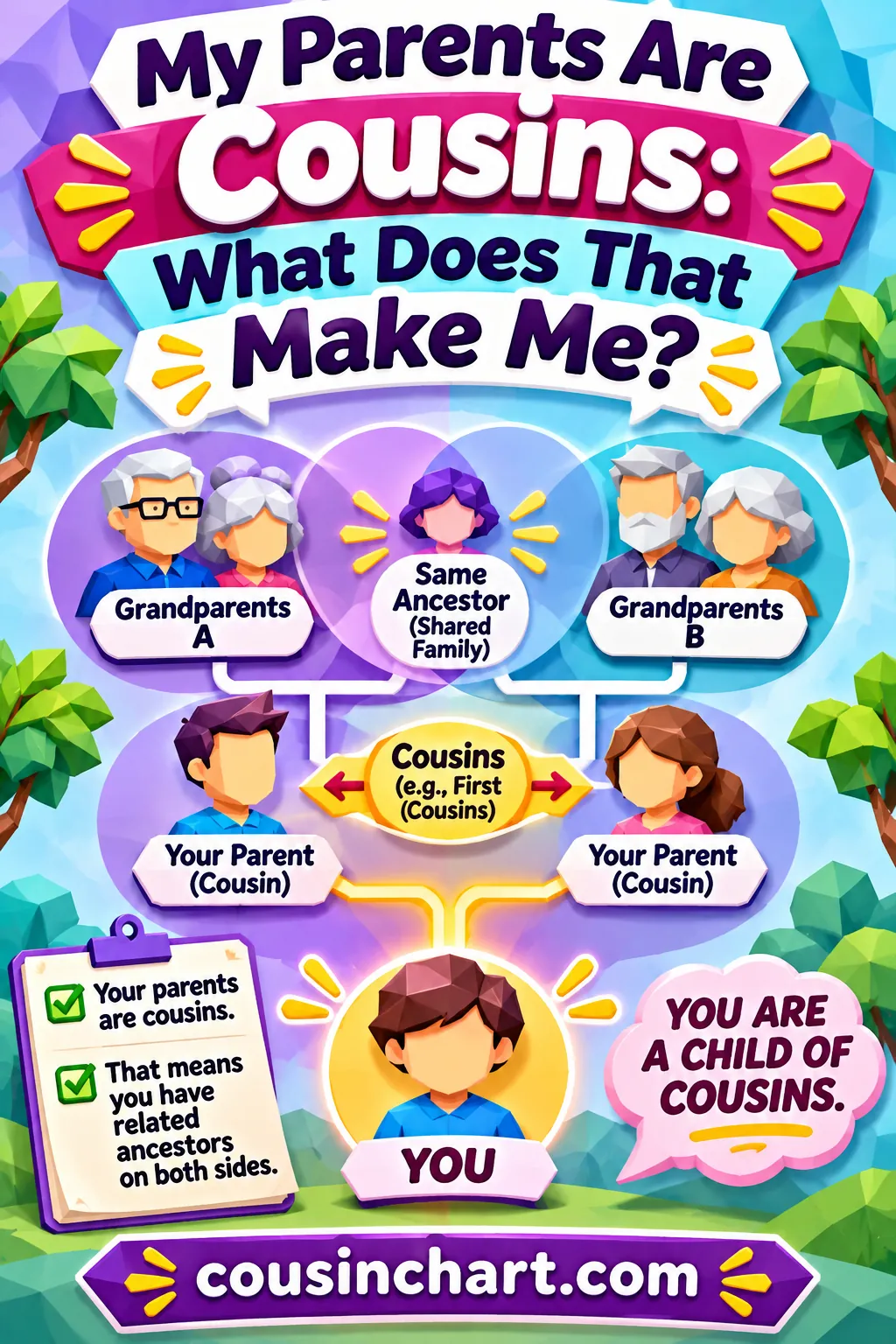
If your parents are cousins, you're still simply their child, but many of your relatives are connected to you along two paths at once. Your mom can also be your first cousin once removed through your dad's side, and some cousins can be both first and second cousins to you. The free Cousin Chart relationship calculator can name each path separately, so you can see exactly how the overlap works.
This is more common than many people think, especially a few generations back. You might learn it from a family tree, a DNA test, or a relative who mentions it in passing. Either way, the labels are something you can work out calmly and clearly. Here's how, with worked examples for first, second and half cousins, the exact calculator settings for each path, and a few words you can use when the topic comes up.
▶ Work it out in the free calculator
The Short Answer: One Person, Two Paths
A normal family tree has two separate sides. Your mom's relatives are on one side, your dad's are on the other, and they don't overlap.
When your parents are cousins, the two sides meet. Somewhere above your parents there's an ancestor, or a couple, who appears on both your mom's side and your dad's side. Every relative who descends from that shared ancestor can reach you along two routes.
So the answer to "what am I?" has two parts:
- To your parents, you're their child. Nothing changes there.
- To the relatives who descend from the shared ancestors, you may have two relationships at once. One through your mom, one through your dad.
Genealogists call this a double relationship. The family-tree name for the overlap at the top is pedigree collapse, because the number of different ancestors in your tree "collapses" when the same people show up twice.
Who gets a second path, and who doesn't
Only relatives who descend from the shared ancestors pick up a second path. Everyone else connects to you just once.
| Relative group | Second path? | Why |
|---|---|---|
| Descendants of the couple your parents share | Yes | They can reach you through your mom and through your dad |
| Your mom's other grandparents' families | No | They connect only through your mom |
| Your dad's other grandparents' families | No | They connect only through your dad |
| In-laws who married into the family | No | They aren't blood kin on either path |
| Your full siblings | No new label | You share both parents, so the overlap is identical for you both |
A Worked Example: Parents Who Are First Cousins
Let's build one family and run the math. Say your parents are first cousins.
- Your mom's mother is Rose.
- Your dad's father is Walter.
- Rose and Walter are sister and brother. Their parents, Henry and Clara, are your great-grandparents.
Because Rose and Walter are siblings, their children (your mom and your dad) are first cousins. Henry and Clara are your great-grandparents twice: once through your mom and once through your dad.
Here's how your close relatives look on each path.
| Relative | Path through your mom | Path through your dad (via Henry and Clara) | Combined description |
|---|---|---|---|
| Your mom | Mother | First cousin once removed | Mother, also 1C1R |
| Your dad | First cousin once removed | Father | Father, also 1C1R |
| Rose (mom's mother) | Grandmother | Great-aunt | Grandmother and great-aunt |
| Walter (dad's father) | Great-uncle | Grandfather | Grandfather and great-uncle |
| Mom's sister | Aunt | First cousin once removed | Aunt and 1C1R |
| Mom's sister's kids | First cousins | Second cousins | First and second cousins |
| Dad's brother's kids | Second cousins | First cousins | First and second cousins |
| Henry and Clara | Great-grandparents | Great-grandparents | Great-grandparents twice |
Not everyone gets a double label. Your mom's father's family, for example, connects to you only through your mom. Only relatives who descend from Henry and Clara pick up a second path.
Checking the math on your mom
The closest ancestors your mom and dad share are Henry and Clara. Count down from them.
- Henry and Clara → Rose → your mom. That's 2 generations.
- Henry and Clara → Walter → your dad → you. That's 3 generations.
Two and three: the smaller number, 2, means first cousin. The difference, 1, means once removed. So along your dad's side, your mom is your first cousin once removed. The same math works for your dad along your mom's side.
That sounds strange to say out loud, and almost nobody does. In daily life she's your mom. The second label only matters for family trees and DNA.
Checking the math on your cousins
Take your mom's sister's son, Ben.
- Through your mom: you and Ben share your mom's parents. You're both 2 generations down. First cousins.
- Through your dad: you and Ben share Henry and Clara. Ben is 3 generations down (Henry and Clara → Rose → Ben's mom → Ben). You're 3 down too, via Walter and your dad. Second cousins.
So Ben is both your first cousin and your second cousin.
More relatives in the same family
Here are a few people the first table didn't cover, using the same Rose and Walter family.
Your dad's sister, June. Through your dad, she's your aunt. Through your mom, she's a granddaughter of Henry and Clara (2 down), and you're 3 down. That's first cousin once removed. So June is your aunt and your first cousin once removed, the mirror image of your mom's sister.
Rose's other brother, Frank. Frank is a child of Henry and Clara, 1 generation down. Through your mom, you're 3 down from Henry and Clara, so Frank is your great-uncle. Through your dad, you're also 3 down, so he's your great-uncle again. He's your great-uncle twice, by two routes that happen to give the same name.
Frank's grandchild, Lily. Lily is 3 generations down from Henry and Clara. You're 3 down on each path. So she's your second cousin through your mom and your second cousin through your dad: a double second cousin.
Ben's child, Max. Through your mom, Max is your first cousin's child: first cousin once removed. Through your dad, Max is your second cousin's child: second cousin once removed. Two removed labels at once.
Your own child, Nora. The double paths carry down to the next generation. Nora is 4 generations down from Henry and Clara through you and your mom, and also 4 down through you and your dad. To Ben, she's a first cousin once removed through your mom's side and a second cousin once removed through your dad's side, the same pair of labels Max has with you. To Rose, she's a great-granddaughter and also a great-grandniece. Henry and Clara are her 2nd great-grandparents twice. Each generation, the second path moves one step further out and matters a little less in daily life, but it stays on the tree.
What If Your Parents Are Second Cousins or Further?
The same idea applies, but the overlap sits higher up the tree and affects fewer people in a noticeable way.
If your parents are second cousins, they share great-grandparents. Those people are your great-great-grandparents on both sides. Your mom would be your second cousin once removed through your dad's side. Relatives who descend from that shared couple pick up a second, more distant path.
If your parents are third cousins or further, the shared ancestors are far enough back that the second path usually doesn't change how anyone thinks about the family. It mostly shows up in a genealogy program, which may list two routes to the same person.
Here's how your parents' link translates to you, at each level.
| Your parents are… | Ancestors they share | Those ancestors to you | Your mom, via your dad's side |
|---|---|---|---|
| First cousins | Grandparents | Great-grandparents | First cousin once removed |
| First cousins once removed | One's grandparents, the other's great-grandparents | Great- or great-great-grandparents | First cousin twice removed, or second cousin |
| Second cousins | Great-grandparents | Great-great-grandparents | Second cousin once removed |
| Third cousins | Great-great-grandparents | 3rd great-grandparents | Third cousin once removed |
The once-removed row depends on which parent is the generation closer, so it's worth running both paths in the calculator rather than guessing.
Worked example: parents who are second cousins
Say your mom and dad share great-grandparents, Otto and Greta. Your mom descends from their son Karl, and your dad from their daughter Elsa.
| Relative | Path through your mom | Path through your dad (via Otto and Greta) |
|---|---|---|
| Your mom | Mother | Second cousin once removed |
| Your mom's mother | Grandmother | First cousin twice removed |
| Karl (your mom's grandfather) | Great-grandfather | 2nd great-uncle (great-great-uncle) |
| Your mom's first cousin on Karl's line | First cousin once removed | Second cousin once removed |
| Otto and Greta | 2nd great-grandparents | 2nd great-grandparents |
Check your mom: Otto and Greta to your mom is 3 generations (Karl, Karl's child, your mom). Otto and Greta to you through your dad is 4 (Elsa, Elsa's child, your dad, you). The smaller is 3, so second cousin. The gap is 1, so once removed.
Check your grandmother: she's 2 down from Otto and Greta, and you're 4 down through your dad. Smaller is 2, so first cousin, and the gap is 2, so twice removed.
You can see the pattern. The second path still exists, but it's further out. Most families never mention it unless someone's building a tree.
Worked example: parents who are first cousins once removed
Say your dad's grandparents are your mom's great-grandparents. In other words, your dad is your mom's first cousin once removed, and he's the one closer to the shared couple.
- Your dad is 2 down from the shared couple, so through your dad you're 3 down: they're your great-grandparents.
- Your mom is 3 down, so through your mom you're 4 down: they're your 2nd great-grandparents.
The same couple are two different generations of your tree at the same time. Your mom, seen through your dad's side, is 3 down while you're 3 down, so she's your second cousin on that path. Your dad, seen through your mom's side, is 2 down while you're 4 down, so he's your first cousin twice removed on that path.
Half-cousins and double cousins
Two related setups often get mixed up with this one:
- Parents who are half-cousins. If Rose and Walter were half-siblings, sharing only one parent, then your parents would be half first cousins. Your mom would be your half first cousin once removed through your dad's side. The structure is the same; everything on the second path gets a "half."
- Double cousins. Double first cousins happen when two siblings marry two siblings from another family. That makes the children cousins on both sides, but their own parents aren't related to each other. It's a different pattern, explained in the guide to double cousins.
Edge Cases: Step, Adopted and By-Marriage Connections
Sometimes "my parents are cousins" turns out to mean something a little different. Here's how the labels work in those cases.
- Step-cousins. If your mom's mother married your dad's father's brother as a second marriage, your parents might call each other cousins without sharing any ancestors. That's a step relationship. There's no second blood path, and DNA won't show any overlap. In the relationship calculator, set the relation type to step to name it.
- Adopted into the family. If one of your parents was adopted, they may be cousins to the other parent socially and legally, without a blood tie. The family relationship is real. The genetic one isn't there, so your DNA won't show a double connection on that line.
- Cousins by marriage. If your mom was your dad's cousin's sister-in-law, they're connected by marriage only. Set the relation type to marriage and the calculator names the in-law tie.
- "Cousins" as a loose word. In many families, "cousin" covers anyone from the same town or church. Before you redraw your tree, check the actual records for a shared ancestor.
The guide to consanguinity explains how genealogists measure blood relationships like these, and how degrees of kinship are counted.
What This Means for DNA Results
If you've tested your DNA, having parents who are cousins can make some matches look a little different from the usual charts.
Relatives who are connected to you along two paths may share more DNA with you than a typical match with that label. For example, a cousin who is both your first and your second cousin may share somewhat more than the common first cousin average of about 866 cM, because the second path adds a bit on top. The typical averages people compare against are roughly 866 cM for first cousins, 229 cM for second cousins and 73 cM for third cousins, but real numbers vary, and the ranges overlap.
A few things you may notice:
- Matches that seem "closer" than their label. A cousin who matches you on both paths can land higher than expected.
- Matches that seem to fit both sides of your tree. When the testing service groups your matches into maternal and paternal sides, relatives from the shared family line can show up on both.
- Long stretches where your two copies of DNA are identical. Some tools and testing companies point these out for people whose parents are related. They're an expected result of the shared ancestry, not an error.
When a match seems too high for its label, check whether that person is on both sides of your tree before assuming the label is wrong.
Reading a double match, step by step
Say Ben, your first and second cousin, shares a number noticeably above the 866 cM first-cousin average.
- Name both paths: first cousin through your mom, second cousin through your dad's side.
- Note the averages for each: about 866 cM and about 229 cM.
- Remember that the second path doesn't simply add its full amount. Some of that DNA is the same pieces you'd already share through the first path. So expect a total above the first-cousin average, but usually well short of the two numbers added together.
- Don't let the higher number push you toward a closer label like half sibling or aunt. Look at the tree first.
Health Questions and Laws, Briefly
People often want to know two things after learning this: whether it matters for health, and whether it was legal.
Health. Children of related parents inherit DNA the same way everyone does, but some stretches may come down identically from both sides. Many people with cousin parents never have any related health issue. If you have questions, or a specific condition runs in the family, a doctor or a genetic counselor can look at your family health history with you. Bringing a simple tree that shows where the shared ancestors sit makes that talk easier. The guide to building a family health history shows how to gather that information.
Laws. Rules about cousin marriage are different from place to place. In the US, laws vary by state, so check your state if you need to know for your own situation. Many families also have marriages that took place in another country or another era, under different rules. The overview of cousin marriage laws has more background.
Neither of these changes your relationship labels. The labels are just a way to describe the family accurately.
How to Check It With the Calculator
The relationship calculator works one path at a time. You pick the relative you both come from, then count generations down to each person. For double relationships, you simply run it twice, once for each shared ancestor.
Your mom, on your dad's side
- Use the shared great-grandparents (Henry and Clara in the example) as the relatives you both come from.
- Set generations down to you: 3.
- Set generations down to the other person, your mom: 2.
- Leave half off if Rose and Walter are full siblings.
- Result: first cousin once removed.
Your mom's sister's child, both paths
- First run: use your mom's parents as the shared ancestors. Set 2 for you and 2 for the cousin. Result: first cousin.
- Second run: use Henry and Clara as the shared ancestors. Set 3 for you and 3 for the cousin. Result: second cousin.
- Write both down: first cousin and second cousin.
Your grandmother Rose, on your dad's side
- Use Henry and Clara as the shared ancestors.
- Set 3 for you and 1 for Rose.
- Pick female for the other person's sex if you want the word "aunt."
- Result: great-aunt (also called grand-aunt).
Quick settings for every relative in the examples
| Relative | Shared ancestor for the second path | You | Them | Half | Second-path result |
|---|---|---|---|---|---|
| Your mom (parents 1st cousins) | Henry and Clara | 3 | 2 | Off | First cousin once removed |
| Dad's sister June | Henry and Clara | 3 | 2 | Off | First cousin once removed |
| Rose | Henry and Clara | 3 | 1 | Off | Great-aunt |
| Ben's child Max | Henry and Clara | 3 | 4 | Off | Second cousin once removed |
| Your mom (parents 2nd cousins) | Otto and Greta | 4 | 3 | Off | Second cousin once removed |
| Your mom (parents half 1st cousins) | The one shared great-grandparent | 3 | 2 | On | Half first cousin once removed |
You can copy each result, download the chart, or print both runs side by side for your family records.
Common Mistakes and How to Fix Them
| Mistake | What goes wrong | The fix |
|---|---|---|
| Combining both paths into one label | You get a name that doesn't exist, like "first-and-a-half cousin" | Keep two separate labels, one per path |
| Using the wrong shared ancestor | The second path gives a nonsense answer | Use the couple your parents share, not your own grandparents |
| Giving every relative a double label | You tag people who aren't on the shared line | Check that they descend from the shared couple |
| Treating a step or adopted tie as blood | You expect DNA overlap that isn't there | Use the step or marriage relation type |
| Reading a high DNA match as a closer relationship | A double cousin gets mistaken for a half sibling | Check the tree for two paths first |
| Mixing this up with double cousins | Wrong pattern on the tree | Double cousins' parents aren't related to each other |
Talking About It in Your Family
Finding out your parents are cousins can bring up questions, and families handle the topic in different ways. Some talk about it openly, as a piece of family history. Others never mention it, often just because it didn't seem worth explaining.
If you'd like to learn more, a few gentle approaches help:
- Start with the history, not the label. Ask how your parents' families knew each other, or where the shared grandparents lived. Those stories often explain a lot on their own.
- Ask an older relative who loves family history. There's often one person who knows every branch and is happy to share.
- Look at the setting. In many rural communities, small towns and immigrant groups in past generations, marriages between cousins weren't unusual. Families often lived near each other and met at church, at work and at gatherings.
- Keep it factual. The genealogy is just a description of how people are connected. It doesn't need a judgment attached.
If you're sharing the news with your own kids, keep it simple. "Mom and Dad's grandparents were brother and sister, so our family tree loops back on itself a little" is usually enough. Kids who enjoy puzzles often find the double labels fun.
And if it feels personal or uncomfortable, you don't have to bring it up at all. Your family tree can show the facts quietly, and you can decide later who you want to talk to about it.
Words you can use
Asking your parents: "I was working on the family tree and noticed Grandma Rose and Grandpa Walter were siblings. Can you tell me how you two met? I'd love to hear the story."
Answering a cousin who asks: "Yep, our parents were cousins, so we're related two ways. You're my first cousin through my mom and my second cousin through my dad."
Answering a doctor's question about family history: "My parents are first cousins. Their shared grandparents were Henry and Clara."
When someone makes a joke: "It was pretty common in their town back then. The family tree's just a bit more interesting because of it."
How to Show It on a Family Tree
Most family tree programs handle this well. You enter each person once and link them as usual. The program notices that the same ancestors appear twice and may show both relationship paths when you check how two people are related.
If you're drawing a tree by hand:
- Draw the shared couple once, near the top.
- Draw both lines coming down from them, one leading to your mom and one to your dad.
- Let the two lines meet at your parents' marriage.
That shape, where two lines come down and join again, is the visual sign of pedigree collapse. It's a normal feature of many older family trees.
Keep notes on both paths
When you record a relative who connects to you twice, write both relationships in their notes, for example "first cousin (through Mom) and second cousin (through Dad's side)." This saves a lot of head-scratching later, especially when you or a relative is sorting DNA matches.
It also helps to mark the shared ancestors clearly. A short note like "appears on both sides of the tree" next to Henry and Clara tells anyone reading the tree why some names seem to repeat. If you ever print a chart or hand a copy to a cousin, that one line answers the question before they have to ask.
A checklist for your own tree
- [ ] Find the closest couple your parents share.
- [ ] Mark them as appearing on both sides.
- [ ] List every relative who descends from that couple.
- [ ] Run each one through the calculator twice and note both labels.
- [ ] Flag those relatives in your DNA notes so their higher numbers make sense.
- [ ] Note any step, adopted or by-marriage ties separately, since they carry no second blood path.
When you're ready to map your own double relationships, run each path through the free relationship calculator, one shared ancestor at a time, and keep the charts together.
▶ Work it out in the free calculator
Frequently Asked Questions
If my parents are first cousins, what is my mom to me?
She's your mother. Along your dad's side of the family, she's also your first cousin once removed, because she's one generation closer than you to the great-grandparents your parents share. Almost nobody uses that second label outside of family trees and DNA work.
Are my cousins related to me twice if my parents are cousins?
Some of them are. Cousins who descend from the ancestors your parents share can be both first and second cousins to you. Cousins from the parts of the family that aren't shared connect to you only once.
Will my DNA matches look different if my parents are cousins?
Some might. Relatives on the shared line can match you a bit more than the usual average for their label, and they may appear on both your maternal and paternal sides. Ranges vary and overlap for everyone, so look at the tree as well as the number.
Is having parents who are cousins the same as being a double cousin?
No. Double cousins have parents who are siblings of each other's spouses, such as two brothers marrying two sisters. Their parents aren't related to each other. When your own parents are cousins, the overlap is in your parents' ancestry instead.
Does having parents who are cousins change who my siblings are?
No. Your brothers and sisters are still your full siblings if you share both parents. The overlap in your parents' ancestry just means you and your siblings share the same double relationships with the rest of the family.
What should I call relatives who are related to me twice?
Use the closer, everyday label in conversation, such as aunt or first cousin. Save the double description for family trees, DNA notes and medical history, where the extra detail is actually useful.
What if my parents are second cousins?
The same idea applies, just further back. Your parents share great-grandparents, who are your 2nd great-grandparents on both sides. Your mom is also your second cousin once removed through your dad's side, and only descendants of that shared couple get a second path.
Do my own children have double relationships too?
Yes, on the same lines. Your kids descend from the shared couple through both of your parents, so relatives on that line connect to them twice as well. Each label just moves one generation further out.
My parents were step-cousins. Am I related to anyone twice?
No, not by blood. Step-cousins don't share ancestors, so there's no second blood path and no extra DNA. The family connection is still real, and you can name it with the step relation type in the calculator.