Two Trees, One Common Ancestor: How Are Their Descendants Related?
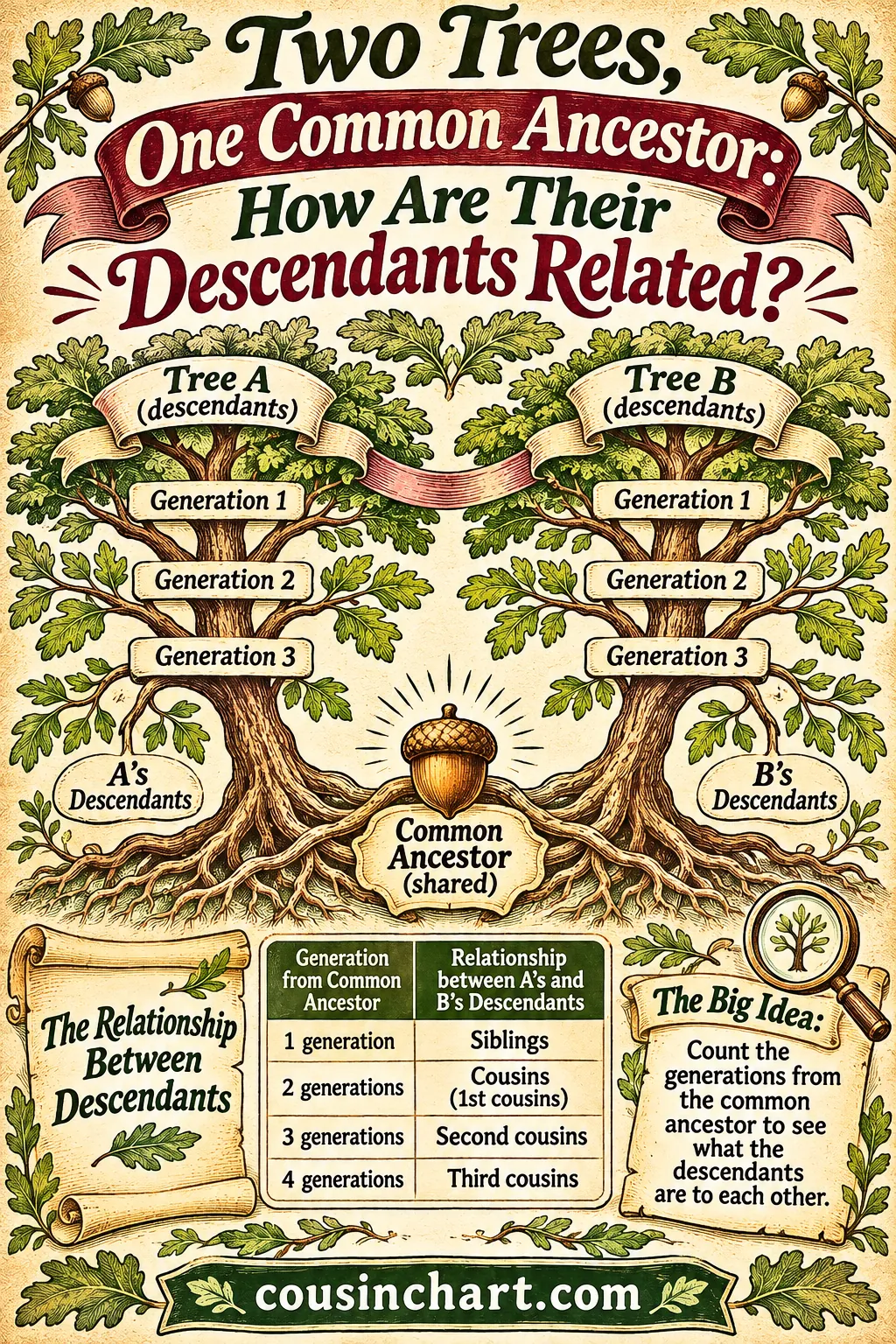
To answer the common ancestor how are we related question, count how many generations down each person sits from that ancestor, take the smaller count and subtract 1 for the cousin number, then subtract the two counts for the number of times removed. Two people who are each 3 generations down are second cousins. If one is 3 down and the other is 4, they're second cousins once removed. The free Cousin Chart relationship calculator does this math for you in seconds.
It feels like a big moment when two family trees finally meet at the same person. Then comes the next question: what does that make us? This guide shows you how to count it out by hand, how to check your work with the calculator and how to handle the tricky cases, like half relationships, aunt and uncle lines, and families that connect more than once.
▶ Work it out in the free calculator
The Two-Number Rule
Every blood relationship between two descendants of the same ancestor comes down to two numbers:
- Your count: how many generations down from the common ancestor you are.
- Their count: how many generations down the other person is.
A child is 1 generation down. A grandchild is 2. A great-grandchild is 3. A 2nd-great-grandchild is 4, and so on.
Then follow these rules:
- If either count is 1, that person is a child of the ancestor. The relationship is an aunt or uncle line, not a cousin line (or a sibling, if both are 1).
- If both counts are 2 or more, you're cousins. Take the smaller number and subtract 1. That's your cousin degree.
- Subtract the smaller count from the larger. That's how many times removed you are. A difference of 0 means you're in the same generation, so you're not removed at all.
That's it. Every cousin label in English genealogy follows those three rules.
The rule in one line
If you like it short: cousin degree = smaller count − 1, and times removed = larger count − smaller count. Write that on a sticky note and keep it next to your research. It handles everything from first cousins to tenth cousins.
Why the closest shared ancestor matters
You and a second cousin share great-grandparents. You also share every ancestor above them: your 2nd-great-grandparents, your 3rd-great-grandparents and so on. If you counted from one of those higher ancestors, you'd get the wrong label.
So always use the closest ancestor you have in common, the one lowest on the tree. If you and a match both descend from Ruby Carter, check whether you also both descend from one of Ruby's children. If you do, that child is the closer common ancestor, and that's the person to count from.
Quick reference: name the ancestor, get the label
If you already know what the shared ancestor is to each of you, this table skips the counting.
| Ancestor is your... | Ancestor is their... | Counts | You are... |
|---|---|---|---|
| Grandparent | Grandparent | 2 and 2 | First cousins |
| Grandparent | Great-grandparent | 2 and 3 | First cousins once removed |
| Great-grandparent | Great-grandparent | 3 and 3 | Second cousins |
| Great-grandparent | 2nd-great-grandparent | 3 and 4 | Second cousins once removed |
| Great-grandparent | 3rd-great-grandparent | 3 and 5 | Second cousins twice removed |
| 2nd-great-grandparent | 2nd-great-grandparent | 4 and 4 | Third cousins |
| 3rd-great-grandparent | 4th-great-grandparent | 5 and 6 | Fourth cousins once removed |
| Parent | Great-grandparent | 1 and 3 | Their great-aunt or great-uncle |
Finding the Common Ancestor in the First Place
The counting is the easy part. Finding the ancestor you share takes more work, especially with a DNA match or a stranger's online tree. These steps cover most cases.
- Start with surnames and places. Compare the family names and towns in both trees. A shared surname in the same county within a few decades is the strongest lead.
- Work up both trees at once. Go back one generation on each side, then the next. Stop when you hit the same person, or the same couple, on both sides.
- Check the match against records. Two trees can both be wrong in the same way if one copied the other. Look for a birth, marriage or death record that names the shared ancestor's child on each line.
- Use shared matches. If you're working from DNA, look at the people who match both of you. If several of them descend from the same couple, that couple is a strong candidate. It's a clue, not proof, so back it up with records.
- Confirm it's the closest ancestor. Once you find a shared person, look one generation down on both lines. If you both descend from the same child, that child is your closer common ancestor.
When the ancestor is confirmed, write both lines in the worksheet below and do the count.
How to Count Generations Without Mistakes
The most common error is counting the ancestor as a generation. Don't. Start at the ancestor's children and count 1.
Here's a simple way to do it:
- Write the common ancestor's name at the top of a page.
- Under it, write their child on your line. Mark it "1."
- Write the next person down and mark it "2."
- Keep going until you reach yourself.
- Do the same on a second column for the other person.
If the ancestor is a couple, like Henry and Clara, count from the couple. You both descend from the same pair, so it's a full relationship. If you descend from Henry and his first wife, and the other person from Henry and Clara, it's a half relationship. More on that below.
A quick shortcut using ancestor titles
You can also work from titles. If the shared ancestor is your:
- Parent: you're 1 down.
- Grandparent: you're 2 down.
- Great-grandparent: you're 3 down.
- 2nd-great-grandparent: you're 4 down.
- 3rd-great-grandparent: you're 5 down.
The number of "greats" plus 2 gives your count. So a 4th-great-grandparent puts you 6 generations down.
Watch the wording, though. "2nd-great-grandparent" and "great-great-grandparent" are the same person, so both mean 4 down. Count the greats, not the words. If someone writes "great-great-great-grandfather," that's three greats, a 3rd-great-grandfather, 5 down.
A two-column worksheet
Here's what a finished worksheet looks like. You and a match named Dana both have Josiah and Ellen Pratt in your trees.
| Generation | Your line | Dana's line |
|---|---|---|
| 0 | Josiah and Ellen Pratt | Josiah and Ellen Pratt |
| 1 | Walter Pratt (b. 1868) | Ida Pratt Lowe (b. 1872) |
| 2 | Margaret Pratt Hill (b. 1897) | Frank Lowe (b. 1901) |
| 3 | Robert Hill (b. 1925) | Dorothy Lowe Ames (b. 1930) |
| 4 | Susan Hill (b. 1954) | Dana Ames (b. 1961) |
| 5 | You (b. 1985) |
You're 5 down. Dana is 4 down. Smaller count is 4, minus 1 is 3, so third cousins. The gap is 1, so third cousins once removed. Writing the birth years in helps too. If a generation looks 60 years long or 10 years short, it's a sign that a person is missing or doubled up.
The Cousin Grid
This table covers the most common pairings. Find your count along the left and the other person's count across the top.
| Your count ↓ / Their count → | 2 | 3 | 4 | 5 |
|---|---|---|---|---|
| 2 | First cousins | 1st cousin 1x removed | 1st cousin 2x removed | 1st cousin 3x removed |
| 3 | 1st cousin 1x removed | Second cousins | 2nd cousin 1x removed | 2nd cousin 2x removed |
| 4 | 1st cousin 2x removed | 2nd cousin 1x removed | Third cousins | 3rd cousin 1x removed |
| 5 | 1st cousin 3x removed | 2nd cousin 2x removed | 3rd cousin 1x removed | Fourth cousins |
Notice that the grid is the same in both directions. If you're 4 down and they're 2, you're first cousins twice removed. If you're 2 down and they're 4, it's the same label. Removed relationships work both ways. Your mom's first cousin is your first cousin once removed, and you're theirs.
Beyond the grid
The pattern keeps going as far back as your records reach. Two people who are each 6 generations down are fifth cousins. If one is 6 and the other is 9, the smaller count gives fifth cousins and the gap of 3 makes it three times removed, which many people write as "thrice removed."
You'll rarely need anything past fifth or sixth cousins in everyday life. Still, when trees meet in the 1700s, these big numbers come up, and the same two rules handle them without any extra steps.
For a printable version you can stick on the fridge or bring to a reunion, the printable cousin chart lays out the same grid with more rows.
The aunt and uncle side of the grid
When one count is 1, you leave the cousin grid and move to the aunt, uncle, niece and nephew line. This table covers those pairings.
| Counts | The person who's 1 down is the other's... | The other person is their... |
|---|---|---|
| 1 and 1 | Sibling | Sibling |
| 1 and 2 | Aunt or uncle | Niece or nephew |
| 1 and 3 | Great-aunt or great-uncle (also called grand-aunt) | Grandniece or grandnephew |
| 1 and 4 | Great-great-aunt or uncle | Great-grandniece or nephew |
| 1 and 5 | 3rd-great-aunt or uncle | 2nd-great-grandniece or nephew |
Unlike cousin labels, these change depending on which side you're looking from. One person is the aunt, the other the niece.
Shared DNA at a glance
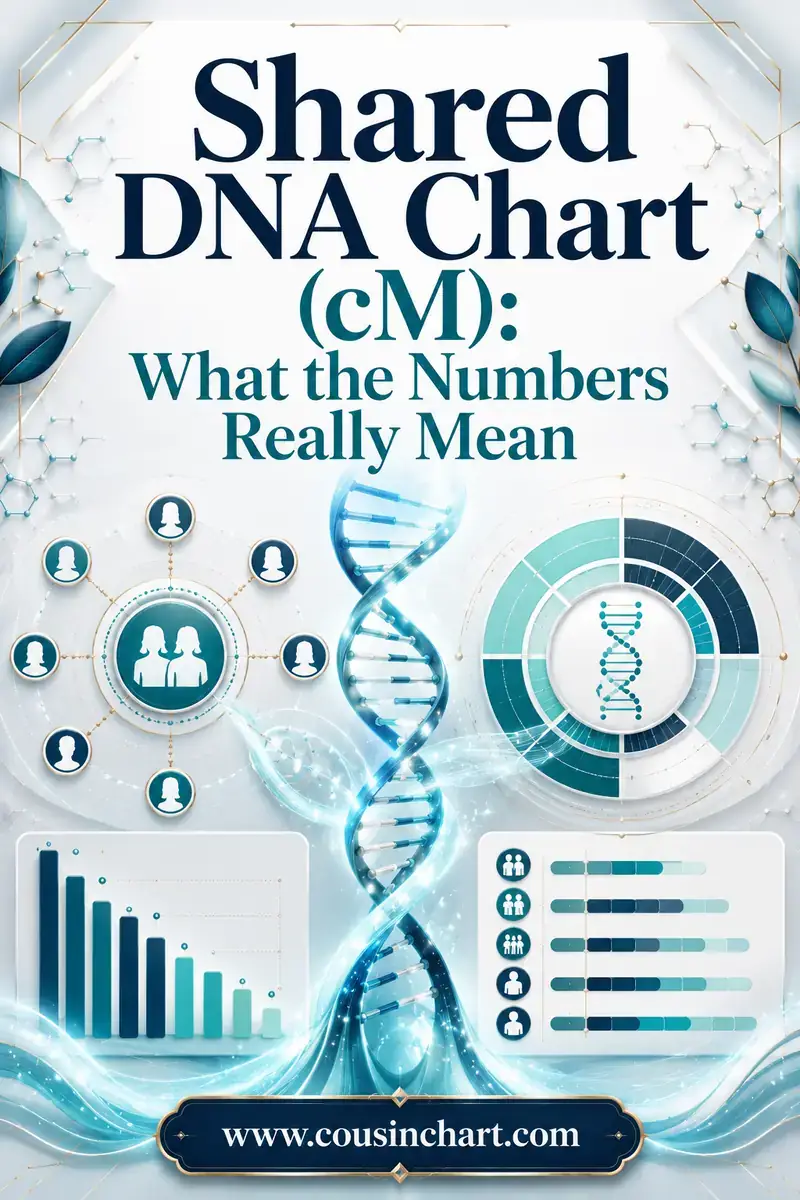
If you're matching a tree link to a DNA result, these are the averages used across this site. Every one of them is just a middle point. Real numbers vary a lot, and the ranges for different relationships overlap.
| Counts | Relationship | Shared ancestor (to each) | Typical shared cM |
|---|---|---|---|
| 1 and 1 | Full siblings | Parents | ~2,613 |
| 2 and 2 | First cousins | Grandparents | ~866 |
| 2 and 3 | First cousins once removed | Grandparents / great-grandparents | ~433 |
| 3 and 3 | Second cousins | Great-grandparents | ~229 |
| 4 and 4 | Third cousins | 2nd-great-grandparents | ~73 |
| 5 and 5 | Fourth cousins | 3rd-great-grandparents | ~35 |
For the full ranges, the shared cM chart lists them side by side.
Worked Examples From Real-Life Tree Matches
The rules are easier to trust once you see them in action. All the families below are made up, but the math is exactly what you'd do with your own tree.
Example 1: Two trees meet at a great-grandmother
You've been building your dad's side. A stranger's online tree has a woman named Ruby Carter, born 1890. You both have her.
- Your line: Ruby → your grandpa → your dad → you. You're 3 down.
- Their line: Ruby → their grandma → their mom → them. They're 3 down.
Both counts are 3. Smaller count minus 1 is 2, so second cousins. The difference is 0, so not removed. You're second cousins.
Example 2: Same ancestor, different generations
Now say the stranger's line is Ruby → their grandpa → them. They're only 2 down. You're still 3.
Smaller count is 2, minus 1 is 1, so first cousins. The difference is 1, so once removed. They're your first cousin once removed. In plain terms, they're your dad's first cousin.
Example 3: A big generation gap
Your match descends from your 3rd-great-grandparents, Thomas and Mary. That makes you 5 down. Your match is younger and descends from Thomas and Mary through a line with shorter generations, so they're 7 down.
Smaller count is 5, minus 1 is 4, so fourth cousins. The difference is 2, so twice removed. You're fourth cousins twice removed.
This happens more than people expect. If one line had kids young and the other had kids late, the generation counts drift apart over a century or two.
Example 4: An aunt or uncle line
Your great-grandfather, Leon, had a much younger brother, Frank. Leon and Frank share their parents, so those parents are the common ancestors.
- Frank is 1 down from his parents.
- You're 4 down: Leon, your grandparent, your parent, you.
Because one count is 1, this isn't a cousin relationship. Frank is your great-great-uncle (some families say great-grand-uncle). He's your great-grandfather's brother.
The page on what a great-great-aunt is explains the naming for this whole line.
Example 5: Two siblings' descendants, 150 years later
Two brothers, Anders and Nils, came to Minnesota in the 1870s. Their parents, back in Sweden, are the common ancestors. Today, Anders's descendant Karen and Nils's descendant Erik meet at a reunion.
- Karen's line: parents → Anders → his son → his granddaughter → her son → Karen. Karen is 5 down.
- Erik's line: parents → Nils → his daughter → her son → Erik. Erik is 4 down.
Smaller count is 4, so third cousins. The gap is 1, so once removed. Karen and Erik are third cousins once removed. The brothers are where the two branches split, and their parents are the couple both lines share.
Notice that Karen and Erik might be the same age. Generations don't track birthdays. Nils's line just had longer gaps between parents and children.
Example 6: A cousin who's also your parent's age
Your mom's first cousin, Gail, is 2 down from your mom's grandparents. You're 3 down. That's first cousins once removed, as in Example 2.
Now add Gail's son, Ben. He's 3 down, the same as you. You and Ben are second cousins, even though you'd never have guessed it from the labels you both grew up using. Many families call Gail "Aunt Gail," which hides the cousin link. When you write it down, the counts show the real path.
Half Relationships: Sharing One Ancestor, Not Two
So far, every example assumes you share a couple. When you share only one person, add "half" to the label.
This usually happens when the shared ancestor had children with more than one partner. Here's how it plays out.
Example 7: Same great-grandfather, different wives
Your great-grandfather, Samuel, married twice. Your grandmother came from his first marriage. Your match's grandfather came from his second.
- You're 3 down from Samuel.
- Your match is 3 down from Samuel.
Without the half rule, you'd be second cousins. But you share only Samuel, not a couple. So you're half second cousins.
The generation math doesn't change at all. The only difference is the word "half" in front. For more on these, see what a half cousin is.
Why "half" matters
Half relatives share less DNA on average than full relatives of the same label, about half as much. If you're comparing a DNA match with your tree, this can explain a lower-than-expected number. Full second cousins share about 229 cM on average, and half second cousins usually share noticeably less. Ranges vary a lot and overlap, so don't use the number alone to decide.
Full or half? How to tell from records
Old records don't always say which wife was the mother. A few checks help:
- Compare marriage and birth dates. If a child was born after the first wife's death date, they came from a later marriage.
- Read the will. Wills often name a second wife and "her children."
- Look at census households. A wife who's too young to be the mother of the oldest children is a clue to a second marriage.
- Check the DNA, if you have it. A match well below the typical amount for a full relationship can point to a half link, though ranges overlap.
Until you're sure, note the link as "full or half, not confirmed." That's better than guessing in a tree others will copy.
Step, Marriage and Adoption
The two-number rule only works for descendants by blood or by adoption. A few notes on the cases that sit outside it.
Step-relatives. If your great-grandmother married a man who wasn't your great-grandfather, his children from another marriage don't descend from your common ancestor. Their descendants are step-relatives to your line, not cousins by blood. In the calculator, set the relation type to step to see the step label.
Relatives by marriage. Your cousin's spouse doesn't descend from your common ancestor at all. They're your cousin-in-law. The calculator's marriage option covers these.
Adoption. An adopted child is a full member of the family, and in a family tree, they take the same place a birth child would. The labels stay the same: an adopted grandchild of the shared ancestor counts as 2 down. The one difference is DNA. An adoptee won't share DNA with their adoptive family, so a DNA match list won't reflect those links. Many families record both the adoptive and birth families in the tree, with a clear note on each link.
How to Check It With the Calculator
The relationship calculator is built on this same two-number method. You can use it two ways.
Use a quick-pick
If your situation matches a common one, tap a quick-pick button. "My second cousin," "My dad's cousin" and "My cousin's child" are all there. The result shows the name and a chart.
Set the generations yourself
For anything else, set the counts directly:
- Find the relative you both come from. That's your common ancestor.
- Use − and + to set how many generations down you are from that relative.
- Set how many generations down the other person is.
- If you share only one ancestor, not a couple, switch on the half relationship option.
- Read the relationship name and look at the chart.
Here's what to expect with the examples above:
| Example | You | Them | Options | Result |
|---|---|---|---|---|
| 1: Ruby Carter, same generation | 3 | 3 | none | Second cousin |
| 2: Ruby Carter, their line shorter | 3 | 2 | none | First cousin once removed |
| 3: Thomas and Mary | 5 | 7 | none | Fourth cousin twice removed |
| 4: Great-grandfather's brother | 4 | 1 | Sex: male | Great-great-uncle |
| 7: Samuel's two marriages | 3 | 3 | Half on | Half second cousin |
| 5: Anders and Nils | 5 | 4 | none | Third cousin once removed |
| 6: Mom's cousin's son | 3 | 3 | Sex: male | Second cousin |
Check it from both sides
Try swapping the two numbers. If you set yourself at 2 and the other person at 3, you'll still see first cousin once removed. That's a good habit when you're unsure which line is which, because the label should never change when you flip the counts. The aunt and uncle lines are the exception: one person is the great-aunt and the other is the great-niece, so the calculator shows the name from your point of view.
You can also set the other person's sex. That's useful for the aunt and uncle lines, where it changes "great-great-uncle" to "great-great-aunt." Tap Download my chart to save the picture, or Print this result to drop it in your research binder.
When You Connect More Than Once
Sometimes two trees meet at two different ancestors. Maybe you share your great-grandparents on your dad's side and your 3rd-great-grandparents on your mom's side. That's two separate relationships.
Count each one on its own. In that case, you'd be second cousins on one side and fourth cousins on the other. Both are true at the same time.
This is common in small towns, farming areas and close-knit communities where families married into each other over many generations. The guide to pedigree collapse explains why this happens and how to record it in your tree.
Worked example: two paths at once
Say you and a match both descend from Henry and Clara Baker, your great-grandparents. You're each 3 down, so you're second cousins on that line.
Then you notice that your mom's side and the match's dad's side both lead to Jacob and Ann Moore. On that line, you're 5 down and the match is 4 down. The smaller count is 4, so third cousins, and the gap of 1 makes it once removed.
So the full answer is: you're second cousins through the Bakers and third cousins once removed through the Moores. Neither cancels the other out. If you're also comparing DNA, expect to share a bit more than a typical second cousin, because some DNA can come down each line.
When you write the connection in your notes, list both paths. If you only record one, another researcher may think you've made a mistake when they spot the second line later.
Double cousins: two paths at the same level
A special case comes up when two siblings marry two siblings. Their children share both sets of grandparents, through two separate couples. Each path gives 2 and 2, so the children are first cousins twice over, often called double first cousins. On average, they share more DNA than ordinary first cousins, because DNA comes down from both couples.
The math is the same as any two-path case. Count each couple separately, then list both relationships.
What the Label Doesn't Tell You
A cousin label is a precise position on the tree, but it leaves a few things out. Keep these in mind when you share it.
Which side of the family. "Second cousin" doesn't say whether the link runs through your mom or your dad. In your notes, add the side and the couple: "second cousin, paternal, through Henry and Clara Baker."
Which branch below the ancestor. Two of your second cousins can come from two different children of your great-grandparents. They share the same label with you, but they might be first cousins to each other, or second cousins, depending on whether they come from the same child.
How much DNA you share. The label gives an average, not a promise. Two full second cousins can share well above or below the typical 229 cM. That's normal variation, not a sign that the tree is wrong, though a very low number is worth a second look.
Ages. A first cousin once removed can be older, younger or the same age as you. Generation counts and birth years drift apart over time, sometimes by decades.
How close you are as people. A label describes the family tree, nothing more. A third cousin you write to every week is family in every way that matters.
Mistakes That Give the Wrong Label
Here are the slips that trip people up most:
- Counting the ancestor as generation 1. The ancestor's child is 1. The ancestor is 0.
- Counting from a sibling of the ancestor. You both have to descend directly from the same person. A sibling of your ancestor is a different person. Their descendants connect one generation further back.
- Mixing up the two counts. Write each line in its own column so you don't swap numbers.
- Forgetting the half rule. Check whether you share a couple or just one person. Remarriages hide easily in old records.
- Mixing up "great" and "grand." A great-aunt and a grand-aunt are the same person, your grandparent's sister. Don't add an extra generation because the word "great" appears.
- Trusting a merged tree. Online trees sometimes merge two people with the same name. Check each generation against records before you settle on a label.
- Not using the closest common ancestor. If you counted from a 3rd-great-grandparent but you both also descend from one of their children, your label will come out a step too distant. Move down to the lowest shared person.
- Skipping a generation. Two men with the same name, a father and son, can get folded into one person. If a man seems to have had children over 40 years, check whether he's really two people.
Fixing a label you got wrong
If you spot an error after you've shared a result, don't worry. Go back to the worksheet, find the line where the count slipped, and fix it there. Then rerun both counts in the calculator and send the corrected result with a short note: "I counted Ruby as generation 1 by mistake. We're actually second cousins, not third." Most matches are grateful for the update.
Write the path down
Once you've settled on a label, write the full path in your notes, from the common ancestor down to each of you. List every name and birth year. That way, if someone questions the link later, or a new record turns up, you can check each step instead of starting over.
A blank common ancestor chart gives you a ready layout for this, with the shared couple at the top and a column for each line.
Make it easy to share
Once you've worked it out, share it with the family. People love seeing the path laid out, especially when two branches have lost touch. Run the counts through the free relationship calculator, tap Copy result and paste it into a message to your new cousin.
A message you can send a new cousin
If the other person is a stranger, a short, friendly note works best. Here's one you can adapt:
Hi Dana, I think we're related through Josiah and Ellen Pratt. I descend from their son Walter, and it looks like you descend from their daughter Ida. By my count, I'm 5 generations down and you're 4, which makes us third cousins once removed. I've attached the path I worked out. Does that match what you have? I'd love to compare notes on the Pratts.
Give the names on both lines, the counts and the label. That way the other person can check your work quickly, and if one of you has a mistake, it shows up right away.
▶ Work it out in the free calculator
Frequently Asked Questions
How do I figure out how I'm related to someone with the same ancestor?
Count how many generations each of you is below the shared ancestor. Take the smaller count and subtract 1 to get the cousin number, then subtract the two counts to find how many times removed. If either count is 1, it's an aunt or uncle line instead.
What does "removed" mean in cousin terms?
It means the two cousins are in different generations from the common ancestor. Once removed is one generation apart, twice removed is two apart. Your parent's first cousin is your first cousin once removed.
What if we share only one ancestor, not a couple?
Then the relationship is a half relationship. The cousin number and the removed count stay the same, but you add "half" to the front. Half cousins usually share less DNA than full cousins of the same degree.
Do I count the common ancestor as a generation?
No. The common ancestor is your starting point, so they count as zero. Their child is 1 generation down, their grandchild is 2 and so on.
Can two people be related in more than one way?
Yes. If your trees meet at two different ancestors, you have two separate relationships. Work out each one on its own and record both paths in your notes.
Is a first cousin twice removed closer than a second cousin?
By generations, a first cousin twice removed connects through a closer ancestor on their side, but the two of you are two generations apart. On average, the two relationships share about the same amount of DNA. Neither label is "closer" in a strict sense; they're just different positions on the tree.
How many generations down am I from my 3rd-great-grandparent?
Five. Add 2 to the number of greats: a 3rd-great-grandparent has three greats, so you're 5 generations down. If the other person also descends from that ancestor and is 5 down, you're fourth cousins.
Which common ancestor should I count from?
Always use the closest one, the lowest person or couple on the tree that both of you descend from. Counting from someone higher up will make the relationship look more distant than it really is.
Are adopted descendants related to the common ancestor?
In the family tree, yes. An adopted child takes the same place a birth child would, and the relationship labels are the same. They won't share DNA with the adoptive line, so DNA matching won't show those links.