First-, Second- and Third-Degree Relatives: Who Counts (Medical vs. Legal)
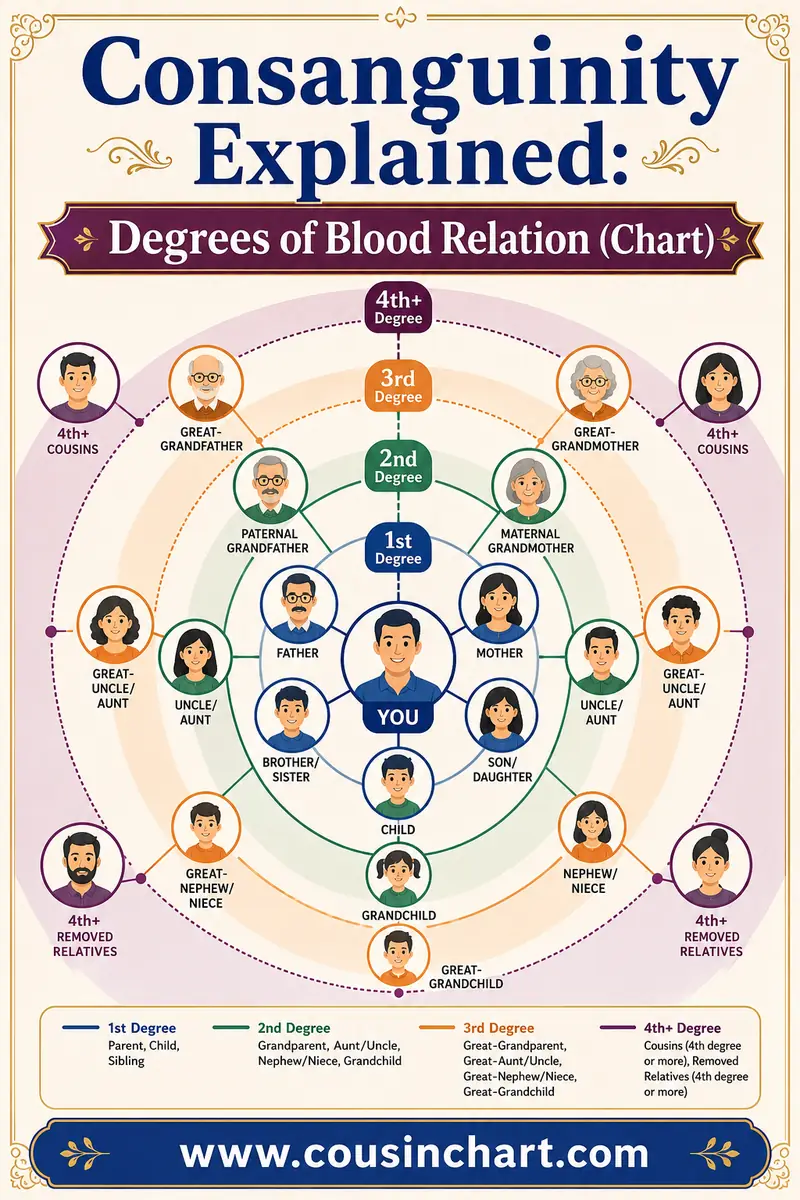
A second degree relative, in the medical sense, is someone who shares about a quarter of your DNA: a grandparent, grandchild, aunt, uncle, niece, nephew or half-sibling. First-degree relatives are your parents, full siblings and children, who share about half. Third-degree relatives share about an eighth, and your first cousin is the classic example. So if your doctor asks whether a cousin counts as second degree, the answer is no. A first cousin is a third-degree relative on the medical scale.
Here's the catch that sends so many people searching. Lawyers count degrees with a different method, and on that scale your first cousin is a fourth-degree relative and your sibling is second degree. Old church records use a third method, where a first cousin is second degree. Same family, three different numbers. Our pillar guide, Consanguinity Explained, walks through the legal counting systems in detail. This article focuses on the medical and genetic scale, shows you exactly where it parts ways with the legal one, and gives you a simple way to work out any relative's degree yourself.
One quick note before we start. This page is general information about how relatives are grouped. It isn't medical or legal advice, and it can't tell you what your own family history means for your health or your legal rights. We'll come back to that near the end.
Quick check. Tap a question for the short answer:
First-, Second- and Third-Degree Relatives at a Glance
The medical scale is built around one idea: how much of your genetic material you'd expect to share with a relative. The National Human Genome Research Institute (NHGRI) defines a first-degree relative as a family member who shares about half of their genetic information with you, and it names parents, siblings and offspring as the examples. NHS England's genomics education service extends the same logic down the line. Its glossary describes a second-degree relative as someone who shares 25% of your DNA on average, and a third-degree relative as someone who shares 12.5% on average, such as a first cousin.
Put those definitions together and you get this table.
| Medical degree | Who's in the group | Average DNA shared |
|---|---|---|
| First-degree | Parents, full brothers and sisters, children | About 50% |
| Second-degree | Grandparents, grandchildren, aunts, uncles, nieces, nephews, half-brothers and half-sisters | About 25% |
| Third-degree | First cousins, great-grandparents, great-grandchildren, great-aunts, great-uncles, grandnieces, grandnephews, half-aunts and half-uncles, half-nieces and half-nephews | About 12.5% |
| Fourth-degree | First cousins once removed, great-great-grandparents, half first cousins | About 6.25% |
| Fifth-degree | Second cousins, first cousins twice removed | About 3.1% |
The first three rows are the ones you'll hear in a doctor's office. The NHS glossary gives the anchor examples for each (parent and child, grandparent and grandchild, first cousins). The rest of each row follows from the same rule, which we'll show step by step in a moment. The fourth and fifth rows rarely come up in clinical conversation, but they're handy if you're comparing DNA test results.
A word on "average." These percentages are expected values, not guarantees. The NHS glossary points out that because of recombination (the shuffling of DNA when eggs and sperm are made), two second-degree relatives may share quite a bit less or quite a bit more than 25%. Parents and children are the exception: you always get exactly one set of chromosomes from each parent, so that pair really is about 50%.
How the Medical Scale Works: Halving at Every Step
The easiest way to understand medical degrees is to think in halves. Each time DNA passes from a parent to a child, the child gets about half of what the parent had. So every step on a family tree cuts the expected overlap in half.
- Your parent gave you half of their DNA: 50%, first degree.
- Your grandparent gave your parent half, and your parent passed half of that to you: 25%, second degree.
- Your great-grandparent is one more step away: 12.5%, third degree.
That's the whole idea for your direct line. The math is just repeated halving: 50, 25, 12.5, 6.25 and so on. In other words, a relative's medical degree is the number of halvings between you, and the expected share is one-half raised to that power. One half once is 50%. One half twice is 25%. One half three times is 12.5%.
Why your brother is first degree, not second
Siblings are where people get tripped up, because a sibling isn't in your direct line. You don't descend from your brother, and he doesn't descend from you. So why is he first degree, right alongside your parents?
The answer is that full siblings share two ancestors, not one. You and your brother each got about half your DNA from Mom. Through Mom alone, you'd expect to overlap by about 25% (a half of a half). But you also share Dad, which adds another expected 25%. Add the two paths together and you get about 50%. That's first-degree territory, so siblings sit in the first-degree group.
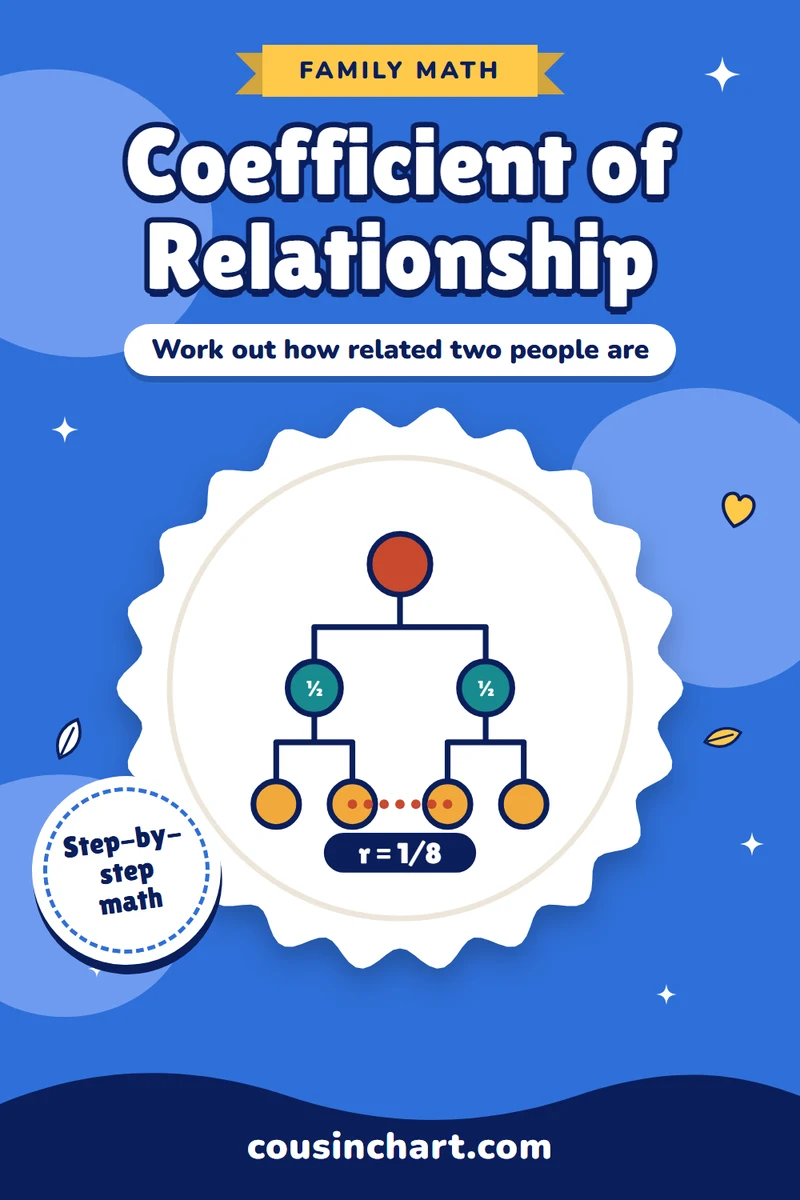
The same doubling happens all the way down the collateral (side) branches of a family tree. Your aunt is your parent's full sister, so she shares both of your grandparents with your parent. Her expected overlap with you works out to 25%, which makes her second degree. Your first cousin shares two grandparents with you, so the two paths add up to 12.5%, third degree. If you want the formal version of this calculation, our guide to the coefficient of relationship shows the path-counting formula geneticists use.
Why your half-sibling is second degree
Now take away one of those shared ancestors. A half-sibling shares only one parent with you. There's just one path, so the expected overlap is a half of a half: 25%. That's why the CDC and the NHS both treat half-siblings differently from full siblings, and why a half-sibling lands in the second-degree group with your grandparents and aunts. The same rule pushes every "half" relative down one degree from the full version: a half-aunt is third degree, and a half first cousin is fourth. Our page on half-siblings vs. full siblings covers the DNA numbers in more detail.
Is a Cousin a Second Degree Relative?
This is the single most common question about degrees, so let's settle it with all three counting systems side by side.
- Medical and genetic scale: a first cousin is a third-degree relative, sharing about 12.5% of your DNA on average. NHS England's genomics education glossary uses first cousins as its example of a third-degree relative.
- Civil-law scale (most modern statutes): a first cousin is a fourth-degree relative. You count two steps up to your shared grandparents and two steps down to your cousin: 2 + 2 = 4.
- Canon-law scale (older church records): a first cousin is a second-degree relative, because only the longer leg of the path is counted, and each of you is two generations from the shared grandparents.
So a cousin can only be called "second degree" if someone is using the old canon-law system. In any medical setting, a cousin is third degree. And second cousins, the children of your parents' first cousins, are further out still: fifth degree on the medical scale, sharing about 3.1% of your DNA on average (one-half raised to the fifth power is 1/32, or about 3.1%).
Why does this mix-up happen so often? Partly because "second" sounds like it should go with "cousin." People hear "second cousin" and "second-degree relative" and assume they're related ideas. They aren't. The word "second" in "second cousin" tells you which great-grandparents you share. The "second" in "second degree" tells you how many halving steps separate you. They're two separate numbering systems that happen to share a word. If the cousin numbers themselves are the confusing part, our guide to degrees of cousinship explains how first, second and third cousins are numbered.
Medical vs. Legal Degrees: Why Doctors and Lawyers Count Differently
Doctors and lawyers are answering different questions, and that's why their numbers don't match.
A clinician wants to know how likely it is that you share a genetic variant with a relative who has a condition. That probability tracks the expected share of DNA. Full siblings share two parents, so they share twice as much as a path through just one ancestor would suggest. The medical scale bakes that in by putting full siblings next to parents.
A lawyer wants a simple, mechanical rule that anyone can apply to a family tree without arguing about genetics. The civil-law method delivers that: count every parent-child step on the path between two people, up to the common ancestor and back down. It doesn't care whether you share one ancestor or two. A sibling is two steps away (up to Mom and Dad, then down to your sibling), so a sibling is second degree. There's no doubling, because the law is counting steps, not DNA.
The result is a predictable pattern:
- For your direct line (parents, grandparents, children, grandchildren), the medical degree and the civil-law degree are the same number. A grandparent is second degree on both scales.
- For full collateral relatives (siblings, aunts, uncles, nieces, nephews, cousins), the medical degree is one less than the civil-law degree. A sibling is first degree medically and second legally. A first cousin is third medically and fourth legally.
- For half collateral relatives (half-siblings, half-aunts, half-cousins), the two scales line up again. A half-sibling is second degree on both. That's because there's only one shared ancestor, so there's no doubling for the medical scale to account for.
If you remember just that pattern, you can translate between the two systems in your head.
Side-by-Side Chart: Medical, Civil-Law and Canon-Law Degrees
Here's the full comparison for the relatives people ask about most. The civil-law and canon-law columns follow the counting methods explained on our consanguinity pillar page. The medical column follows the halving rule above, anchored by the NHGRI and NHS definitions.
| Relative | Medical degree | Civil-law degree | Canon-law degree | Average DNA shared |
|---|---|---|---|---|
| Parent or child | 1st | 1st | 1st | About 50% |
| Full sibling | 1st | 2nd | 1st | About 50% |
| Half-sibling | 2nd | 2nd | 1st | About 25% |
| Grandparent or grandchild | 2nd | 2nd | 2nd | About 25% |
| Aunt, uncle, niece or nephew | 2nd | 3rd | 2nd | About 25% |
| Great-grandparent | 3rd | 3rd | 3rd | About 12.5% |
| First cousin | 3rd | 4th | 2nd | About 12.5% |
| Great-aunt or great-uncle | 3rd | 4th | 3rd | About 12.5% |
| First cousin once removed | 4th | 5th | 3rd | About 6.25% |
| Second cousin | 5th | 6th | 3rd | About 3.1% |
| Spouse, in-law or step-relative | None | None (affinity) | None (affinity) | None by descent |
Three things jump out from the chart. First, the medical column is the only one where the number lines up neatly with DNA. Second, the civil-law column is always equal to or one higher than the medical column. Third, the canon-law column compresses many relatives into the same small numbers, which is why it was useful for medieval marriage rules but is rarely used today outside historical research.
The last row matters too. Your spouse, your in-laws and your step-relatives have no degree on any of these blood-relation scales, because you don't share a common ancestor with them. They can still be very close family, but they don't count toward a medical family history of inherited risk. Our guide to blood relatives vs. relatives by marriage sorts out who belongs in which group.
Where You'll Hear "First-Degree" and "Second-Degree" in Medicine
You'll mostly meet these terms in three places: intake forms, screening conversations, and genetic counseling.
Family health history forms
Many health questionnaires ask, "Has a first-degree relative been diagnosed with...?" That's shorthand for "your parents, siblings or children." When a form asks about second-degree relatives, it wants your grandparents, aunts, uncles, nieces, nephews, grandchildren and half-siblings too.
Interestingly, the CDC's consumer guidance avoids the jargon altogether. Its family health history overview simply asks you to collect information about your parents, sisters, brothers, half-sisters, half-brothers, children, grandparents, aunts, uncles, nieces and nephews. Look closely and you'll see that's exactly the first-degree group plus the second-degree group, spelled out in plain words. MedlinePlus Genetics, from the National Library of Medicine, adds cousins and says a complete record covers three generations of relatives.
Screening decisions
The CDC gives concrete examples of how close relatives change the conversation with your doctor. It suggests asking about genetic counseling and testing if your mother or sister had breast cancer before age 50, and asking about earlier or more frequent colonoscopies if a parent or sibling had colorectal cancer before age 50. Every relative in those examples is first degree. That's not an accident. The closer the relative, the more DNA you share, and the more their diagnosis may say about your own risk.
The CDC also notes that your risk may be higher when more than one close relative has a disease, or when a relative was diagnosed younger than usual. So the degree isn't the only thing that matters. How many relatives, which side of the family, and what age they were all count too.
Formal risk tools
Clinicians sometimes use structured questionnaires that are written in degree language. The U.S. Preventive Services Task Force (USPSTF) recommendation on BRCA-related cancer risk assessment lists several of these tools. One screening questionnaire it describes asks whether any first-degree relatives had breast or ovarian cancer. Other tools it lists give points for second- and third-degree relatives as well. The same document also describes relatives in everyday words, separating immediate family (parents and siblings) from more distant relatives such as aunts, uncles, grandparents and cousins.
You don't need to fill out those tools yourself. The point is that if a clinician asks about "second-degree relatives," they're asking about a specific, well-defined group, and you'll give them better information if you know who's in it.
Where You'll Hear Degrees in Law
Legal degrees show up in rules about who can marry, who inherits without a will, and who has a conflict of interest. In almost every modern U.S. setting, the count used is the civil-law method.
Here's a real example. The federal law on when a judge must step aside from a case, 28 U.S.C. § 455, says a judge must disqualify themselves when a party or lawyer in the case is "within the third degree of relationship" to the judge or the judge's spouse, or is the spouse of such a person. The same statute then states that the degree is calculated according to the civil law system.
Let's apply it. On the civil-law scale, third degree reaches your parents, grandparents, great-grandparents, children, grandchildren, great-grandchildren, siblings, aunts, uncles, nieces and nephews. A first cousin is fourth degree, so a first cousin falls just outside "within the third degree" under that statute's counting rule. If the statute had used the medical scale instead, a first cousin would have been inside the line. That's a vivid illustration of why you always need to know which scale a rule is using.
Marriage and inheritance laws work the same way, but the details differ a lot from state to state, and they change over time. If you're curious about the marriage side, our page on cousin marriage laws covers the U.S. picture in general terms. For inheritance, the closest-relative rules are explained in our guide to next of kin. Laws vary by place, so always check the current rules where you live.
How to Work Out Any Relative's Medical Degree, Step by Step
You don't need to memorize a chart. With three questions, you can work out the medical degree for almost anyone in your family.
- Find your closest shared ancestor or ancestors. For a sibling, that's your parents. For a first cousin, it's a pair of grandparents. For your grandmother, it's simply her: you descend from her directly.
- Count the parent-child steps on the path between you. Go up from you to the shared ancestor, then down to the relative. Each step is one. (This step gives you the civil-law degree.)
- Adjust for full relatives. If the relative is a full collateral relative, meaning you share a couple rather than just one ancestor and the relative isn't in your direct line, subtract one. If you share just one ancestor (a "half" relationship), or the relative is in your direct line, don't subtract anything.
The number you end up with is the medical degree. To get the average DNA share, halve 100% that many times.
Worked example 1: your mother's brother
This example is illustrative. Say you want the degree for your uncle Leo, your mother's full brother.
- Shared ancestors: your maternal grandparents (a couple).
- Path: you up to Mom (1), Mom up to your grandparents (2), down to Leo (3). Civil-law degree: 3.
- Leo is a full collateral relative, so subtract one. Medical degree: 2.
- DNA share: halve 100% twice, 50% then 25%. About 25%.
Leo is a second degree relative, exactly as the NHS definition says for an uncle.
Worked example 2: your father's half-sister
Also illustrative. Your aunt Rosa is your father's half-sister. They share a mother (your paternal grandmother) but have different fathers.
- Shared ancestor: only your paternal grandmother.
- Path: you up to Dad (1), Dad up to Grandma (2), down to Rosa (3). Civil-law degree: 3.
- Only one shared ancestor, so don't subtract. Medical degree: 3.
- DNA share: halve 100% three times, 50%, 25%, 12.5%. About 12.5%.
So a half-aunt is a third-degree relative, one step further than a full aunt. This is why it helps to note "half" relationships on a family health history. They change the picture.
Worked example 3: your great-grandfather
Illustrative again. Your great-grandfather Samuel is in your direct line.
- Path: you, your parent, your grandparent, Samuel. Three steps. Civil-law degree: 3.
- Direct line, so don't subtract. Medical degree: 3.
- DNA share: about 12.5%.
Samuel and your first cousin are both third-degree relatives, even though one is three generations above you and the other is in your own generation. Degree measures expected relatedness, not age or generation.
Try it yourself
Work these out using the three steps, then check the answers below.
- Your sister's daughter.
- Your half-brother's son.
- Your grandmother's sister (your great-aunt), assuming they're full sisters.
- Your first cousin's child.
Answers: (1) Up 1, down 2, civil degree 3; full sister, so subtract one: second degree, about 25%. (2) Up 1, down 2, civil degree 3; half-brother, so no subtraction: third degree, about 12.5%. (3) This one is a trap. You go up to your parent (1), up to your grandmother (2), up to her parents (3), then down to her sister (4). Civil degree 4; full sisters, so subtract one: third degree, about 12.5%. (4) Up 2 to your shared grandparents, down 3 to your cousin's child, civil degree 5; full cousins, so subtract one: fourth degree, about 6.25%.
Why was question 3 a trap? The shared ancestors aren't your grandmother herself. They're her parents, because your great-aunt doesn't descend from your grandmother. That's the most common slip when counting collateral relatives. Always go all the way up to the people both of you descend from.
Common Mix-Ups About Relative Degrees
"My aunt is a first-degree relative because she's close family"
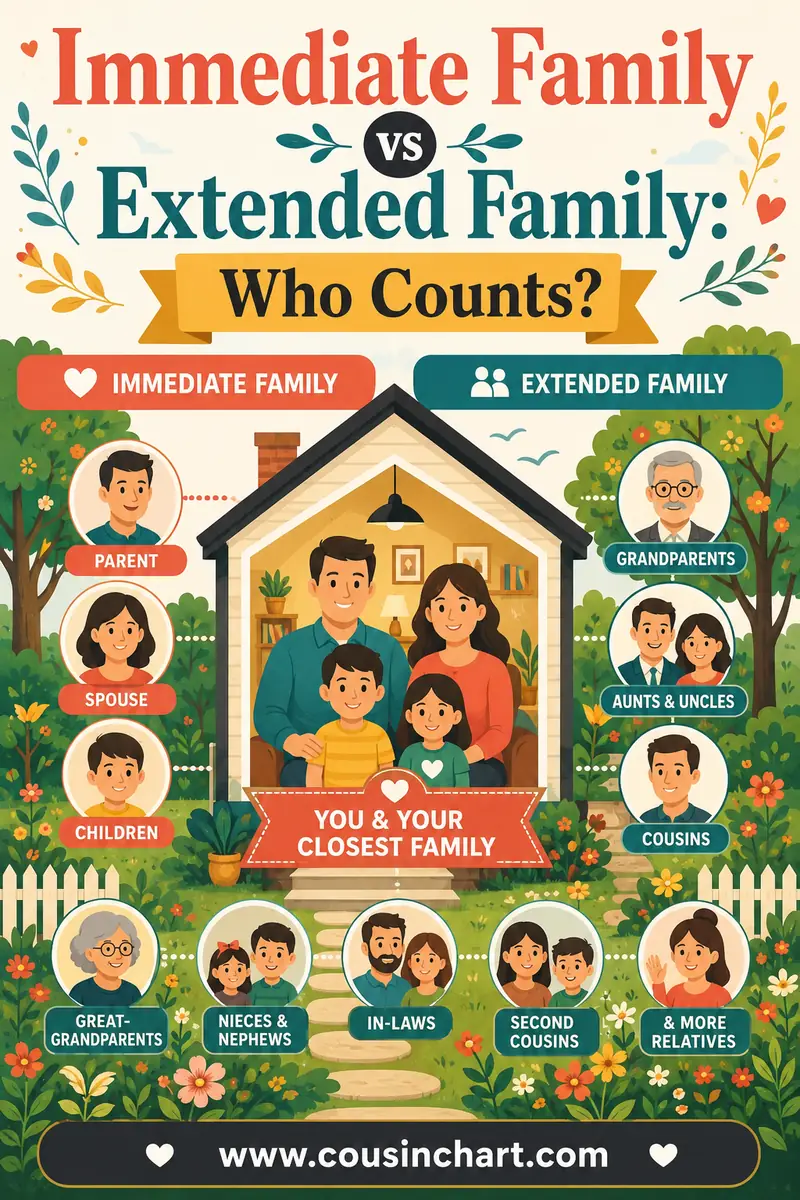
Degree isn't about emotional closeness or how often you see someone. An aunt who helped raise you is still a second-degree relative on the medical scale, because the category is about shared DNA. If you're thinking about who counts as "close family" in everyday life, that's a different question, and our guide to immediate family vs. extended family deals with it.
"Half-siblings are first degree because they're siblings"
Not on the medical scale. A half-sibling shares about 25% of your DNA on average, so they're second degree. This matters for health history. The CDC deliberately lists half-sisters and half-brothers separately from sisters and brothers for this reason.
"My grandmother is first degree because she's in my direct line"
Your direct line doesn't make someone first degree. Only your parents and children are first-degree relatives in that line. Your grandparents are second degree, and your great-grandparents are third.
"An identical twin must be a 'zero-degree' relative"
Identical twins are a special case. The NHS glossary entry for first-degree relatives notes that, apart from identical (monozygotic) twins, first-degree relatives are the people you share the most DNA with. Identical twins share essentially all of their inherited DNA, so they're usually treated as their own category rather than squeezed onto the degree scale. In practice, clinicians simply note "identical twin" on the family history.
"Adopted relatives and step-relatives have a degree too"
For medical purposes, adopted and step-relatives don't share DNA with you by descent, so they don't count toward inherited risk. For legal purposes, adoption usually creates a full legal parent-child relationship, which is a separate matter and depends on local law. If you were adopted, your biological relatives are the ones who matter for genetic risk, even if you don't know them.
"Removed" cousins and degrees are the same thing
"Once removed" tells you about a generation gap between cousins. It's not a degree. Your first cousin once removed is a fourth-degree relative on the medical scale and a fifth-degree relative on the civil-law scale. If "removed" still feels slippery, our explanation of "once removed" sorts it out.
Special Cases: Double Cousins, Families Connected Twice and Missing Information
The halving rule assumes a typical family tree where everyone is connected by just one path. Real families aren't always that tidy.
Double first cousins
Double first cousins happen when two siblings from one family marry two siblings from another. The children share all four grandparents instead of two. Their expected DNA overlap is about 25%, double the usual 12.5%. On a strict DNA basis, that's the same expected share as a second-degree relative. Clinicians usually just record the relationship plainly ("double first cousin") so its significance isn't lost.
Families with more than one connection
When relatives are connected through more than one line, for instance when cousins married in an earlier generation, the expected overlap can be higher than the standard degree suggests. Genealogists call one version of this pedigree collapse. A genetic counselor will want to know about these extra connections, because they can matter for certain inherited conditions.
When you don't know who's who
Sometimes you can't place a relative precisely. You might not know if two siblings in an older generation were full or half siblings, or a relative may be known only by family stories. That's normal. Write down what you know and flag what you're unsure about. MedlinePlus Genetics points out that a family history is still useful even when it's incomplete, and that having no known family history of a condition doesn't rule out your own risk. A partial history beats no history.
How to Use Degrees When You Build a Family Health History
Knowing the degrees helps you decide where to spend your time. Here's a practical order of attack.
- Start with first-degree relatives. Your parents, full siblings and children carry the most weight. Get conditions and, just as important, ages at diagnosis.
- Add the second-degree group. Grandparents, aunts, uncles, nieces, nephews, grandchildren and half-siblings complete the three-generation picture that MedlinePlus recommends.
- Note third-degree relatives when a pattern shows up. If three cousins on your mother's side had the same kind of cancer, that's worth recording even though each cousin is "only" third degree.
- Keep the sides separate. Label your mother's side and your father's side. A cluster on one side tells a different story than the same number of cases spread across both.
- Mark half-relationships clearly. As the worked examples showed, "half" shifts a relative down one degree.
The NHGRI describes a pedigree as a chart that diagrams the inheritance of a trait or health condition through generations of a family, making it easy to see who is connected to whom. A simple hand-drawn pedigree with ages and conditions is often all a clinician needs. Our family health history guide walks through the full process of gathering and drawing one.
What to say when a form asks "which degree?"
Forms don't always give you room to explain, so it helps to translate before your appointment. Make a short list with three headings: first-degree, second-degree and third-degree. Under each, write the relatives who have had a relevant condition, which side of the family they're on, and how old they were at diagnosis. For example (illustrative only): "Second-degree: maternal grandmother, breast cancer at 62; paternal uncle, type 2 diabetes at 48." When the form asks a yes-or-no question about a degree group, you'll know the answer at a glance, and you'll have the details ready if your clinician wants them.
If you're unsure where a relative belongs, write the relationship in words instead, such as "my mother's half-brother." A clinician can always place a clearly described relative on the right rung. A wrong degree number, on the other hand, can quietly mislead.
A Quick Note on Professional Advice
Everything on this page is general information about how relatives are grouped and counted. It isn't a diagnosis, a risk estimate, or legal advice. If a relative's diagnosis worries you, talk to your doctor or a genetic counselor, who can look at your whole family history and explain what it means for you. If you have a legal question that turns on degrees of relationship, such as inheritance, marriage or a conflict of interest, talk to a lawyer licensed where you live. Laws vary by place and change over time, and the counting method can differ from one law to the next.
Wrapping Up: Second Degree Relative, Cousins and the Two Scales
On the medical scale, a first-degree relative shares about half your DNA (parents, full siblings, children), a second degree relative shares about a quarter (grandparents, grandchildren, aunts, uncles, nieces, nephews, half-siblings), and a third-degree relative shares about an eighth (first cousins, great-grandparents, great-aunts and great-uncles). Legal systems usually count every parent-child step instead, which makes full siblings, aunts, uncles and cousins one degree further away than they are in medicine. For the legal counting methods in depth, head back to our pillar guide, Consanguinity Explained.
And if you'd rather not count steps at all, try our free family relationship calculator. You pick how two people connect, and it names the relationship for you, such as "first cousin once removed."
Frequently Asked Questions
Who counts as a second degree relative?
On the medical and genetic scale, second-degree relatives are the people who share about 25% of your DNA on average. That group is your grandparents, your grandchildren, your aunts and uncles, your nieces and nephews, and your half-brothers and half-sisters. They're one more halving step away than your parents, full siblings and children, who share about 50%. When a doctor or a health questionnaire asks about second-degree relatives, these are the people they mean. Spouses, in-laws and step-relatives don't count, because you don't share a common ancestor with them.
Is a cousin a second-degree or third-degree relative?
In medicine, a first cousin is a third-degree relative. You share two grandparents, and the expected DNA overlap is about 12.5%, which is the third-degree level. A cousin is only called second degree under the old canon-law counting used in historical church records. Under the civil-law method used in most modern statutes, a first cousin is a fourth-degree relative. So the answer depends on who is asking, but in any doctor's office or genetic counseling session, a first cousin is third degree, and a second cousin is further out still.
Is an aunt a first-degree relative?
No. An aunt is a second-degree relative on the medical scale, sharing about 25% of your DNA on average. First-degree relatives are only your parents, your full siblings and your children. It doesn't matter how close you are to your aunt or whether she helped raise you, because the degree measures expected shared DNA, not emotional closeness. Under the civil-law counting used in many legal settings, an aunt is a third-degree relative: two steps up to your grandparents and one step down to her.
Are half-siblings first-degree relatives?
Not on the medical scale. A half-sibling shares only one parent with you, so you'd expect to share about 25% of your DNA, which puts them in the second-degree group alongside grandparents, aunts and uncles. Full siblings share both parents, which doubles the overlap to about 50% and makes them first degree. That's why family health history checklists from the CDC list half-sisters and half-brothers separately. In civil-law counting, both full and half siblings are usually counted as second degree, though some laws treat half-blood relatives differently.
Who are third-degree relatives?
Third-degree relatives share about 12.5% of your DNA on average. The group includes your first cousins, great-grandparents, great-grandchildren, great-aunts and great-uncles, grandnieces and grandnephews, and half-aunts, half-uncles, half-nieces and half-nephews. NHS England's genomics education glossary uses first cousins as its example of a third-degree relative. These relatives are less central to a family health history than first- and second-degree relatives, but they're worth recording when a pattern of the same condition shows up among them.
Why do doctors and lawyers count degrees differently?
They're answering different questions. Doctors care about shared DNA, so their scale halves at each step and gives full siblings, who share two parents, the same degree as parents. Lawyers want a mechanical rule anyone can apply, so the civil-law method counts every parent-child step on the path between two people, up to the shared ancestor and back down. For direct-line relatives like grandparents the two numbers match. For full side relatives like siblings, aunts and cousins, the legal degree is one higher than the medical one.
Is a grandparent a first-degree relative?
No. A grandparent is a second-degree relative on both the medical scale and the civil-law scale. You inherit about half your DNA from each parent, and your parent inherited about half from each of their parents, so you share about 25% with each grandparent on average. Only the people one step away from you, your parents and your children, are first-degree in your direct line. Your full siblings are the only other first-degree relatives, because you share both parents with them.
Do in-laws or step-relatives count as first- or second-degree relatives?
Not for medical purposes. Degrees of relationship in medicine and genetics describe relatives by descent, people who share a common ancestor with you. Your spouse, your in-laws and your step-parents or step-siblings don't share DNA with you that way, so they don't count toward inherited risk. Some legal codes have a separate degree system for relationships by marriage, called affinity, and rules about conflicts of interest sometimes include spouses of relatives. That's a legal matter that varies by place, not a genetic one.
How do I figure out what degree a relative is?
Use three steps. First, find the closest ancestor or ancestral couple you both descend from. Second, count the parent-child steps on the path between you, going up to that ancestor and back down; that number is the civil-law degree. Third, if the relative is a full side relative, such as a sibling, aunt or cousin who shares an ancestral couple with you, subtract one to get the medical degree. For direct-line relatives and half relatives, don't subtract. Then halve 100% that many times for the average DNA share.
Sources
We checked every source below while writing this guide. Last reviewed October 30, 2026, by Joan Ramos.
- First-Degree Relative (Talking Glossary of Genomic and Genetic Terms) (National Human Genome Research Institute)
- Pedigree (Talking Glossary of Genomic and Genetic Terms) (National Human Genome Research Institute)
- First degree relative (glossary) (NHS England Genomics Education Programme)
- Second degree relative (glossary) (NHS England Genomics Education Programme)
- Third degree relative (glossary) (NHS England Genomics Education Programme)
- About Family Health History (Centers for Disease Control and Prevention)
- Why is it important to know my family health history? (MedlinePlus Genetics, National Library of Medicine)
- BRCA-Related Cancer: Risk Assessment, Genetic Counseling, and Genetic Testing (U.S. Preventive Services Task Force)
- 28 U.S. Code § 455: Disqualification of justice, judge, or magistrate judge (Legal Information Institute, Cornell Law School)