Family Secret Santa: Which Cousins Should Be in the Gift Exchange?
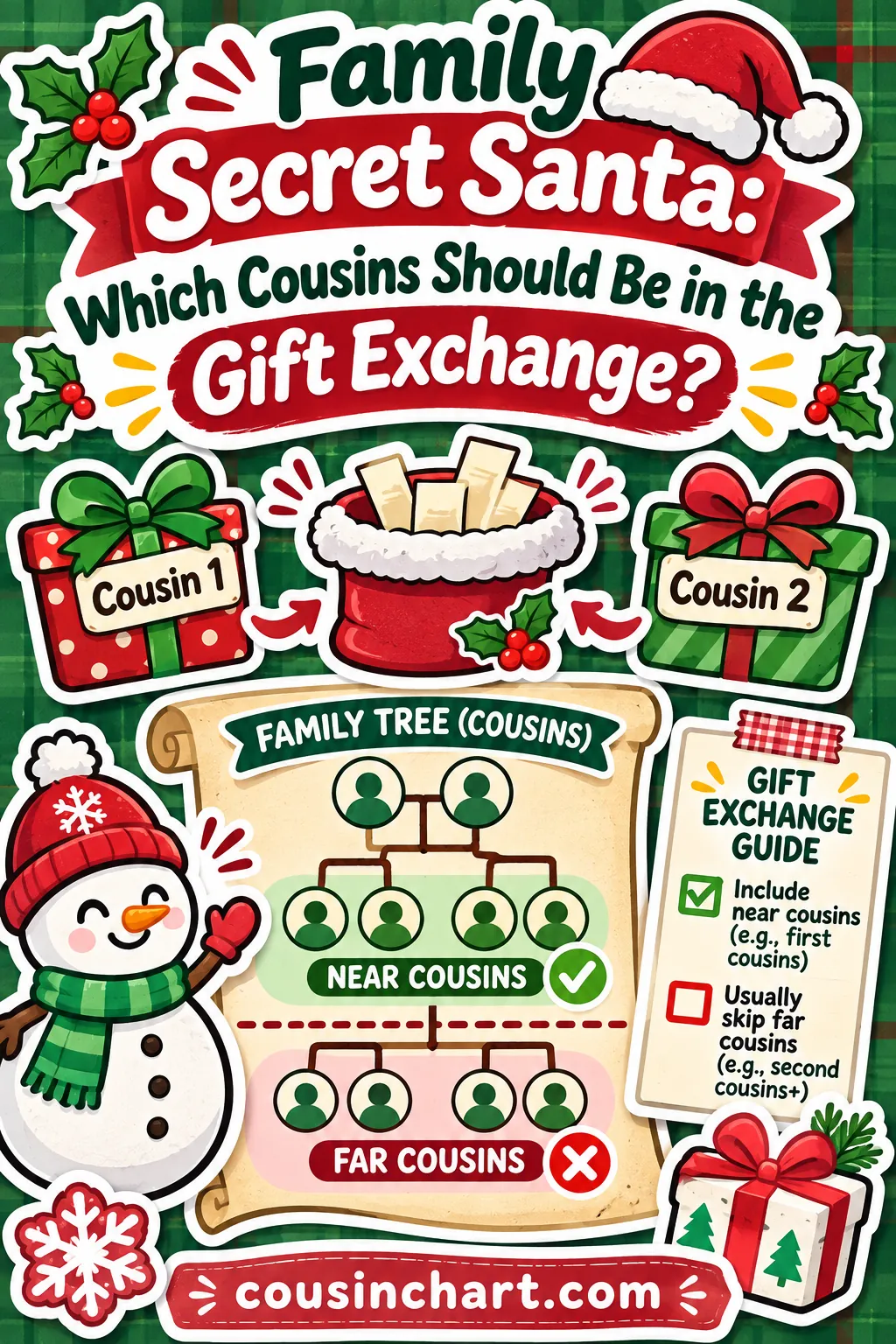
For most family Secret Santa exchanges, the fairest line is everyone who descends from the same set of grandparents: you, your siblings, your first cousins and their partners and kids. That's one clear rule that nobody has to argue about. If your family is small, you can widen it to great-grandparents, which brings in second cousins and your parents' cousins.
The trouble is that "cousins" can mean a dozen different people. Before you draw names, run any doubtful relative through the free Cousin Chart relationship calculator so you know exactly who's a first cousin and who's a second cousin. Then pick your line and stick to it.
▶ Work it out in the free calculator
Why a Relationship Cut-Off Works
Gift exchanges get awkward when the list feels personal. "Why is Aunt Carol's stepson in, but my cousin Dana's kids aren't?" A cut-off based on the family tree takes the guesswork out. It's not about who you like. It's about where everyone sits on the chart.
A good cut-off does three things:
- It's easy to explain in one sentence in the group chat.
- It's consistent. If one first cousin is in, every first cousin is in.
- It keeps the budget sane. Each step up the tree adds a lot more people, so pick the level your family can manage.
Why "cousins" alone isn't a rule
"Let's do all the cousins" sounds clear until someone asks which cousins. Your mom's cousins? Your cousin's kids, who are technically cousins too? The second cousins you see once a year? Every one of those people can fairly be called a cousin, so the word alone doesn't draw a line.
A shared ancestor does. "Everyone who descends from Grandma and Grandpa Ortiz" has one answer for every person in the family. You either come from that couple, or you married someone who does, or you don't. That's why the rest of this guide uses the shared ancestor as the line, and the cousin labels as a way to check where people fit.
The Four Common Cut-Offs
Here are the lines most families end up choosing, from smallest to biggest.
1. Immediate family only
Parents, kids and siblings. This works for small households or when the grown kids are just starting their own families. It's simple, but cousins aren't part of it at all. The guide to immediate family vs. extended family covers who usually counts in each group.
2. Grandparents' descendants (first cousins)
Everyone who descends from one set of grandparents. That's your parents, aunts and uncles, siblings, first cousins, and any kids in those households. This is the most popular choice for a "cousins exchange," because it matches the group that already shows up at Grandma's house.
3. Grandparents' descendants plus the next generation
Same group, but your first cousins' kids now get their own names in the draw instead of being covered by their parents. Your cousin's child is your first cousin once removed. They're still on the grandparents' branch, so this cut-off is really just about age, not distance.
4. Great-grandparents' descendants (second cousins)
Everyone who descends from one set of great-grandparents. That brings in your parents' first cousins and your second cousins. It's lovely for families that gather in one big crowd every year, like a summer reunion that rolls into a holiday party. Your parents' cousins often know stories about your great-grandparents that nobody else remembers, so including them can be a real gift in itself. It also gets large very fast, so many families run it as a "white elephant" game instead of one-to-one Secret Santa.
How to pick between them
Answer these four questions, and the right line usually shows itself.
| Question | If the answer is... | Lean toward |
|---|---|---|
| Who actually shows up for the holiday? | Just parents and kids | Cut-off 1 |
| Grandma's whole crew | Cut-off 2 | |
| A big reunion-style crowd | Cut-off 4, as a group game | |
| How many of the cousins have teens or grown kids? | Few or none | Cut-off 2 |
| Several | Cut-off 3, with an age line | |
| Can one person organize it? | Yes, easily | Any |
| Only if it stays small | Cut-off 1 or 2, or draw by household | |
| Do the branches know each other well? | Yes | Cut-off 2 or 4 |
| Some branches are strangers | Cut-off 2, plus a separate group game |
The question that matters most is the first one. A gift exchange works best when it matches the group that's already in the room. If the second cousins never come to Christmas, drawing their names means mailing gifts to people you'd struggle to shop for.
Cousin Cut-Off Table
Use this table to see where each relative lands. The "Generations" column counts down from the shared ancestor to you, then to them.
| Relative | Shared ancestor | Generations (you / them) | Relationship | In at which cut-off |
|---|---|---|---|---|
| Sibling | Parents | 1 / 1 | Sibling | All |
| Aunt or uncle | Grandparents | 2 / 1 | Aunt or uncle | 2 and up |
| Cousin | Grandparents | 2 / 2 | First cousin | 2 and up |
| Cousin's child | Grandparents | 2 / 3 | First cousin once removed | 3 and up (2 if covered by parent) |
| Parent's cousin | Great-grandparents | 3 / 2 | First cousin once removed | 4 |
| Parent's cousin's child | Great-grandparents | 3 / 3 | Second cousin | 4 |
| Second cousin's child | Great-grandparents | 3 / 4 | Second cousin once removed | 4, usually covered by parent |
Notice something odd? Your cousin's child and your parent's cousin are both "first cousin once removed." That's correct. "Once removed" just means one generation apart. But they sit on different branches. Your cousin's kid comes from your grandparents. Your parent's cousin comes from your great-grandparents. So a "first cousins and closer" rule is less precise than a "descendants of Grandma and Grandpa" rule. Use the shared ancestor as your line, not the cousin label.
Count your list before you commit
Before you announce a cut-off, count the names. It takes five minutes and prevents a lot of surprises.
- Write each of the shared ancestors' children down the left side of a page.
- Under each child, list their spouse or partner, then their kids, then their kids' partners.
- Add any grandkids who are over your age line.
- Total each branch, then total the page.
Do the same for the next cut-off up, and you'll see how big the jump is. Going from grandparents to great-grandparents often doubles or triples the list, because each of your grandparents' siblings brings a whole branch along.
How to Check It With the Calculator
If you aren't sure where someone fits, the relationship calculator will tell you in a couple of seconds.
- Think of the shared ancestor. Who do you and this relative both come from? Grandparents? Great-grandparents?
- Set the generations down to you. Grandparents = 2. Great-grandparents = 3.
- Set the generations down to the other person. Your cousin is 2. Your cousin's kid is 3.
- Add options if needed. Turn on the half relationship for a cousin through a half-aunt or half-uncle. Set the relation type to step or marriage for step-cousins and cousins' spouses.
- Read the name. For 2 and 2, you'll see first cousin. For 3 and 3, second cousin. For 2 and 3, first cousin once removed.
The quick-pick buttons help too. "My second cousin" and "My dad's cousin" are both there, so you can check those in one tap. Hit Copy result and paste it into the family chat if someone asks why they did or didn't make the list.
Settings for the relatives people argue about
| Relative | Settings (you / them) | Options | Result | In the grandparents' draw? |
|---|---|---|---|---|
| Your cousin's teenage son | 2 / 3, or "My cousin's child" | Sex: male | First cousin once removed | Yes, if over the age line |
| Your dad's cousin | 3 / 2, or "My dad's cousin" | none | First cousin once removed | No, he's from the great-grandparents' line |
| Your cousin through a half-uncle | 2 / 2 | Half on | Half first cousin | Yes |
| Your aunt's stepdaughter | Relation type: step | none | Step-cousin | Yes, if she comes to the holiday |
| Your cousin's wife | Relation type: marriage | Sex: female | Cousin-in-law | Yes, if partners count |
| Your mom's cousin's daughter | 3 / 3, or "My second cousin" | Sex: female | Second cousin | No, unless you use cut-off 4 |
The last column is the useful one. The calculator tells you the relationship name. The shared ancestor tells you whether they're in. Your dad's cousin and your cousin's teenage son carry the same label, but only one of them descends from your grandparents.
Worked Example: The Garcia Family Exchange
Let's walk through one family's choice.
Grandma and Grandpa Garcia had four kids. Those four kids have nine children between them, the first cousins. Five of those cousins are married, and three have little ones.
Cut-off 2 (grandparents' descendants): Grandma and Grandpa, the four kids and their spouses, the nine cousins, and the five cousins' spouses. That's 2 + 8 + 9 + 5 = 24 names. The little ones get gifts from their own parents, outside the draw.
Cut-off 3 (add the next generation): Add the cousins' kids who are old enough to join, say 4 of them. Now it's 28 names.
Cut-off 4 (great-grandparents' descendants): Grandpa Garcia had two sisters, each with their own families. Bring in their kids, grandkids and spouses, and you could easily double the list.
The Garcias chose cut-off 2, with one tweak: any cousin's kid aged 12 and up gets their own name. That rule is clear, it's based on the chart, and it grows fairly as the kids get older. When cousin Sofia's daughter turns 12 next year, nobody needs to vote. She's in automatically, and the list goes to 25.
They also invited Grandpa's sisters' families to a separate white elephant game at the party. Everyone who came could bring one wrapped gift and play. That way the second cousins weren't left out, and the main draw stayed small enough to manage.
A note on aunts and uncles
People sometimes forget the generation in the middle. Your aunts and uncles are your parents' siblings, so they descend from the same grandparents and belong in any grandparents-line exchange. Some families let the older generation opt out and just enjoy watching the gift opening. That's fine too, as long as the choice is theirs and it applies to every branch the same way. If Uncle Ray sits it out, Aunt Linda gets to sit it out as well.
Worked Example 2: A Blended Family Exchange
Blended families are where the "who's in" question gets real. Here's the Walker family.
Grandpa Walker has three children from his first marriage: Dawn, Eric and Joy. After he remarried, he and his second wife, Nina, had a son, Luke. Nina also has a daughter, Carmen, from her own first marriage. Everyone gathers at Grandpa and Nina's house for the holidays.
The organizer, Dawn's daughter Bree, wants a grandparents' line exchange. Here's how she sorted it.
- Dawn, Eric and Joy. Grandpa's children. In.
- Luke. Grandpa's son with Nina, so he's Dawn's half-brother and Bree's half-uncle. He descends from Grandpa. In.
- Luke's two kids. Bree checks one in the calculator: she's 2 down from Grandpa, they're 2 down too. With half switched on, the result is half first cousin. They descend from Grandpa, so they're in. (For more on this link, see what a half cousin is.)
- Carmen. Nina's daughter, not Grandpa's. She's Bree's step-aunt. She doesn't descend from Grandpa, but she's at every holiday.
- Carmen's son, Mateo. Bree's step-cousin. Same situation as his mom.
Bree's first draft of the rule was "Grandpa's descendants plus partners." That would have put Luke's kids in and left Carmen and Mateo out, in their own mom and grandma's house. So she changed the rule to: "Everyone who descends from Grandpa or Nina, plus partners." That brought in Carmen and Mateo, kept the line clear, and didn't open the door to anyone else's step-relatives from outside the house.
The lesson is simple. In a blended family, the "shared ancestor" can be the couple who hosts, even when the kids came from different marriages. Define the top of the tree around the household that brings everyone together.
Worked Example 3: A Small Family Widening the Circle
The Kim family has the opposite problem. Grandma Kim had two children, and each had one child. That's a grandparents' line of just six adults, and two of them live overseas. A Secret Santa with four people who all live in different states isn't much fun.
So they widened it to Grandma Kim's parents, the great-grandparents. Grandma had three brothers. Bringing in their descendants added two great-uncles, their kids (the first cousins once removed of the youngest generation) and several second cousins. The list went from four to nineteen, which is a nice size for a draw.
The settings they used to check the new names:
- Grandma's brother's son, to Grandma's grandchild: 3 / 2. First cousin once removed.
- Grandma's brother's grandchild, to Grandma's grandchild: 3 / 3. Second cousin.
- Grandma's brother's great-grandchild, to Grandma's grandchild: 3 / 4. Second cousin once removed.
None of those people would have been in a grandparents' line exchange. All of them descend from the great-grandparents, so the rule is still one sentence long.
Who Else Belongs? Partners, Step-Relatives and Friends
The family tree handles blood relatives neatly. Real families are messier. Here's how most groups handle the edge cases.
Spouses and long-term partners
Most families include them. A cousin's husband has no blood tie, but he's at the table and he'll feel left out if he's the only adult without a gift. A simple rule: "If you come to Christmas, you're in."
Step-cousins and half-cousins
A half-cousin shares one grandparent with you instead of two. They're still blood family on your grandparents' line, so they fit right in. A step-cousin is family by marriage. If they're part of the holiday, include them. The article on what a step-cousin is covers how that link works.
Family friends and "honorary" cousins
Lots of families have a "Cousin Mike" who isn't related at all. If he's at every holiday, add him by name. Just say so in the rules, so nobody uses him to argue for adding everyone's college roommate.
More edge cases
Adopted relatives. An adopted child is part of the branch they were adopted into, with the same standing as any other child or grandchild. If your cousin adopted a 14-year-old, and your age line is 12, she's in.
Double cousins. When two siblings marry two siblings, their kids share both sets of grandparents. Those double cousins qualify for the exchange on both sides of the family, so they may end up in two draws. That's fine. Just make sure they don't draw each other in both.
Divorce. When a marriage ends, the blood relatives stay in, and the former spouse usually leaves the draw. Some families keep an ex who's still close to the kids. If you do, say so in the rules and apply it the same way to every branch.
New babies. A newborn doesn't need a name in the draw. Write the age line so babies are covered automatically.
Relatives who can't come. If a cousin is in the exchange but won't be there in person, decide in advance whether gifts get mailed or handed over later. Put it in the rules, so the person who draws them isn't left guessing.
Setting the Rules
Once you know who's in, write the rules down. A short message works:
- Who's in: All descendants of Grandma and Grandpa, plus spouses and partners. Kids 12 and up get their own name.
- Spending limit: Pick one amount and keep it the same for everyone.
- Draw date: Two or three weeks before the gathering.
- No-swap rule: Don't draw your own spouse or someone in your house.
- Wish lists: Everyone adds two or three ideas.
A message you can copy into the group chat
Hi everyone! This year's Secret Santa includes everyone who descends from Grandma and Grandpa, plus partners. Cousins' kids who are 12 or older get their own name. Same spending limit for everyone. Names get drawn on December 1, and nobody draws someone from their own house. Please add two or three wish-list ideas by then. Reply here if I missed anyone who fits the rule!
The last line is the most useful one. It invites people to point out names you forgot, without inviting a debate about the rule itself.
How to draw names fairly
- Make the list. Every name that fits the rule, grouped by household.
- Mark the exclusions. Nobody draws their own household. Many families also skip whoever you drew last year.
- Draw. Use slips in a hat at Thanksgiving, or a free online name-drawing tool if people are spread out.
- Check for a stuck last name. If the last person left in the hat can only draw themselves or their own household, redraw the whole thing. Don't swap a few slips by hand, because that can leave someone with a person from their own house.
- Send privately. Tell each person their match in a direct message or a sealed card, never in the group chat.
- Keep a sealed copy. One trusted person, ideally not the organizer, keeps the full list so it can be checked if someone forgets who they drew.
When the list gets too big
Sometimes the grandparents' line still gives you 30 or 40 names. That's a lot of shopping for one organizer to track, and it's easy for a name to slip through the cracks. A few fixes that keep the rule intact:
- Draw by household. Each couple or family draws one other household and buys one shared gift. The list stays the same, but the number of gifts drops.
- Split by branch. Each of Grandma's kids and their families draw among one another, then everyone joins a big group game at the party.
- Adults-only draw. Grown-ups draw names, and the kids get a separate exchange with a lower limit.
None of these change who counts as family. They only change how the gifts move around.
Keep the same line next year unless the family votes to change it. Consistency is what keeps it fair. If a cousin marries in or a baby arrives, the rule already tells you what to do.
Keep a family list handy
Organizers often keep a simple tree to check names year to year. A printable family tree gives you a clean sheet to fill in, with each branch under the right grandparent. It's also a fun thing to bring to the party for the kids.
What to Say When Someone Asks "Why Wasn't I Included?"
Even with a clear rule, someone will ask. Keep the answer about the rule, and keep it warm.
To a parent's cousin who wants in: "We kept it to Grandma and Grandpa's side this year so it stays manageable. We'd love to have you in the white elephant game at the party, though!"
To a second cousin's family: "This one's just for Grandma's kids and grandkids. If the family wants to widen it next year, I'll put it to a vote, and I'll make sure you're asked."
To a cousin who wants to add a new partner after the draw: "We already drew, but we'll add them next year for sure. They're welcome to join the group game this time."
To someone who wants to opt out: "Totally fine. You're still invited to everything. Just let me know before the draw so I can take your name out."
To a relative who's upset about a step-relative being in: "Our rule is everyone who comes to the holiday at Grandpa and Nina's. That includes Carmen and Mateo, and it'll include anyone who marries in later too."
Common Mistakes and How to Fix Them
Using "first cousins" as the rule instead of the shared ancestor. Your parent's cousin and your cousin's kid are both first cousins once removed, but only one descends from your grandparents. Fix it by writing the rule around the ancestor: "descendants of Grandma and Grandpa."
Calling your cousin's kids your second cousins. They're your first cousins once removed. Your kids and your cousin's kids are the second cousins. Check it in the calculator before the group chat starts a debate.
Forgetting the middle generation. Aunts and uncles get skipped because people think "cousins exchange." Ask them directly whether they want in.
Changing the rule for one person. Adding one second cousin because she asked nicely means every second cousin now has a fair claim. If you want to widen the rule, widen it for everyone.
No age line. "Kids can join when they're old enough" leads to arguments. Pick a number and write it down.
Announcing the matches in public. One reply-all and the surprise is gone. Send matches one by one.
Letting the list drift. Over a few years, names creep in through friends, roommates and partners of partners, and nobody remembers why. Fix it by checking each new name against the written rule before the draw. If someone doesn't fit, they can still join the group game.
Mixing up who covers the little ones. If babies and toddlers aren't in the draw, say who gives them gifts. Usually it's their own parents and grandparents, outside the exchange, so the kids aren't left empty-handed.
Two Families, One Exchange
What if the gathering mixes your side and your spouse's side? Don't merge them into one big draw unless both families already know each other well. It's usually smoother to run two smaller exchanges, one per side, each with its own grandparents' line. Your kids are first cousins to the cousins on both sides, so they can join both.
If the two families overlap through marriage, like two siblings who married two siblings, check with the free relationship calculator first. Some of those kids may be double cousins, sharing both sets of grandparents. That just means they're in both exchanges.
Example: when the two sides overlap
Rosa and her sister Ana married two brothers, Luis and Pablo Medina. Rosa and Luis have two kids. Ana and Pablo have three. Those five kids share both sets of grandparents, so they're double first cousins.
The Medina side runs a grandparents' line exchange. So does Rosa and Ana's side. All five kids qualify for both. Rosa, Ana, Luis and Pablo qualify for both too, as children of one set of grandparents and partners of the other.
The two organizers compared lists and agreed on one rule: anyone in both draws can't pull the same person twice. They also agreed that the double cousins could pick one exchange and join the other as a group game, if two gifts felt like too much. Most of the teens chose both. The point is that the rule held up. Nobody had to be added or dropped by hand, because the family tree already answered the question.
Organizer's Timeline
A family exchange runs smoothly when the organizer works a few weeks ahead. Here's a simple timeline you can borrow.
Six weeks out - Pick or confirm the cut-off. - Count the names under that rule. - Post the rule and the age line in the group chat.
Four weeks out - Collect the final list. Ask each household to confirm partners, new babies and kids who crossed the age line. - Mark exclusions: same household, last year's match. - Ask everyone to add wish-list ideas.
Three weeks out - Draw names and send each match privately. - Hand the sealed master list to a second person.
One week out - Send a friendly reminder about the date and the spending limit. - Check that anyone who can't attend has a plan for their gift.
After the holiday - Save the final list with the date. - Note any changes for next year: new partners, kids turning the age line, anyone who opted out.
That last step saves the most time. Next fall, you start with a list that's already sorted by branch, and the rule tells you who to add.
▶ Work it out in the free calculator
Frequently Asked Questions
Should second cousins be in a family Secret Santa?
Only if your exchange is built around great-grandparents. Second cousins share great-grandparents with you, not grandparents. Most families keep the exchange to the grandparents' line and invite second cousins to a group game instead.
Are cousins' spouses included in a family gift exchange?
Most families include them. They have no blood tie, but they come to the gathering, and leaving one adult out feels unkind. "If you come to Christmas, you're in" is a common, simple rule.
What is my cousin's child to me?
Your cousin's child is your first cousin once removed. You share the same grandparents, but they're one generation further down. Many families call them "cousin" or "little cousin" in everyday talk.
How do we include kids in a Secret Santa?
Pick an age line, like 10 or 12 and up, and give older kids their own names in the draw. Younger kids can get gifts from their parents or from a separate kids' exchange. Write the age into the rules so it's the same for every branch.
Should half-cousins be in the gift exchange?
Yes, if you're using the grandparents' rule. A half-cousin shares one grandparent with you instead of two, so they still descend from your grandparents' line. In the calculator, turn on the half relationship option to see the exact name.
What if someone feels left out?
Point to the rule, not the person. "We're doing everyone who descends from Grandma and Grandpa" is easy to explain and hard to take personally. You can also add a group game where anyone at the party can join.
Is my parent's cousin in a grandparents' line exchange?
No. Your parent's cousin descends from your great-grandparents, not your grandparents, even though the label is first cousin once removed, the same as your cousin's child. They'd join only if you widen the exchange to your great-grandparents' descendants.
How do step-relatives fit a family Secret Santa?
Step-relatives don't descend from your grandparents, so a strict bloodline rule leaves them out. Most families fix this by defining the line around the household that hosts, like "descendants of Grandpa or his wife, plus partners." That keeps step-children and step-grandchildren in without opening the list to everyone.
What's the easiest way to run a draw when family lives far apart?
Use a free online name-drawing tool that lets you block pairs, like spouses or people in the same house. Each person gets their match privately by email or text. Agree in the rules whether gifts are mailed or swapped at the next visit.