Which Relative Should Take a DNA Test to Solve My Family Mystery?
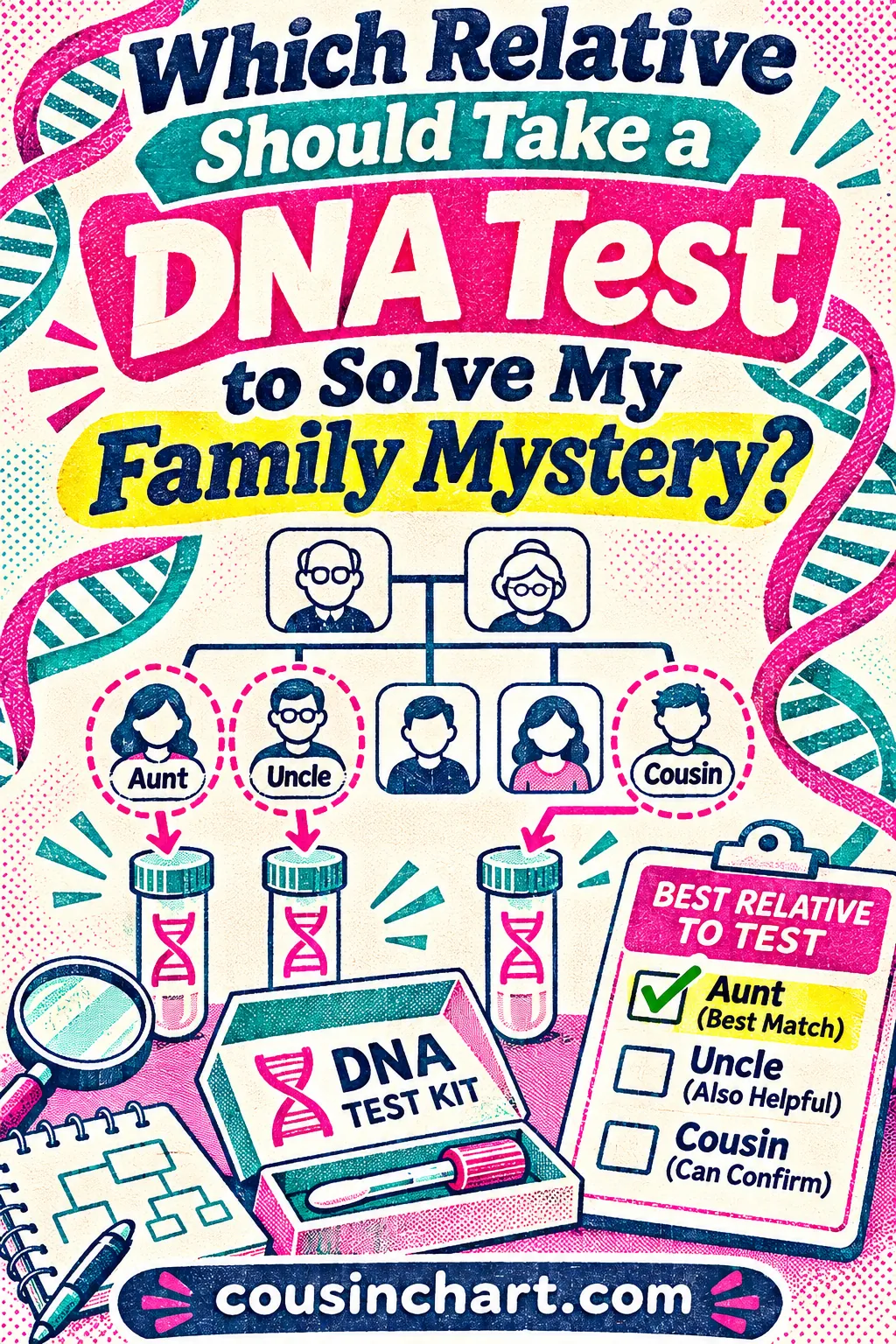
The best relative to DNA test is usually the oldest living person on the branch where the mystery sits, such as a grandparent, a great-aunt or your parent from that side. Each generation closer to the mystery doubles the DNA you can compare, so their matches are bigger and easier to place. You can see exactly how much bigger with the free DNA match calculator, which shows the shared cM you'd expect for each relationship.
If you only have one or two test kits, who takes them matters more than which company you pick. This guide walks you through choosing the right person, with worked examples for the most common mysteries, like an unknown grandfather or a rumored half sibling. You'll also find scripts for asking a reluctant relative, a checklist for before the kit ships, and the mistakes that waste a test.
Why the Older Generation Wins
You got about half your DNA from each parent. That means you carry only about half of what your mom or dad inherited from their own parents. The rest of it is gone from your line, at least in you.
Here's what that does to your matches. Say a cousin from your dad's side has tested. Your dad shares a certain amount of DNA with that cousin. You share, on average, about half of that amount. Go one more step down and your child shares about half of yours.
So when you test the person one generation up:
- Their matches on that line are about twice as large as yours.
- Small matches that you'd miss entirely can show up for them.
- Relationship guesses get clearer, because bigger numbers overlap less.
- They carry pieces of DNA from the mystery ancestor that you never inherited.
That last point matters most. A grandparent who carries a chunk of DNA from the unknown man in your tree is your best link to his family. You might not have that chunk at all.
Picture it as a stack of photocopies
Think of each generation as a photocopy that only copies half the page. Your grandmother has her full page from each of her parents. Your mom got half of grandma's page, picked at random. You got half of your mom's half. By the time it reaches you, a quarter of grandma's page is all you hold, and the rest is blank in your copy.
A DNA company can only compare the pieces a person actually carries. If the piece that connects your family to a lost cousin sits in the blank part of your copy, that cousin never shows up on your match list. On grandma's list, they might be sitting near the top.
The math in one line
On average, every generation you add between the tester and the mystery ancestor cuts the expected shared DNA with that ancestor's other descendants roughly in half. Every generation you remove roughly doubles it. That's the whole case for testing up.
Which Relative Should DNA Test First: A Quick Ranking
Use this as a rough order of choice. Always pick someone from the branch where the mystery actually is. Your mom's test won't help with a mystery on your dad's side.
| Who tests | Generations closer to the mystery than you | How their matches compare to yours | Best for |
|---|---|---|---|
| A grandparent from that side | 2 | Roughly four times as large | Great-grandparent mysteries, old family rumors |
| A great-aunt or great-uncle | 2 | Roughly four times as large | Unknown great-grandparent |
| Your parent from that side | 1 | Roughly twice as large | Unknown grandparent, grandparent's origins |
| An aunt or uncle on that side | 1 | Roughly twice as large | When your parent can't test |
| A parent's first cousin | 1 | Roughly twice as large, on one sub-branch only | When the mystery is one specific grandparent of theirs |
| A full sibling | 0 | Similar size, different pieces | Adding coverage you didn't inherit |
| You | 0 | Baseline | When no one older can test |
Two of the same generation can help too. Your dad and his full sister each inherited a different mix from their parents. Testing both catches more of the family's DNA than testing just one.
Why "right branch" beats "oldest person"
A 95-year-old great-uncle on your mom's side is a wonderful tester, but not for a mystery on your dad's side. Age only helps when the person sits on the line that leads to the mystery. Before you pick anyone, trace the branch first and age second.
Step One: Pin Down Exactly Where the Mystery Sits
Most wasted tests come from skipping this step. "Something odd on dad's side" isn't specific enough. You want to name the exact person or couple you're trying to identify.
Ask yourself these questions, in order:
- Which of my parents does the mystery come through? Mom or dad. If you don't know, test yourself and one parent first, which sorts every match into one side or the other.
- Which of that parent's parents? For an unknown grandfather, the mystery is your dad's father, not his mother.
- How far back is the gap? An unknown grandparent is a gap one generation above your parent. An adopted great-grandmother is a gap two generations above your parent.
- Who is still living below the gap? List every living descendant of the mystery person, oldest first.
- Who among them shares the mystery line fully? A full sibling of the person at the gap is a strong pick. A half sibling only helps if they share the mystery parent.
Once you've answered those, the right tester is usually obvious. It's the oldest living person on that list who's willing to spit in a tube.
A quick branch check
| If the mystery is… | Test someone descended from… | Don't spend a kit on… |
|---|---|---|
| Dad's unknown father | Dad's father (dad, dad's full siblings, dad's paternal half siblings) | Dad's maternal half siblings, anyone on mom's side |
| Mom's adopted grandmother | That grandmother (her children, grandchildren) | Your mom's dad's side |
| Grandpa's rumored first family | Grandpa (his known children, then their children) | Grandma's relatives |
| Your own biological father | Yourself first, then your known half siblings on that side | Your mom's relatives, except to sort matches |
Worked Examples: Common Family Mysteries
Here's how the choice plays out in real situations.
An unknown paternal grandfather
This is the most common family mystery. Your dad never knew his father, and no one will say who he was.
Who to test: your dad, if he's living and willing. He's one generation closer to the unknown grandfather than you are.
Why it helps: let's say the unknown grandfather had a brother, and that brother has a grandchild who has tested. Here's how the relationships line up:
- That grandchild is your dad's first cousin once removed.
- That same grandchild is your second cousin.
Now compare the numbers. Second cousins share about 229 cM on average. A first cousin once removed shares roughly double that, in the low 400s on average. So your dad's match to that person is likely to be about twice as large as yours. It will land in a range that's easier to read and much harder to miss.
Pull up the DNA match calculator, enter both figures, and you'll see how much tighter the list of likely relationships gets with the bigger number.
If your dad can't test: look for his full siblings, who share the same unknown father. A half sibling who shares only the mother won't help with this line at all. If your dad has a half sibling through that unknown father, though, that's a strong choice.
A Y-DNA option: if your dad, his son or his brother carries the male-line Y chromosome from the unknown grandfather, a Y-DNA test can point to a surname. The guide to Y-DNA, mtDNA and autosomal tests explains how each test traces a different line.
Mom's grandmother was adopted
Your mom's maternal grandmother was adopted as a baby, and her birth family is a blank. That makes her the mystery, and her parents are the couple you're trying to find.
Counting generations from that couple down:
- Your great-grandmother: 1 generation down
- Your grandmother: 2 down
- Your mom: 3 down
- You: 4 down
Who to test: the oldest living person in that line. If your grandmother is alive, test her first. She's two generations closer than you, so her matches to the birth family are about four times as large as yours on average.
What you'd see: suppose the adopted great-grandmother had a full sister you've never heard of. That sister's grandchild would be your grandmother's second cousin. They'd share about 229 cM on average. For you, that same person is your second cousin twice removed, and the expected number drops to well under 100 cM. At that level, a match can easily blend in with hundreds of other distant cousins.
If your grandmother has passed: test her siblings, then your mom and her siblings. Each extra test from the same generation adds DNA that the others didn't inherit.
Is my brother really my full brother?
Sometimes the mystery is in your own generation. You and your brother have very different looks and the family has hinted at something.
Who to test: both of you. This is the one case where your own generation is the right place to start.
What the numbers say: full siblings share about 2,613 cM on average. Half siblings share much less, roughly in the 1,700s on average. That half-sibling range overlaps with grandparents, aunts and uncles, which is why the DNA match calculator lists several possible relationships for a number in that area.
Testing a parent as well clears things up fast. If both of you match your mom as a parent and only one of you matches your dad, you have your answer. The guide on whether a match is an aunt, uncle, grandparent or half sibling covers how to separate those look-alike numbers.
A brick wall at your 2nd great-grandparents
Your dad's mother's mother's father shows up in one census and then vanishes. He's your 2nd great-grandfather, and nobody knows where he came from.
Count the generations from his parents, the couple you're trying to find:
- Your 2nd great-grandfather: 1 down
- Your great-grandmother: 2 down
- Your grandmother: 3 down
- Your dad: 4 down
- You: 5 down
Who to test: your grandmother, if she's living. If not, test her siblings, who are also 3 down. If they've all passed, test your dad and his siblings, plus any of your grandmother's nieces and nephews (your dad's first cousins on that side).
Why several testers help here: at this depth, the descendants of the lost man's siblings are third and fourth cousins to your dad's generation. Third cousins share about 73 cM on average and fourth cousins about 35 cM, and plenty of real fourth cousins share none at all. One tester will catch some of those cousins. Three testers from different sub-branches will catch more, because each inherited different pieces.
What to do with the results: look for matches that appear on two or more of your testers' lists and also share each other. The guide to shared DNA matches explains how those overlapping matches form groups that point to one ancestral couple.
Grandpa's rumored first family
Family lore says grandpa had a child with someone before he married grandma. You'd like to know if that half aunt or uncle exists.
Who to test: grandpa, if he's living. If he's not, test his known children, which means your dad and your dad's full siblings.
What you'd see: a half sibling to your dad shares, on average, roughly the 1,700s cM with him, the same half-sibling range as above. To you, that person would be a half aunt or uncle, which typically lands around half that amount. The half aunt's or uncle's children would be your dad's half nephews and nieces and your half first cousins. Your dad's numbers will be roughly double yours, so his list makes the half sibling much easier to recognize.
What to watch for: half relatives and full relatives one generation apart can land in the same cM range. A half sibling and a full uncle look alike on a number alone. Ages, other shared matches and a tree help you sort it out.
You're the one who was adopted
If you're the adoptee, the mystery is your own birth parents, so you're the closest living person to it. Test yourself first. No one else in your adoptive family carries any of that DNA.
After that: once you identify a birth relative, ask whether an older birth relative would test too. A birth grandparent or aunt can confirm which side a match is on. Then work outward from there: identify the shared ancestors of your closest matches, build their trees down, and look for the couple whose descendants fit every match.
Expected cM by Relationship
These are the averages used across this site. Real numbers vary from match to match, and the ranges for neighboring relationships overlap. Treat them as guides, not fixed values.
| Relationship to the tester | Generations from the shared ancestors (each side) | Average shared cM |
|---|---|---|
| Full sibling | 1 and 1 (shared parents) | 2,613 |
| First cousin | 2 and 2 (shared grandparents) | about 866 |
| Second cousin | 3 and 3 (shared great-grandparents) | about 229 |
| Third cousin | 4 and 4 (shared 2nd great-grandparents) | about 73 |
| Fourth cousin | 5 and 5 (shared 3rd great-grandparents) | about 35 |
Look at the drop from row to row. Each step out cuts the shared DNA sharply. That's why testing one generation up helps so much: a faint fourth cousin match for you is a noticeably larger match for your parent, and a larger number is easier to place.
The same cousin, seen by three testers
Here's one distant cousin seen from three generations of your family. Say she descends from your grandmother's grandparents, so she's your grandmother's second cousin.
| Tester | Relationship to that cousin | What to expect |
|---|---|---|
| Your grandmother | Second cousin | About 229 cM on average |
| Your parent | Second cousin once removed | Roughly half of that |
| You | Second cousin twice removed | Roughly a quarter, often under 100 cM |
The cousin didn't change. Only the tester did. For the full picture of how sharing drops off across cousin levels, see how much DNA cousins share.
How to Check It With the Calculator
Before you send a kit, it helps to see what you're likely to get. Here's a simple way to plan with the tools on this site.
- Name the mystery couple. Write down who you're trying to identify, such as "Dad's father and his parents."
- Work out the relationship. Use the free relationship calculator to name how a known relative on that side relates to you. Set how many generations down each of you is from the shared ancestor, and it returns the relationship name with a chart.
- Look up the expected number. Open the DNA match calculator and enter a cM figure to see the likely relationships. Try the average for your relationship, then try roughly double to see what your parent would share with the same person.
- Compare the two lists. The list for the larger number is usually shorter and easier to act on. That's your case for testing the older person.
Expect the calculator to show several possible relationships for most numbers. That's normal. You narrow it down with ages, trees and other matches.
A full walkthrough: the unknown grandfather
Here are the exact settings for the first worked example.
Your side of the math. The shared ancestors are the unknown grandfather's parents, your great-grandparents. In the relationship calculator, set yourself to 3 generations down from them (great-grandparents, grandfather, dad, you, counting each step below the couple). Set the other person, the brother's grandchild, to 3 generations down as well. Leave the relation type on blood and the half option off. The result reads second cousin.
Your dad's side of the math. Now set the first person to 2 generations down (your dad) and keep the other person at 3. The result reads first cousin once removed.
Plug in the numbers. In the DNA match calculator, enter 229 cM, the second-cousin average. You'll see a spread of possible relationships at that level. Now enter something in the low 400s, about what your dad would share. The list shifts toward closer relationships, and the spread you have to sort through gets smaller.
Write it down. Use Copy result or Download my chart in the relationship calculator to save both charts. When you ask your dad to test, showing him the two charts side by side is a simple way to explain why his kit matters more than yours.
A walkthrough for a half relationship
Say your dad's half brother through their shared father is willing to test. In the relationship calculator, set the shared ancestor as the father, with your dad at 1 generation down and the half brother at 1 down. Turn on the half relationship option. The result reads half brother. Set yourself at 2 down instead of your dad, keep the half option on, and you'll see half uncle. Expect roughly half the cM that a full uncle would share.
Half, Step, Adopted and Other Edge Cases
Not every relative carries useful DNA for every mystery. Here's how the less common relationships work out.
- Half relatives. A half sibling, half aunt or half cousin shares only one ancestor on the line that connects you. That's actually useful when you want to isolate one person. A half sibling through your dad's mother can only match on her side, so any match you share with them points to her line.
- Step relatives. A step-parent, step-grandparent or step-sibling shares no DNA with you through that step connection. Their test can't help with your mystery unless they're also blood kin through another line. In the relationship calculator, the step relation type will show the name, but no cM is expected.
- Relatives by marriage. An aunt by marriage shares no DNA with you. Her children, your first cousins, do, through your blood aunt or uncle.
- Adopted relatives. An adopted aunt or uncle carries their own birth family's DNA, not yours. They're family in every way that counts, but their test won't match your ancestral lines. Their children by birth will match your blood relatives only through the parent who's related to you.
- Double cousins. If two brothers married two sisters, their children are double first cousins and share more DNA than ordinary first cousins. That can make a test look closer than it is. Ask the calculator about both lines separately, then expect the real number to run higher.
- Identical twins. Identical twins share essentially the same DNA. If one has tested, the other's test won't add new matches. Pick a different relative.
- Parents who are related. In families where cousins married, everyone tends to share a bit more DNA with everyone else, and matches look closer than they are. Testing more relatives and checking the shared matches matters even more here.
When Your Best Tester Isn't Available
Not everyone has a living grandparent to ask, and not every relative wants to test. That's fine. You still have options.
- Test the closest living relative from that line. A great-aunt, an uncle or an older cousin from the mystery side all carry DNA you didn't inherit.
- Test more than one sibling. Two or three full siblings together cover far more of your parents' DNA than one of you alone.
- Ask with care. Older relatives sometimes worry about privacy or what a test might reveal. Explain what you're looking for and how the results will be used. The page on DNA test privacy can help you answer their questions.
- Don't push. A family secret may be painful for the person who holds it. A gentle conversation sometimes tells you more than a test would.
If you test and still don't see a relative you expected, don't panic. Distant cousins don't always share detectable DNA, even when the paper tree is right.
A backup order when the oldest person says no
- A full sibling of the person who declined, who's in the same generation.
- The children of the person who declined, more than one if you can.
- That person's nieces and nephews on the mystery line.
- You and your full siblings.
Each step down costs you some match size, but more testers from one generation make up part of the difference.
How to Ask a Relative to Test: What to Say
Asking an older relative to take a DNA test can feel awkward. Keep it short, honest and low pressure. Here are a few ways to say it.
For a grandparent who loves family stories: "Grandma, I'm trying to find out more about your mom's family. Your DNA would tell us far more than mine can, because you're closer to her. Would you be willing to do a spit test? I'll handle all the setup."
For a parent who's unsure: "Dad, I'd like to learn more about your father's side. If you test, your matches will be about twice as strong as mine, so we'd have a real chance of finding his relatives. You don't have to look at the results unless you want to."
For a relative worried about privacy: "I understand. You can choose not to have a public tree, and you can decide who sees the results. I'll show you the privacy settings before we send it in. If you'd rather not, that's okay too."
For a sensitive mystery: "I know this might be hard to talk about. I'm not trying to judge anyone. I'd just like to know where we come from. If something comes up, I'll talk to you first before I tell anyone else."
Things to avoid saying
- Don't promise a specific answer. DNA might not solve it.
- Don't spring a family secret on someone through the test. Talk first.
- Don't imply they owe you their DNA. Consent matters, and so does a no.
Checklist Before the Kit Ships
Run through this list before the sample goes in the mail.
- [ ] The tester is on the right branch for the mystery.
- [ ] They agreed freely and understand what DNA can reveal, including surprises.
- [ ] You've agreed who will manage the account and who sees the results.
- [ ] The privacy and matching settings are set the way the tester wants.
- [ ] The kit is registered under the tester's name, not yours.
- [ ] You've written down the mystery couple and the relationships you expect to see.
- [ ] You've run the expected cM through the DNA match calculator so you know what a "hit" looks like.
- [ ] You have a plan for what happens if the results show something unexpected.
Common Mistakes When Choosing Who to Test
- Testing the wrong branch. Your maternal uncle can't help with a paternal mystery. Check which side the mystery is on first.
- Testing a half relative on the wrong parent. A half sibling only helps if they share the parent whose line holds the mystery.
- Choosing the youngest because they're easiest. Teens and kids are easy to swab, but they carry the least of the old family DNA.
- Waiting too long. If an elderly relative is willing, don't put it off. Their DNA is the hardest to replace.
- Reading one match alone. Use several matches, ages and trees together before you draw a conclusion.
How to fix them if you've already tested
| Mistake | What happened | The fix |
|---|---|---|
| Tested the wrong side | Matches don't connect to the mystery | Use those results to rule matches out, then test someone on the right side |
| Tested a half relative on the wrong parent | No matches on the mystery line | Use their list as a filter: anyone they share with you is on the other line |
| Tested only the youngest | Small, hard-to-place matches | Add an older tester and compare lists |
| Took the top label as fact | A guess led to the wrong family | Check the cM in the calculator and look at every likely relationship |
| Used just one tester for a deep brick wall | Too few distant cousins | Add testers from different sub-branches of the same line |
Ready to Plan Your Tests?
Pick the oldest living person on the right branch, then check what their matches should look like. Enter a few numbers in the free DNA match calculator and you'll see right away why the older generation gives you clearer answers.
Frequently Asked Questions
Is it better to test my parent or myself?
Your parent, if the mystery is on their side. They carry the full set of DNA from that line, and you only have about half of it. Their matches will be roughly twice as large, which makes them easier to spot and place.
Should I test my grandmother or my mom?
Test your grandmother first if she's on the right side and willing. She's one generation closer to the mystery than your mom. If you can test both, do it, because each carries some DNA the other didn't pass down.
Does it help to test more than one sibling?
Yes. Full siblings each inherited a different half of their parents' DNA. Testing two or three of you together picks up matches that one person alone would miss.
Can my mom's test help with a mystery on my dad's side?
No. Your mom's DNA comes from her own parents, so her matches only connect to her side of the family. She can help by ruling matches out, since anyone who matches both of you is likely on her side.
What if the only person left is me?
Test yourself and work with what you get. Your matches are smaller, but close and mid-range cousins still show up clearly. Building out your matches' family trees can fill in a lot of what an older relative's test would have shown.
Is a Y-DNA test better than a regular DNA test?
It depends on the mystery. A Y-DNA test only follows the straight father-to-son line and can point to a surname. A regular autosomal test catches cousins from every branch and is usually the better first choice for an unknown parent or grandparent.
Will my step-grandfather's DNA test help with my family tree?
Only if he's also related to you by blood through another line. A step connection carries no shared DNA, so his matches will belong to his own family. He can still help by sharing stories and documents.
Is a great-aunt as good as a grandparent for testing?
On the same line, yes. A full sister of your grandparent sits the same number of generations from the mystery, so her matches are about the same size. She inherited a different mix, so testing both is even better.
How many relatives should I test for a deep brick wall?
There's no fixed number, but more than one helps a lot once the mystery is three or more generations back. Pick testers from different sub-branches of the same line, like a grandparent's sibling and a grandparent's cousin. Each picks up distant cousins the others miss.