DNA Test Privacy: What Companies Do With Your Data
Genetic privacy has one feature that makes it unlike every other kind: you cannot make the decision alone. Testing exposes information about your parents, your siblings, your children and cousins you have never met, none of whom were asked. That is not a scare story — it is the same mechanism that lets adoptees find birth families and lets investigators identify suspects through distant relatives. Everything else worth knowing follows from it: what companies keep, what changes when terms are rewritten or a business is sold, and which settings genuinely control something. If you want the benefits without sleepwalking into the trade-offs, read the settings before you post the tube, then use the DNA match calculator for the part you actually came for.
Which privacy question is yours? Tap the closest match.
Tap an option above. The theme: most of this is a setting, and defaults are decisions too.
What does a testing company actually hold?
Four separate things, with four separate lifespans — and people usually think about only one of them.
The physical sample. The tube of saliva or the swab. Companies commonly store it so they can re-run or upgrade your test later, unless you ask for destruction.
The raw genotype data. The digital file of your results. This is the part that can be downloaded, uploaded elsewhere and, in principle, copied indefinitely.
Your account and tree data. Name, email, payment details, family tree, notes, messages to matches. Often more personally identifying than the DNA itself.
Derived and inferred data. Ethnicity estimates, health reports where offered, relationship predictions and match lists. These are generated from your file and regenerated whenever the company updates its models — one reason results change over time.
Deleting one does not delete the others. Closing an account may leave the sample in storage; destroying the sample does not remove a file you already exported. Ask about each explicitly.
What happens if the company is sold?
Your data is an asset, and assets move. This is the part of the terms almost nobody reads.
Ownership can change. Businesses are acquired, merged, restructured and occasionally wound up. Customer databases are typically part of what transfers, subject to whatever the privacy terms in force allow.
Terms can be amended. Policies are living documents. The rules you agreed to at purchase are not guaranteed to be the rules in five years, and continued use often counts as acceptance of an update.
Bankruptcy is the awkward case. Insolvency proceedings can treat data differently from an ordinary sale, and outcomes depend on jurisdiction and the terms themselves.
So check current terms rather than remembered ones. Read the actual policy on the company's site today, look for the sections on business transfers and on data retention, and re-read them if you hear the company has changed hands. Nothing in this guide substitutes for that.
Keep your own copy either way. Download and store your raw data file somewhere you control, so a service change never leaves you without your own results.
How does law-enforcement matching work?
Not by police searching a company database at will — by uploading a crime-scene profile into a genealogy database and working outwards through relatives.
It relies on distant cousins, not the person sought. Investigators find matches at second, third or fourth cousin level, build family trees from public records, and narrow the tree to a candidate. The technique became widely known after a long-unsolved Californian serial-offender case was closed in 2018 using an uploaded profile in a public genealogy database.
Availability differs by site. Some databases offer law-enforcement matching as an explicit setting, opt-in at one and opt-out at another. Others state they do not permit it and require legal process for any disclosure.
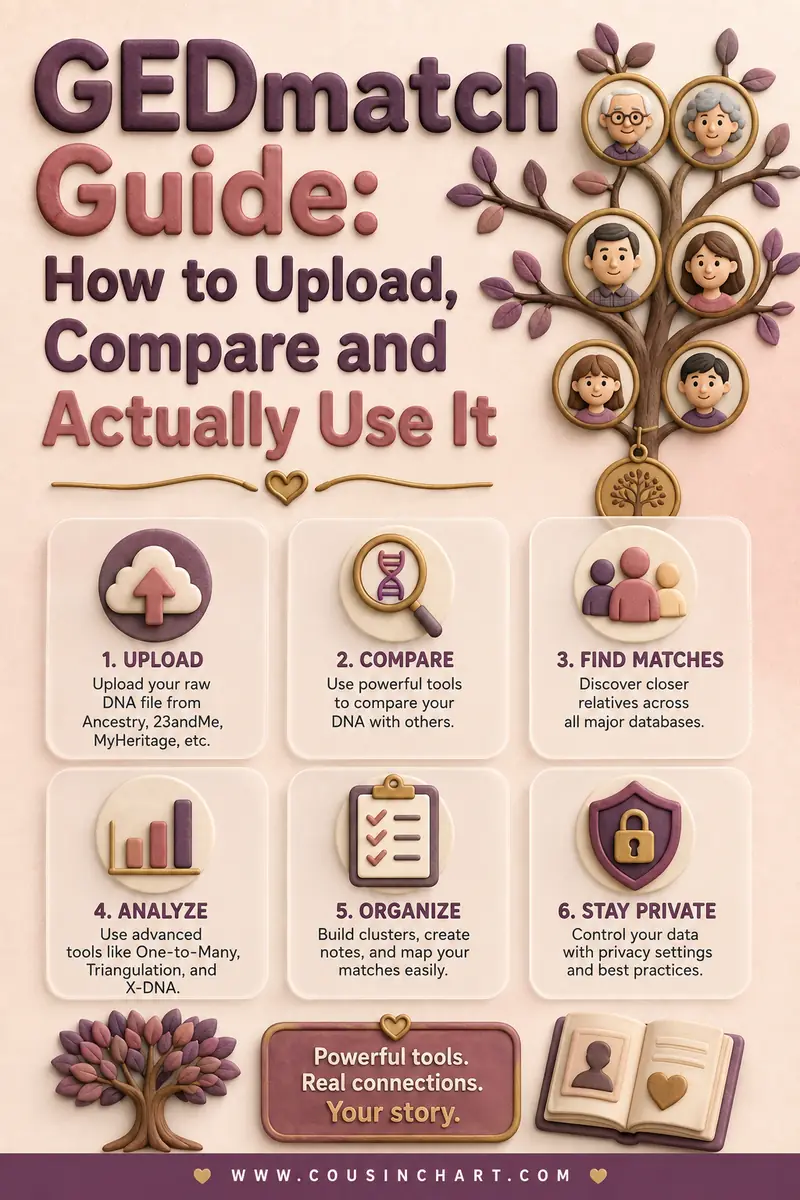
The setting is real and it is yours. If you upload to a site with a law-enforcement option — GEDmatch is the best known — find that toggle and set it deliberately. Neither choice is wrong; accepting a default without reading it is the part worth avoiding.
It cuts both ways. The same reasoning identifies unidentified remains and returns names to families, and it is the same technique used in the unknown parent DNA search method that reunites adoptees with birth relatives.
What can't you consent to on your relatives' behalf?
Any of it, really. This is the honest core of genetic privacy.
Your file describes them too. A sibling's results are largely predictable from yours, a parent's substantially so. You cannot publish half of someone else's genome without publishing part of theirs.
They can be found through you. A relative who has deliberately never tested can still be identified by investigators, journalists or searching relatives working outwards from your match list.
Family secrets surface without warning. Misattributed parentage, undisclosed adoptions and donor conception routinely come to light through a cousin's test result. The person most affected is often not the person who tested.
A conversation costs nothing. Telling your parents and siblings before you test does not give them a veto, but it prevents the worst version, where somebody learns something enormous from a notification email.
And be careful what you upload about others. Posting a relative's raw data, or their tree, is a decision about their privacy rather than yours — including in the search techniques described in the guide to finding living relatives.
Which settings actually matter?
Most privacy anxiety attaches to things you control. Here is what to look for in any account.
| Setting | What it controls | Sensible default for most people |
|---|---|---|
| Matching visibility | Whether you appear in other testers' match lists | On, if finding relatives is why you tested |
| Displayed name | What matches see — full name, initials or a username | Initials or a username |
| Family tree visibility | Whether your tree is public or private | Private, with living people hidden |
| Research participation | Whether your data joins academic or commercial studies | Optional; decline freely if unsure |
| Law-enforcement matching | Whether investigative uploads can match you | A deliberate choice either way |
| Segment or chromosome sharing | Whether matches can see your DNA segments | On for serious research, off otherwise |
| Health reports | Whether health interpretations are generated | Only if you want them |
| Sample storage | Whether the physical sample is kept | Keep if you may upgrade; destroy if not |
Matching visibility is the trade-off in miniature. Turn it off and you are private and useless to yourself; the entire value of a consumer test is being findable.
Two-factor authentication belongs on this list too. Genealogy accounts have been hit by credential-stuffing attacks that reused passwords leaked elsewhere. A unique password plus 2FA removes most of that risk.
Can you delete your data and destroy the sample?
Usually yes, and they are separate requests that need separate confirmations.
Account deletion removes your profile and matching presence. Expect to lose your match list, notes and messages permanently — export anything you want first.
Sample destruction must be asked for. It is normally a distinct instruction in account settings or by written request.
Some things cannot be recalled. Data already included in completed research, results another user has downloaded, and anything you exported and shared yourself are all outside the company's ability to retrieve.
Regional rights vary. People in some jurisdictions have stronger statutory rights of access and erasure than others, and companies apply those rights according to where you live.
Get it in writing. Ask for confirmation of both deletion and destruction, and keep it.
Does a DNA test affect your insurance?
In the United States, health cover and employment are protected. Several other kinds of policy are not.
Federal law covers health insurance and employment. The Genetic Information Nondiscrimination Act of 2008 prohibits health insurers and employers from using genetic information to make decisions about you.
It does not cover life, disability or long-term care insurance. In many states, insurers offering those products may ask about genetic test results, and some states add their own protections on top. This gap is real and is the reason health-related testing deserves a moment's thought — the combination kits are described in the guide to ancestry and health DNA tests.
Consumer results are not medical records. Direct-to-consumer companies are generally not covered by health-privacy rules that apply to clinics and hospitals, which surprises people.
Rules differ outside the US. Some countries operate moratoria or statutory limits on insurers using genetic results. Check what applies where you live before assuming either way.
And ancestry-only kits are a different proposition. A test with no health interpretation raises the question far less sharply, which is one reason many people choose one.
What should you do before you spit?
A short checklist that covers most of the risk.
Decide why you are testing. Ancestry only, health included, or a specific family question. The answer determines which product and which consents make sense.
Read the privacy policy sections on sharing, retention and transfer. Ten minutes, once, on the company's own site.
Set a unique password and enable two-factor authentication. The likeliest breach is an account takeover, not a laboratory leak.
Use initials or a username as your display name. You stay findable to matches without publishing your full identity to strangers.
Choose your research and law-enforcement settings deliberately. Defaults are decisions someone else made.
Download your raw data and store it safely. It protects you against service changes, and it is what you would upload elsewhere later.
Tell close relatives first. Especially parents and siblings, and especially if a surprise would be life-altering. A test can dissolve a family story overnight, which is why unexpected results feature so heavily among common DNA testing myths and misunderstandings — and why adoptee searches, covered in the guide to DNA tests for adoptees, start with support rather than with a kit.
FAQ
Which DNA test is best for privacy?
The one whose current terms you have actually read and whose settings you have configured deliberately. Ancestry-only kits raise fewer questions than health kits, and any company that publishes clear policies on retention, research sharing, law-enforcement matching and business transfers is easier to assess.
Can police access my DNA test results?
Not by browsing a company database. Investigators upload a crime-scene profile to genealogy databases that permit it and identify suspects through distant relatives. Some sites offer law-enforcement matching as an explicit setting; others require legal process. Check and set your preference deliberately.
Can I delete my DNA data after testing?
Usually yes. Account deletion and destruction of the physical sample are normally separate requests, so make both and keep the confirmations. Data already used in completed research, or files you exported and shared yourself, cannot be recalled afterwards.
What happens to my DNA if the company is sold?
Customer data is generally treated as a business asset and can transfer in a sale, merger or insolvency, subject to the privacy terms then in force. Those terms can also be amended over time, so check the current policy rather than relying on what you agreed to at purchase.
Does taking a DNA test affect life insurance in the US?
It can. The Genetic Information Nondiscrimination Act covers health insurance and employment but not life, disability or long-term care policies. Some states add protections. Rules differ by country, so check what applies where you live before taking a health-reporting test.
Does my DNA test expose my relatives?
Yes, unavoidably. Your results reveal substantial information about parents, siblings and children, and let others identify cousins who never tested. You cannot consent on their behalf, which is why telling close relatives before you test is worth doing.
Read the settings, then enjoy the results
None of this is an argument against testing. Millions of people have found family, answered lifelong questions and built real trees from a tube of saliva, and the risks are mostly manageable with about twenty minutes of attention. Read the current policy on retention, sharing and business transfer. Set a unique password with two-factor authentication, display initials rather than your full name, and choose your research and law-enforcement settings on purpose. Download your raw data and keep your own copy. Then tell your parents and siblings before the results arrive — and when a match does appear, the cousin calculator will help you work out exactly who they are.