DNA Testing Myths vs Facts: 10 Things People Get Wrong
Most disappointment with a DNA test comes from expecting the wrong thing. A consumer test is excellent at one job — telling you how closely you're related to other people in the same database — and much weaker at everything the marketing implies. It can't name a specific ancestor, can't tell you your nationality, isn't legal proof of anything, and won't find every cousin you have.
Below are ten myths that come up constantly, each with the honest version. None of this is a reason to skip testing. It's a reason to read your results correctly — and the most reliable thing in them, the shared centimorgan figure, is exactly what the DNA match calculator is built to interpret.
Myth or fact? Tap a claim to see the honest answer:
Tap a claim above and the honest answer will appear here.
Myths vs Facts at a Glance
| The myth | The honest fact |
|---|---|
| Ethnicity percentages are precise measurements | They're statistical estimates built from reference panels of modern populations |
| A changed percentage means the company erred | Panels and algorithms improve; the interpretation updates, your DNA doesn't |
| Ethnicity tells you your nationality | It reflects recent-centuries geography, not citizenship, culture or "blood" |
| Full siblings should get the same results | Each child inherits a different random half from each parent |
| A test can prove descent from a named ancestor | Autosomal DNA gives relationship ranges only; names come from records |
| Every real cousin will appear in your matches | Beyond ~3rd cousin, many true cousins share nothing detectable |
| One test finds all your relatives | Each company has its own separate matching database |
| Consumer results are legal proof | No chain of custody, so no court standing |
| Health reports are a diagnosis | They screen selected variants; they don't rule conditions in or out |
| A test proves tribal or heritage membership | Membership is determined by nations and organizations, not by a percentage |
Myth 1: Ethnicity Percentages Are a Precise Measurement
They're estimates, and the companies say so in their own documentation.
Here's how they're produced. The company assembles reference panels — groups of present-day people with deep documented roots in one region. Your DNA gets compared statistically against those panels, and the algorithm reports which combination best explains your genome. That's a model output, not a reading off a dial.
Two consequences follow. First, the answer depends heavily on how good the panel is for your ancestry. Regions with large, well-sampled reference groups (Ireland, Scandinavia, West Africa) give tighter results than regions with sparse sampling. Second, neighbouring populations blur. Northwest European groups have intermarried for centuries, so a "Germanic Europe" versus "England and Northwestern Europe" split is a genuinely hard call, and different companies split it differently.
Read percentages as approximations with error bars. Our deeper look at ethnicity estimate accuracy shows where the confidence is high and where it isn't.
Myth 2: If My Results Changed, the First Ones Were Wrong
Your DNA hasn't changed since the day you were born. What changed is the interpretation — and usually for the better.
Companies periodically rebuild their ethnicity models: adding reference samples, splitting one broad region into several finer ones, or switching to a more capable algorithm. When that happens, your percentages get recalculated. Someone who was "42% Europe West" might become "28% Germanic Europe, 19% France" under a newer model. That's a refinement, not a correction of an error.
It's fair to find this frustrating, especially if you'd told family about a specific number. But the alternative — freezing results at the accuracy level of the year you tested — would be worse. Expect updates roughly every couple of years, and treat any single percentage as provisional.
One thing that does not meaningfully change: your match list and your shared cM figures. Those are direct comparisons between two people's raw data, not model outputs, so they're far more stable.
Myth 3: My Ethnicity Estimate Tells Me My Nationality
An ethnicity estimate describes where your genetic ancestors likely lived over roughly the last several hundred years. It doesn't tell you nationality, citizenship, culture, language or identity.
The mismatch has a few common shapes:
- Borders moved. Regions in Central and Eastern Europe changed nationality repeatedly. A genetic region can't respect a political line that didn't exist yet.
- Populations moved. People migrated, were displaced, were trafficked, and settled somewhere else. Modern reference panels sit on top of all that.
- A percentage isn't an ancestor count. "25%" doesn't guarantee one great-grandparent from that region — recombination is random, and a specific ancestor's contribution can be higher or lower than the textbook fraction.
- Culture isn't inherited genetically. You can have deep family roots in a place and show a small percentage, or the reverse.
None of that makes the estimate useless. It's a reasonable picture of geography. Just don't hand it a job it was never designed for.
Myth 4: Full Siblings Should Get the Same Results
They shouldn't, and it isn't a sign of a problem.
You inherit exactly half your autosomal DNA from each parent — but which half is randomly determined by recombination. Your sibling got a different draw. Full siblings share about 50% of their DNA with each other, which means roughly half of what each of you carries, the other doesn't.
So two full siblings routinely see:
- Different ethnicity percentages, sometimes differing by double digits on a given region.
- Different match lists. Your sibling may match a fourth cousin who doesn't appear on your list at all.
- Different "trace" regions. A small percentage can appear in one sibling and vanish in the other entirely.
The practical takeaway: testing a sibling isn't a waste of money. Between you, you cover more of your parents' DNA than either of you does alone, which surfaces cousins neither would find solo.
Myth 5: A DNA Test Can Prove I Descend From a Specific Ancestor
Autosomal DNA — the kind all the main consumer tests use — produces one output that matters: how much DNA you share with another living person, and therefore a range of possible relationships. That's it. There's no line in your results reading "great-great-grandfather: confirmed."
This is where people get caught out by claims about famous ancestors. What genetic evidence can genuinely support is a pattern: several documented descendants of the same ancestral couple all matching you at levels consistent with the expected relationships. That's real evidence, and it's how serious genetic genealogy works. But it requires known descendants who have tested, a documented tree, and consistency across multiple matches — not one number.
Y-DNA and mitochondrial DNA testing follow strict single lines (father's father's father, and mother's mother's mother) and can confirm or exclude membership of a paternal or maternal line. They're powerful for surname studies and deep-ancestry work, but they cover a tiny slice of your ancestry and still don't name an individual.
If you want to see what your number actually permits, run it through the DNA match calculator — it lists every relationship consistent with a given shared cM figure, which is the honest form of the answer.
Myth 6: If Someone Is Really My Cousin, They'll Show Up in My Matches
Close relationships are reliable. Distant ones aren't.
Parents, siblings, grandparents, aunts, uncles, first cousins and second cousins essentially always show up, because the amount of shared DNA is large. Third cousins usually do. From fourth cousin outward, sharing becomes genuinely hit-and-miss, and a substantial share of true fourth cousins share no detectable DNA at all.
The reason is straightforward. Each generation, recombination shuffles and drops segments. By the time you're four generations back from a shared couple, the chance that you and your cousin both happened to keep an overlapping piece from that couple stops being a sure thing.
Two rules follow:
- A match is evidence of a relationship. A non-match is not evidence of no relationship. You can't disprove a distant cousin connection by failing to match.
- Small matches are noisy. Under about 20 cM, a shared segment may reflect distant background sharing rather than a traceable common ancestor. Treat tiny matches as leads, not conclusions. Our centimorgan explainer covers why segment size matters so much.
Myth 7: One Test Finds All My Relatives
Every company matches you only against people who tested with — or uploaded to — that company. The databases are separate and they don't talk to each other.
That means your half-sibling could be sitting in 23andMe's database while you're in Ancestry's, and neither of you will ever see the other. The practical fix is to spread yourself around:
- Test where the pool is biggest for cousin-hunting. AncestryDNA has the largest matching database by a wide margin; our Ancestry vs 23andMe comparison covers the trade-offs.
- Download your raw data — every major company lets you — and upload it free to GEDmatch, FamilyTreeDNA and MyHeritage. That multiplies your reach without buying more kits.
- Note that Ancestry and 23andMe don't accept uploads. To be in those pools you have to test with them.
- Check back periodically. New people test constantly, and a close match can appear years after you first looked.
Myth 8: Consumer Results Are Legal Proof
They aren't, and no reputable company claims otherwise.
Legal paternity and relationship testing uses an accredited laboratory with chain-of-custody procedures: identity verified, samples collected by a neutral third party, documented handling from collection to report. A consumer kit you spit into at your kitchen table meets none of that, no matter how accurate the underlying science is.
So a consumer test can tell you something true and still carry no weight in a court, an immigration file, or an inheritance dispute. If you need a result that holds up formally, that's a separate accredited test — and questions about what a result means legally belong with a lawyer in your jurisdiction, not a genealogy site.
The same caution applies socially. A shared cM figure is a strong biological signal, not a complete account of what happened in a family. DNA establishes a relationship; it never explains it.
Myth 9: The Health Section Is a Diagnosis
Some companies offer health-related reports. They screen for selected variants — a defined list, not everything known to be associated with a condition.
That produces two asymmetric errors. A "variant not detected" result doesn't mean you're not at risk, because the test only checked the variants on its list. And a "variant detected" result doesn't mean you'll develop anything, because most conditions involve many genes plus environment and chance.
Consumer health reports are conversation-starters with a clinician, not clinical findings. Anything that would change a medical decision should be confirmed through proper clinical testing with a genetic counsellor involved. We're a genealogy site — take medical questions to a medical professional.
Myth 10: A DNA Test Proves Heritage or Tribal Membership
Membership in a Native American tribe or nation is determined by that nation's own citizenship rules — typically documented lineal descent from people listed on specific historical rolls. A commercial DNA percentage is not part of that process, and tribes do not accept it as such.
There's a technical reason too, on top of the sovereignty one: reference panels for Indigenous American populations are limited, partly because many communities have declined to contribute samples for entirely legitimate historical reasons. That makes those estimates less precise than for well-sampled regions.
The broader point applies everywhere. A percentage isn't a passport, a claim, or an identity. It's a statistical estimate of where some of your ancestors probably lived.
Bonus Myth: Two Matches at the Same cM Are the Same Relationship
This one causes more wasted effort than any other, and it isn't really about marketing — it's about how the math works.
Shared DNA measures how much, not how. Several completely different relationships produce the same amount. The clearest example is the cluster around 25%: a half-sibling, a grandparent, a grandchild, an aunt, an uncle, a niece and a nephew all share roughly 1,300 to 2,300 cM. No amount of staring at the number will separate them, because there's nothing there to find.
What separates them is context you bring from outside the test:
- Age difference. A grandparent is two generations up. A half-sibling usually isn't.
- Which side your shared matches sit on. That eliminates half the tree in one move.
- What a parent shares with the same match. If your mother shares ~3,500 cM with them, they're her parent or her child.
- Records. Census pages, obituaries, marriage certificates. Genetic genealogy ends in a document.
The same pattern repeats further out. A first cousin once removed, a half-first cousin, a great-great-aunt and a second cousin can all land within a few hundred cM of each other. Any published chart gives you a shortlist, never a verdict — and treating a shortlist as a verdict is how people build family trees they later have to dismantle.
So What Is a DNA Test Genuinely Good At?
Plenty — this is why people keep testing.
- Confirming close relationships. Parent, sibling, half-sibling, grandparent, aunt, uncle, first cousin: the numbers here are clear and reliable.
- Finding living relatives who've tested, including ones no record would have led you to.
- Breaking through brick walls. A cluster of matches descending from the same unknown couple can identify an ancestor that documents never named.
- Testing a hypothesis. If your tree says someone is your second cousin, the shared cM either fits or it doesn't.
- Answering unknown-parentage questions, which is where the technology has changed the most lives.
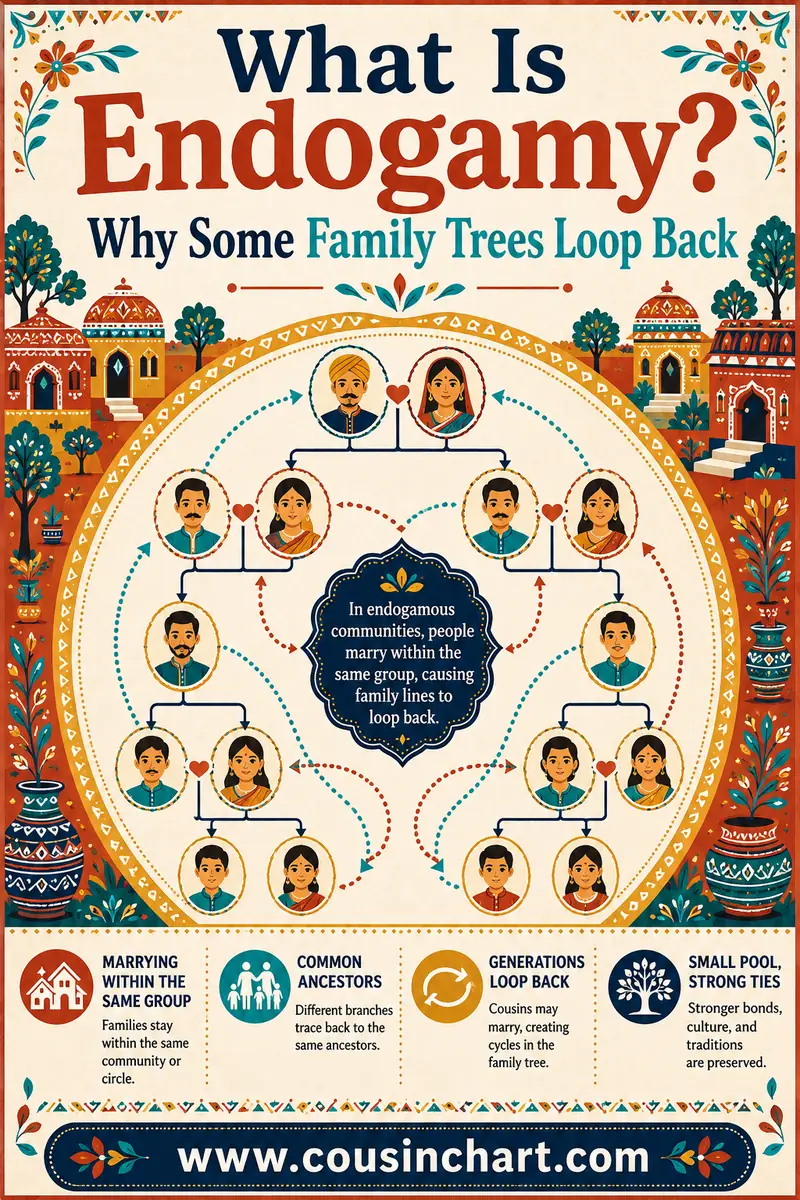
One honest complication: if your ancestry comes from a historically intermarried community, matches will look closer than they are, because you share DNA through many small connections at once. See what endogamy is before trusting any standard chart in that situation. And if you're weighing which kit to buy, our Ancestry accuracy review sets realistic expectations.
FAQ
Why did my DNA ethnicity results change?
Because the company updated its reference panels or algorithm and recalculated everyone's estimate. Your DNA is unchanged — the model interpreting it improved. Updates typically arrive every couple of years and often split broad regions into finer ones, which is why a single percentage can turn into two or three.
Can a DNA test prove who my father is?
It can show a parent/child level of sharing, around 3,400 to 3,700 cM, which is unmistakable biologically. But a consumer kit isn't collected under chain-of-custody conditions, so it isn't legal proof. Formal questions of paternity require an accredited legal test and, if there are consequences involved, legal advice.
Why doesn't my known cousin show up as a DNA match?
If they're a fourth cousin or more distant, this is normal — many genuine cousins at that range share no detectable DNA. If they're a first or second cousin, check that they tested at the same company you did, since matching databases are entirely separate.
Are ethnicity estimates accurate at the continental level?
Broad continental assignments are generally reliable. The precision drops as regions get smaller, especially across neighbouring European populations that have intermarried for centuries. Treat continent-level results as solid and country-level splits as informed estimates that may shift with the next update.
Do I need to test with more than one company?
Not necessarily, but it widens your reach. A cheaper route is to test once, download your raw data, and upload it free to GEDmatch, FamilyTreeDNA and MyHeritage. Ancestry and 23andMe don't accept uploads, so being in those pools requires testing with them directly.
Is a small DNA match still a real relative?
Sometimes, but small matches are unreliable. Below roughly 20 cM, a shared segment can come from distant background population sharing rather than an identifiable common ancestor. Use small matches as leads to investigate alongside other evidence, never as standalone proof of a connection.
Read Your Results for What They Are
A DNA test is a genuinely powerful genealogy tool with a specific job description. It measures relatedness to living people extremely well. It estimates geography reasonably well. It doesn't do nationality, doesn't do legal proof, doesn't do diagnoses, and doesn't do named ancestors.
The most trustworthy number in your account is the shared centimorgan figure on each match. Put one into the DNA match calculator to see exactly which relationships it allows — or use the family relationship calculator to work out what to call a cousin once you've placed them. That's the part of your results you can build on.