DNA Tests for Adoptees: Which Databases Matter Most
For an adoptee, the choice of kit matters far less than people think, and the choice of database matters far more. Every company matches you only against its own customers, so testing is really a question of which pool of people you want to be visible in. Buy the biggest one first, then get yourself into the others free by uploading your raw data file. The single number that will shape your whole search is the shared centimorgan figure on your closest match — feed it into the DNA match calculator and you will know within minutes whether you are looking at weeks of work or months.
Where are you in the search? Tap the closest match.
Tap an option above. The short version: be visible in every pool you can.
Which database should you test in first?
The largest one available in the country where your birth family most likely lives.
Size is the only feature that reliably changes outcomes. A bigger pool means a closer top match, and the closeness of that match determines how much tree-building you will have to do. Everything else — interface, ethnicity map, health add-ons — is decoration by comparison.
For US-born adoptees that generally means the biggest American consumer database. It has the most testers, the deepest set of member family trees, and grouping tools that make clustering easier.
For adoptees born outside the US, weigh reach differently. One major company has a stronger presence across Europe and parts of Latin America and the Middle East, so it can matter more than raw global size.
Autosomal only, at this stage. Y-DNA and mtDNA each cover a single line and cannot find the broad cousin network you need. They become useful later, for confirming a specific paternal or maternal hypothesis.
Why don't the databases talk to each other?
Because matching is a closed pool at each company, by design. This is the fact adoptees most often learn too late.
Each company compares you only to its own testers. Your biological half-sibling could have tested last year at a different company, and neither of you would ever appear in the other's list.
So coverage, not accuracy, is the problem to solve. Being present in four pools rather than one roughly quadruples the number of people who can find you, without improving your DNA at all.
Uploads bridge most of the gap. Several companies accept a raw data file exported from another test and will match it against their database, usually free for basic matching with a small fee for extra tools. At least one major company does not accept uploads at all, so being in that pool means buying its kit. Policies do change, so check current terms before you assume.
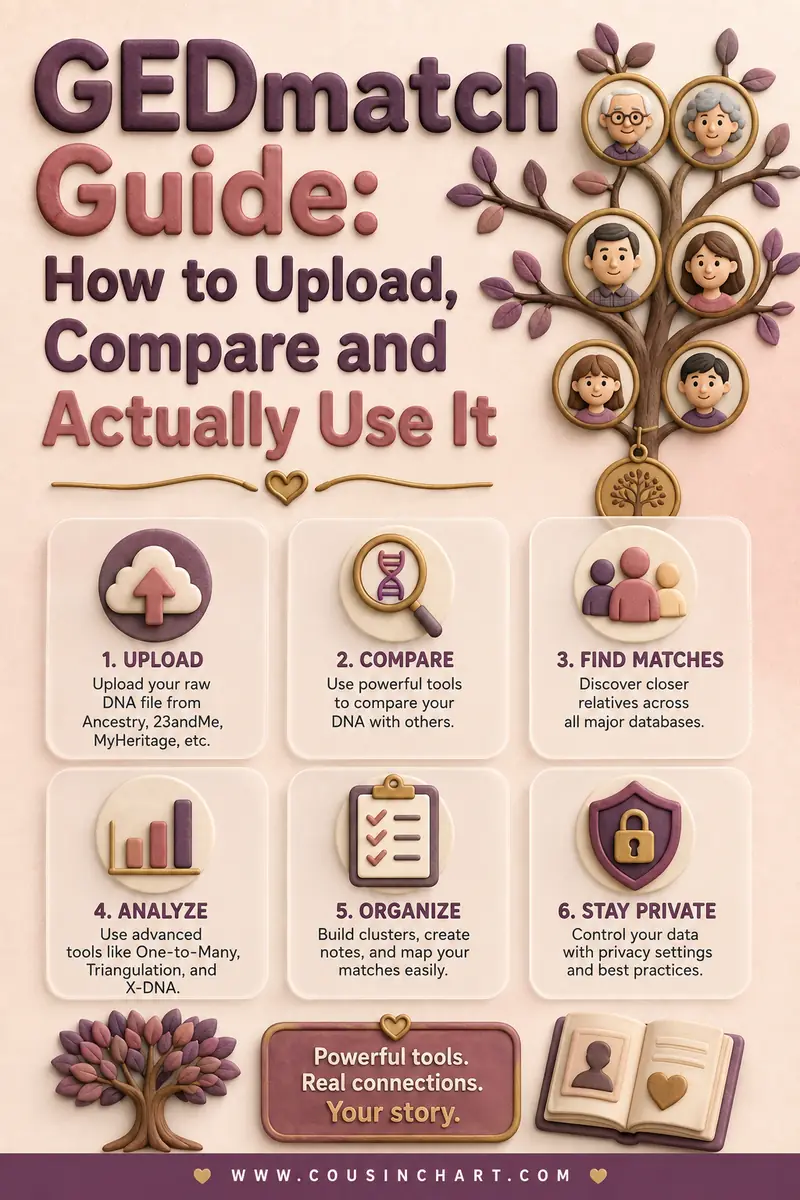
Third-party sites add analysis, not just reach. GEDmatch accepts files from most companies and offers segment tools the consumer sites keep behind their own walls.
What does your closest match tell you?
More than any other single thing. Read the top of your list before you read anything else.
| Closest match, shared cM | Likely relationship | What the search looks like |
|---|---|---|
| 2,300–3,400 | Full sibling or parent | Usually resolved immediately |
| 1,300–2,300 | Half-sibling, grandparent, aunt or uncle | Days to weeks; identity often follows quickly |
| 850–1,300 | First cousin, great-aunt or great-uncle, half-aunt or half-uncle | Weeks; one or two trees to build |
| 400–850 | First cousin once removed, half first cousin, second cousin | Weeks to a few months of tree work |
| 200–400 | Second cousin | Months; several trees, cluster carefully |
| 90–200 | Second cousin once removed to third cousin | Slow but very often still solvable |
| Under 90 | Fourth cousin or more distant | Hard; wait for closer matches and test elsewhere |
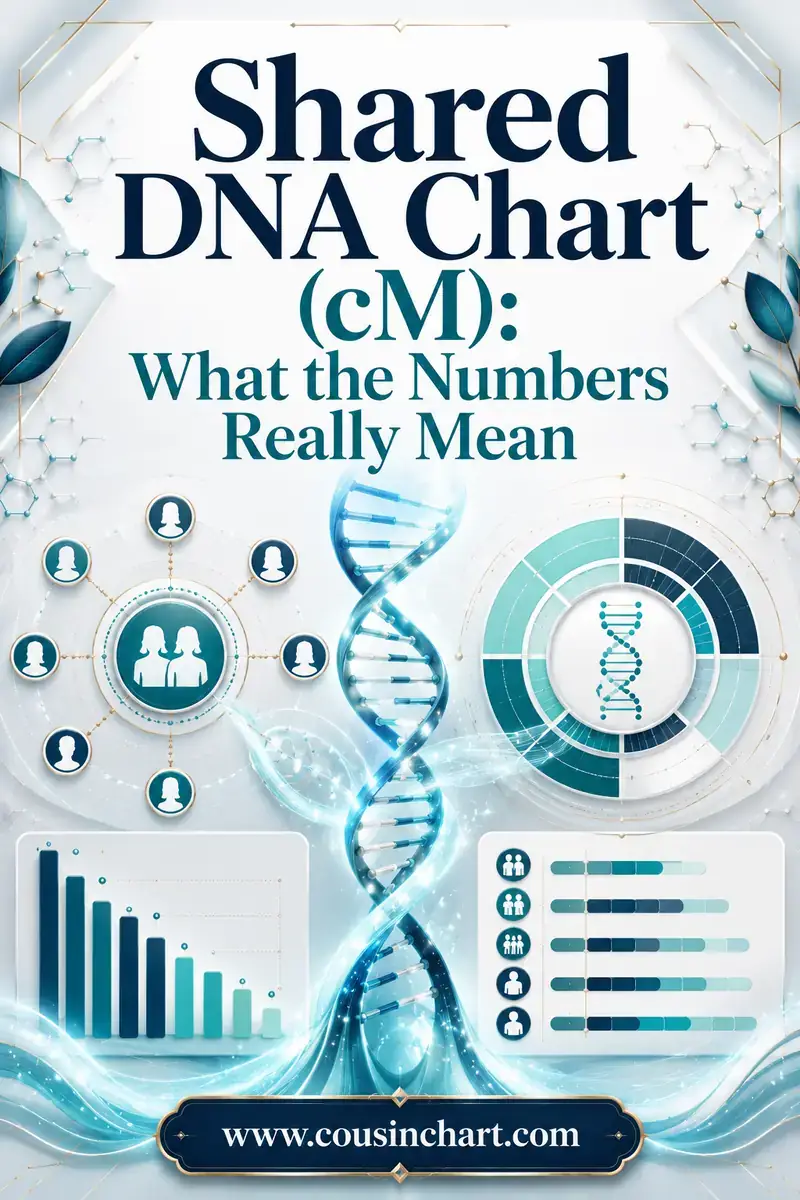
Ranges overlap heavily. A single number rarely identifies one relationship — 1,700 cM fits a half-sibling, a grandparent and an aunt equally well, and only age, shared matches and testing another relative separate them. The full picture is in the guide to reading a shared cM chart.
Distant top matches are not a dead end. They mean more tree-building, not failure, and the picture changes every time a new person tests.
Check the top of the list again every few weeks. Databases grow constantly, and searches that stalled for a year have been solved by one new tester.
Which uploads are worth doing?
Nearly all of them, because the cost is your time rather than your money.
Do it in one sitting. Download the raw data file from wherever you tested, then upload it to each site that accepts one. An hour of admin buys you months of extra reach.
Expect a small unlock fee at some sites. Basic matching is often free while advanced tools cost a modest one-off payment. That is usually worth paying at the site where your best matches turn out to be.
Then set your preferences deliberately. Opting in or out of relative-finder features, segment sharing and law-enforcement matching are all real decisions with real consequences, covered in the guide to DNA test privacy.
Log in occasionally at each. New matches appear where you are not looking, and several sites only email sporadically.
Does the ethnicity estimate help an adoptee?
A little, at the start, and much less than the marketing suggests.
It can narrow a completely blank slate. If you know nothing at all, a strongly weighted result gives you a first working assumption about one side of your ancestry.
It cannot tell you who anyone is. Estimates are statistical comparisons against reference panels; they change when panels change, and they differ between companies for the same person.
Unequal components sometimes flag a mixed parentage. A result split between two very different ancestries can suggest one birth parent from each, which is a genuinely useful hint when combined with match clustering.
Do not chase small percentages. Trace figures below a few per cent are the least stable part of any result and are a poor basis for a search decision.
How do you turn matches into a name?
By grouping first and building second. This is the part that takes real time.
Cluster your matches into family lines. Sort by who your matches also match, so unrelated groups separate; the Leeds method does this on paper in about an hour and is still the best starting technique.
Build trees down, not up. Take a cluster's shared ancestral couple, then trace their descendants forward to people of the right age and place. This is the core method described in the unknown parent DNA search guide.
Look for convergence. When two separate clusters descend from the same couple, that couple is likely your grandparents or great-grandparents.
Confirm before you conclude. A hypothesis is not an answer until the predicted relationship matches the shared DNA and the paper record supports it.
What if the results are not what you expected?
They quite often are not, and it helps to have thought about it beforehand.
Half-siblings show up more than people expect. A match around 1,300–2,300 cM may be a half-sibling you did not know existed. That range also fits a grandparent or an aunt, so confirm rather than assume.
The story you were told may be partly wrong. Agency paperwork, non-identifying information and family accounts all contain errors, and DNA is indifferent to what a file says.
Other people's results get disturbed too. Your appearance in a database can reveal a secret in someone else's family. That is not your fault, and it is worth being ready for the reaction.
Line up support before results arrive. Not afterwards. The practical and emotional preparation is covered thoroughly in the adoptee genealogy guide.
How should you spend, and in what order?
A sensible sequence saves both money and disappointment.
One kit at the largest database. Wait for a sale if you can; the major kits discount repeatedly through the year.
Then free uploads everywhere. No new DNA, several new pools.
Then a second kit only where uploads are refused. This is the one case where buying twice genuinely buys you something.
Then a subscription, briefly, if you need member trees. Many searches need a records subscription for a month, not a year. Cancel when the tree work is done.
Skip the extras until they answer a question you actually have. Health reports, traits and deep-ancestry add-ons do nothing for a birth family search.
FAQ
Which DNA test is best for adoptees?
The one with the largest matching database in the country where your birth family probably lives — for US-born adoptees, the biggest American consumer database. Then upload your raw data file free to every other site that accepts uploads, so you appear in as many match pools as possible.
Do I need to buy more than one DNA test?
Usually only one. Download your raw data file and upload it to the sites that accept transfers, which puts you in several databases for the price of one kit. Buy a second test only for a major company that does not accept uploaded files.
How close a match do I need to find my birth parents?
Anything at or above roughly 400 cM makes for a fast search, and matches above 1,300 cM often resolve within days. Second and third cousins around 90–400 cM still work, but they need clustering and several weeks of building trees down to living people.
Can I search without my birth family finding out I tested?
Not reliably. Being in a matching database means relatives can see you as a match, which is the mechanism that makes the search work at all. You can limit a displayed name to initials, but you cannot be visible to them and invisible to them at once.
Should I upload my DNA to GEDmatch?
It gives access to segment tools and matches from many companies, which helps difficult searches. It also carries a law-enforcement matching option you should set deliberately. Read the current terms and choose your setting consciously rather than accepting the default.
What if my closest match is only a third cousin?
Your search is slower, not impossible. Cluster your matches into family groups, build trees down from each cluster's shared ancestral couple, and check for new matches every few weeks. Databases grow constantly, and a single new tester can change everything.
Be visible in every pool you can
If there is one action worth taking today, it is making sure your DNA is sitting in more than one database. Test at the largest pool available where you were born, download the raw file, and upload it free everywhere that accepts it — an hour of admin that quietly multiplies your chances for years. Then read the top of your match list, cluster before you climb, and build trees downward from shared couples rather than upward from yourself. Whenever a new match appears and you need to know what the number could mean, the cousin calculator will lay out the possible relationships for you.