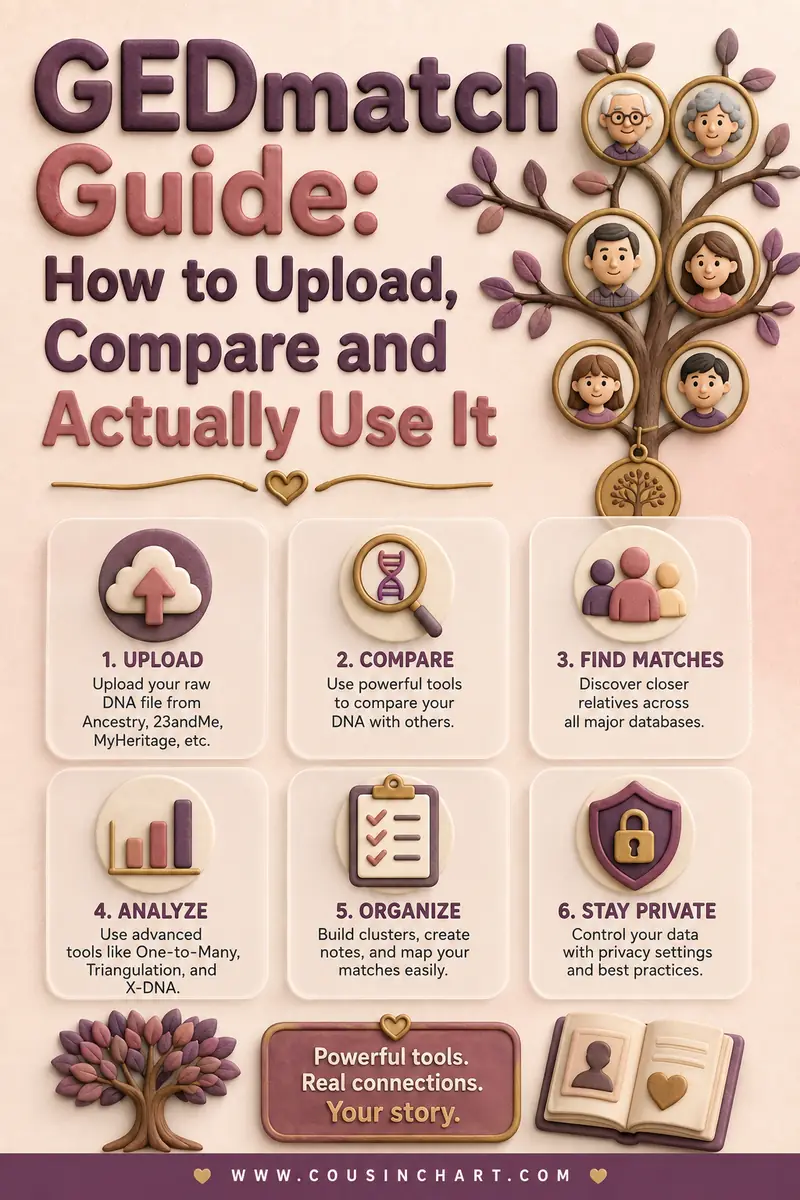
GEDmatch Guide: How to Upload, Compare and Actually Use It
GEDmatch is a free third-party website where you upload the raw DNA file from any testing company and compare it against everyone else who has done the same. That's the whole idea, and it's genuinely powerful: it's the one place a person tested at AncestryDNA can be compared, segment by segment, with someone tested at 23andMe or MyHeritage.
You don't test with GEDmatch. You download your raw data from wherever you tested, upload it, wait for the file to process, and then use the comparison tools — the One-to-Many match list, the One-to-One comparison, and a chromosome browser that shows exactly where on your chromosomes you overlap with someone. Basic accounts are free; a paid tier unlocks extra utilities.
If you're already staring at shared centimorgan numbers and wondering what relationship they mean, run them through our DNA match calculator first — GEDmatch will give you plenty more numbers to feed it.
What do you want GEDmatch to do? Tap a goal:
Tap a goal above to see which tool to use.
Turn shared cM into a relationship →What is GEDmatch, exactly?
GEDmatch is a comparison platform, not a testing company. It has existed since the early 2010s, built originally by hobbyist genealogists who wanted to compare results across companies that wouldn't talk to each other.
Here's the problem it solves. AncestryDNA won't let you import a 23andMe file. 23andMe won't import an Ancestry file. If your closest cousin tested somewhere else, the two of you simply never appear on each other's match lists. GEDmatch is neutral ground: everyone uploads, everyone gets compared, and the database mixes testers from all the major companies.
It also does something Ancestry deliberately doesn't — it shows you the segments. Ancestry gives you a total shared centimorgan figure and no chromosome browser at all. GEDmatch tells you which chromosome, which start and end position, and how long each shared piece is. For anyone doing serious match analysis, that alone is worth the upload.
Ownership has changed hands over the years, and the site's tool menu and policies get revised, so treat any specific claim about features or prices — including the ones here — as something to verify on the site itself before relying on it.
How do you upload your DNA to GEDmatch?
The process is genuinely simple, and it's the same regardless of where you tested.
- Download your raw DNA file from your testing company. Every major company offers this — look in account settings or the DNA settings area for "download raw data". You'll usually need to confirm by email or password.
- Don't unzip it. The file arrives as a compressed archive. GEDmatch generally accepts it as-is, and unzipping it can produce a file it doesn't recognize. If you do unzip it, keep the original.
- Create a free GEDmatch account with an email address and password.
- Upload the file through the upload page, giving the kit a name and a donor identifier. You'll be asked to confirm you have permission to upload that person's DNA — which matters if you're managing a relative's kit.
- Choose the kit's privacy setting at upload time. This is a real decision, not a formality, and there's a whole section on it below.
- Wait. Processing takes time — often hours, sometimes longer during busy periods. Batch processing for one-to-many matching may run on its own schedule, so a kit that uploaded fine may still show incomplete match results for a day or two.
You'll be given a kit number. Keep it somewhere you can find it, because nearly every tool on the site asks you to type it in. The leading character usually indicates which company the data came from, which is why match lists let you see at a glance where each person tested.
Can you upload a file from any company?
GEDmatch accepts raw data from the main autosomal testing companies. Support depends on the chip version a company used at the time you tested — very old kits or newer chip formats occasionally cause trouble, and the site maintains its own list of what it accepts.
One thing it can't do is create matches out of nothing. If your file was produced on a chip with limited overlap with other companies' chips, your comparisons may be noisier or your matches fewer. This is a technical limitation of consumer testing, not a GEDmatch fault.
What does the One-to-Many tool do?
One-to-Many is your master match list — the equivalent of the match page at your testing company, but drawing on everyone who has uploaded from anywhere.
Enter your kit number and you get a table of everyone who shares detectable DNA with you, typically showing:
- Their kit number and the name or alias attached to it
- Which company the kit came from
- Total shared cM — the headline number
- Largest segment — often more informative than the total
- Their contact email, where they've made it available
Sort by total shared cM and work down from the top. Your closest matches are your most useful matches, every time.
Reading the numbers properly
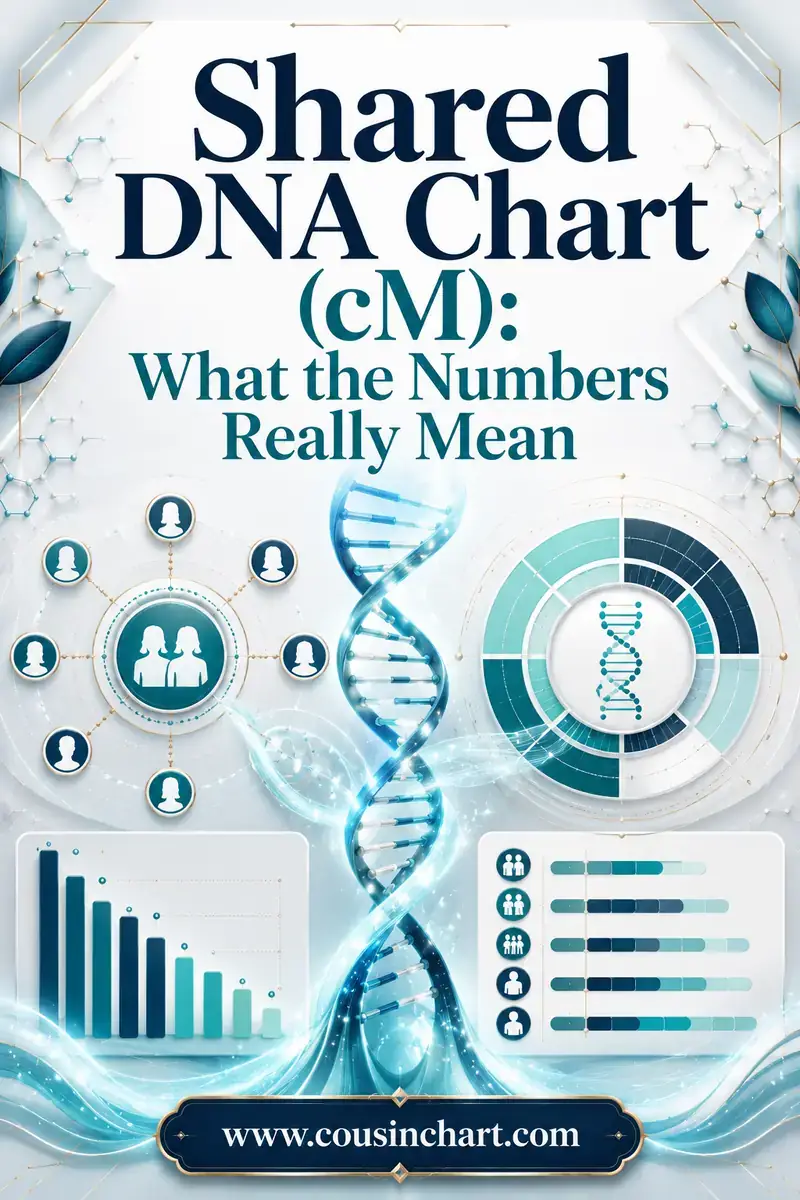
The same interpretation rules apply here as anywhere else. Total shared cM narrows the range of possible relationships; it never names one. A match at 1,800 cM could be a half-sibling, a grandparent, an aunt, an uncle, a niece or a nephew, and the number alone can't tell you which. Our shared cM chart shows the full overlapping ranges, and what a centimorgan actually measures explains why the numbers behave the way they do.
The largest segment column deserves more attention than most people give it. A match showing 60 cM total spread across many small segments is a much weaker signal than 60 cM in one clean 45 cM block. Small segments are where false matches live.
Why is my GEDmatch total different from Ancestry's?
Because different platforms use different matching thresholds and different algorithms for deciding what counts as a shared segment. GEDmatch also lets you set your own thresholds, which changes the results you see.
Neither number is wrong. They're measurements taken with slightly different rulers. Use one platform's numbers consistently when you're comparing matches to each other, and don't be alarmed when the same person shows 720 cM in one place and 745 cM in another.
What is One-to-One comparison for?
One-to-Many says who you match. One-to-One says how.
Enter two kit numbers and the autosomal comparison tool reports:
- Total shared cM between those two kits
- The number of shared segments
- The largest segment
- A list of every shared segment with chromosome number, start and end position, and length
That segment list is the raw material for real analysis. It's what lets you say "these three matches all share the same block on chromosome 7, so they probably connect through the same ancestral couple."
There's a separate X-chromosome comparison too, which matters because the X follows its own inheritance rules and can eliminate whole branches of a tree from consideration.
The chromosome browser
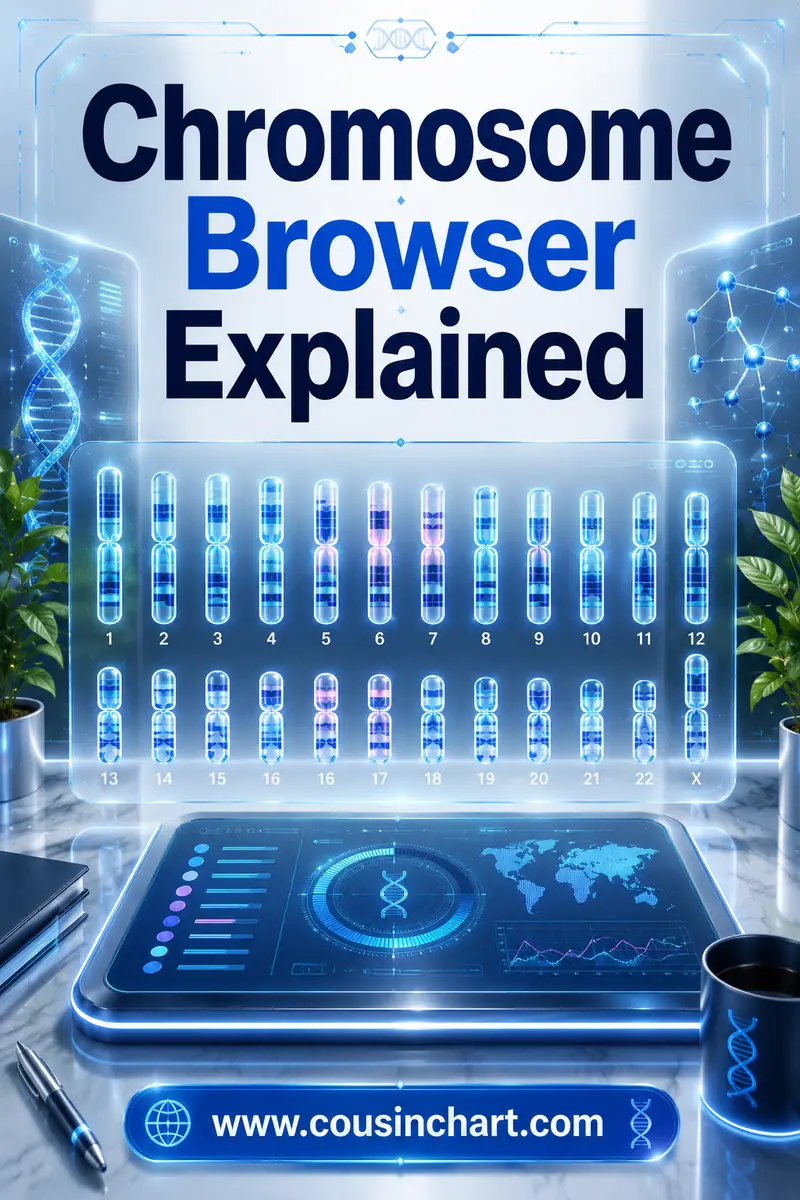
The graphical output in the One-to-One tool is GEDmatch's chromosome browser: colored bars running along each chromosome showing exactly where you and another person overlap.
Why it matters:
- Ancestry doesn't have one. If you tested there, this is your only route to segment data.
- It makes triangulation possible. Three people who all share the same segment region very likely inherited it from a common ancestor.
- It exposes weak matches. A "match" made of scattered tiny fragments looks very different on screen from a solid single block.
Our guide to reading a chromosome browser covers how to interpret the bars, what triangulation actually proves, and the segment-size thresholds worth trusting.
Which other GEDmatch tools are worth knowing?
The site has accumulated a lot of utilities over the years. The menu changes, but a handful come up constantly in genealogy circles.
| Tool | What it does | When to use it |
|---|---|---|
| One-to-Many | Lists everyone who matches your kit | Your starting point, every session |
| One-to-One autosomal | Compares two specific kits segment by segment | Investigating a single match seriously |
| One-to-One X | Compares X-chromosome sharing | Narrowing which lines a match can come through |
| People who match one or both of 2 kits | Shows matches shared between two kits | Working out which side of the family a match belongs to |
| Are Your Parents Related? | Looks for identical DNA on both chromosome copies | Checking for endogamy or a close-relative pairing in your ancestry |
| Admixture utilities | Various third-party ethnicity models | Curiosity — treat the output loosely |
| Paid tier utilities | Additional analysis, including clustering and reconstruction tools | Once you're doing sustained, serious research |
The "people who match one or both of 2 kits" tool is the underrated one. Feed it your kit and a mystery match's kit, and the people who appear on both lists usually cluster on one side of your family. That's often the single fastest way to place an unknown match.
"Are Your Parents Related?" answers a question nobody expects to ask. It looks for stretches where both of your chromosome copies are identical, which happens when your parents inherited that stretch from a shared ancestor. A positive result doesn't imply anything scandalous — it's common in populations where families intermarried within a community for generations, which is what endogamy describes. It matters because endogamy inflates shared cM totals across the board, and knowing about it changes how you read every match you have.
Why do adoptees and people with unknown parentage rely on GEDmatch?
Because when you're searching for a biological family, the size and breadth of the pool is everything, and GEDmatch pools people from every company at once.
If you test at one company, you see that company's testers. Your closest biological relative might have tested somewhere else entirely and be invisible to you forever. Uploading everywhere — including GEDmatch — is the difference between one pond and four.
The practical workflow looks like this:
- Test at one company, then upload the raw file everywhere it's accepted, including GEDmatch.
- Work One-to-Many from the top down. Anything above roughly 200 cM is a genuinely close relative and worth serious effort.
- Sort your top matches into groups using shared-match tools. Clustering techniques like the Leeds method split matches into groups that usually correspond to grandparent lines — enormously helpful when you have no tree of your own to start from.
- Build trees downward. Take the surnames and locations from a cluster and build forward in time until the trees start converging on a couple, then a household, then a person.
- Confirm with segments. The chromosome browser lets you check that a group really does share the same DNA rather than merely sharing a surname.
Two honest notes. First, this takes weeks or months, not an evening. Second, it doesn't always work — some searches stall because the right relatives simply haven't tested. Our overview of how DNA matches work covers how to read your list realistically before you invest that time.
What should you know about GEDmatch privacy?
This is the part to read slowly, because it's the part people regret not reading.
When you upload to GEDmatch, you're placing your genetic data on a third-party site to be compared with strangers. That's the point of the service — but it's a deliberate choice, and it deserves a deliberate decision.
Kit visibility settings
Each kit you upload has a visibility level. In broad terms, a kit can be made available for matching by other users, or kept out of general matching, or set to a research-only mode that doesn't appear in others' lists. The exact names and behaviors of these settings have changed over the years, so check what the options say at the moment you upload, rather than trusting anyone's description — including this one.
The trade-off is simple and unavoidable: a kit nobody can see finds nobody.
Law enforcement matching
GEDmatch came to public attention in 2018 when investigators used the database to identify a suspect in the long-unsolved Golden State Killer case by finding distant relatives of the unknown DNA profile. Since then, forensic genetic genealogy has been used in many cold cases.
Following that publicity, the site changed its approach so that comparison with law enforcement kits became something users opt into rather than something that happened by default. If you want your kit included in that kind of matching, you turn it on; if you don't, you leave it off.
Reasonable people land in different places on this. Some testers are glad their data might help identify a victim or solve a decades-old crime. Others object to their DNA being available to investigators at all, particularly since your DNA also carries information about relatives who never consented to anything.
What matters is that you choose, rather than discovering your setting later. Check it when you upload, and check it again if the site's ownership or policies change — which has happened more than once.
Uploading someone else's DNA
If you manage a kit for a parent, aunt or cousin, you're making this decision for them. Ask first, explain what the site does, and explain the law enforcement option in plain language. "I put your DNA on a website" is a bad conversation to have after the fact.
What are the honest downsides?
GEDmatch is a fantastic tool, but it isn't polished, and it isn't magic.
- The interface is dated. It looks like a utility built by genealogists for genealogists, because that's what it is. Expect kit numbers, plain tables and menus rather than a slick app.
- The database is smaller than the big companies'. Only a fraction of testers ever bother to upload, so your GEDmatch match list will be shorter than the one at your testing company.
- Most kits have no tree attached. You'll frequently find a strong match and a kit number with nothing else — no tree, sometimes no working email.
- Processing delays are normal. Uploads and batch matching take time, and busy periods make it worse.
- Contact rates are low. Many uploaded kits belong to people who did this years ago and never came back. Silence is common; don't take it personally.
- Segment data invites over-interpretation. Having a chromosome browser tempts people into chasing 6 cM segments that are statistical noise. Bigger is better; small segments lie.
FAQ
Is GEDmatch free?
Basic use is free. Uploading your raw DNA, running One-to-Many match lists and using the One-to-One comparison tools with the chromosome browser don't cost anything. A paid membership tier unlocks additional analysis utilities, billed as a subscription — check the site for the current price, since it changes.
How do I upload my DNA to GEDmatch?
Download the raw DNA file from your testing company's settings area, leave it zipped, create a free GEDmatch account, and upload the file. You'll name the kit, confirm you have permission to upload that person's data, and choose a privacy setting. You'll get a kit number back; processing may take hours or longer before matches appear.
Does GEDmatch accept AncestryDNA and 23andMe files?
Yes — accepting raw data from all the major autosomal companies is the whole reason it exists. Support depends on the chip version used for your test, so very old or very new files occasionally need special handling. GEDmatch publishes which file formats it currently accepts.
Why are my GEDmatch cM totals different from my testing company's?
Because platforms use different matching thresholds and algorithms to decide what counts as a shared segment, and GEDmatch lets you adjust some thresholds yourself. Neither figure is wrong — they're measured slightly differently. Compare matches against each other within one platform rather than across platforms.
Is GEDmatch safe to use?
It's a legitimate, long-established site, but you are placing genetic data on a third-party platform for comparison with strangers, which is inherently a privacy trade-off. Read the current privacy settings at upload, decide deliberately about law-enforcement matching, and get explicit permission before uploading a relative's DNA.
Can police use my GEDmatch DNA?
Only if your kit is opted in to law-enforcement matching. After the publicity around the 2018 Golden State Killer case, GEDmatch made forensic comparison an opt-in choice rather than the default. Check your kit's setting directly on the site, and re-check it after any policy or ownership change.
Upload, then start comparing
If you've tested anywhere and you're serious about your matches, GEDmatch is worth the twenty minutes it takes to upload. It's the one place your Ancestry results and your cousin's 23andMe results can meet, and — if you tested at Ancestry — it's your only route to seeing the actual segments you share.
Upload your file, choose your privacy settings deliberately, then work your One-to-Many list from the top down. When a number comes back that you can't place, drop it into our DNA match calculator to see which relationships fit, and use the family relationship calculator to work out what you'd actually call the cousin you just found.