What Is a Great Cousin? Great-Great Cousin and Grand Cousin, Explained
A "great cousin" usually means your parent's first cousin, and the correct genealogy term for that person is your first cousin once removed. "Great cousin" isn't an official term. It's a friendly family nickname borrowed from "great-aunt" and "great-uncle." By the same habit, a "great-great cousin" or "grand cousin" is usually a grandparent's first cousin, who is properly your first cousin twice removed.
The tricky part is that people use "great cousin" for different relatives, including a cousin's child. Tap the relative you have in mind to see the correct term and why.
▶ Work it out in the free calculator
Great cousin, great-great cousin and grand cousin: what people usually mean
Here's how the informal names line up with the standard terms genealogists, family tree software and DNA sites use.
| What people say | Who they usually mean | Correct term |
|---|---|---|
| Great cousin | Your mom's or dad's first cousin | First cousin once removed |
| Great cousin (other direction) | Your first cousin's child | First cousin once removed |
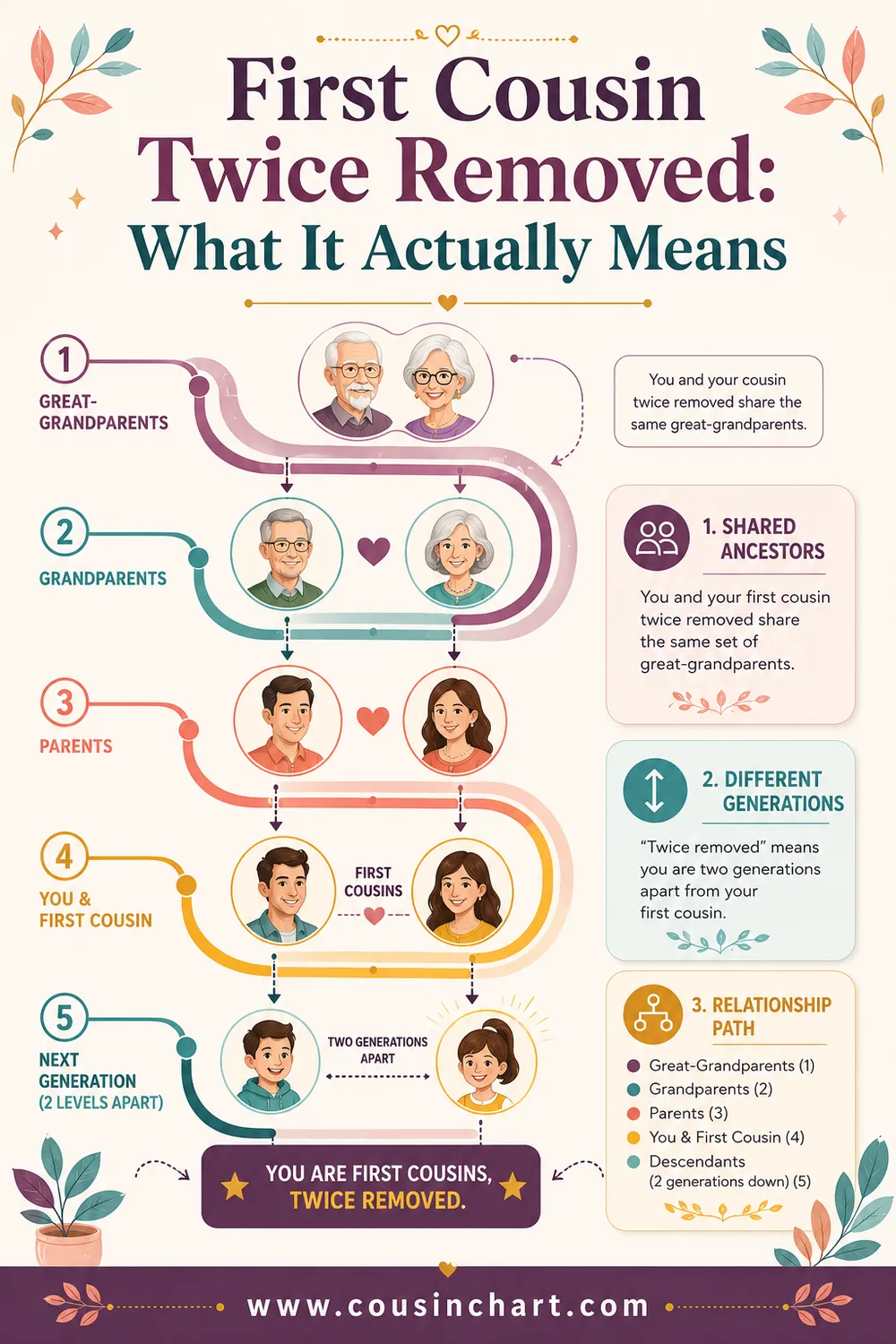
| Great-great cousin | Your grandparent's first cousin | First cousin twice removed |
| Grand cousin | Your grandparent's first cousin, or your first cousin's grandchild | First cousin twice removed |
| Great-great-great cousin | Your great-grandparent's first cousin | First cousin three times removed |
| Great second cousin | Your parent's second cousin | Second cousin once removed |
Notice the pattern: wherever someone adds a "great" or "grand" to a cousin, the proper term adds a "removed" instead. One generation apart is once removed, two is twice removed, and so on.
Why isn't "great cousin" the right term?
Good question, because it sounds perfectly logical. Your grandma's sister is your great-aunt, so why isn't your grandma's cousin your great-cousin?
It comes down to how the two word ladders work:
- Aunts and uncles are always in an older generation than you, so "great" and "grand" simply push the title up one more generation. Your parent's sister is your aunt, your grandparent's sister is your great-aunt, and so on. (Great-aunt and grand-aunt mean the same person, by the way. Our guide to grand aunt vs great aunt explains why both are right.)
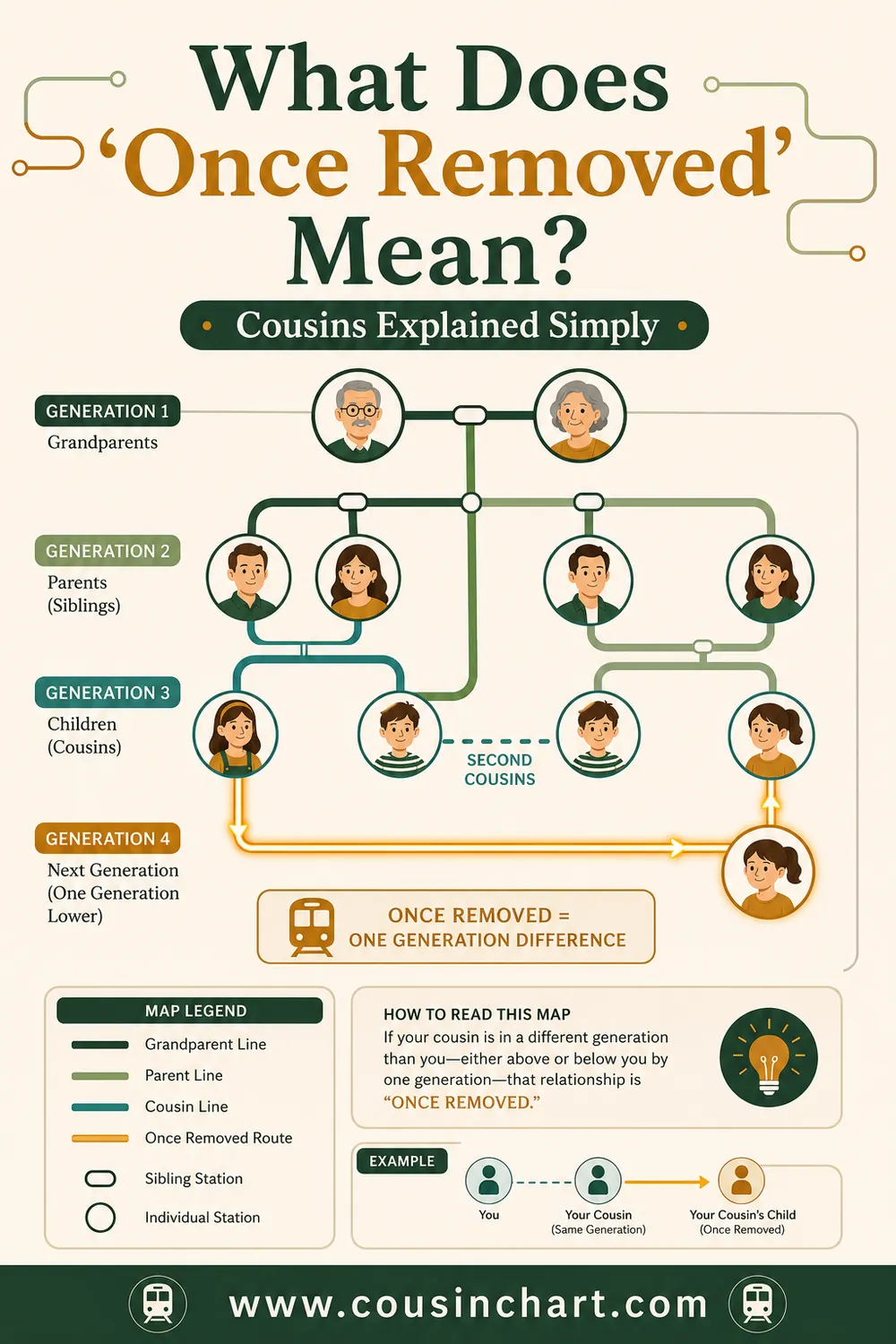
- Cousins can be in your generation, an older one or a younger one. So cousin terms need two numbers: one for how far back you share an ancestor, and one for how many generations apart you are.
"Great cousin" only gives you one of those, and it doesn't even say which direction. Is your great cousin older than you or younger? The "removed" system works both ways. Your mom's cousin is your first cousin once removed, and you are her first cousin once removed, too.
How to work out the correct cousin term
It takes two quick steps:
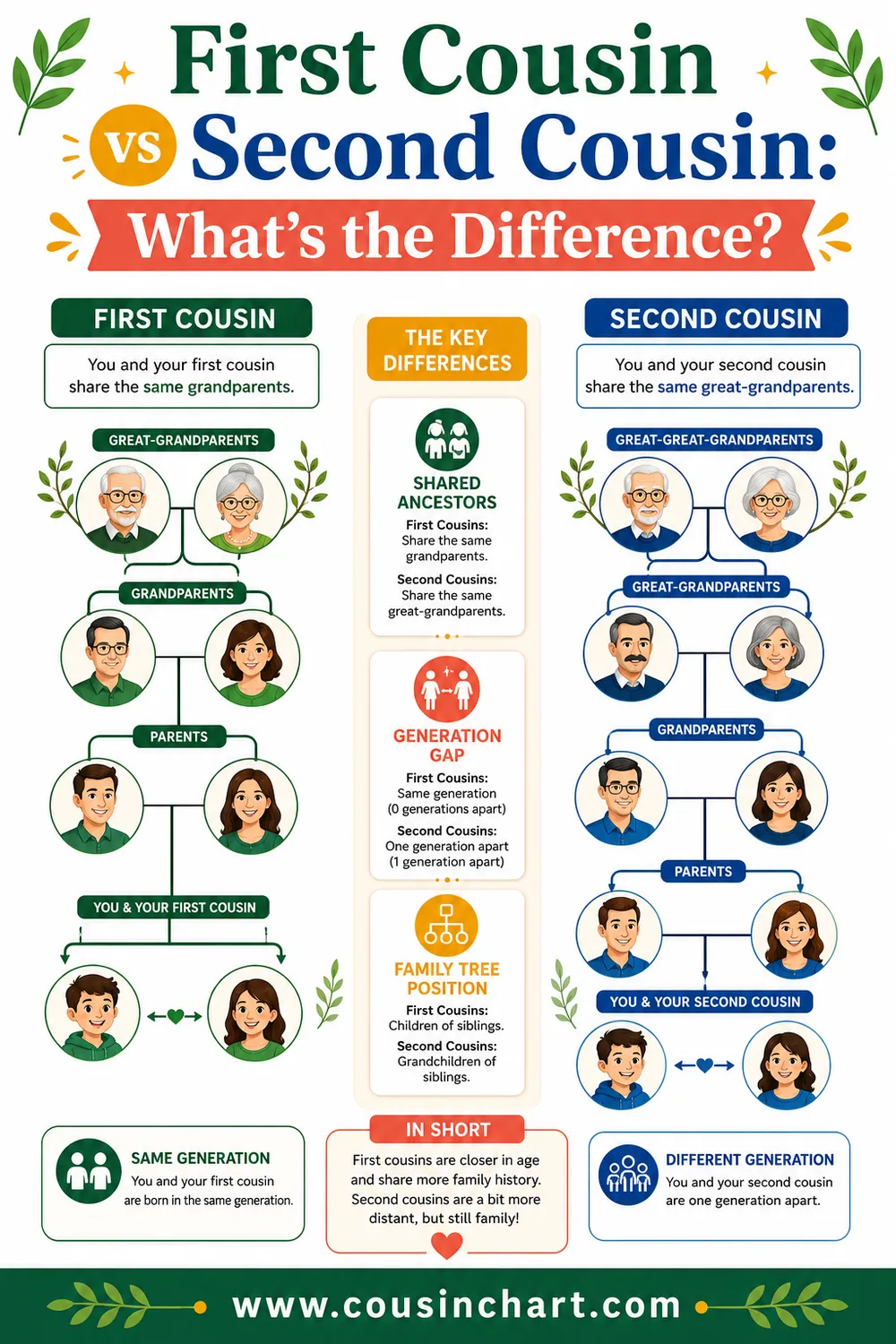
- Find the cousin number. Look at the two people who are on the same generation, usually your parent or grandparent and their cousin. If they share grandparents, they're first cousins. If they share great-grandparents, they're second cousins. That number stays the same as you move down the tree.
- Count the generation gap. How many generations separate you from the cousin? One generation is once removed, two is twice removed.
Worked example: Mom's cousin Linda
Your mom and her cousin Linda share grandparents, so they're first cousins. Those shared grandparents are your great-grandparents. Linda is in your mom's generation, one above you. So Linda is your first cousin once removed. Lots of families would call her "my great cousin" or just "Aunt Linda," and both are sweet. On a family tree, though, she's 1C1R. Our guide to what your mom's cousin is to you walks through it with a chart.
Worked example: Grandpa's cousin Walter
Your grandpa and Walter share grandparents, so they're first cousins. Walter is in your grandpa's generation, two above you. That makes him your first cousin twice removed. This is the relative people most often call a "great-great cousin" or "grand cousin." See what your grandma's cousin is to you for his whole branch, kids and grandkids included.
Worked example: Your cousin's baby
Your first cousin just had a baby. The baby is one generation below you, so the baby is your first cousin once removed. That's the same term as your mom's cousin, just in the other direction. Some families call this baby a "great cousin" or "little cousin." Your kids and that baby, on the other hand, are second cousins, because they're in the same generation.
How far does "removed" go?
As far as your tree does. Each step up or down adds one more removal:
| Their first cousin | What they are to you |
|---|---|
| Your first cousin | First cousin |
| Your parent's first cousin | First cousin once removed |
| Your grandparent's first cousin | First cousin twice removed |
| Your great-grandparent's first cousin | First cousin three times removed |
| Your great-great-grandparent's first cousin | First cousin four times removed |
If you're looking at a relative three generations away, our guide to cousin three times removed has the chart and examples.
Is it ever okay to say great cousin?
Of course. At the dinner table, call relatives whatever feels warm and natural. Plenty of families use "great cousin," "cousin Linda" or "Aunt Linda" for a parent's cousin, and kids understand it just fine.
The standard term matters in a few places:
- Family tree software, which only understands "removed" terms.
- DNA match lists, where "1C1R" or "first cousin once removed" is how a match is labeled.
- Written family histories and records, where a future reader needs to know exactly who someone was.
What most people get wrong
- Calling a parent's cousin your second cousin. This is the most common mix-up. Your parent's cousin is your first cousin once removed. Your second cousins are the children of your parent's first cousins, people in your own generation.
- Treating a grandparent's cousin like a great-aunt. Grandma's sister is your great-aunt. Grandma's cousin is your first cousin twice removed. They sit on different word ladders.
- Thinking "removed" means someone left the family. It only counts generations. Nobody gets removed from anything!
Still unsure about a particular relative? The free relationship calculator names any cousin in a couple of taps. Set how far up each of you goes to the shared ancestor, and it gives you the exact term and a little chart to go with it.
▶ Work it out in the free calculator
Frequently Asked Questions
What is a great cousin?
A great cousin usually means your parent's first cousin. It's an informal family name. The correct term is first cousin once removed.
What is a great-great cousin?
Most people mean a grandparent's first cousin. The standard term is first cousin twice removed, because that cousin is two generations above you.
What is a grand cousin?
Grand cousin is another informal name, usually for a grandparent's first cousin or a first cousin's grandchild. Either way, the correct term is first cousin twice removed.
Is my mom's cousin my second cousin?
No. Your mom's first cousin is your first cousin once removed. Your second cousins are that cousin's children, who are in your generation.
What is my cousin's child to me?
Your first cousin's child is your first cousin once removed. Your own children and your cousin's children are second cousins to each other.
Why do cousins use removed instead of great?
Cousins can be older, younger or the same age as you, so the term needs two parts: the cousin number for how far back you share ancestors, and removed for the generation gap.