What Is My Grandma's Cousin to Me?
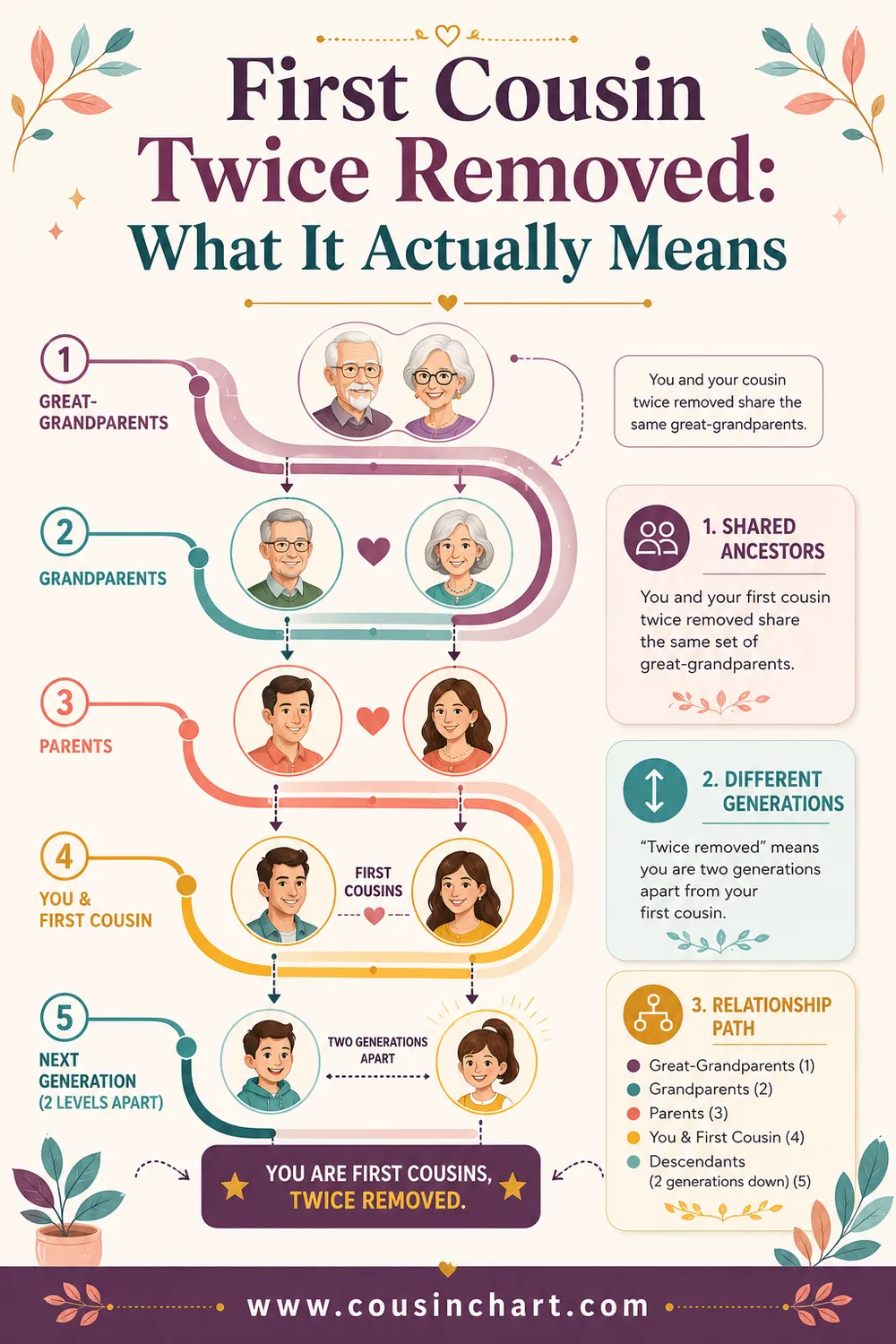
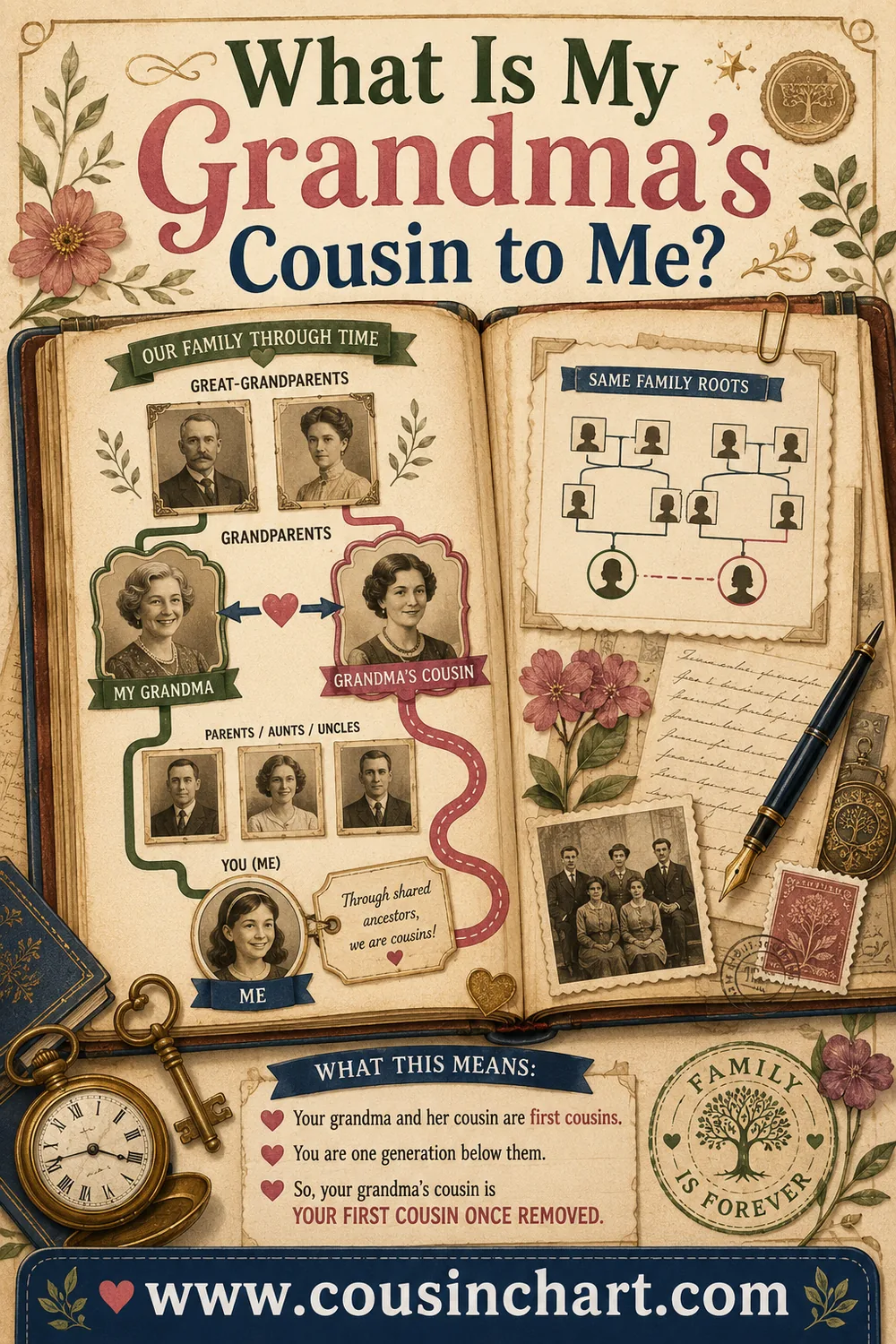
Your grandma's first cousin — grandpa's too — is your first cousin twice removed. The relationship stays a first cousin relationship because it's anchored at your grandmother's generation, and the "twice removed" counts the two generations between her level and yours.
One term, two little measurements. This guide shows exactly how they work, maps grandma's cousin's whole branch (their kids and grandkids turn out to be your second and third cousins), covers the DNA you share, and untangles the aunt/uncle confusion that always comes up. And if you'd rather point and tap than count generations, the free family relationship calculator names any relative in seconds.
Relationship quick-check. Tap a phrase to see the correct term:
The answer will appear here.
The Two-Step Rule
Every cousin term is built from two numbers, and grandma's cousin is a perfect worked example:
- Find the cousin number from the pair who are actually cousins. Grandma and her cousin share grandparents, so they're first cousins. That number is fixed — it never changes as you move down the tree.
- Count the generations between you and the other person. Grandma's cousin sits at grandma's level; you're her grandchild, two floors down. Two generations = twice removed.
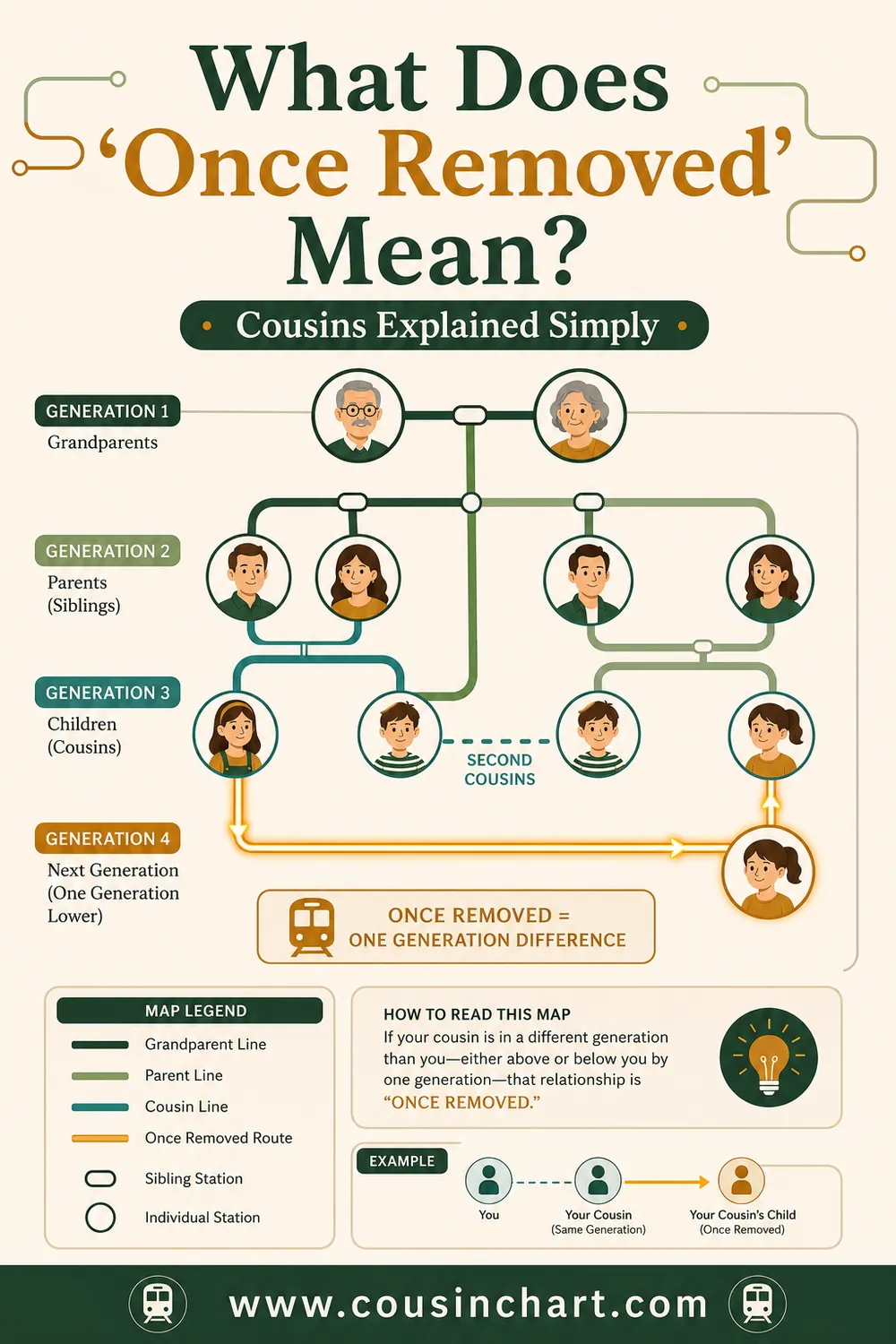
Result: first cousin twice removed — often shortened to 1C2R in genealogy circles. The full theory of the "removed" system lives at what does once removed mean, and the broader 1C2R relationship (which also covers your cousin's grandchild) has its own page at first cousin twice removed.
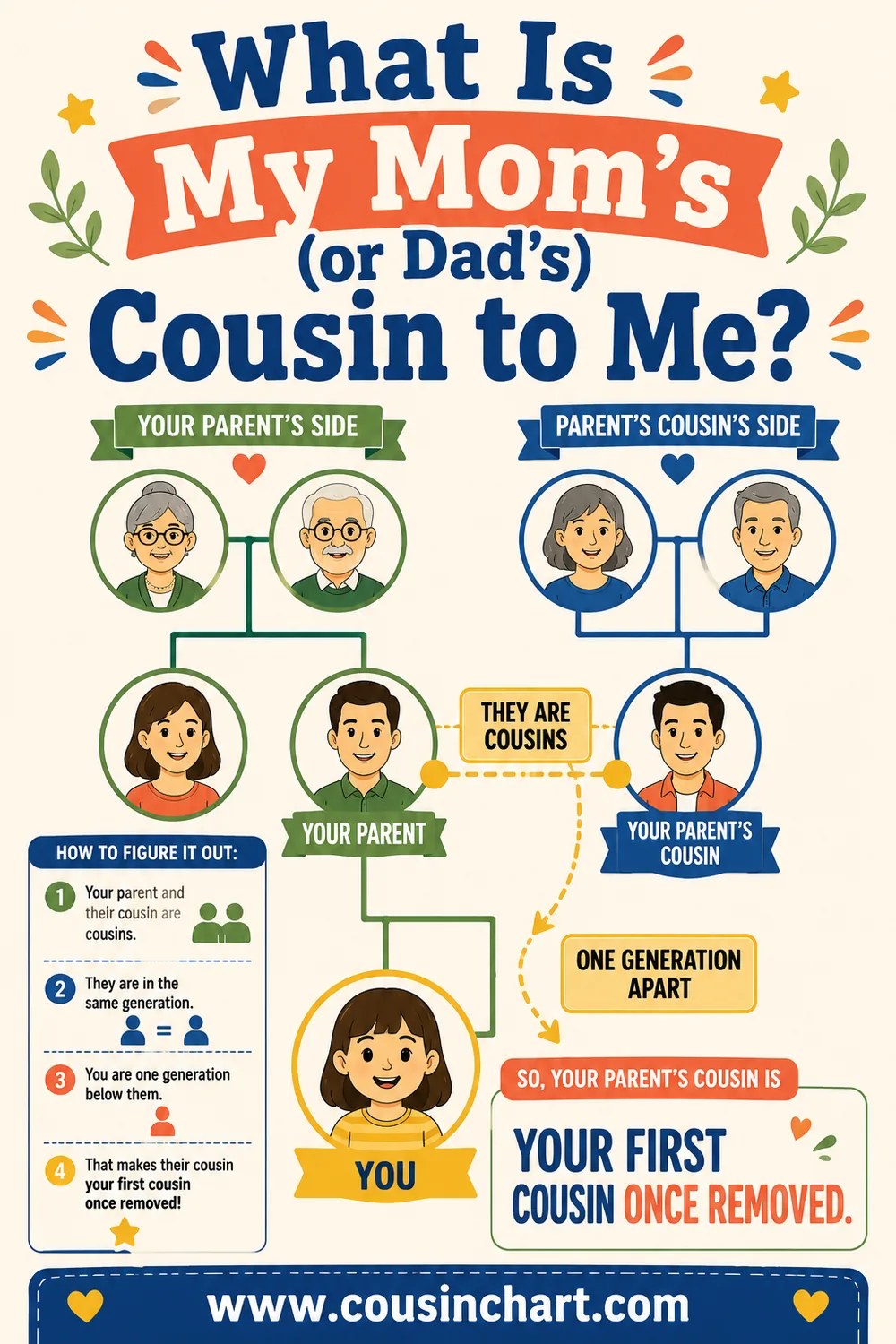
There's a tidy family pattern hiding here: your parent's cousin is once removed, your grandparent's cousin is twice removed, your great-grandparent's cousin is three times removed. The cousin's rung on your ancestor ladder tells you the removal count directly.
Grandma's Cousin's Whole Branch, Mapped
Here's the payoff for learning one relationship: the entire branch snaps into place. Say your grandmother's first cousin is named Walter:
| Person | Their distance from the shared ancestors | What they are to you | Avg. shared DNA |
|---|---|---|---|
| Walter | 2 generations | First cousin twice removed | ~3.125% (~230 cM) |
| Walter's children | 3 | Second cousins once removed | ~1.56% (~120 cM) |
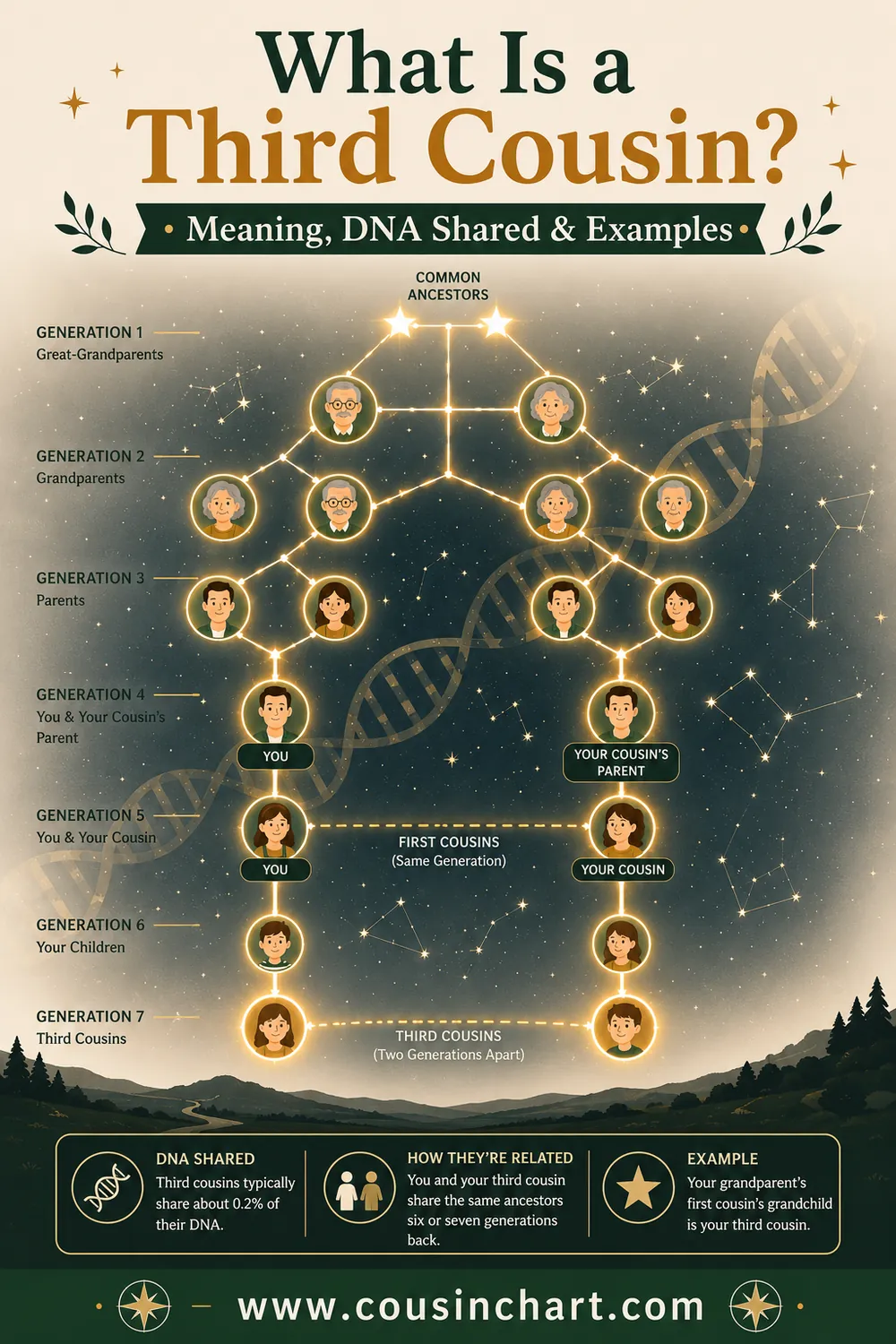
| Walter's grandchildren | 4 | Third cousins | ~0.78% (~75 cM) |
| Walter's great-grandchildren | 5 | Third cousins once removed | ~0.39% |
The shared ancestors here are grandma and Walter's mutual grandparents — your great-great-grandparents. Walter's grandchildren are exactly as far from that couple as you are (four generations), which is what makes you third cousins: same generation, shared 2nd great-grandparents.
This is worth pausing on, because it's how DNA-match genealogy actually works. When a stranger matching you at ~75 cM turns out to descend from your great-great-grandparents, the connecting hinge is often precisely a "grandma's cousin" figure neither of you ever met.
Is Grandma's Cousin a Great-Aunt? An Uncle? Something Else?
The confusion is understandable — grandma's cousin feels like grandma's sister, and grandma's sister is your great-aunt. But the two are on different word ladders:
- Siblings of ancestors take aunt/uncle titles: grandma's sister = your great-aunt.
- Cousins of ancestors stay on the cousin grid: grandma's cousin = your first cousin twice removed.
The genetic gap backs up the terminology: a great-aunt shares about 12.5% of your DNA; grandma's first cousin only about 3.125% — a fourfold difference between two people your family may treat identically at holidays.
Socially, of course, many families call grandma's cousin "Aunt Ruth" or just "cousin," and that's lovely. Save the precise term for the three places it earns its keep: family tree software, DNA match lists, and inheritance paperwork.
The DNA Between You
A first cousin twice removed shares about 3.125% of your DNA — roughly 230 centimorgans on average, commonly ranging from about 75 to 350 cM. Two practical notes:
- The average matches a second cousin's. A 2C and a 1C2R both center near 3.125%, so a DNA company can't distinguish them from the number alone — it will show a range like "2nd–3rd cousin." Only the family tree tells you which one your match actually is.
- Grandma shares four times more. Her ~12.5% with her cousin became ~6.25% for your parent and ~3.125% for you — the halving-per-generation rule in action. If grandma or a parent has tested, their much larger match to this branch is a shortcut for confirming yours.
For a mystery match in this range, work the two-step rule backwards: the relationship calculator lets you try candidate paths ("great-grandparent's sibling's line? grandparent's cousin's line?") until the generations fit the centimorgans.
Meeting This Relationship in the Wild
Where "grandma's cousin" actually turns up:
- Reunions and funerals. The elderly gentleman who knows every story about your great-great-grandparents' farm? Odds are he's a grandparent's cousin — a 1C2R. He's also the best interview in the room; two generations of removal means two generations of memories you don't have.
- DNA match lists, filed under 2nd–3rd cousin, as above.
- Old photos and letters. "Cousin Walter" scrawled on the back of a 1940s photograph usually means a cousin of the photo's owner — your grandparent — so translate: your 1C2R.
- Probate notices. When someone dies without close kin, courts trace outward through exactly these relationships, and the difference between a 1C2R and a 2C can decide who's in the will's residue class. (Rules vary by state.)
The Ancestor's-Cousin Cheat Sheet
The grandma's-cousin rule is one row of a bigger pattern, and once you see the whole grid you'll never have to look it up again. An ancestor's cousin keeps the cousin number and picks up one removal per generation between you and that ancestor:
| Whose cousin? | Their first cousin is your… | Their second cousin is your… |
|---|---|---|
| Your parent's | First cousin once removed | Second cousin once removed |
| Your grandparent's | First cousin twice removed | Second cousin twice removed |
| Your great-grandparent's | First cousin three times removed | Second cousin three times removed |
| Your great-great-grandparent's | First cousin four times removed | Second cousin four times removed |
Two things to notice. First, the cousin number and the removal count move independently — one comes from the pair at the top, the other from the floors between you, and they never interfere with each other. Grandma's second cousin is your second cousin twice removed; the "twice" didn't budge.
Second, the grid mirrors downward. Your first cousin's grandchild is also your first cousin twice removed, because the same two measurements apply whether the generation gap runs up or down. If that symmetry ever feels slippery at a reunion, remember that the term describes the shape of the connection, not who's older — a 1C2R can be ninety or nine. (Grandma's cousin is the classic ninety; see what is my mom's cousin to me for the once-removed floor of the same grid.)
Ten Minutes With Grandma's Cousin Is Worth an Hour of Archives
Here's the thing genealogists know about 1C2Rs that casual reunion-goers don't: they are usually the oldest living people who knew your great-great-grandparents' household from the inside. Grandma's cousin grew up visiting the same farmhouse, heard the same kitchen-table stories, and — crucially — heard them from a different branch's angle than the version that came down to you.
If you get ten minutes with a Walter, skip "how are you related to me again?" (you now know) and ask instead:
- "Who were the grandparents you and Grandma shared? What were they actually like?" You'll get personality, not just dates.
- "Who's in this photo?" Bring the unlabeled ones. A 1C2R can often name faces nobody else alive can.
- "Where did the family live before [the town you know about]?" Migration stories often survive in one branch only.
- "Did anyone ever mention how the family got here / lost the farm / changed the name?" The legends differ between branches, and the differences are clues.
Record it — a phone voice memo is fine. Census records will still exist in twenty years; Walter's memory of why his grandmother never spoke to her sister will not. In genealogy terms, an afternoon with a first cousin twice removed is a primary source with opinions.
FAQ
What is my grandmother's first cousin to me?
Your first cousin twice removed. The "first cousin" part comes from grandma's relationship; "twice removed" counts the two generations between her level and yours.
Is my grandma's cousin my second cousin?
No. Second cousins are in your own generation and share great-grandparents with you. Grandma's cousin is two generations up. Their grandchildren — not they themselves — are your third cousins, and their children are your second cousins once removed.
What are my grandma's cousin's children to me?
Your second cousins once removed: they're your parent's second cousins, one generation above you. Their children are your third cousins.
How much DNA do I share with my grandma's cousin?
About 3.125% on average — roughly 230 centimorgans, typically ranging from 75 to 350 cM. That's the same average as a second cousin, which is why DNA sites report a range instead of a single label.
Is my grandma's cousin my great-aunt?
No — a great-aunt is your grandparent's sister. Cousins of a grandparent stay cousins: first cousin twice removed. The DNA difference is real too: ~12.5% for a great-aunt versus ~3.125% for grandma's cousin.
Are my kids related to my grandma's cousin's grandchildren?
Yes — your children and Walter's grandchildren are third cousins once removed (your kids sit one generation below the third-cousin pair). Walter's great-grandchildren and your children line up as fourth cousins: same generation, sharing your great-great-great-grandparents.
What am I to my grandma's cousin?
Also their first cousin twice removed — the term is symmetric. You're two generations below the cousin pair; they're two generations above you. Same label, opposite directions.
Two Numbers and You're Done
Cousin number from the pair at the top, removals from the floors between you — that's the entire trick, and grandma's cousin is just "first" plus "two floors." Their kids and grandkids cascade neatly into your second-cousin and third-cousin rows, with the DNA halving on schedule. Next time an unfamiliar elder waves at you across the reunion pavilion, don't guess: open the free family relationship calculator, tap "my grandma → her cousin," and greet them by the right name — or at least know exactly what "Cousin Walter" means this time.