Do You Get More DNA From Your Mother or Your Father?
Do you get more DNA from your mother or father? Strictly speaking, from your mother, but only by a sliver. You get exactly one copy of each of your 22 numbered chromosome pairs from each parent, so most of your DNA really is a 50/50 split. The tiny extra from Mom comes from two places: your mitochondrial DNA, which comes from your mother alone, and, if you're male, the X chromosome, which is much bigger than the Y chromosome you got from your father. Daughters get an X from each parent, so their split is closer to even.
So the honest answer has three parts. Daughters get almost exactly half from each parent, plus a tiny mitochondrial bonus from Mom. Sons get noticeably more from Mom, roughly 3% more by raw size, because of the X-versus-Y difference. And none of this means you "take after" your mother more, which is a different question entirely. This guide walks through each piece with real numbers from the National Library of Medicine and the National Human Genome Research Institute, then shows how it plays out on a DNA test. If you're here because of a DNA match, our pillar page, the shared cM chart, shows how much DNA you should share with every kind of relative.
Quick check. Tap a question for the short answer:
Do You Get More DNA From Your Mother or Father? The Short Answer
Here's the whole answer in one table. We'll unpack every row below.
| Type of DNA | What daughters get | What sons get |
|---|---|---|
| Autosomes (chromosomes 1 to 22) | One copy of each from Mom, one from Dad | One copy of each from Mom, one from Dad |
| Sex chromosomes | An X from Mom and an X from Dad | An X from Mom and a Y from Dad |
| Mitochondrial DNA | All from Mom | All from Mom |
| Overall | Almost exactly 50/50, with a tiny extra from Mom | A little more from Mom, mainly because the X is much larger than the Y |
The key thing to notice is that the "extra" from Mom is real but small. For a daughter it's so small you'd need a calculator to see it. For a son it's bigger, but still only a few percent. Everything else, the vast bulk of your genome, is a clean half-and-half.
Where Your DNA Comes From: 23 Pairs and a Tiny Extra
Most of your DNA lives in the nucleus of your cells, packed into chromosomes. The NHGRI's chromosomes fact sheet explains that humans have 23 pairs of chromosomes, 46 in total, and that one copy of each chromosome is inherited from the female parent and the other from the male parent.
Here's how that works. Egg and sperm cells are the only cells in your body that don't carry pairs. Each one carries a single copy of every chromosome, which means 23 chromosomes each. When an egg and a sperm combine, the 23 from Mom and the 23 from Dad pair up, and you're back to 46. That's the basic reason the split is close to 50/50: each parent hands you exactly one set.
Of those 23 pairs, 22 are called autosomes. They're numbered roughly by size, and they look the same in males and females. The 23rd pair is the sex chromosomes: two X chromosomes in most females, and one X and one Y in most males.
There's one more piece of DNA that sits outside the nucleus. Your cells contain tiny structures called mitochondria, often described as the cell's power plants, and they carry their own small loop of DNA. That's the mitochondrial DNA, and as we'll see, it follows completely different rules.
The size of the whole package helps put everything in perspective. The NHGRI's genome glossary entry says the human genome contains about 3 billion nucleotides, the chemical letters of DNA. Keep that 3 billion figure in mind as a rough yardstick for one parent's set. Every comparison below is measured against it.
The Autosomes: A Genuinely Even Split
Chromosomes 1 through 22 are where the 50/50 rule is exact. You have two copies of chromosome 1: one from Mom and one from Dad. Two copies of chromosome 2: one from each. And so on, all the way to chromosome 22. No exceptions in a typical inheritance.
What isn't even is which parts of your grandparents' DNA you got. Your mother had two copies of each autosome herself, one from her mother and one from her father. When she made the egg that became you, those two copies swapped segments in a process called recombination. The chromosome she passed down was a patchwork of your maternal grandmother's and grandfather's DNA, stitched together in a new pattern. Your father's sperm went through the same shuffling.
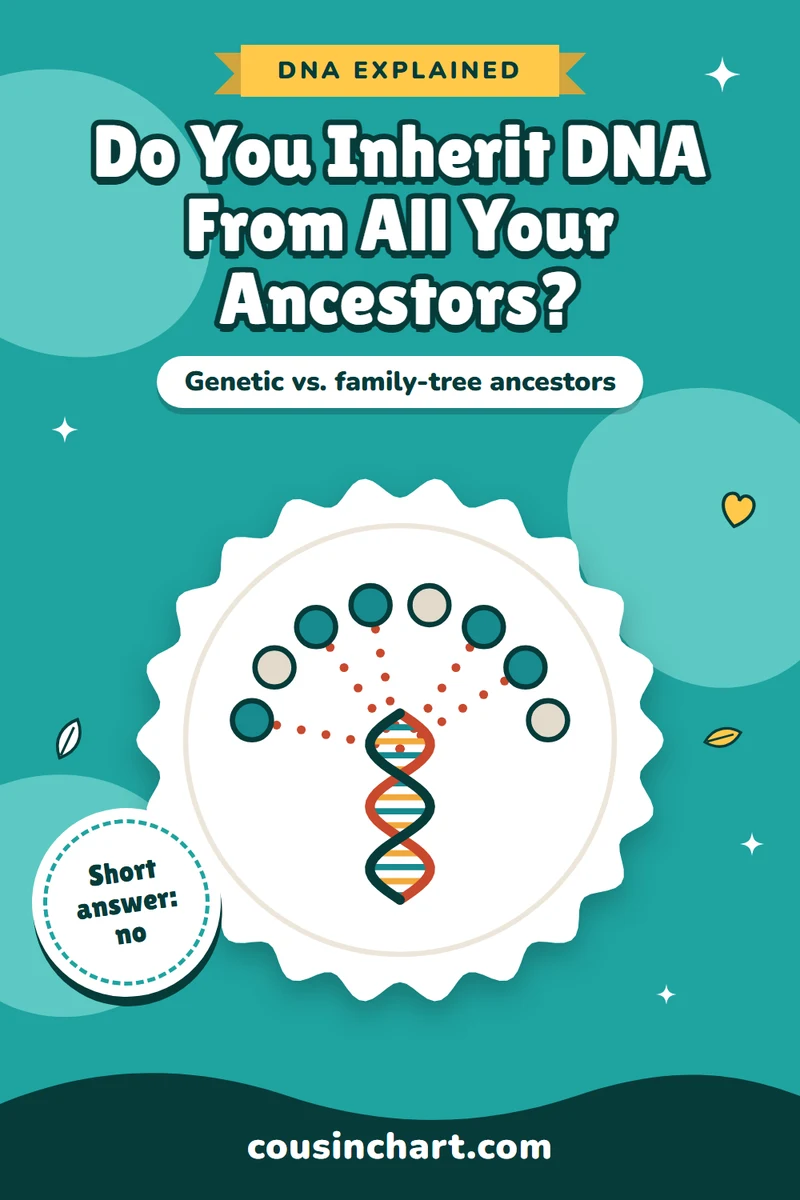
So your autosomes are always exactly half Mom and half Dad, but they're not exactly a quarter from each grandparent. You might have inherited a little more from your mother's mother than from your mother's father, just by chance. Our guide to whether you inherit DNA from all your ancestors explains how that randomness builds up over generations until some ancestors leave no detectable DNA in you at all.
The X and Y Chromosomes: Where Sons and Daughters Differ
The sex chromosomes are where the mother-versus-father question gets interesting, because the X and the Y are very different sizes.
According to MedlinePlus Genetics, the X chromosome spans about 155 million DNA base pairs, makes up about 5 percent of the total DNA in cells, and likely contains 900 to 1,400 genes that provide instructions for making proteins. The Y chromosome, by contrast, spans more than 59 million base pairs, represents almost 2 percent of total DNA, and likely contains 70 to 200 protein-coding genes. (Gene counts on the Y are hard to pin down. The NHGRI's own glossary gives a lower estimate, so treat any single number as approximate.)
| Chromosome | Approximate size | Protein-coding genes (estimate) | Who passes it on |
|---|---|---|---|
| X | About 155 million base pairs | 900 to 1,400 | Mothers to every child; fathers to daughters only |
| Y | More than 59 million base pairs | 70 to 200 | Fathers to sons only |
| Mitochondrial DNA | About 16,500 base pairs | 37 genes in total (13 code for proteins) | Mothers to every child |
What daughters get
A daughter gets one X from her mother and one X from her father. That's an even trade, X for X, so the sex chromosomes don't tilt her toward either parent. Her father's X is special in one way: he only has one X, so he passes that exact X, essentially unchanged, to every daughter. Her mother's X, on the other hand, is a recombined mix of the two X chromosomes Mom carries.
There's a twist in how a daughter's two X chromosomes behave. MedlinePlus explains that in females, one of the X chromosomes is randomly and permanently inactivated in cells other than egg cells. So in some of a daughter's cells, the X from Mom is the active one, and in others, the X from Dad is. Her body is a mosaic of the two.
What sons get
A son gets his X from his mother and his Y from his father. Since the X is far bigger and carries far more genes than the Y, a son receives more DNA from his mother through the sex chromosomes. MedlinePlus Genetics' page on inheritance patterns spells out the consequences: fathers cannot pass X-linked traits to their sons, and a Y-linked variant can only be passed from father to son.
That's why sons often show traits that run through their mother's side of the family on the X chromosome. A son's only X came from his mother, so if her X carries a particular variant, there's no second X from his father to balance it out. Our page on X-DNA inheritance shows exactly which ancestors can and can't have contributed to your X.
Mitochondrial DNA: The Part That Comes Only From Mom
Mitochondrial DNA, usually shortened to mtDNA, is the one kind of DNA almost everyone gets only from their mother. The NHGRI's glossary entry on mitochondrial DNA states plainly that offspring inherit mitochondria, and therefore mitochondrial DNA, from their mother.
Why only Mom? The NHGRI chromosomes fact sheet explains that only egg cells keep their mitochondria during fertilization, so mitochondrial DNA is inherited from the female parent. MedlinePlus' page on genetic ancestry testing puts it the same way: only egg cells provide mitochondria to the developing embryo, so only females pass mitochondrial DNA to their children.
How much DNA are we talking about? Not much. MedlinePlus Genetics says human mtDNA spans about 16,500 base pairs and contains 37 genes, all essential for normal mitochondrial function. Thirteen of those genes code for proteins involved in making energy, and the rest help build the cell machinery that reads them. It's a small fraction of your total DNA, but it's present in many copies, because most of your cells contain thousands of mitochondria, each with one or more copies of mtDNA.
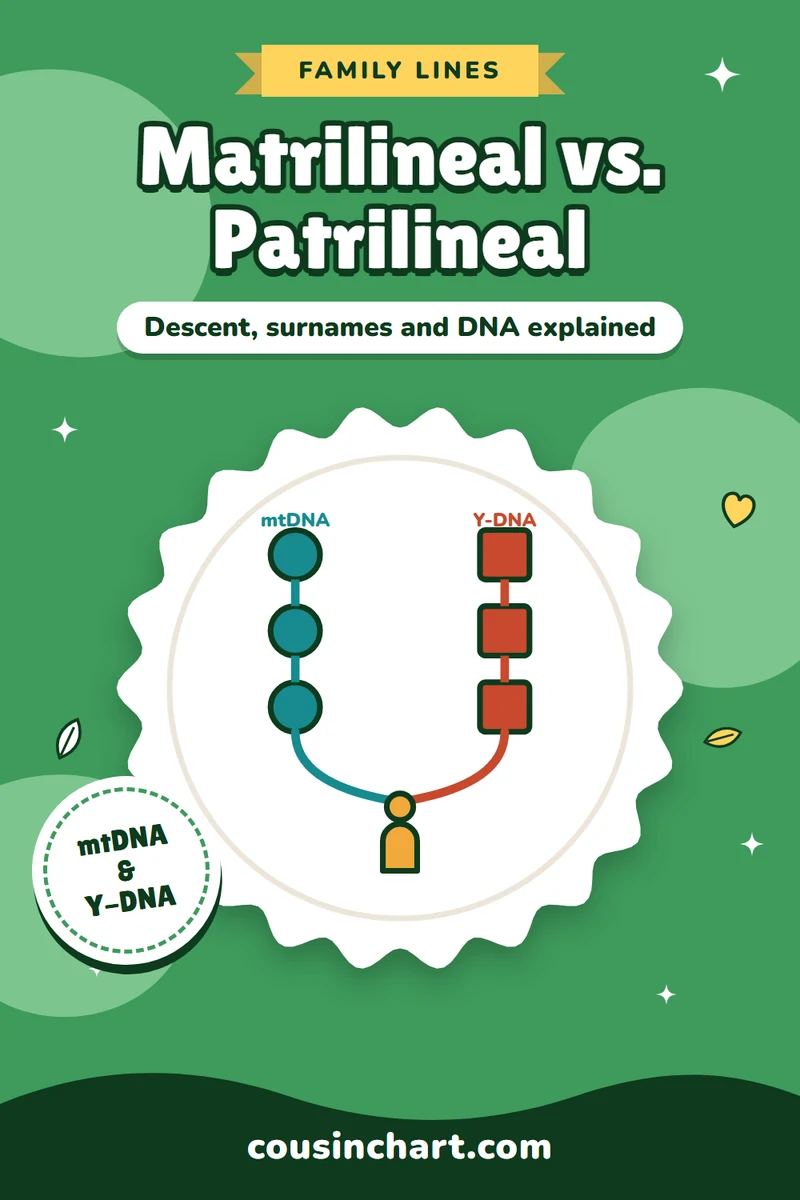
Sons and daughters both get their mtDNA from their mother. The difference is what happens next. A daughter will pass her mtDNA on to all her children. A son won't pass his on at all. That's why mtDNA follows a straight mother-to-mother line back through time, and why genealogists use it to trace the maternal line. Our guide to matrilineal vs. patrilineal lines explains how mother-line and father-line tracing work, both in genetics and in family customs around the world.
Adding It Up: How Much More From Mom, in Numbers
Let's put real numbers on the difference. We'll use the MedlinePlus figures for each chromosome and the NHGRI's "about 3 billion" as a rough yardstick for one parent's set. These are approximate, back-of-the-envelope figures, but they show the scale.
For a daughter
- From Mom: 22 autosomes, one X, and her mtDNA.
- From Dad: 22 autosomes and one X.
- The autosomes and the X chromosomes cancel out, so the only difference is the mtDNA: about 16,500 base pairs.
- 16,500 ÷ 3,000,000,000 = 0.0000055, or about 0.00055%.
In other words, a daughter's extra from her mother is roughly five ten-thousandths of one percent. That's real, but it's tiny. For practical purposes, a daughter's split is 50/50.
For a son
- From Mom: 22 autosomes, one X (about 155 million base pairs), and his mtDNA.
- From Dad: 22 autosomes and one Y (more than 59 million base pairs).
- The autosomes cancel out. The difference is the X minus the Y: about 155 million minus about 59 million, or roughly 96 million base pairs. The mtDNA adds a trivial 16,500 on top.
- 96,000,000 ÷ 3,000,000,000 = 0.032, or about 3%.
So a son receives roughly 3% more base pairs from his mother than from his father. Counted in genes rather than base pairs, the gap is more lopsided for the sex chromosomes, because the X carries roughly 900 to 1,400 protein-coding genes and the Y carries roughly 70 to 200. Still, both of those are small next to the many thousands of genes on the 22 autosomes, which split evenly.
| Daughter | Son | |
|---|---|---|
| Autosomes from Mom vs. Dad | Equal | Equal |
| Sex chromosome from Mom | X (about 155 million base pairs) | X (about 155 million base pairs) |
| Sex chromosome from Dad | X (about 155 million base pairs) | Y (more than 59 million base pairs) |
| mtDNA | From Mom | From Mom |
| Extra from Mom, roughly | About 16,500 base pairs (about 0.00055%) | About 96 million base pairs (about 3%) |
One caveat: these figures describe raw DNA, not how much each parent "shapes" you. A long stretch of DNA can do relatively little, and a single tiny change can matter a lot. Which brings us to the next question.
More DNA Doesn't Mean You're More Like Your Mom
People often ask the mother-or-father question because they're wondering who they take after. DNA quantity doesn't answer that. A few reasons:
Genes come in pairs, and pairs interact
For every gene on your autosomes, you have one copy from each parent. Sometimes one version has a stronger visible effect than the other. Sometimes the two blend. Sometimes many genes on different chromosomes work together, as they do for traits like height. You can resemble your father in one trait and your mother in another, even though you got the same amount of autosomal DNA from each.
Some genes care which parent they came from
For a small number of genes, it matters which parent the copy came from. This is called genomic imprinting. MedlinePlus Genetics explains that for these genes only one of the two copies is active, and which copy is active depends on the parent it came from. Some are active only when inherited from the father, others only when inherited from the mother. MedlinePlus notes that only a small percentage of human genes are imprinted. It's a good example of a parent-of-origin effect that has nothing to do with DNA quantity.
X-inactivation makes daughters a mosaic
As mentioned earlier, in daughters one X is switched off at random in each cell. So even within one person, some cells "use" Mom's X and others use Dad's. That's another reason quantity and influence aren't the same thing.
Families share more than genes
Looks, habits, accents and food tastes are shaped by environment and upbringing too. A child raised mostly by one parent may seem to "take after" that parent for reasons that have nothing to do with DNA. So when Grandma says you're the spitting image of your mother, she may be right, but it's not because Mom gave you more DNA.
What a DNA Test Shows: Parent Matches and One-Line Tests
If you take a consumer DNA test with both parents, you'll see the 50/50 split in action. Most of these tests compare autosomal DNA. MedlinePlus explains that autosomal testing evaluates large numbers of markers across the autosomes, which gives a broad picture covering both parental lines. Because you got exactly one copy of each autosome from each parent, your match with your mother and your match with your father should look about the same. If you're reading a match list, the shared cM chart shows the expected ranges, and parent-child is the one relationship where the numbers barely vary.
Mitochondrial and Y tests trace just one line
Some tests look only at the parts that don't split 50/50. MedlinePlus describes two of them:
- Mitochondrial DNA tests can be taken by anyone, but they reflect only the female line: your mother, her mother, her mother's mother, and so on.
- Y chromosome tests can only be taken by males, because the Y is passed from father to son. They trace only the direct male line: your father, his father, and so on.
Neither test tells you whether you got "more" from one parent. Each one simply follows a single line back in time and ignores everyone else in your tree. Most of your ancestors sit off both of those lines.
Ethnicity estimates can differ by parent's side
If your parents have different ancestries, your ethnicity estimate can make it look like one parent "won." That's usually not about quantity. MedlinePlus notes that companies use different reference databases and that populations aren't represented equally in all of them, so some ancestries are estimated less precisely than others. Your DNA from each parent is still half of your autosomes.
Sons vs. Daughters: Who Gets What From Each Parent
Because the sex chromosomes and mtDNA follow special rules, it's worth laying out exactly what each child can receive.
| Parent to child | Autosomes | X chromosome | Y chromosome | mtDNA |
|---|---|---|---|---|
| Mother to daughter | One of each pair | Yes, a recombined mix of Mom's two X's | No | Yes |
| Mother to son | One of each pair | Yes, a recombined mix of Mom's two X's | No | Yes |
| Father to daughter | One of each pair | Yes, Dad's single X | No | No |
| Father to son | One of each pair | No | Yes | No |
A few interesting consequences fall out of this table:
- Sisters who share a father share his whole X. Because Dad has only one X and passes it unchanged to every daughter, full sisters always share their father's X. Brothers never get it.
- Brothers who share a father share his Y. Barring rare mutations, full brothers carry essentially the same Y chromosome as their father and their paternal grandfather.
- All full siblings share their mother's mtDNA. Sons and daughters alike carry it, but only the daughters can pass it on.
If you're comparing half-siblings, these rules can help you tell a maternal half-sibling from a paternal one. Our page on half-siblings vs. full siblings shows how the shared DNA numbers differ.
A Worked Example: Following One Family's DNA Down Two Generations
Numbers make more sense with people attached. This family is made up and purely illustrative, but the rules it follows are the real ones described above.
Meet Elena and Marcus. Elena has two X chromosomes: one she got from her mother, Rosa, and one from her father, Tom. Marcus has an X from his mother, June, and a Y from his father, Walter. Elena and Marcus have two children, a daughter named Lily and a son named Sam.
What Lily got
- Autosomes: one copy of each of chromosomes 1 to 22 from Elena and one from Marcus. Each of Elena's copies is a shuffled mix of Rosa's and Tom's DNA. Each of Marcus's copies is a shuffled mix of June's and Walter's.
- X from Mom: a recombined X made from pieces of the X that Elena got from Rosa and the X she got from Tom.
- X from Dad: Marcus's single X, passed down whole. That X came to Marcus from his mother, June. So Lily carries June's X, a little like a family heirloom handed through her father.
- mtDNA: Elena's, which Elena got from Rosa, and Rosa from her own mother.
What Sam got
- Autosomes: the same deal as Lily, one of each pair from each parent, though shuffled differently, so Sam and Lily don't carry identical copies.
- X from Mom: his own recombined mix of Rosa's and Tom's X chromosomes. It's almost certainly a different mix from Lily's.
- Y from Dad: Marcus's Y, which came from Walter, and from Walter's father before him.
- mtDNA: Elena's, the same as Lily's.
What the example shows
Look at what each child got from each grandparent. Lily got June's whole X through her father, but nothing from Walter's Y. Sam got Walter's Y but none of June's X, because his father gave him the Y instead. Both children got Rosa's line of mtDNA, but neither got any of Marcus's mtDNA, and nobody got June's mtDNA except Marcus himself. On the autosomes, both children got exactly half from Elena and half from Marcus, but how much traces back to each of the four grandparents depends on how the shuffle fell.
That's the mother-or-father question in miniature. The big autosomal block splits evenly. The small special pieces, the X, the Y and the mtDNA, follow their own paths, and those paths depend on whether the child is a son or a daughter.
Why the Mother-or-Father Split Matters for Family Health History
The X chromosome rules aren't just trivia. They help explain why some conditions show up more often in one sex and seem to "skip" through a family.
MedlinePlus Genetics' overview of inheritance patterns describes X-linked conditions as those caused by variants in genes on the X chromosome. Because a son has only one X, which always came from his mother, he has no second X to back it up. A daughter has two X chromosomes, one from each parent, so a variant on one X may be balanced by a working copy on the other. And because fathers cannot pass X-linked traits to their sons, a condition of this kind can't run straight from father to son.
Mitochondrial conditions follow the other special rule. MedlinePlus notes that only females can pass on mitochondrial variants to their children. A father with such a variant doesn't pass it to either his daughters or his sons.
None of this means you can diagnose anything from a family tree. Many conditions involve the autosomes, many genes, or no clear pattern at all. But if you're writing down your family's health history, noting which side a condition came from, and whether it showed up in sons, daughters or both, gives a doctor or genetic counselor the clues they need. If something in your family worries you, that's the conversation to have with a professional.
Rare Exceptions and Special Cases
Everything above describes typical inheritance. Biology has exceptions, and it's worth knowing they exist, even though they're uncommon.
Could you inherit mitochondrial DNA from your father?
The textbook rule is that mtDNA comes only from the mother. In 2018, a team led by Shiyu Luo and Taosheng Huang published a study in the Proceedings of the National Academy of Sciences reporting biparental inheritance of mitochondrial DNA in humans in three unrelated families. The authors themselves concluded that maternal inheritance remains the general rule, and other scientists published letters debating how the findings should be interpreted. So paternal mtDNA, if it happens at all, is a rare exception and not something that changes the answer for ordinary families.
Both copies from one parent
Occasionally, a child inherits both copies of a chromosome, or part of one, from the same parent instead of one from each. This is called uniparental disomy. MedlinePlus Genetics describes it on the same page as imprinting, because when it involves imprinted genes it can cause genetic conditions. Prader-Willi syndrome and Angelman syndrome, both linked to chromosome 15, are the classic examples. These are uncommon, and they're diagnosed by doctors, not by consumer DNA tests.
Different numbers of sex chromosomes
MedlinePlus uses the word "typically" when it says females have two X chromosomes and males have one X and one Y. Some people have a different combination of sex chromosomes. In those cases, the mother-and-father math above shifts. If this applies to you or someone in your family, a genetic counselor is the right person to explain what it means.
Common Myths About Mom's DNA and Dad's DNA
"Boys get their brains from their mothers"
This one circulates widely. It's true that sons get their only X from their mother, and the X carries many genes. But brain development involves genes on many chromosomes, including the autosomes, which come equally from both parents. There's no simple rule that one parent supplies a child's intelligence.
"You're 50% Mom, 50% Dad, and 25% each grandparent"
The first part is close. The second isn't quite right. As we saw, recombination means you can get somewhat more DNA from one grandparent than another on the same side. On average it's about 25%, but individual results vary. Our guide to grandparent DNA tests explains why that variation makes grandparent results trickier to read than parent results.
"Siblings share exactly 50% of their DNA"
Full siblings share about 50% on average, but not exactly. Each sibling got a different random half from each parent, so two siblings can share a bit more or a bit less. Only identical twins share essentially all of their inherited DNA.
"If I don't match my dad's side much, I got more from Mom"
Not on the autosomes. You always get one full set from each parent. If your matches on one side are sparse, the usual reasons are that fewer relatives on that side have tested, or that a parent's family comes from a population that's underrepresented in testing databases.
Try It Yourself: Which Relative Shares More DNA?
The same halving logic that explains the 50/50 split also answers a common follow-up: which relatives share the most DNA with you? Work these out, then check below.
- Would you share more DNA with a half-sibling or a first cousin?
- A man's maternal grandfather: could he have contributed any X-DNA to his grandson?
- A woman's paternal grandmother: could she have contributed any X-DNA to her granddaughter?
- Do a brother and sister share any mtDNA in common?
Answers: (1) A half-sibling. You share one parent, so you'd expect about 25% (a half of a half). A first cousin shares about 12.5% on average. (2) Yes. The grandson's X came from his mother, and his mother's X chromosomes came from her mother and her father, so her father's X could be part of the mix. (3) Yes, and in fact she must have contributed. The granddaughter got her father's single X, and her father's X came from his mother. So all of the granddaughter's paternal X came from that grandmother, recombined from the grandmother's own two X chromosomes. (4) Yes. Both got their mtDNA from the same mother, so it matches. Only the sister will pass it on.
For cousin-level numbers in more detail, our guide to how much DNA cousins share has the ranges.
Wrapping Up: Mom Gives a Little More, Dad Gives Half Too
So, do you get more DNA from your mother or father? A little more from your mother, every time. For daughters the extra is only the tiny mitochondrial genome, so the split is effectively 50/50. For sons the extra is larger, roughly 3% by raw size, because the X from Mom is so much bigger than the Y from Dad. Across chromosomes 1 through 22, though, every child gets exactly one copy from each parent, and that's the part most DNA tests compare. To see what that means for every other relative on your match list, head back to our shared cM chart.
And if you're trying to figure out how a DNA match fits into your family, our free family relationship calculator can help. You pick how two people connect, and it names the relationship, such as "first cousin once removed."
Frequently Asked Questions
Do boys get more DNA from their mom or dad?
Boys get a bit more from their mom. Like everyone, a son gets one copy of each of chromosomes 1 through 22 from each parent, so that part is an even split. The difference is in the sex chromosomes. A son gets an X from his mother and a Y from his father, and the X is much larger, at about 155 million base pairs versus a little over 59 million for the Y. He also gets all his mitochondrial DNA from his mother. Added up, that's roughly 3% more DNA from Mom by raw size.
Do girls get more DNA from their mom or dad?
Girls get almost exactly half from each parent. A daughter receives one copy of each autosome from each parent, plus an X chromosome from her mother and an X from her father, so the nuclear DNA is an even trade. The only extra from Mom is mitochondrial DNA, which is about 16,500 base pairs. Measured against a genome of roughly 3 billion letters, that's about 0.00055%, a difference so small it doesn't matter in practice. For daughters, the honest answer is 50/50.
Is mitochondrial DNA really only from your mother?
As a rule, yes. The National Human Genome Research Institute states that offspring inherit mitochondria, and therefore mitochondrial DNA, from their mother, because only egg cells keep their mitochondria at fertilization. A 2018 study in the Proceedings of the National Academy of Sciences reported apparent father-to-child transmission in three unusual families, but the authors themselves said maternal inheritance remains the general rule, and other scientists debated the findings. For everyday family history and DNA testing, you can treat mtDNA as coming only from your mother.
Do I look more like my mother because I got more DNA from her?
Probably not because of DNA quantity. The extra DNA from your mother is small, and it's concentrated on the X chromosome and in mitochondria. Most visible traits are shaped by many genes across the autosomes, which you got equally from both parents. How those gene pairs interact, a few parent-specific effects such as genomic imprinting, and plain environment and upbringing all play a part. So you can strongly resemble your father, your mother, or a mix, regardless of the small mother-side extra.
Does a DNA test show I share more with my mom than my dad?
Usually no. Most consumer DNA tests compare autosomal DNA, the 22 numbered chromosome pairs, and you received exactly one copy of each from each parent. So your match with your mother and your match with your father should look about the same. Some companies also compare the X chromosome, which can show a difference for sons, who share an X only with their mother. Separate mitochondrial and Y-chromosome tests follow just one line each and don't measure how much you got from either parent overall.
Which parent determines a baby's sex?
In typical inheritance, the father's contribution does. Every egg carries an X chromosome from the mother. Each sperm carries either an X or a Y from the father. If the sperm carries an X, the baby typically has two X chromosomes and develops as female. If it carries a Y, the baby typically has an X and a Y. MedlinePlus Genetics notes that a gene on the Y chromosome called SRY is responsible for the development of a fetus into a male. Some people have different sex chromosome combinations, which a genetic counselor can explain.
Do you get exactly 25% of your DNA from each grandparent?
Not exactly. You get exactly half from each parent, but each parent's half is a shuffled mix of their own two parents' DNA. That shuffling, called recombination, happens at random, so you might get somewhat more from your mother's mother than from your mother's father. On average it works out to about 25% per grandparent, but individual people vary. That's why grandparent DNA results are less predictable than parent results, and why siblings can match the same grandparent at different levels.
What relatives share the most DNA with you?
Identical twins share essentially all of their inherited DNA, so they come first. After that, your parents, your children and your full siblings each share about 50% with you. Parents and children are always very close to exactly half, while full siblings vary a little around that average. Next come relatives who share about 25%: grandparents, grandchildren, aunts, uncles, nieces, nephews and half-siblings. First cousins share about 12.5% on average, which is why a half-sibling usually shares more DNA with you than a first cousin does.
Can a father pass his X chromosome to his son?
No. A father has one X and one Y, and he gives his son the Y. That's what makes the child a son in typical inheritance. So a son's only X always comes from his mother. MedlinePlus Genetics puts it simply: fathers cannot pass X-linked traits to their sons. A father does pass his single X to every daughter, essentially unchanged, which is why full sisters always share their father's entire X chromosome while brothers share none of it.
Sources
We checked every source below while writing this guide. Last reviewed October 30, 2026, by Joan Ramos.
- Chromosomes Fact Sheet (National Human Genome Research Institute)
- Genome (Talking Glossary of Genomic and Genetic Terms) (National Human Genome Research Institute)
- Mitochondrial DNA (Talking Glossary of Genomic and Genetic Terms) (National Human Genome Research Institute)
- X chromosome (MedlinePlus Genetics, National Library of Medicine)
- Y chromosome (MedlinePlus Genetics, National Library of Medicine)
- Mitochondrial DNA (MedlinePlus Genetics, National Library of Medicine)
- What are the different ways a genetic condition can be inherited? (MedlinePlus Genetics, National Library of Medicine)
- What are genomic imprinting and uniparental disomy? (MedlinePlus Genetics, National Library of Medicine)
- What is genetic ancestry testing? (MedlinePlus Genetics, National Library of Medicine)
- Biparental Inheritance of Mitochondrial DNA in Humans (Luo et al., PNAS 2018) (PubMed, National Library of Medicine)