How to Label a Four-Generation Christmas Photo: Names and Relationships
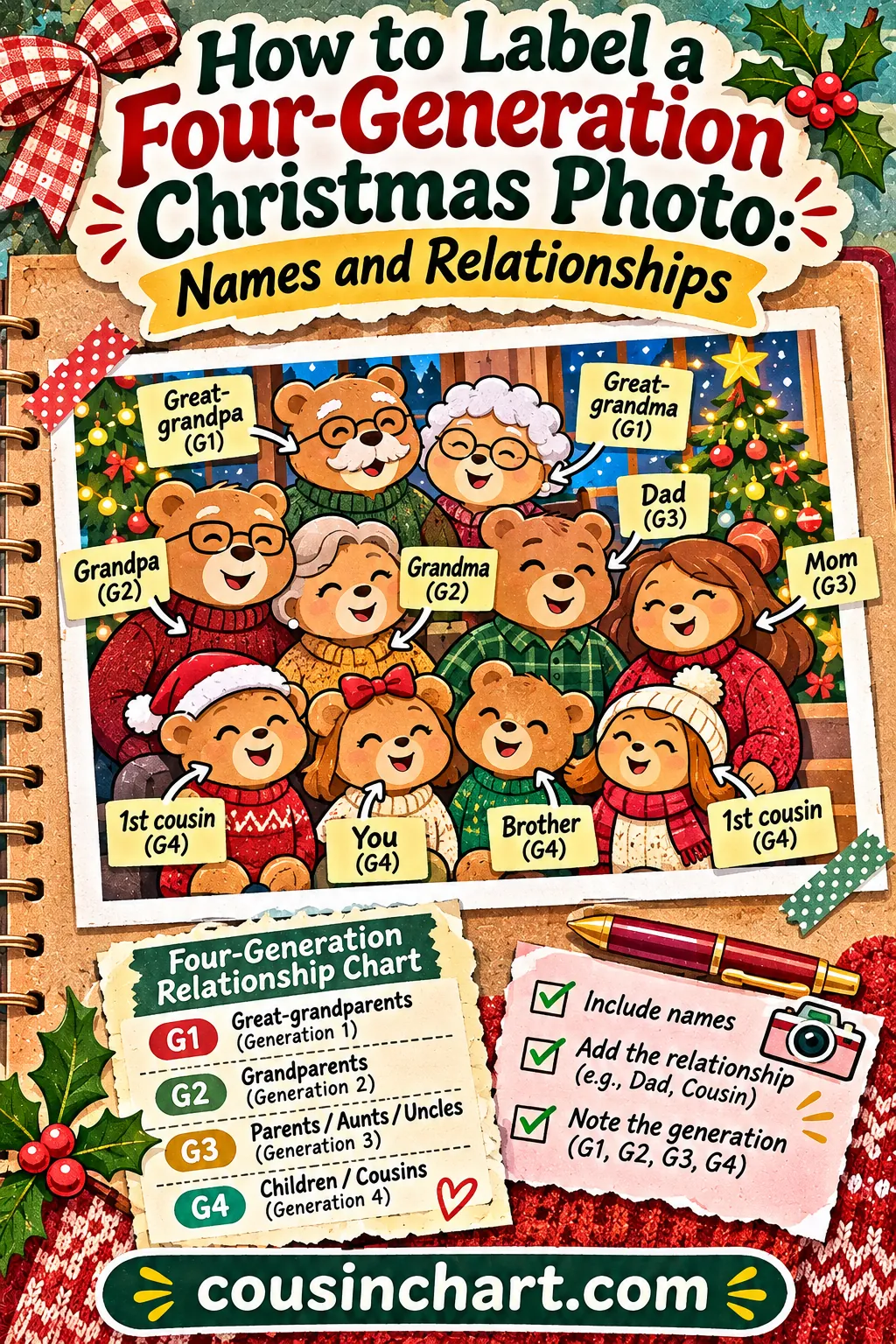
To label a four-generation Christmas photo, pick one reference person, usually the youngest, and name everyone in relation to them: the baby, the baby's parent, the baby's grandparent and the baby's great-grandparent, for example "Four generations: Great-Grandma Ruth, Grandma Linda, Mom Kate and baby Ellie." For cousins, in-laws and great-aunts who join the picture, look up each title in the free Cousin Chart relationship calculator so every name on the card is right. Then copy a caption format from this guide.
A four-generation photo is one of the sweetest things a family can put on a Christmas card. It's also surprisingly easy to caption wrong. Grandma is Great-Grandma to the baby but Mom to the woman next to her. The toddler in the corner is the baby's cousin, but which kind? This guide gives you the titles, a simple rule for choosing whose point of view to use, exact calculator settings, ready-to-copy captions and a holiday plan for getting the photo taken and the cards out.
▶ Work it out in the free calculator
Who Is Who in a Four-Generation Photo
The classic four-generation photo is one straight line: a great-grandparent, their child, their grandchild and their great-grandchild. Four people, four generations, each one the parent of the next.
Here's how each person's title looks from the baby's point of view, which is the most common way to caption it:
| Generation in the photo | Title from the baby's side | Common caption name | Generations above the baby |
|---|---|---|---|
| Oldest | Great-grandmother or great-grandfather | Great-Grandma, Great-Grandpa, or a family nickname | 3 |
| Second | Grandmother or grandfather | Grandma, Grandpa, Nana, Papa | 2 |
| Third | Mother or father | Mom, Dad | 1 |
| Youngest | The baby | First name | 0 |
The rule behind the titles is simple. One generation up is a parent, two is a grandparent, and every generation past that adds one "great." If your photo has five generations, the oldest person is the baby's great-great-grandparent.
Four generations isn't always four people
Plenty of four-generation photos have more than four people in them. Both great-grandparents might be there, or a grandma and grandpa, or twin babies. That's fine. Each person still belongs to one of the four generations, and their title comes from where they sit in the line.
What changes things is when someone in the photo isn't in the straight line. A great-aunt, a cousin, an uncle by marriage, a stepgrandparent. Those people need their own titles, and they're the ones families most often get wrong. We'll cover each of them below.
The same people, seen from each person's side
Every title depends on who's doing the looking. Here's the same four-generation line from all four points of view:
| Person | To the great-grandma | To the grandma | To the mom | To the baby |
|---|---|---|---|---|
| Great-grandma Ruth | (herself) | Mother | Grandmother | Great-grandmother |
| Grandma Linda | Daughter | (herself) | Mother | Grandmother |
| Mom Kate | Granddaughter | Daughter | (herself) | Mother |
| Baby Ellie | Great-granddaughter | Granddaughter | Daughter | (herself) |
Read across any row and you'll see how one person collects four different titles in one picture. That's why the first job is choosing whose point of view the caption follows. For a longer look at how generations stack up in a family, the guide to family generations explained lays out the whole pattern.
Pick One Reference Person First
The most common captioning mistake isn't a wrong word. It's mixing points of view. A card that says "Great-Grandma Ruth, Mom Linda, Kate and baby Ellie" uses three different reference people in one line. Ruth is named from the baby's side, Linda from Kate's side, and Kate by name only. Readers get lost.
Pick one person and caption everyone from their side. Here are the three choices that work, and when to use each:
| Reference person | Example caption | Best for | Watch out for |
|---|---|---|---|
| The youngest | Great-Grandma Ruth, Grandma Linda, Mom Kate and baby Ellie | Christmas cards, baby's first holiday, most families | Calling your own mother "Grandma" feels odd to some people |
| The oldest | Ruth with her daughter Linda, granddaughter Kate and great-granddaughter Ellie | A gift for the great-grandparent, an album page about them | Long words. Great-granddaughter takes up a lot of room |
| No one (names and generations) | Four generations: Ruth, Linda, Kate and Ellie | Simple cards, social posts | Friends outside the family won't know who's who |
Why the youngest usually wins
Captioning from the baby's side has two big advantages. First, it matches what the family already says out loud. Everyone calls Ruth "Great-Grandma" when the baby is around. Second, it's the version the baby will read years from now when they find the card in a box.
If the card is going out from the grandparents rather than the young parents, you can still caption from the baby's side. It keeps the card about the newest member of the family, which is usually the point of the photo.
When the oldest should be the anchor
If the photo is a gift for the great-grandparent, or if it's being used in a birthday slideshow or a tribute, caption it from their side. It honors the person at the top of the family and shows everything that came from them. The words get long, so the oldest-anchor style works better in an album or frame than on a small card.
Captions in left-to-right order
Whatever reference person you choose, list names in the order people appear in the photo, left to right. Add "from left" or "left to right" if the order isn't obvious. If the generations are arranged oldest to youngest, the caption reads like a family line, which is a nice touch.
How to Do It With the Free Tool
The straight line is easy once you know the "add a great" rule. The tricky part is everyone else in the photo. The free relationship calculator names any blood relationship in a couple of seconds, and it handles marriage and step relationships too. Here's how to use it to caption a holiday photo.
Step 1: Set yourself up as the reference person
The calculator has two builders, YOU and THEM. The idea is that "you" is the reference person, usually the baby, and "them" is whoever you're labeling. Each builder asks how far up the tree the shared relative sits, the person you both come from, and it has + and − buttons with a label that names that generation.
The label under YOU is also the quickest way to check a straight-line title. Tap + or − and watch it change:
- Set to 1, the label reads parent.
- Set to 2, it reads grandparent.
- Set to 3, it reads great-grandparent.
- Set to 4, it reads great-great-grandparent.
For a four-generation photo captioned from the baby's side, the oldest person sits at 3. Count up from the baby, set YOU to that number and copy the word.
Step 2: Label the side branches
For anyone who isn't the baby's direct ancestor, use both builders. Count from the baby up to the shared relative for YOU, and from the other person up to that same relative for THEM.
- The baby's aunt (Mom's sister): the shared relative is Grandma. Set YOU to 2 and THEM to 1. The result reads Aunt or uncle.
- The baby's great-aunt (Grandma's sister): the shared relative is Great-Grandma, who is Grandma's mother and her sister's mother too. Set YOU to 3 and THEM to 1. The result reads Grandaunt or granduncle, which means great-aunt or great-uncle.
- The baby's first cousin (child of Mom's sister): set both to 2. The result reads 1st cousin.
- Mom's first cousin: the shared relative is Great-Grandma. Set YOU to 3 and THEM to 2. The result reads 1st cousin once removed.
- Another great-grandchild in the photo (child of Mom's cousin): set both to 3. The result reads 2nd cousin.
That last one surprises people. If two cousins each bring a baby to Great-Grandma's house, those two babies are second cousins, because they share great-grandparents.
Step 3: Pick female or male for the exact word
Under They are, tap female or male. "Aunt or uncle" becomes aunt or uncle, and "grandaunt or granduncle" becomes grandaunt or granduncle. Leave it on either if you're only checking the generation.
Step 4: Switch the setting for in-laws and step-relatives
Under Related by, there are three buttons: blood, step and marriage.
- marriage adds "-in-law" to the result. Set YOU to 1, THEM to 1, pick marriage and male, and the result reads Brother-in-law. That's the label for a sister's husband from her sibling's side.
- step gives step titles for side-branch relatives. The steppers start at 1, so the result box never shows a straight-line title like grandparent. For a step-grandparent, read the YOU label at 2 (grandparent) and add "step" yourself, as in step-grandmother.
For a step-relative on a side branch, set the two builders as you would for a blood relative and tap step. For example, YOU 2, THEM 1 and step gives Step-aunt or uncle.
Step 5: Leave "half" off unless it applies
Half relationship? only matters when two people share one parent instead of two. If Grandma's half-brother is in the photo, set YOU to 3, THEM to 1, tick the half box and pick male. The result reads Half granduncle. On a card, most families just write "great-uncle" and leave the half off. It's your call.
Step 6: Add names and save a key
Open Make it yours under the result. You can type a name for each person on the little chart, up to 18 characters each, and add a photo from your device. The page notes that photos stay on your device, since everything happens in your browser.
Then use the buttons under the result. Copy result copies a one-line answer you can paste into your caption notes. Download my chart saves a picture of the path with your names on it. Print this result gives you a paper copy. A downloaded chart for each side-branch relative makes a tidy key to tuck in the album next to the photo.
Caption Formats You Can Copy
Once you know everyone's title, the caption is just a matter of picking a format that fits the space. A Christmas card has room for a line or two. An album page has room for a paragraph. The back of a print has room for whatever you can write neatly.
For the front of a Christmas card
Keep it to one line, or two at most. These all work for a classic four-generation photo:
- Four generations of love: Great-Grandma Ruth, Grandma Linda, Mom Kate and baby Ellie
- Merry Christmas from four generations of the Harris family
- Great-Grandma, Grandma, Mama and me. Ellie's first Christmas
- Four generations, one Christmas: Ruth, Linda, Kate and Ellie
If you're using a card template with a separate small-print line, put the short phrase on the front ("Four generations") and the full name list underneath.
For the inside of the card or a letter
You have more room here, so add a little context:
"This year Ellie got to meet her great-grandma Ruth, who turned 88 in October. Four generations in one photo, from left: Great-Grandma Ruth, Grandma Linda, Mom Kate and Ellie, 4 months."
Ages are a lovely detail for a four-generation card. They show the span of the family at a glance, and the people who receive the card will love doing the math.
For an album page or the back of a print
This is the version that will matter in 30 years, when someone pulls the photo out of a box. Use full names, the date and the place, and give each person's relationship to someone the reader is likely to know:
Christmas Day 2026, Ruth's house in Dayton, Ohio. Left to right: Ruth Ellen Carter (born 1938), her daughter Linda Carter Harris, Linda's daughter Kate Harris Moreno, and Kate's daughter Ellie Moreno, 4 months.
Notice that this version anchors each person to the one before. "Her daughter," "Linda's daughter," "Kate's daughter." That never goes out of date, no matter who's reading. Titles like "Grandma" shift as the family grows, but "Linda's daughter" will always be true.
For a social post
Shorter and warmer is best. Skip last names if you'd rather not share them publicly.
- Four generations under one Christmas tree 🎄 Great-Grandma, Grandma, Mama and baby
- Ellie's first Christmas with her great-grandma, her grandma and her mama
- Same smile, four generations
A caption formula you can fill in
If you want a pattern rather than examples, this one fits nearly every four-generation photo:
[Opening phrase]: [Title] [Name], [Title] [Name], [Title] [Name] and [Name], [age if a baby]
Fill in the titles from the youngest person's side, and you're done. For a five-generation photo, add one more title at the front, Great-Great-Grandma.
Worked Example: The Big Christmas Photo With Everyone In It
The straight-line photo is the easy part. Then someone says, "Let's get everybody in one," and suddenly there are 14 people on Great-Grandma's couch. Here's a made-up family to show how the labeling works for a bigger group.
Great-Grandma Ruth has two children, Linda and Mark. Linda's kids are Kate and Josh. Mark's daughter is Ava. Kate has baby Ellie. Ava has a son, Leo, who's 3. Linda's husband Tom and Ava's wife Sam are in the photo too, plus Ruth's younger sister June.
Kate wants the album caption to name everyone from Ellie's side, so she runs each person through the relationship calculator:
| Person | Who they are | Title from Ellie's side | Calculator settings |
|---|---|---|---|
| Ruth | Linda's mother | Great-grandmother | YOU label at 3 reads great-grandparent |
| June | Ruth's sister | Great-great-aunt | YOU 4, THEM 1, female: Great-grandaunt |
| Linda | Kate's mother | Grandmother | YOU label at 2 reads grandparent |
| Tom | Linda's husband, Kate's dad | Grandfather | YOU label at 2 reads grandparent |
| Mark | Linda's brother | Great-uncle | YOU 3, THEM 1, male: Granduncle |
| Josh | Kate's brother | Uncle | YOU 2, THEM 1, male: Uncle |
| Ava | Mark's daughter, Kate's first cousin | First cousin once removed | YOU 3, THEM 2: 1st cousin once removed |
| Sam | Ava's wife | First cousin once removed by marriage | Same settings, tap marriage |
| Leo | Ava's son | Second cousin | YOU 3, THEM 3: 2nd cousin |
| Kate | Ellie's mom | Mother | YOU label at 1 reads parent |
A few things jump out:
- June gets one more "great" than you'd guess from her generation. She's Ruth's sister, so she sits on Ruth's level, three generations above Ellie. Her title is great-great-aunt in everyday speech, or great-grandaunt in the calculator's words. Both mean the same person.
- Ava is a "removed" cousin. She's Kate's first cousin, and to Ellie she's one generation up, so first cousin once removed. If that one always trips you up, the guide to what your cousin's child is to you explains the same relationship from the other direction.
- Leo and Ellie are second cousins. They're the same generation, and their shared ancestor is Ruth, their great-grandmother.
- Sam is family by marriage. She shares no blood with Ellie, and the calculator's marriage setting adds "-in-law" to her result. On a card, most families just call her "Cousin Sam" or "Aunt Sam," whichever the kids use. That's warmer and perfectly fine.
Turning the table into a caption
Here's how Kate wrote the album caption, left to right as people sat:
Christmas 2026 at Great-Grandma Ruth's. Back row: Great-Uncle Mark, Uncle Josh, Grandpa Tom, Cousin Ava and Cousin Sam. Middle: Grandma Linda, Great-Grandma Ruth and Great-Great-Aunt June. Front: Mom Kate holding Ellie, and Leo, 3.
For the Christmas card, she cut it down to one line:
Four generations and a whole lot of cousins. Merry Christmas from the Carter family!
That's a good habit. Keep the full who's-who for the album and the short, warm version for the card.
Cousins on a card: the simple version
Most families don't write "first cousin once removed" on a Christmas card, and you don't need to. On the card, "Cousin Ava" is perfect. Save the exact titles for the album key or the back of the print, where someone researching the family later will be glad you did.
Spelling, Hyphens and Capital Letters
Relationship words have a few spelling habits that are easy to get wrong in a hurry. Here's a quick reference for US spelling:
| Write it like this | Not like this | Why |
|---|---|---|
| great-grandmother | great grandmother, greatgrandmother | "Great" joins to the title with a hyphen |
| great-great-grandfather | great great grandfather | Every "great" gets a hyphen |
| grandmother, grandson | grand mother, grand son | "Grand" titles are one word |
| great-aunt, great-uncle | great aunt, greataunt | Hyphenated like great-grandmother |
| granduncle, grandaunt | grand-uncle, grand uncle | One word when spelled with "grand" |
| mother-in-law | mother in law | Hyphens on both sides of "in" |
| sisters-in-law | sister-in-laws | Make the main word plural, not "law" |
| great-grandchildren | great-grandchilds | "Children" is already plural |
| stepmother, stepbrother | step-mother, step brother | Close-family step titles are one word |
| step-grandmother | stepgrandmother | Hyphenated when "step" joins a longer title |
When to use capital letters
Capitalize a relationship word when you're using it like a name, right before a person's name or in place of it:
- Great-Grandma Ruth gave Ellie her first ornament.
- Merry Christmas, Grandpa!
Leave it lowercase when it's just describing someone, usually after "my," "her," "our" or "the":
- Ellie's great-grandmother, Ruth, turned 88 this year.
- Our grandpa still makes the pancakes.
In a caption list, "Great-Grandma Ruth, Grandma Linda, Mom Kate" is all capitals, because each title works like part of the name. In a sentence like "Ruth with her daughter Linda," the relationship word stays lowercase. If your family uses special grandparent names like Nana, Gigi or Pop, those are always capitalized. The guide to grandparent names has plenty of them if a new great-grandparent is still choosing one.
Plurals and possessives in captions
A couple of patterns come up a lot on group cards:
- More than one great-grandparent: "Great-Grandma and Great-Grandpa Carter," or "the great-grandparents." Not "Great-Grandparent's."
- A family name on the card: "Merry Christmas from the Carters" (plural, no apostrophe), not "the Carter's."
- Something belonging to one person: "at Great-Grandma Ruth's house," with the apostrophe on the last word.
Taking the Photo and Sending the Cards: A Holiday Plan
The caption is easier when the photo is planned with it in mind. A few small choices at the shoot make the labels clearer later.
Arrange people so the caption reads naturally
- Oldest to youngest, left to right. The caption then reads like a family line, and you can write "left to right" without anyone squinting.
- Seat the oldest generation. Great-grandparents are usually more comfortable seated, and a seated person in the middle makes a natural center.
- Put the baby on the lap of the generation above. Mom holding the baby, sitting next to Grandma, next to Great-Grandma, keeps the line visible.
- Take a straight-line shot and a group shot. First the four people in the direct line, then everyone else joins. You get the classic four-generation photo and the big family photo in five minutes.
A four-week Christmas timeline
| When | What to do |
|---|---|
| Early December | Plan who's in the photo, and when the oldest generation will be available. Make a list of names in generation order |
| The photo day | Take the straight-line shot first while the baby is fresh, then the group shot. Snap a quick list of who sat where |
| Same evening | Look up every side-branch title in the calculator. Write the full album caption while the seating is still fresh in your mind |
| Two or three days later | Choose the card photo and write the one-line card caption. Order or print the cards |
| Mailing week | Address and mail. Check your carrier's official holiday shipping dates, since deadlines change every year |
| After Christmas | Print an extra copy for the album, write the long caption on the back, and file it |
Writing on the back of a print safely
If you're labeling a printed photo, write on the back lightly with a soft pencil or a pen made for photos. Ballpoint pressure can show through to the front, and some inks smudge or bleed over time. Write near the edge, not in the middle. For old family photos you're also labeling while everyone's together, the guide on how to preserve old family photos covers safe handling and storage.
Use the gathering to label old photos too
When four generations are in one room, that's the best time to name the faces in old pictures. Bring a stack of unlabeled prints and ask the oldest person in the room who's who. Write their answers on a sticky note on the back right away, or record them on your phone. Then look up each title in the calculator later. A great-grandma who can name her own aunts and cousins is giving you information nobody else may have.
Tricky Cases: Step, Half, In-Laws and Five Generations
Real families rarely fit a four-person line perfectly. Here's how to caption the situations that come up most.
| Situation | How to caption it | Calculator check |
|---|---|---|
| A step-great-grandparent is in the photo | Use the name the kids use, like "Great-Grandpa Al," or "step-great-grandfather" in an album key | YOU label at 3 reads great-grandparent. Add "step" yourself |
| Grandma remarried and her husband is in the photo | "Grandpa Dave" on the card if that's what the kids say. "Step-grandfather" in the album | YOU label at 2 reads grandparent. Add "step" yourself |
| A half-sibling of a grandparent is there | Most families write "great-aunt" and leave off "half" | YOU 3, THEM 1, tick half: Half grandaunt or granduncle |
| An aunt's husband joins the photo | "Uncle Rob" on the card. "Uncle by marriage" in the album | YOU 2, THEM 1, marriage, male: Uncle-in-law |
| A parent's cousin is there | "Cousin Ava" on the card. "First cousin once removed" in the album | YOU 3, THEM 2: 1st cousin once removed |
| Twin babies in the youngest generation | Name both: "and twins Ellie and Rose" | No calculator check needed |
| Five generations, not four | Add one more title at the top: Great-Great-Grandma | YOU label at 4 reads great-great-grandparent |
| The line runs through a son, not a daughter | Same titles, different words: Great-Grandpa, Grandpa, Dad and baby | Same settings |
| An adopted child is in the line | Same titles as any other child. No label needed | Same settings |
When the calculator and your family use different words
The calculator says granduncle. Your family says great-uncle. The calculator says great-grandaunt, and your family says great-great-aunt. These pairs always mean the same person. The calculator uses the "grand" forms because they line up with grandparent and grandchild. On the card, write what your family says out loud. Just use the calculator to make sure the generation count is right.
When there's a divorce or a gap in the family
Sometimes a four-generation photo has someone missing, or the family has split and rejoined. You don't have to explain any of that in a caption. "Four generations" is true whether or not every branch is in the photo. Stick to the people who are there, use the names they go by, and keep the long story for the family history, not the holiday card. For the formal side of in-law titles after a divorce or a death, the in-law relationship chart lays out what changes and what doesn't.
Variations by family
The same rules work for every family. The wording just shifts a little.
All-girl or all-boy lines
A line of four women is often called "four generations of women" or a "mother-daughter four generations" photo. The caption can name the relationships one after another: "Ruth, her daughter Linda, her granddaughter Kate and her great-granddaughter Ellie." The same works for a line of men: "four generations of Carter men."
Mixed lines
Most four-generation lines mix sons and daughters. Use "child," "grandchild" and "great-grandchild" if you're writing from the oldest person's side and want one word that covers everyone, or caption from the youngest side, where each title is gendered on its own: Great-Grandpa, Grandma, Dad and baby.
Blended families
A baby in a blended family might have three or four grandmothers and more than one great-grandmother. Caption each by the name the family uses, like Grandma Linda and Grandma Pat. If two people share a title in the photo, a first name always tells them apart.
Very young kids helping with the card
Kids love being in charge of the card. Give them the titles to sign: "Love, Ellie (and Mom, Grandma and Great-Grandma)." It's a sweet way for a child to learn who's who, and it's easier to read than a long list.
Make Your Four-Generation Caption
Pick the youngest person as your reference, list everyone left to right, and give each person the title they hold from that child's side. For anyone outside the straight line, the free Cousin Chart calculator names the exact relationship in seconds, from great-great-aunts to second cousins and in-laws. Keep the short version for the card, write the full who's-who on the back of a print, and the photo will make sense to everyone who picks it up, this Christmas and decades from now.
▶ Work it out in the free calculator
Frequently Asked Questions
What is a four-generation photo?
It's a photo of four people in one family line, each the parent of the next: a great-grandparent, a grandparent, a parent and a child. Families often take one when a new baby arrives while a great-grandparent is still living. Extra relatives can join, but the four generations form the core.
How do you caption a four-generation picture?
Pick one reference person, usually the youngest, and name everyone from their side, left to right. For example: "Four generations: Great-Grandma Ruth, Grandma Linda, Mom Kate and baby Ellie." Add ages, the date and the place for an album version.
Is it "great-grandma" or "great grandma"?
The standard US spelling is hyphenated: great-grandma, great-grandmother. Capitalize it when it's used as a name, as in "Great-Grandma Ruth," and keep it lowercase when it's a description, as in "her great-grandmother."
What are two great-grandchildren of the same person to each other?
If their parents are siblings, they're first cousins. If their parents are first cousins, they're second cousins, because they share great-grandparents. In the calculator, set YOU and THEM both to 3 and the result reads 2nd cousin.
What do I call my mom's cousin in a family photo caption?
To you, your mom's first cousin is your first cousin once removed. On a holiday card, "Cousin" plus their first name is perfectly fine. Save the exact title for an album key or the back of a print.
Is my grandma's sister my great-aunt or great-great-aunt?
She's your great-aunt, also called a grandaunt. Your great-grandma's sister is your great-great-aunt. Each one sits on the same level as the grandparent or great-grandparent she's a sister to.
Should a step-grandparent be included in a four-generation caption?
If they're in the photo and part of the family, yes. On a card, use the name the kids use, like "Grandpa Dave." In an album key you can add "step-grandfather" if you want the record to be exact.
What's the difference between a four-generation and a five-generation photo?
A five-generation photo adds one more person at the top, so the oldest is the youngest person's great-great-grandparent. The captioning works the same way, with one more "great" on the oldest title.