Grandparent Names: Nana, Gigi, Pop-Pop and 150 More Ideas (With Meanings)
The most popular grandparent names in the US are still the simple ones: Grandma and Grandpa, Nana and Papa, Granny and Gramps. But there's no rulebook. Grandparent names can come from a family language (Abuela, Nonna, Lola, Oma), from a region (Mamaw and Papaw), from a toddler's first try at a word (Gigi, Bop, Lolly), or from the grandparent's own first name. This guide gathers more than 150 options, with meanings, native spellings for names from other languages, and a step-by-step way to pick one that fits.
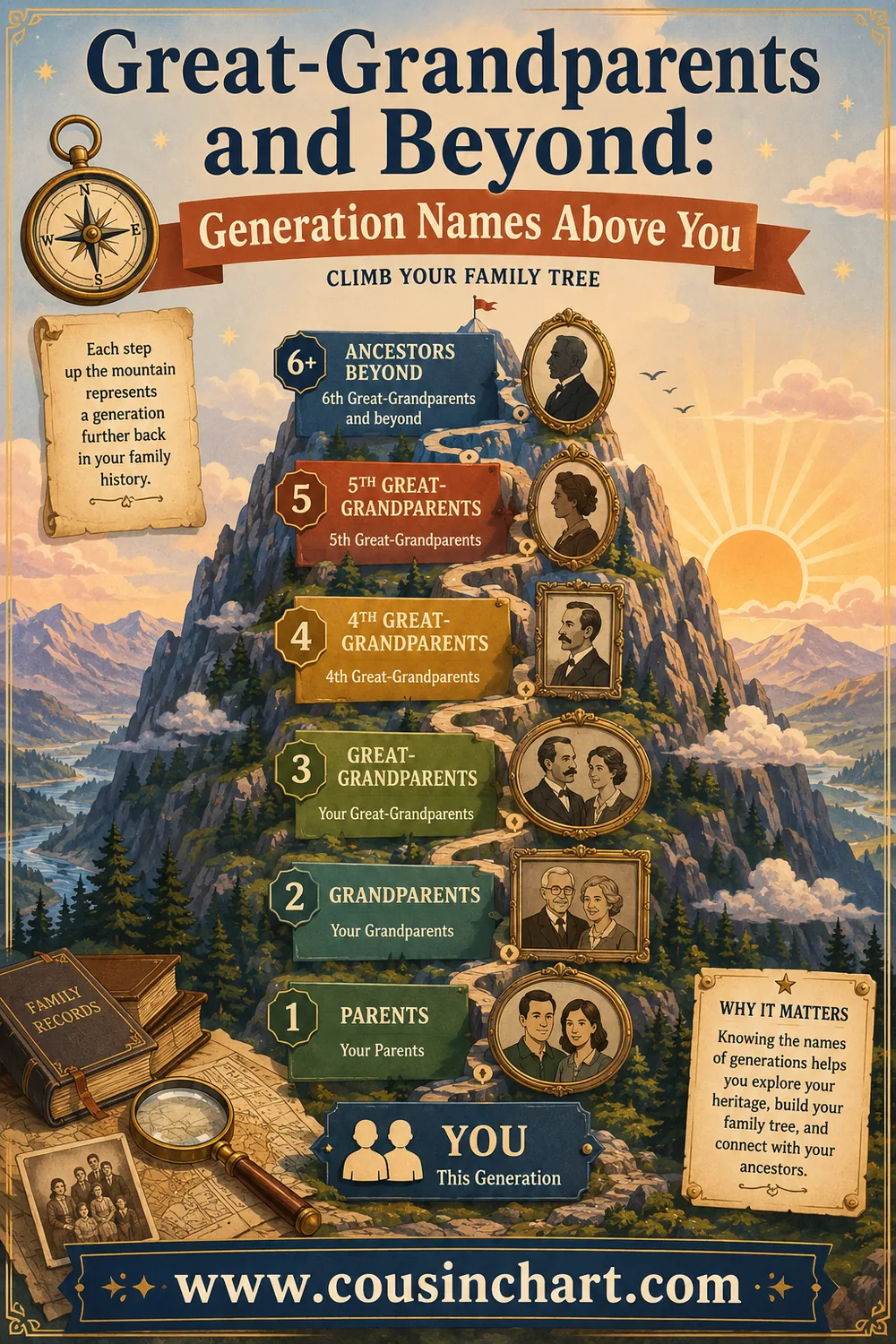
If you're trying to work out who's who above you before you pick a name, start with our great-grandparents chart, which lays out every generation from grandparents up to your third and fourth great-grandparents. This page is about the friendlier side of that ladder: what the grandkids actually call the people on it.
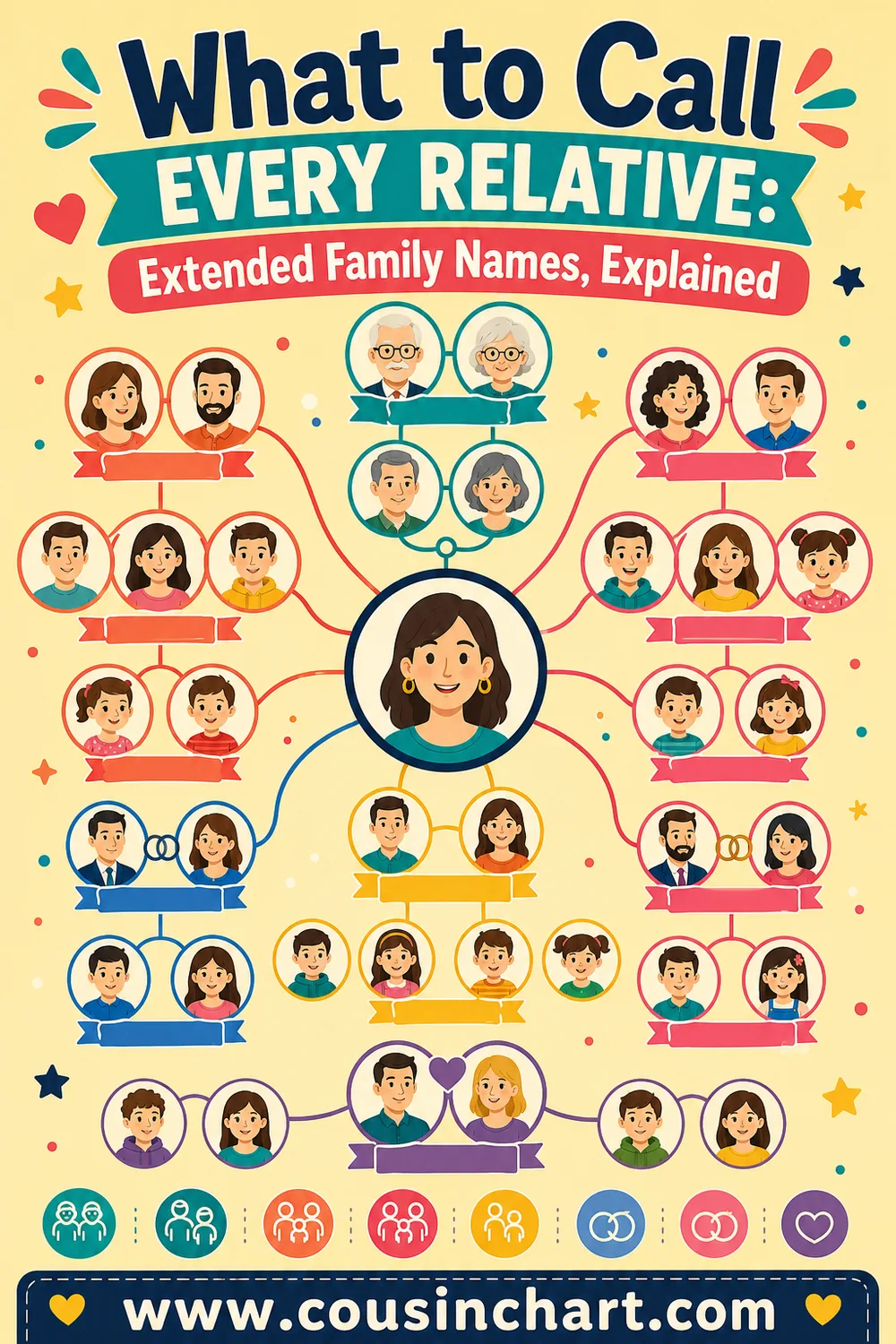
A quick note on scope. The official relationship words (grandmother, great-grandfather, grandaunt) are covered in our guide to what to call every relative. Here we're talking about nicknames and terms of address: the word a four-year-old shouts across the yard.
Quick check. Tap a question for the short answer:
Why Grandparent Names Matter More Than You'd Think
It's easy to treat a grandparent name as a cute detail, but it does real work in a family. It tells kids which grandparent is which. It can carry a language or a heritage across generations. And for a lot of new grandparents, it's the first concrete sign that their role has changed.
There are a lot of people wearing these names, too. The National Center for Family & Marriage Research at Bowling Green State University, using Census Bureau survey data, found that 53% of US adults age 50 and older were grandparents in 2021, about 63.5 million people. That's a lot of Nanas.
Most of them keep it traditional. An AARP survey of grandparents found that while most still answer to "grandma" and "grandpa," about one in 20 prefers to be called by their first name. In other words, about 95% of grandparents stick with some kind of grandparent title. The variety comes in which title.
Grandparents even have their own holiday in the US. Federal law asks the President to proclaim the first Sunday in September after Labor Day as National Grandparents Day, which makes it a natural deadline if your family is still deciding on names.
Who gets to pick?
In practice, three groups have a say:
- The grandparent. Many people have a name in mind long before the first grandchild arrives. Some want their own grandmother's name; others want anything but.
- The parents. They're the ones who will repeat the name hundreds of times a week, so they often steer things, especially when there are several grandparents to tell apart.
- The grandchild. The wild card. A baby who says "Gigi" instead of "Grandma" has made a decision, and families often let it stick.
The happiest outcomes usually come from talking it over early, before the baby is born or soon after, and then using the chosen name consistently. Kids learn any name easily. It's the adults who stumble when a name changes halfway through.
Classic Grandparent Names for Grandmothers
These are the grandmother names you'll hear most often in English-speaking families. Several are old nursery words, meaning words that grew out of the way small children talk. Dictionary.com, for example, traces "nana" to around 1835 to 1845 as a nursery word, related to "nanny," and lists it as an informal word for a grandmother in the Northeastern US.
| Name | Feel | Notes |
|---|---|---|
| Grandma | Classic | The default in most US families. |
| Grandmother | Formal | More common in writing or in very traditional families. |
| Grandmama | Old-fashioned, gentle | Popular in older novels and some Southern families. |
| Gramma | Casual | A spelling of how "Grandma" is usually said aloud. |
| Grammy | Playful | Affectionate form of Grandma. |
| Granny | Warm, homey | Long-standing nickname; some people find it too "old," others love it. |
| Gran | Short, crisp | Common in Britain, Ireland, Australia and many US families. |
| Nan | Short | Especially common in Britain and Australia. |
| Nana / Nanna | Sweet | One of the most popular US choices; not tied to either side of the family in English. |
| Nanny | Old-fashioned | Used for grandmothers in some families, but easily confused with a paid caregiver. |
| Mimi | Bright | Very popular; often comes from a toddler's version of "me-me" or a first name. |
| Gigi | Stylish | From the letter G (for Grandma); also used for great-grandmothers. |
| Gaga | Toddler-made | A common baby-talk version of Grandma. |
| Mamaw / Mammaw | Regional | Often heard in the South and Appalachia. |
| Memaw / Meemaw | Regional | A cousin of Mamaw; same regional flavor. |
| Mema | Soft | A simpler form of Memaw. |
| Big Mama | Affectionate | Used in some families for the senior matriarch. |
| Grandmom | Familiar | Common in parts of the Mid-Atlantic. |
| G-Ma | Modern | Short and sporty. |
| Glamma | Playful | A blend of "glamorous" and "grandma." |
| Lolly | Whimsical | Often a toddler's twist on Lola or a first name. |
| Birdie | Whimsical | A nature nickname some grandmothers choose. |
| Honey | Affectionate | A term of endearment turned title. |
| Bunny | Whimsical | Popular with grandparents who want something light. |
| Grandma + first name | Practical | "Grandma Rose," "Grandma Lin": great when there are several grandmothers. |
A few more that families use and like: Granna, Grams, Gammy, Mamma, Mams, Ama, Nonie, Nene, Lovey, Sugar, Sunny, Dolly, Bee, Gran-Gran, Nana-Banana (yes, really) and Grandma-Jo-style combos that pair the title with a nickname.
Classic Grandparent Names for Grandfathers
Grandfather names tend to lean on "P" and "B" sounds, which babies can say early. That's why Papa, Pop and Bop show up so often.
| Name | Feel | Notes |
|---|---|---|
| Grandpa | Classic | The US default. |
| Grandfather | Formal | Mostly used in writing or very formal families. |
| Granddad / Grandad | Friendly | Common in Britain and many US families. |
| Gramps | Casual | Breezy and a little teasing. |
| Grampa / Gramp | Casual | How "Grandpa" sounds when said fast. |
| Grandpop | Familiar | Common in parts of the Mid-Atlantic. |
| Pop / Pops | Short, warm | Easy for toddlers; also used for fathers. |
| Pop-Pop | Playful | The doubled sound babies love. |
| Poppy | Sweet | Gentle and popular. |
| Papa | Classic | Among the most common choices; stress varies by family (PAH-pah or pah-PAH). |
| Pappy | Old-time | Folksy and affectionate. |
| Papaw / Pawpaw | Regional | The grandfather match for Mamaw, often heard in the South and Appalachia. |
| Peepaw | Regional, playful | A cousin of Papaw. |
| Pa | Old-fashioned | Short and simple. |
| Bop / Bop-Pop | Toddler-made | A baby-talk favorite. |
| Bumpa | Toddler-made | Often a toddler's version of "Grandpa." |
| Gampy | Toddler-made | Another baby-talk version of "Grandpa." |
| G-Pa | Modern | The partner to G-Ma. |
| Grandpa + first name | Practical | "Grandpa Joe," "Grandpa Luis." |
| Big Papa | Affectionate | For the senior patriarch. |
| Chief / Captain / Coach | Fun | Titles that reflect a hobby or career. |
More grandfather names families use: Grandy, Granda, Gramp-Gramp, Pip, Pappa, PawPaw Joe-style combos, Bubba, Buddy, Boompa, Paps, Pep, Skip, Ace, Doc and Gramps-plus-surname.
Grandparent Names From Around the World (With Native Spelling)
If your family speaks another language, or if you want to honor a heritage, a word from that language can make a lovely grandparent name. The table below lists terms we're confident of, with the native spelling, a simple pronunciation and what each one means. Many languages have both a formal word and a cozy everyday one, and families usually use the cozy one.
| Language | Grandmother | Grandfather | Say it |
|---|---|---|---|
| Spanish | abuela (cozy: abuelita) | abuelo (cozy: abuelito) | ah-BWEH-lah / ah-BWEH-loh |
| Portuguese | avó (cozy: vovó) | avô (cozy: vovô) | ah-VAW / ah-VOH; voh-VAW / voh-VOH |
| Italian | nonna | nonno | NOHN-nah / NOHN-noh |
| French | grand-mère (cozy: mamie, mémé) | grand-père (cozy: papy, pépé) | grahn-MEHR / grahn-PEHR; mah-MEE / pah-PEE |
| German | Großmutter (cozy: Oma) | Großvater (cozy: Opa) | OH-mah / OH-pah |
| Dutch | grootmoeder (cozy: oma) | grootvader (cozy: opa) | OH-mah / OH-pah |
| Afrikaans | ouma | oupa | OH-mah / OH-pah |
| Polish | babcia | dziadek | BAHB-chah / JAH-dek |
| Czech | babička | dědeček | BAH-beech-kah / DYEH-deh-chek |
| Russian | бабушка (babushka) | дедушка (dedushka) | BAH-boosh-kah / DYEH-doosh-kah |
| Hungarian | nagymama | nagypapa | NODGE-mah-mah / NODGE-pah-pah |
| Greek | γιαγιά (yiayiá) | παππούς (pappoús) | yah-YAH / pah-POOS |
| Hebrew | סבתא (savta) | סבא (saba) | SAHV-tah / SAH-bah |
| Yiddish | באָבע (bobe, often spelled bubbe) | זיידע (zeyde, often spelled zayde) | BUB-bee / ZAY-dee |
| Arabic | جدة (jadda); in the Levant also تيتا (teta) | جد (jadd); in the Levant also جدو (jiddo) | JAD-dah, TEH-tah / JAD, JID-doh |
| Persian | مادربزرگ (mādarbozorg) | پدربزرگ (pedarbozorg) | mah-dar-bo-ZORG / peh-dar-bo-ZORG |
| Japanese | おばあちゃん (obāchan) | おじいちゃん (ojīchan) | oh-BAH-chan / oh-JEE-chan |
| Korean | 할머니 (halmeoni) | 할아버지 (harabeoji) | HAHL-muh-nee / hah-rah-buh-jee |
| Filipino (Tagalog) | lola | lolo | LOH-lah / LOH-loh |
| Hawaiian | tūtū (often tūtū wahine) | tūtū (often tūtū kāne) | TOO-too |
| Māori | kuia | koroua | KOO-ee-ah / KOH-roh-oo-ah |
| Swahili | bibi | babu | BEE-bee / BAH-boo |
| Irish | mamó | daideó | mah-MOH / dad-YOH |
| Scottish Gaelic | seanmhair | seanair | SHEN-a-var / SHEN-ar |
| Welsh (north) | nain | taid | NINE / TIDE |
| Welsh (south) | mamgu | tad-cu | MAM-gee / tad-KEE |
| Finnish | isoäiti (cozy: mummo) | isoisä (cozy: ukki, vaari) | EE-so-AY-tee, MOOM-moh / EE-so-ee-sa, OOK-kee |
A few of these deserve a closer look:
- Māori. Te Aka, the Māori dictionary, defines kuia as an elderly woman, grandmother or female elder, and koroua as an elderly man, grandfather or granduncle. So both words also carry the wider sense of "elder," which is part of their warmth.
- Irish. The Foras na Gaeilge dictionary gives mamó as "granny", a cozy word rather than the formal "seanmháthair."
- Hawaiian. Tūtū works for either grandparent. Families often add wahine (woman) or kāne (man) to make it clear, or simply say "Tūtū" plus a first name.
- Yiddish. Bubbe and zayde are English-friendly spellings. You'll also see bubby, bubbie, bobe, zaydie and zeide. All are fine; families tend to spell them the way their own relatives did.
- French. Mamie and papy are the everyday words French children use. Mémé and pépé are older-feeling versions that some families still love.
Maternal vs. Paternal: Languages With Built-In Sides
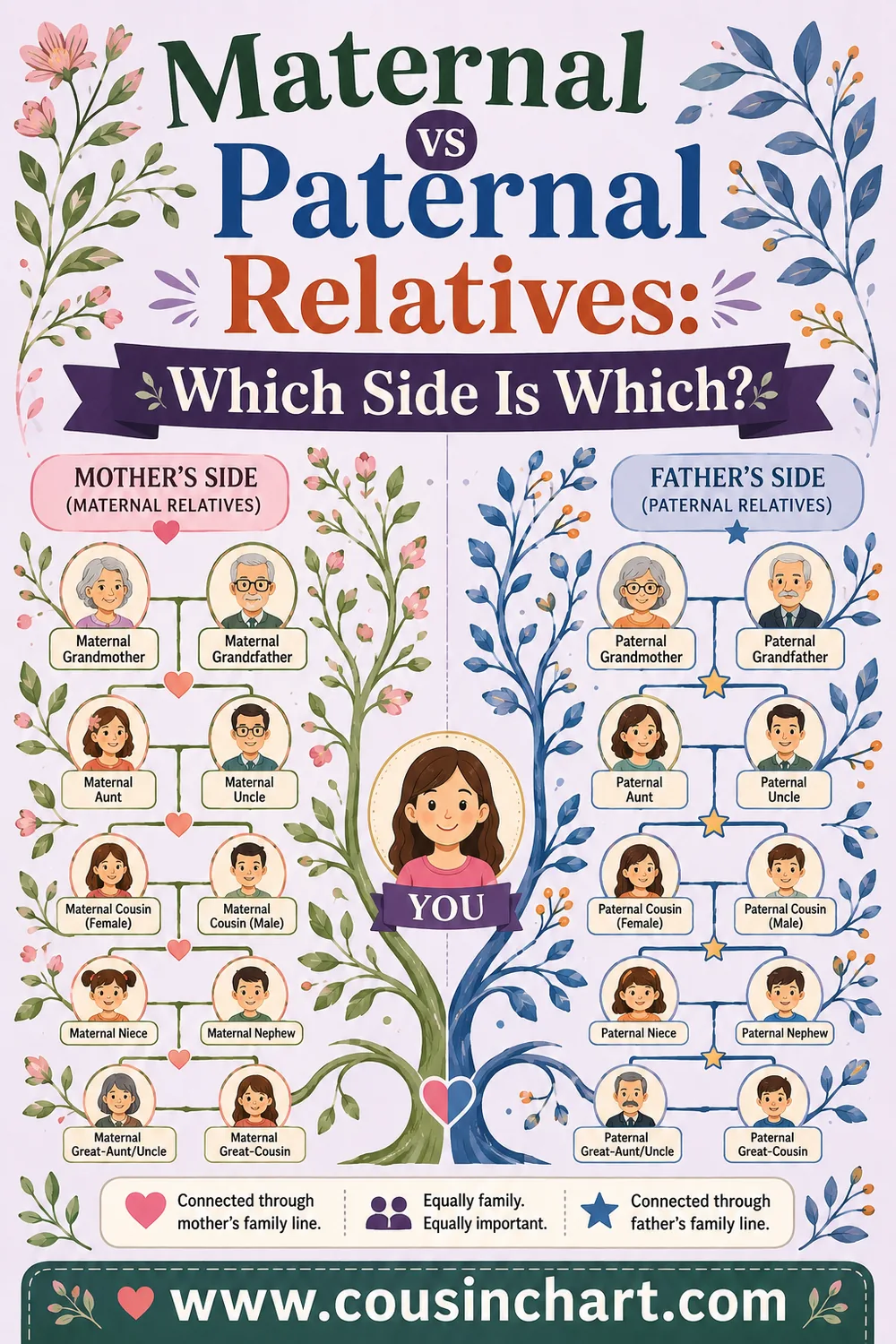
Here's a question people search for a lot: is "nana" for the mother's side or the father's side? In English, it's neither. Nana, Grandma and Granny can be used for any grandmother, and families just pick. The confusion comes from other languages where the word really does tell you the side.
The best-known example is Hindi and Urdu, where the names for the two sets of grandparents are completely different words:
| Language | Mother's mother | Mother's father | Father's mother | Father's father |
|---|---|---|---|---|
| Hindi | नानी (nani) | नाना (nana) | दादी (dadi) | दादा (dada) |
| Swedish | mormor | morfar | farmor | farfar |
| Mandarin Chinese | 外婆 (wàipó) or 姥姥 (lǎolao) | 外公 (wàigōng) or 姥爷 (lǎoye) | 奶奶 (nǎinai) | 爷爷 (yéye) |
| Vietnamese | bà ngoại | ông ngoại | bà nội | ông nội |
| Turkish | anneanne | dede | babaanne | dede |
| Korean | 외할머니 (oehalmeoni) | 외할아버지 (oeharabeoji) | 할머니 (halmeoni) | 할아버지 (harabeoji) |
So if you've heard "nana" and "nani" used together, here's the answer: in Hindi, both nana (grandfather) and nani (grandmother) are on the mother's side. Dada and dadi are on the father's side. And notice the twist for English speakers: in Hindi, "nana" is a grandfather, while in English "Nana" is usually a grandmother. That trips up a lot of mixed-language families.
Some of these words are easy to decode once you see the pattern:
- Swedish just stacks words: mor (mother) + mor = mother's mother; far (father) + mor = father's mother. Norwegian and Danish work the same way.
- Turkish does the same thing: anne (mother) + anne = anneanne; baba (father) + anne = babaanne. Grandfathers on both sides share the word dede.
- Chinese, Korean and Vietnamese mark the mother's side with an "outer" word: 外 (wài) in Chinese, 외 (oe) in Korean, and ngoại in Vietnamese. The father's side is treated as the "inner" line, which reflects older customs about which family a married woman joined.
Want the bigger picture on sides of the family? Our explainer on maternal vs. paternal relatives covers how to tell them apart and why it matters in genealogy and DNA.
Borrowing the idea in English
Even if your family only speaks English, you can borrow the logic. Some families give each side a different "flavor" of name: Grandma and Grandpa for one side, Nana and Pop for the other. Others use a language word for one side (Oma and Opa for the German-speaking grandparents) and English for the other. It solves the "which Grandma?" problem before it starts.
Names for a Second (or Third) Set of Grandparents
Many kids have four grandparents, and lots of kids have more: step-grandparents, bonus grandparents, a grandparent's longtime partner. When two grandmothers both want to be "Grandma," you need a plan. Here are the approaches that work.
- Add a first name. "Grandma Ruth" and "Grandma Maria." Simple, clear and nobody has to give up the title.
- Add a place. "Beach Grandma" and "City Grandma," or "Grandma Texas." Kids love this, and it's surprisingly durable.
- Use different titles. One Nana, one Grandma; one Papa, one Pop. This is the most common fix.
- Use a family language for one side. Abuela and Grandma, Nonno and Grandpa, Lola and Nana.
- Use a pet name. Gigi, Mimi, Bop, Poppy. These feel personal and avoid any sense of ranking.
- Use "bonus." Some blended families prefer "Bonus Grandma" over "Step-Grandma," in the same spirit as a bonus mom.
A tip from families who've done it: decide as a group, not one grandparent at a time. If the first grandmother to ask grabs "Nana," the second may feel pushed into something she didn't want. A short conversation with everyone (or the parents deciding and sharing the plan) avoids hurt feelings.
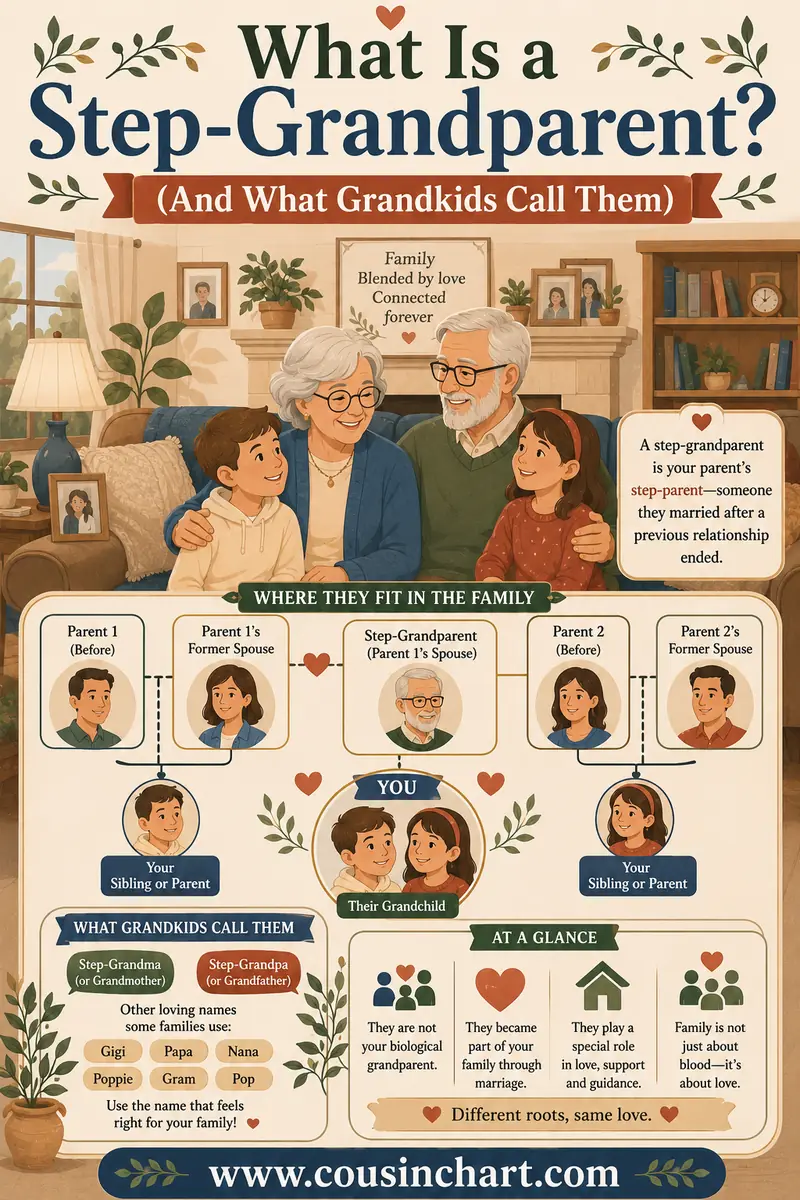
Step-grandparents bring their own questions about titles and family ties. Our page on what a step-grandparent is covers how they fit on the tree and what grandkids commonly call them.
Same-sex grandparent couples
When two grandmothers or two grandfathers are a couple, the same tricks apply. Many choose matching pairs that still sound different: Nana and Gigi, Grandma and Mimi, Papa and Pop, Grandpa and Poppy. Others use first names with a title for each. There's no special rule; just aim for two names a toddler can tell apart by sound.
Great-Grandparent Names
Great-grandparents are more common than they used to be, as people live longer. Our great-grandparents chart shows how far up the ladder goes, but in daily life most great-grandparents need a name that's short enough to say and distinct from Grandma and Grandpa.
| Name | For | How it's built |
|---|---|---|
| Great-Grandma / Great-Grandpa | Either | The formal title, often shortened to "Great-Gran." |
| GG / Gigi | Great-grandmother (sometimes either) | The two G's of "Great-Grandma." |
| Grandma Great / Grandpa Great | Either | A cheerful reversal of the title. |
| Great-Nana / Great-Papa | Either | Adds "Great" to the grandparent's own nickname. |
| Big Nana / Big Pop | Either | "Big" for the senior generation. |
| Nana + first name | Either | "Nana Jean" when the grandchildren's Nana is someone else. |
| bisabuela / bisabuelo | Spanish | The prefix bis- marks one more generation. |
| bisnonna / bisnonno | Italian | Same bis- prefix. |
| arrière-grand-mère / arrière-grand-père | French | Arrière means "back" or "behind." |
| Uroma / Uropa | German | The prefix Ur- means "original" or "ancient." |
| prababcia / pradziadek | Polish | The prefix pra- marks the older generation. |
| lola sa tuhod / lolo sa tuhod | Filipino | Literally "grandparent at the knee." |
Here's a pattern that shows up in many families: when a grandmother becomes a great-grandmother, she often keeps her own name and the new generation simply adds "Great" or "Big" to it. Grandma becomes "Great-Grandma" to the little ones while staying "Grandma" to her grandchildren. That keeps continuity without anyone losing a beloved title.
How Toddlers Invent Grandparent Names
A huge share of beloved grandparent names were never chosen at all. A baby tried to say "Grandma" and it came out "Gaga" or "Mimi," and the name stuck. Knowing how that happens can help you pick a name that will actually survive the toddler years.
Babies start with sounds they can make with their lips and the front of the mouth. That's why you hear so many names built from these sounds:
- M and N: Mimi, Mama, Nana, Nonie, Memaw
- P and B: Papa, Pop, Bop, Bumpa, Poppy, Bubbe
- D and T: Dada, Tata, Didi
- Doubled syllables: Gaga, Gigi, Pop-Pop, Lolo, Nana, Mimi
"Gr" clusters and the "nd" in Grandma and Grandpa are much harder for a one-year-old, which is why those names often get squished into Gamma, Gampy, Bumpa or Gaga at first. Sound-repeating names like Nana, Papa, Lola and Lolo have a built-in advantage: they're already in baby-talk shape. That may be part of why such names show up in so many unrelated languages.
Should you let the toddler name stick?
It's up to the family. Some grandparents love their baby-made name and keep it for life; plenty of adults still call a grandparent "Gaga" at 40. Others gently keep using the chosen name until the child can say it. If you have a strong preference, the trick is consistency: everyone in the house uses the same name every time, and the toddler catches up.
How to Choose Grandparent Names: A Step-by-Step Method
If you're a new grandparent (or a parent helping several grandparents decide), walk through these steps. It takes about ten minutes.
- List what the family already uses. Write down what each living grandparent and great-grandparent is called now. You don't want to duplicate a living Nana unless you add a first name.
- Check for family languages. Is there a language one side spoke at home: Spanish, Tagalog, Italian, Yiddish, Korean? A word from it can honor that heritage.
- Look at names from your own childhood. Many people want the name they called their own grandparent. Others want to leave it with that person. Both are fair.
- Say it out loud a few times. Imagine a toddler yelling it from across a playground, and a teenager mumbling it on the phone. Does it work at both ages?
- Test for tell-apart. If kids will have a Nana and a Gigi, those are easy to tell apart. A Nana and a Nanna are not.
- Talk to the other grandparents. A two-minute chat now saves a lot of awkwardness later.
- Share it with the parents. They'll be the ones teaching it, so make sure they're on board.
- Use it from day one. Cards, texts, baby books and "Nana's here!" at the door all teach the name.
Five questions to ask before you decide
If you're stuck between two or three favorites, these questions usually break the tie:
- Will it still feel right in 20 years? "Glamma" is fun at 55. Picture a 25-year-old grandchild giving a toast at your 80th birthday and saying it.
- Does it fit how you'll actually be involved? A grandparent who does weekly school pickups may want something quick to shout. One who lives overseas may want a name that's easy to say on video calls.
- Does it carry something you care about? A family language, a hometown, a grandparent of your own. Names with a story behind them tend to stick.
- Is it easy to spell? Kids will write it on birthday cards for years. "Nana" is easy; "Nanna" vs. "Nana" vs. "Nanah" can cause gentle confusion.
- Would you mind if it changed? If you'd be heartbroken by a toddler's version, pick something already toddler-friendly, like a doubled-sound name.
There's no wrong answer. A name that makes you smile when you hear it is doing its job.
Try it yourself: an illustrative example
Here's a made-up family to show how this works. (The people below are illustrative, not real.)
Baby Theo has four grandparents and one great-grandmother:
- Mom's parents, Carmen and Luis, grew up speaking Spanish.
- Dad's parents, Linda and Mark, speak only English. Linda's own grandkids from her first marriage already call her "Grandma."
- Great-grandmother Rose is Mark's mother. Everyone already calls her "Nana."
Working through the steps:
- "Grandma" (Linda) and "Nana" (Rose) are taken.
- Spanish is a family language, so Carmen and Luis choose Abuela and Abuelo.
- Linda keeps Grandma, which her other grandkids already use.
- Mark picks Papa, which is easy for a baby to say.
- Great-grandmother Rose becomes Great-Nana to Theo, while staying Nana to her grandchildren.
Five grandparent names, no duplicates, and each one is easy to tell apart by sound. If Theo ends up calling Abuela "Wela" (a very common toddler version), that's fine too.
Matching Pairs: Grandparent Names That Go Together
Grandparent couples often like names that sound like a set. It helps kids learn that the two people belong together, and it just feels nice at the front door. Here are pairings that families use, grouped by style.
| Style | Pairs | Why they work |
|---|---|---|
| Traditional | Grandma and Grandpa; Grandmother and Grandfather; Granny and Grandad | Instantly understood by teachers, doctors and other families. |
| Short and sweet | Nana and Papa; Gran and Gramps; Nan and Pop | Easy for toddlers, still fine for teenagers. |
| Doubled sounds | Mimi and Pop-Pop; Gigi and Bop-Bop; Nana and Poppy | Built from the sounds babies say first. |
| Regional | Mamaw and Papaw; Memaw and Peepaw; Grandmom and Grandpop | Carries a family's roots in a particular part of the country. |
| Heritage | Abuela and Abuelo; Nonna and Nonno; Oma and Opa; Lola and Lolo; Bubbe and Zayde; Yiayia and Pappous; Savta and Saba | Keeps a family language in daily use. |
| Mixed | Nana and Opa; Gigi and Grandpa; Abuela and Pop | Lets each grandparent pick independently. |
| Playful | Glamma and Grandpa Cool; Honey and Pops; Birdie and Captain | Fun for grandparents who don't feel like a "Granny" yet. |
Matching isn't required, though. Plenty of couples pick names that reflect their own personalities or backgrounds, and kids don't mind at all. A grandmother who's always been Nana in her family and a grandfather who wants to be Opa after his German grandparents can each keep what's meaningful to them.
Changing a Grandparent Name Later (and Honoring One Who Has Died)
Sometimes a name doesn't fit after all. A grandfather picked "Grandfather" and realizes it feels stiff. A grandmother who wanted "Gigi" finds the toddler insists on "Nana." Can you change it?
Yes, and earlier is easier. Very young children usually adjust quickly as long as the adults around them all switch at once. With older kids, it helps to explain: "Grandpa decided he'd like to be called Pop now. Isn't that fun?" Then everyone uses the new name consistently for a few weeks. Older children may keep the old name, and that's okay too; younger siblings and cousins will pick up whichever name they hear most.
When a grandparent name is tied to someone who has died
Many people feel a name belongs to the grandparent who wore it. If your own beloved Nana has died, you might choose a different name so hers stays special, or you might take her name on purpose as a tribute. Both choices are loving. It can help to talk with your siblings and parents first, since they may have strong feelings about seeing the name reused.
Some families also make up a "memory name" for a grandparent who died before the grandkids could meet them. Speaking of "Grandpa Joe" or "Abuelo Luis" in stories and photo albums gives children a way to know that grandparent, even if they never met.
Grandparents who live far away
For grandparents the kids mostly see on video calls, a clear name matters even more. Kids learn faces and names together, so saying "Here's Nana Rose!" at the start of every call helps them link the two. A photo on the fridge labeled with the grandparent name does the same job between calls.
Common Mix-Ups With Grandparent Names
A few misunderstandings come up again and again.
- "Nana is always the mom's mom." Not in English. Nana can be either side. In Hindi, though, nana is the mother's father, which is where the idea comes from.
- "Lola means grandma in Spanish." Lola is Filipino (Tagalog) for grandmother. In Spanish, Lola is a nickname for the first name Dolores. The Spanish word is abuela.
- "Nanny and Nana are the same." Some families do use Nanny for a grandmother, but in modern US usage "nanny" usually means a paid childcare worker. Dictionary.com notes that "nana" itself has also been used for a nursemaid in the Southeast and a godmother in the Gulf States, so regional meanings vary.
- "Opa and Oma are Dutch only." They're used in both German and Dutch, and in Afrikaans you'll see the related ouma and oupa.
- "Babushka means a headscarf." In English, "babushka" has picked up a second meaning: a scarf tied under the chin. In Russian, бабушка means grandmother.
- "Gigi is only for great-grandmothers." Some families use it for great-grandmothers (G for Great, G for Grandma), but plenty use it for a regular grandmother. Both are fine.
- "A step-grandparent can't use a grandparent name." There's no rule against it. Many step-grandparents are simply Grandma or Papa, especially when they've been around since the grandkids were born.
Writing Grandparent Names on a Family Tree
Nicknames are a gift to future family historians, as long as they're recorded clearly. A great-great-grandchild may find a letter signed "Love, Mimi" and have no idea who Mimi was. A few habits help:
- Record the legal name first. Write the full birth name in the main box: "Rosa Elena Garcia."
- Add the grandparent name in quotation marks. "Rosa Elena 'Abuelita' Garcia" or a note line: Called "Abuelita" by grandchildren.
- Note who used it. If one set of grandkids said "Nana" and another said "Grandma Rose," write both. It explains old letters and photo captions.
- Keep the original language. "Lola" carries information that "grandmother" doesn't. It tells future readers the family spoke Tagalog.
- Date it if it changed. "Called 'Gaga' until about age 5, then 'Grandma'" is a sweet detail that's easy to lose.
If you're filling in the generations above you, our guide to family generations shows how each generation is counted and named, so the nicknames land on the right person.
Choosing Grandparent Names: Pulling It Together
Grandparent names don't have to follow any rule beyond this one: the kids should be able to say it, and the family should be able to tell everyone apart. Traditional names like Grandma, Nana, Papa and Pop are popular because they work. Language names like Abuela, Nonna, Lola, Oma, Savta and Halmeoni carry heritage forward. And toddler-made names like Gigi, Bop and Gaga often end up being the most loved of all.
Once you know what everyone's called, the next puzzle is often how everyone connects. Our great-grandparents chart maps the generations above you, and the guide to what to call every relative covers the official terms. When you need to name an exact relationship, like how your grandmother's cousin's grandson is related to you, try our free family relationship calculator: you pick how two people connect, and it names the relationship.
Frequently Asked Questions
What are the most popular grandparent names?
In the US, the most common grandmother names are Grandma, Nana, Granny, Grammy, Mimi and Gigi. For grandfathers, Grandpa, Papa, Pop, Pop-Pop, Gramps and Granddad lead the list. An AARP survey found that most grandparents still answer to grandma and grandpa, and only about one in 20 prefers to be called by a first name. Regional names like Mamaw and Papaw and heritage names like Abuela, Nonna, Lola and Oma are also very common in families with those roots.
Is Nana for the mother's side or the father's side?
In English, Nana isn't tied to either side. Any grandmother can be Nana, and families simply choose. The idea that it belongs to one side comes from Hindi and Urdu, where nana means the mother's father and nani means the mother's mother, while dada and dadi are the father's parents. So in Hindi, nana is a grandfather on the mother's side, while in English Nana is usually a grandmother on whichever side picks it first.
What do you call a second grandma so kids can tell them apart?
The easiest fixes are adding a first name, such as Grandma Ruth and Grandma Maria, or using two different titles, like Grandma for one and Nana or Mimi for the other. Some families add a place, such as Beach Grandma, or use a family language for one side, like Abuela or Oma. The key is choosing names that sound different to a toddler. Nana and Nanna are too close; Nana and Gigi are easy to tell apart.
What are some unique grandma names?
If you want something less common, families use names like Gigi, Mimi, Lolly, Birdie, Bunny, Honey, Glamma, Nonie, Bee and Lovey. Words from other languages also feel fresh in English-speaking homes: Oma (German and Dutch), Nonna (Italian), Yiayia (Greek), Savta (Hebrew), Babcia (Polish), Lola (Filipino), Bibi (Swahili) and Tutu (Hawaiian). Many of the most loved unique names were never chosen at all: a toddler mispronounced Grandma, and the new name stuck for life.
What are good grandpa names besides Grandpa?
Popular alternatives include Papa, Pop, Pops, Pop-Pop, Poppy, Gramps, Granddad, Grandpop, Pappy and Papaw. Toddler-made names like Bop, Bumpa and Gampy are common and charming. Heritage options include Abuelo (Spanish), Nonno (Italian), Opa (German and Dutch), Zayde (Yiddish), Saba (Hebrew), Lolo (Filipino), Babu (Swahili) and Pappous (Greek). Some grandfathers pick a title tied to a hobby or career, such as Captain, Chief, Coach or Doc.
What do you call a great-grandmother?
Great-Grandma is the standard title, and many families shorten it to Great-Gran, GG or Gigi. Others add Great or Big to an existing nickname, so a Nana becomes Great-Nana or Big Nana to the newest generation. In other languages, great-grandparents usually get a prefix: bisabuela in Spanish, bisnonna in Italian, Uroma in German, prababcia in Polish and arriere-grand-mere in French. In Filipino families you may hear lola sa tuhod, meaning grandparent at the knee.
Who decides what grandkids call their grandparents?
There's no rule. Usually the grandparent suggests a name, the parents agree to teach it, and the grandchild has the final say by what they can actually pronounce. Talking it over before the baby arrives helps, especially when several grandparents might want the same name. After that, consistency matters most. If everyone in the house uses the chosen name every time, toddlers learn it quickly. If the child invents a different name, many families happily let that one stick.
When is National Grandparents Day?
In the United States, National Grandparents Day falls on the first Sunday in September after Labor Day. Federal law, at 36 U.S. Code section 125, asks the President to issue a proclamation each year designating that Sunday and inviting people and organizations to observe it. Many families use the day as a deadline for settling grandparent names, making cards with those names, or recording the stories behind them in a family tree or baby book.
Can a step-grandparent use a grandparent name like Grandma or Papa?
Yes. Nothing stops a step-grandparent from being called Grandma, Papa or any other grandparent name. It's especially common when the step-grandparent has been part of the family since before the grandchildren were born. Some families prefer a distinct name, such as Gigi, Mimi or a first name, to avoid two Grandmas at the same table. Others like Bonus Grandma or Bonus Grandpa. The family decides together, and kids adapt to whatever name everyone uses consistently.
Sources
We checked every source below while writing this guide. Last reviewed October 30, 2026, by Joan Ramos.
- The Prevalence of Grandparenthood in the U.S. (National Center for Family & Marriage Research, Bowling Green State University)
- 2018 Grandparents Today National Survey (AARP Research)
- 36 U.S. Code § 125 - National Grandparents Day (Legal Information Institute, Cornell Law School)
- Nana (definition and origin) (Dictionary.com)
- kuia (Te Aka Maori Dictionary)
- koroua (Te Aka Maori Dictionary)
- mamó (Foclóir Gaeilge-Béarla) (Foras na Gaeilge (teanglann.ie))