How to Read FamilySearch and MyHeritage Labels Like '4th Cousin 2x Removed'
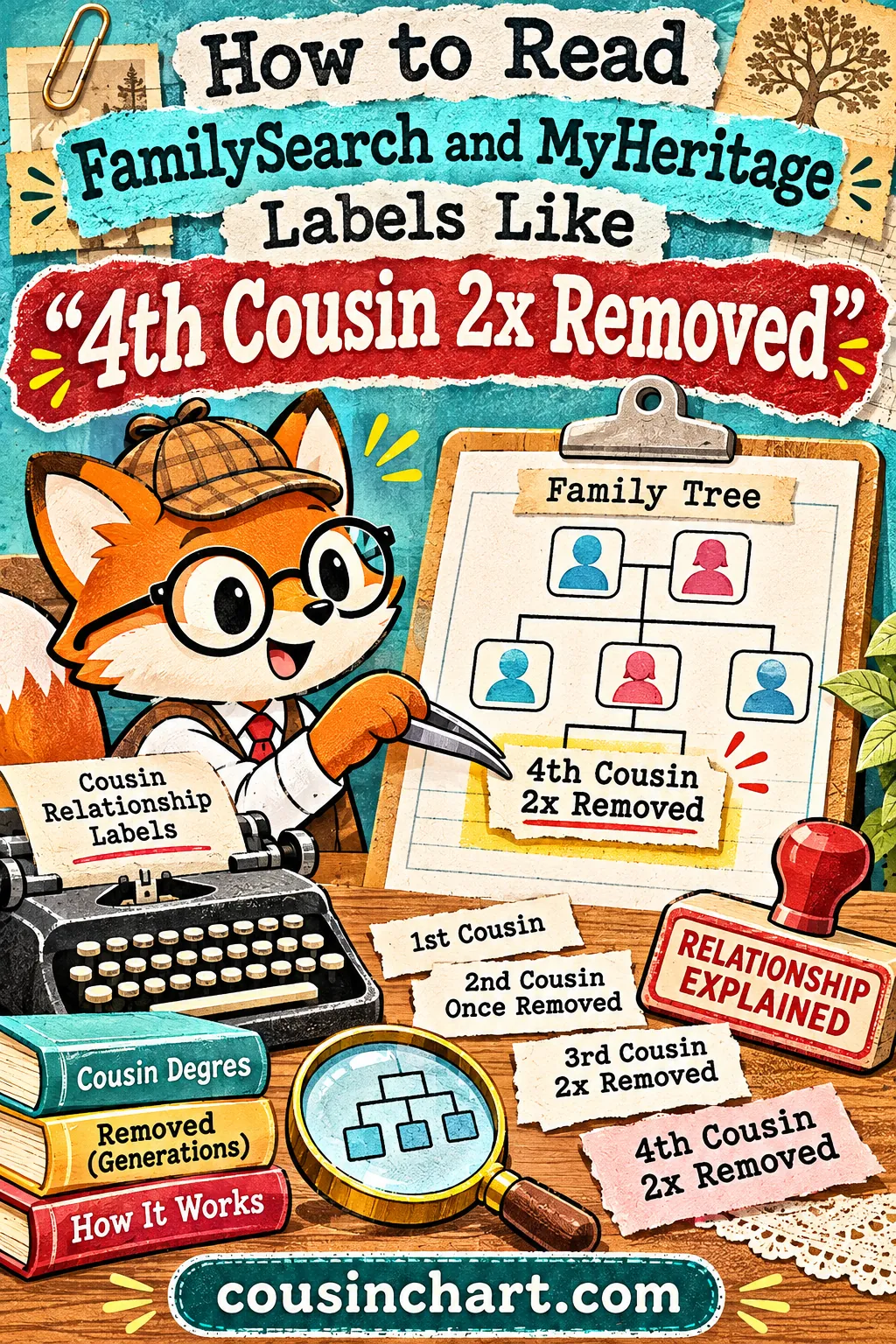
A "4th cousin 2x removed" is someone who shares a set of ancestors with you, where one of you is 5 generations down from that couple and the other is 7 generations down. The "4th cousin" part comes from the person closer to the shared ancestors, and "2x removed" means there's a gap of two generations between you. To turn any label into plain English, enter the generations in the free Cousin Chart relationship calculator and it names the relationship with a chart.
Family history sites love compact labels. FamilySearch, MyHeritage and other tree sites show lines like "4th cousin 2x removed," "fourth cousin twice removed" or just "4C2R." They all mean the same thing. This guide shows you how to read them, how to find the shared ancestor behind the label, and how to tell which one of you is in the older generation. It also covers the labels that aren't cousins at all, like "2nd great-uncle," plus the counting mistakes that lead people astray.
▶ Work it out in the free calculator
What the Two Parts of the Label Mean
Every cousin label has up to two parts.
The cousin number (1st, 2nd, 3rd, 4th…) tells you how far back the shared ancestors are. You find it from the person who's closer to them.
- First cousins share grandparents.
- Second cousins share great-grandparents.
- Third cousins share 2nd great-grandparents.
- Fourth cousins share 3rd great-grandparents.
The removed part tells you how many generations apart you and the other person are. "1x removed" (once removed) means one generation apart. "2x removed" (twice removed) means two. No "removed" at all means you're in the same generation.
So "4th cousin 2x removed" reads like this: the closer person is a fourth cousin's distance from the shared couple, and the other person sits two generations further away. For a fuller explanation of the second part, see the guide to what "once removed" means.
The Generation Math Behind the Label
The fastest way to decode any label is to count generations down from the shared ancestors. Here's the rule:
- Count how many generations down each of you is from the shared couple. A child is 1, a grandchild is 2, a great-grandchild is 3, and so on.
- Take the smaller number and subtract 1. That's the cousin number.
- Subtract the smaller number from the larger one. That's how many times removed.
Now work backward for 4th cousin 2x removed:
- Cousin number 4 means the smaller count is 4 + 1 = 5.
- Removed 2 means the larger count is 5 + 2 = 7.
So one of you is 5 generations down from the shared couple, and the other is 7. For the person at 5, the shared couple are their 3rd great-grandparents. For the person at 7, the same couple are their 5th great-grandparents.
That's the whole label in one line: you share a couple who are one person's 3rd great-grandparents and the other person's 5th great-grandparents.
Generation count to ancestor name
You'll use this conversion constantly. Find the number of generations down, and the second column tells you what the shared couple are to that person.
| Generations down from the couple | The couple are that person's… | Cousin number if both are at this level |
|---|---|---|
| 1 | Parents | Siblings, not cousins |
| 2 | Grandparents | 1st cousins |
| 3 | Great-grandparents | 2nd cousins |
| 4 | 2nd great-grandparents | 3rd cousins |
| 5 | 3rd great-grandparents | 4th cousins |
| 6 | 4th great-grandparents | 5th cousins |
| 7 | 5th great-grandparents | 6th cousins |
| 8 | 6th great-grandparents | 7th cousins |
A handy pattern: from 3 generations onward, the "great" number is always the generation count minus 2. Seven generations down means 5th great-grandparents.
The counting trap
Most wrong answers come from counting the wrong people. Don't count the shared ancestor, and do count yourself. Start at the couple's child as 1 and keep going until you land on your own name. If you're unsure, check one easy case: you to your parents is 1, so you to your grandparents must be 2. If your method gives 3 for grandparents, you're counting an extra person.
Common Labels Decoded
Here's a quick decoding table for labels you're likely to see on a tree site or a DNA match list. The cM figures are rough averages, and farther-out relationships often share little or no DNA.
| Label | Generations down (closer, farther) | Shared ancestors are… | Typical shared cM |
|---|---|---|---|
| 1st cousin | 2, 2 | Grandparents for both | about 866 |
| 1st cousin 1x removed | 2, 3 | Grandparents and great-grandparents | roughly half a 1st cousin |
| 2nd cousin | 3, 3 | Great-grandparents for both | about 229 |
| 2nd cousin 2x removed | 3, 5 | Great-grandparents and 3rd great-grandparents | much lower, often under 100 |
| 3rd cousin | 4, 4 | 2nd great-grandparents for both | about 73 |
| 3rd cousin 1x removed | 4, 5 | 2nd and 3rd great-grandparents | lower than a 3rd cousin |
| 4th cousin | 5, 5 | 3rd great-grandparents for both | about 35 |
| 4th cousin 2x removed | 5, 7 | 3rd and 5th great-grandparents | often little or none |
Ranges vary a lot and overlap from one relationship to the next. Don't treat any one number as proof of a relationship.
Labels That Aren't Cousins: Direct Line, Aunts and Nieces
Tree sites label everyone, not just cousins. When one of you descends from the other, or when one of you is the child of the shared couple, the label changes shape.
Direct-line labels. If the other person is your ancestor, the label is just their place in your line: "3rd great-grandfather" means your grandparent's grandparent's grandparent, five generations up. There's no cousin number because there's no shared couple, you descend straight from them.
Aunt and uncle labels. If the other person is a child of the shared couple (1 generation down) and you're further down, they're an aunt or uncle of some kind:
| Generations down (them, you) | Label you'll see | Plain meaning |
|---|---|---|
| 1, 2 | Aunt or uncle | Your parent's sibling |
| 1, 3 | Great-aunt or great-uncle (also grand-aunt) | Your grandparent's sibling |
| 1, 4 | 2nd great-aunt or great-grand-uncle | Your great-grandparent's sibling |
| 1, 5 | 3rd great-aunt | Your 2nd great-grandparent's sibling |
Niece and nephew labels. Flip the table above and you get nephew, grandnephew, great-grandnephew and so on. If you're the one at 1 generation down, the other person is your niece or nephew of some degree.
The tricky one is the second row, where sites disagree between "great-aunt" and "grand-aunt." They're the same person. The guide to grand-aunt vs. great-aunt explains why both names exist.
Which One of You Is the Older Generation?
Here's what trips most people up. The label doesn't say which person is closer to the shared couple. "4th cousin 2x removed" could mean either of two very different things.
Case 1: You're the closer one (5 generations down). The other person is two generations below you. They're your fourth cousin's grandchild. They're probably much younger than you.
Case 2: You're the farther one (7 generations down). The other person is two generations above you. They're your grandparent's fourth cousin. They're probably much older, or they lived in an earlier era.
Here's the same idea for a few labels, seen from both directions:
| Label | If you're the closer one, they're… | If you're the farther one, they're… |
|---|---|---|
| 1st cousin 1x removed | Your first cousin's child | Your parent's first cousin |
| 2nd cousin 1x removed | Your second cousin's child | Your parent's second cousin |
| 3rd cousin 2x removed | Your third cousin's grandchild | Your grandparent's third cousin |
| 4th cousin 2x removed | Your fourth cousin's grandchild | Your grandparent's fourth cousin |
Tree sites usually show the path, so you can see the chain of people between you. Follow it up from yourself to the shared couple and count. If you count 5, you're Case 1. If you count 7, you're Case 2.
On a DNA match list, there's no path to look at. A label there is just an estimate from shared DNA, so the age of the match and their tree become your best clues.
Using birth years to pick the direction
When there's no path, ages help. Generations usually run somewhere around 25 to 35 years. A two-generation gap often shows up as a 50- to 70-year age difference, though big families and late marriages blur that.
- If the match is about your age, a "removed" label is less likely to be right, and a same-generation cousin may fit better.
- If the match is decades older, they're probably in the older generation.
- If the match is decades younger, they're probably in the younger one.
Worked Examples: Reading Real Labels
Let's put the rule to work on a tree path, a DNA match and a label you have to decode in reverse, then a few trickier cases.
A FamilySearch relationship path
Say you open a person's page on FamilySearch and see that Thomas Kelly, born 1801, is labeled as your relative through a path. You also notice a living cousin, Grace, with the label "4th cousin 2x removed."
Follow the path:
- Thomas Kelly and his wife Mary are the shared couple.
- From Thomas down to you: son, grandson, great-granddaughter, 2nd great-grandson, 3rd great-granddaughter, 4th great-grandson, and then you. That's 7 generations.
- From Thomas down to Grace: daughter, granddaughter, great-grandson, 2nd great-granddaughter, and then Grace. That's 5 generations.
Now apply the rule. The smaller count is 5, so 5 − 1 = 4: fourth cousin. The gap is 7 − 5 = 2: twice removed. Grace is your fourth cousin twice removed, and she's two generations above you. She's your grandparent's fourth cousin.
If Grace was born in the 1940s and you were born in the 1990s, the ages fit, too.
The FamilySearch guide has more tips on finding and checking relationship paths in its shared tree.
A MyHeritage DNA match
Now say MyHeritage lists a DNA match, Lars, with an estimated relationship of "3rd cousin 1x removed" and 41 cM shared.
Here's how to read it:
- 3rd cousin 1x removed means one of you is 4 generations down from the shared couple and the other is 5.
- 41 cM is a modest amount. Several relationships fit that number, including third cousins, third cousins once removed, fourth cousins and some half relationships.
- The label is an estimate. The site picked a likely relationship based on the cM. It doesn't know your tree.
So treat "3rd cousin 1x removed" as a starting point. Look at Lars's tree for surnames and places that match yours. If you find the shared couple, count the generations yourself and see whether the label holds up.
The guide to distant cousins explains why matches this far out can be hard to pin down.
Working backward from "2nd cousin 3x removed"
Sometimes you see a label and want to know who the shared ancestors must be before you even open the tree. Say a relative on a tree site is listed as your "2nd cousin 3x removed," and you know she was born in 1870.
Work it backward:
- Cousin number 2 means the closer person is 2 + 1 = 3 generations down from the shared couple.
- 3x removed means the farther person is 3 + 3 = 6 generations down.
A woman born in 1870 is almost certainly the closer one. So the shared couple are her great-grandparents and your 4th great-grandparents. That tells you exactly which generation of your tree to look at: your 4th great-grandparents, probably born in the mid-to-late 1700s.
From her side, you're her second cousin's great-grandchild. From your side, she's your great-grandparent's second cousin. Either way, the label now points you to a specific couple instead of a vague "distant cousin."
A half label: "Half 2nd cousin 1x removed"
Say a tree site lists Ruth as your "half 2nd cousin 1x removed." Strip off "half" first and decode the rest: 2nd cousin means the closer person is 3 generations down, and 1x removed means the other is 4 down.
Now add "half" back. It means you share only one ancestor at the top, not a couple. Usually that's a man who had children with two different wives, or a woman with children by two husbands. Ruth descends from one of those families, and you descend from the other.
In practice, look at the top of the path. If it shows one person rather than a couple, that's your half connection. Expect roughly half the DNA a full relationship of the same type would share.
Two labels for one person
Sometimes FamilySearch or another site shows you're related to someone two different ways, such as "3rd cousin" through one line and "4th cousin 1x removed" through another. That isn't an error. It means your families crossed more than once, which was common in small towns where a few families married into each other for generations.
Decode each label separately. Then remember that the DNA you share is the total from both lines, so it may look closer than either label alone. When you check the numbers, expect the real figure to run higher than the table for either label.
A long-dead relative: "1st cousin 4x removed"
Say you find a Civil War soldier, Samuel, born in 1840, labeled as your "1st cousin 4x removed." That sounds close, since "1st cousin" usually means someone at the family picnic. The "4x removed" changes everything.
Decode it:
- 1st cousin means the closer person is 1 + 1 = 2 generations down from the shared couple.
- 4x removed means the farther person is 2 + 4 = 6 generations down.
Samuel, born in 1840, is clearly the closer one. The shared couple are his grandparents and your 4th great-grandparents. So Samuel is a first cousin of your 3rd great-grandparent. They probably grew up in the same county and may have known each other well.
This kind of label is worth a second look. A soldier's pension file, letters or a county history about Samuel may mention your direct ancestor too, because first cousins often lived nearby and turned up in each other's records as witnesses or neighbors.
A label by marriage: "Husband of 2nd cousin"
A label that includes "husband of," "wife of" or "spouse of" isn't a blood relationship. Decode the cousin part as usual, then add the marriage. Here, his wife is your second cousin, and he's related to you only through her. You won't share DNA with him unless you're related another way.
Other Label Variations You'll See
Sites and people write the same relationships in different ways. Here's how to read the most common variations.
- "2x removed" vs. "twice removed." Same thing. "3x removed" means three times removed.
- "4C2R." A short form: 4th cousin, 2 times removed. You'll also see "1C1R" for first cousin once removed. The page on the abbreviation for cousin lists more.
- "Half 2nd cousin." You share only one ancestor, not a couple. Usually it means two of your ancestors were half siblings.
- "Great-grand-uncle" vs. "2nd great-uncle." Sites differ here. Both usually mean the brother of your great-grandparent.
- "Grand-aunt" vs. "great-aunt." These mean the same relationship, the sister of a grandparent.
- "Wife of your 3rd cousin." A relationship by marriage. There's no shared ancestor between you and that person.
When two sites give different labels for the same person, they're often using different wording, or one of the trees has an error. Count the generations yourself to see which is right.
Quick translation chart
| You see | Same as | Generations down (closer, farther) |
|---|---|---|
| 1C1R | First cousin once removed | 2, 3 |
| 2C | Second cousin | 3, 3 |
| 2C2R | Second cousin twice removed | 3, 5 |
| 3C1R | Third cousin once removed | 4, 5 |
| 4C2R | Fourth cousin twice removed | 5, 7 |
| 5C3R | Fifth cousin three times removed | 6, 9 |
| Half 1C | Half first cousin | 2, 2 (one shared grandparent) |
Labels in "Relatives Around Me" and relationship finders
Some apps and tools show relationship labels for people around you, such as at a family reunion or a genealogy event. FamilySearch's Relatives Around Me feature is one well-known example, and many tree sites have a relationship finder that traces how two people connect.
These labels follow the same rules as everything above. They're built from the shared tree, so they're only as accurate as the links in it. If a label surprises you, open the path, find the shared couple and count the generations. A label like "6th cousin 1x removed" at a reunion is a fun conversation starter, and now you'll know exactly what it means.
How to Check It With the Calculator
The relationship calculator is the quickest way to double-check a label or decode one you haven't seen before. Here's how to check "4th cousin 2x removed":
- Find the shared ancestor. On the tree site, follow the path to the couple you both descend from.
- Set your generations. Use the − and + buttons to set how many generations down from that couple you are. In the FamilySearch example above, that's 7.
- Set theirs. Set how many generations down the other person is. In the example, that's 5.
- Pick the options. Leave it on blood relation. Tick the half relationship option if you share only one ancestor.
- Read the result. It should show "fourth cousin twice removed" with a chart of the path.
You can download the chart or print it to keep with your research notes. Quick-picks like "My second cousin" and "My cousin's grandchild" cover common cases in one tap.
Settings for the other examples
| Label to check | Your generations | Their generations | Half option | Result to expect |
|---|---|---|---|---|
| 2nd cousin 3x removed (1870 relative) | 6 | 3 | Off | Second cousin three times removed |
| 3rd cousin 1x removed (Lars) | 4 or 5 | 5 or 4 | Off | Third cousin once removed |
| Half 2nd cousin 1x removed (Ruth) | 3 or 4 | 4 or 3 | On | Half second cousin once removed |
| 2nd great-uncle | 4 | 1 | Off | Your great-grandparent's brother (great-great-uncle) |
| 1st cousin 4x removed (Samuel) | 6 | 2 | Off | First cousin four times removed |
For the "husband of" labels, set the relation type to marriage. The calculator then names the in-law relationship instead of a blood one.
Tips for trusting a label
- Tree labels are only as good as the tree. Shared trees can contain errors. Check a few key links with records before you rely on a distant label.
- DNA labels are estimates. They come from the amount of shared DNA, which varies a lot. Look at several possible relationships, not just the top one.
- Distant cousins may not share DNA. At fourth cousin and beyond, many real cousins share little or no detectable DNA. A missing DNA match doesn't mean the paper tree is wrong.
- Watch for double connections. If you're related through more than one line, a label may only show one of them.
- Check birth years. Generations usually run somewhere around 25 to 35 years. If a label says someone is two generations above you but they were born the same decade as you, look again at the path.
- Note where the label came from. Write down whether it came from a tree path or a DNA estimate. A tree label and a DNA label for the same person can disagree, and knowing the source tells you which to question first.
- Count it yourself. Two minutes with the generation math or the calculator settles most confusion.
Common Mistakes When Reading Labels
| Mistake | Why it happens | The fix |
|---|---|---|
| Thinking "2nd cousin" means a cousin's child | The word "second" sounds like a next generation | A second cousin is in your generation and shares great-grandparents |
| Reading "removed" as a lesser or distant tie | "Removed" sounds like less family | It only means a generation gap |
| Counting the ancestor as generation 1 | Starting at the top of the path | Start at the couple's child as 1 |
| Assuming the other person is older | Most people picture a parent's cousin | Check the path or birth years for direction |
| Treating a DNA label as fact | The site shows one best guess | Run the cM and look at every likely relationship |
| Missing a "half" | Some sites show half only in the path | Check whether one person or a couple sits at the top |
| Adding up two labels | Two paths look like a mistake | Decode each path on its own |
A note on "great" vs. "grand"
Some sites write "great-grandnephew" and others "2nd great-nephew" for the same person. Both count up the same way. When in doubt, ignore the wording and count generations from the shared couple. The numbers never lie, even when the names disagree.
Keeping a Label Log
If you're working through a lot of matches or relatives, a simple log saves you from decoding the same label twice.
For each person, write down:
- Their name and birth year.
- The label the site gave, and whether it came from a tree path or a DNA estimate.
- The shared couple, if you've found them.
- Your generation count and theirs.
- The relationship name from the calculator.
- Shared cM, if they're a DNA match.
A printable cousin chart is a good companion to the log. Pin it next to your desk and you can read most labels at a glance.
Got a Label You Can't Read?
Grab the generation counts from the path and plug them into the free relationship calculator. It turns "4C2R" and every other shorthand into a plain relationship name with a chart you can save.
▶ Work it out in the free calculator
Frequently Asked Questions
What does 4th cousin 2x removed mean?
It means you share a couple who are one person's 3rd great-grandparents and the other person's 5th great-grandparents. One of you is 5 generations down from that couple and the other is 7. The two of you are two generations apart.
Is a 4th cousin 2x removed older or younger than me?
It can be either. If you're the person closer to the shared couple, they're two generations below you. If you're the farther one, they're two generations above you, like a grandparent's fourth cousin.
How much DNA do 4th cousins twice removed share?
Often very little or none. Fourth cousins share about 35 cM on average, and each extra generation lowers the expected amount further. Many fourth cousins twice removed won't show up as DNA matches at all.
Why do FamilySearch and MyHeritage show different labels for the same person?
They may use different wording, or one tree may have different or wrong links. On a DNA list, the label is an estimate from shared cM, not from a tree. Count the generations from the shared ancestors yourself to confirm.
What does "2x" mean in a relationship label?
It's short for "twice." So "2x removed" means twice removed: you and the other person are two generations apart from each other.
What is the difference between "removed" and "half"?
"Removed" means you're in different generations. "Half" means you share only one ancestor instead of a couple. A label can include both, like "half 2nd cousin 1x removed."
Why does FamilySearch say I'm related to someone in two ways?
Your families likely crossed more than once, such as two siblings marrying into the same family. Each path gives its own label, and both can be right. Decode each one on its own using the generation counts.
Is "2nd great-uncle" the same as "great-great-uncle"?
Usually, yes. Both mean the brother of your great-grandparent. Some sites call him a great-grand-uncle instead, which names the same person.
Is "1st cousin 1x removed" the same as a second cousin?
No. A first cousin once removed shares grandparents with one of you and is a generation apart. A second cousin shares great-grandparents and is in your generation. They're easy to mix up, so count the generations to be sure.