How an Estate Divides Down the Branches: Per Stirpes vs Per Capita
Two cousins can be equally close to the person who died, equally beloved, and inherit wildly different amounts. Under a per stirpes division, what you receive depends on how many siblings you have — not on how close you were to the deceased. An only child inheriting their late parent's branch can take double or triple what a cousin from a bigger family takes. Per capita divides the same estate by heads instead of by branches, and the two methods can differ by a factor of two or three on identical facts. The arithmetic below shows exactly how. To be sure which branch you're actually standing in, check the relationship with the cousin calculator.

Which division applies to you? Tap the closest match.
Tap an option above. Branch or head — that single choice can double or halve a cousin’s share.
This is general information, not legal advice. Intestacy formulas and the meaning courts give to these phrases vary by state and country, and a will can define its own terms. For a specific estate, ask a probate attorney in the jurisdiction where it's being administered.
The difference in one sentence, then the catch
Start with the plain version, because the rest is arithmetic.
Per stirpes means "by the branch" — the estate is divided at one generation, and each deceased person's share drops whole to their own descendants. Latin stirps means stock or stem. Each of the deceased's children heads a branch, and each branch gets the same amount regardless of how many people are standing in it.
Per capita means "by the head" — the takers each receive an equal share. Ten takers, ten equal shares, whatever branch they came from.
The catch is that "per capita" gets used for two different formulas. One is pure head-count among everyone entitled. The other, per capita at each generation, divides equally within a generation but still steps down branch by branch. They give different answers, which is why the exact wording of a will matters more than the label.
Neither method is fairer in the abstract. Per stirpes treats your parent's share as your parent's, which feels right to people who think in family lines. Per capita treats every cousin as equally related to the deceased, which feels right to people who think in individuals.
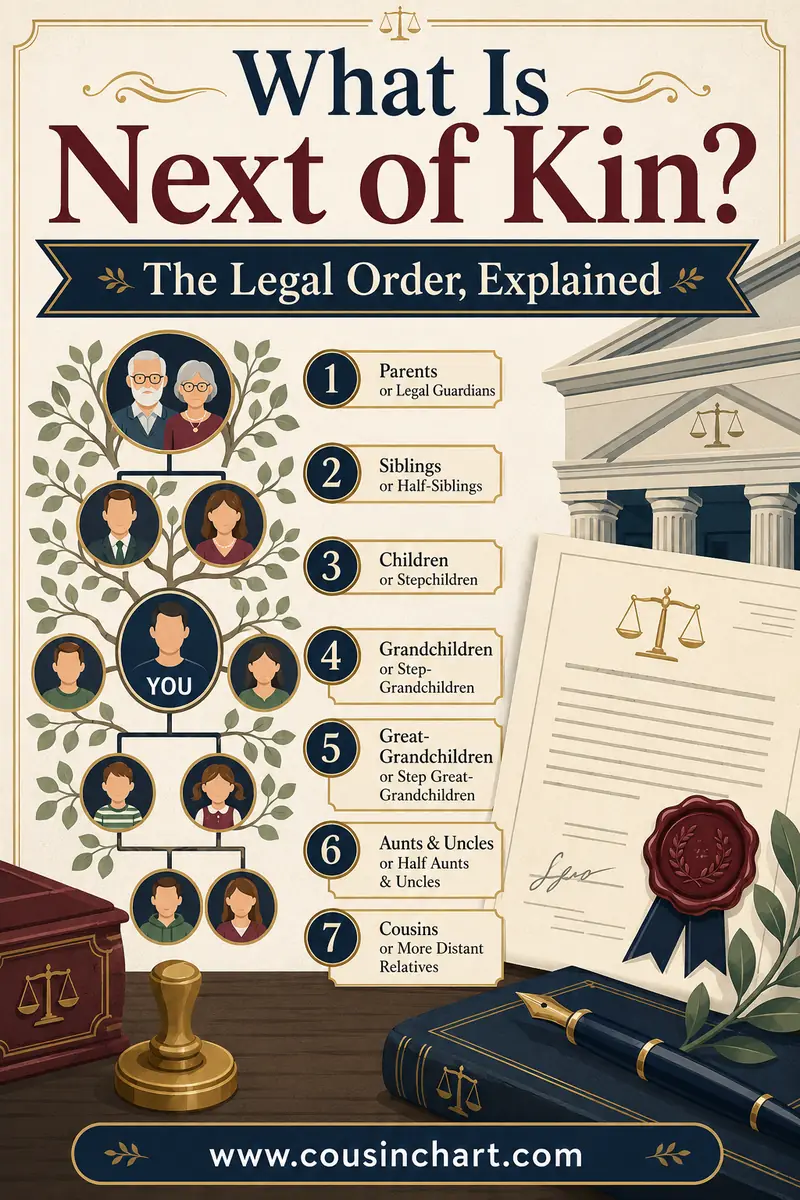
And this is a separate question from who inherits at all. The order of entitlement — spouse, then children, then parents, then siblings and outwards — is set by intestacy law, and next of kin and the legal order covers that ladder. What follows assumes you've already established that a group of descendants is entitled, and asks only how the money splits between them.
A worked example: one estate, three branches
Numbers make this obvious in a way definitions never do. Here is the standard case.
Margaret dies leaving an estate of $600,000 and three children. Ann is alive. Brian died before his mother, leaving two children, Ben and Bella. Clare also died before her mother, leaving one child, Cal.
So four people are entitled to take: Ann, and three grandchildren — Ben, Bella and Cal. Ben, Bella and Cal are first cousins to each other. Now watch what the method does to them.
Strict per stirpes divides at the children's generation, always. Three branches, so three shares of $200,000. Ann takes her $200,000. Brian's $200,000 splits between Ben and Bella at $100,000 each. Clare's $200,000 goes whole to Cal, because he's the only person in that branch.
Per capita at each generation divides at the nearest generation with someone living, then pools what's left. Ann is alive, so the first cut is still at the children's level: three shares of $200,000. Ann takes hers. But the two branch shares belonging to deceased children — $400,000 in total — are combined and divided equally among the three grandchildren entitled to take: $133,333 each.
Pure per capita ignores generations entirely. Four takers, four equal shares of $150,000.
| Who | Strict per stirpes | Per capita at each generation | Pure per capita |
|---|---|---|---|
| Ann (living child) | $200,000 | $200,000 | $150,000 |
| Ben (Brian's child) | $100,000 | $133,333 | $150,000 |
| Bella (Brian's child) | $100,000 | $133,333 | $150,000 |
| Cal (Clare's only child) | $200,000 | $133,333 | $150,000 |
| Total | $600,000 | $600,000 | $600,000 |
Look at Cal against Ben. They are first cousins, both grandchildren of the deceased, both one generation removed. Under strict per stirpes Cal receives exactly twice what Ben receives — for no reason other than that Cal's mother had one child and Ben's father had two.
That's the whole argument in one row of a table. People who feel strongly about per stirpes and people who feel strongly about per capita are usually reacting to precisely that comparison.
Where the gap gets much wider
The three-branch case is mild. Change the shape of the family and the same choice swings much harder.
Take a second estate. Ted dies at 88, unmarried, with no children and no surviving parents. His three siblings all died before him. Rose left one child, Nina. Sam left four children. Tom died childless. The estate is $300,000, and the takers are Ted's nieces and nephews.
Strict per stirpes divides at the sibling generation, and empty branches drop out. Tom left no descendants, so his branch disappears. Two branches remain, at $150,000 each. Nina takes the whole $150,000. Sam's four children take $37,500 each.
Per capita at each generation makes the first cut where the living people are. No siblings survived, so the estate is divided at the niece-and-nephew generation: five takers, $60,000 each.
| Who | Strict per stirpes | Per capita at each generation | Difference |
|---|---|---|---|
| Nina (Rose's only child) | $150,000 | $60,000 | −$90,000 |
| Each of Sam's four children | $37,500 | $60,000 | +$22,500 each |
Nina's share is two and a half times larger under one method than the other. Nothing about her relationship to Ted changed. Only the formula did.
This is the fact pattern that produces family arguments, and it's why the wording in a will is worth ten minutes of care when it's written and a great deal of money afterwards.
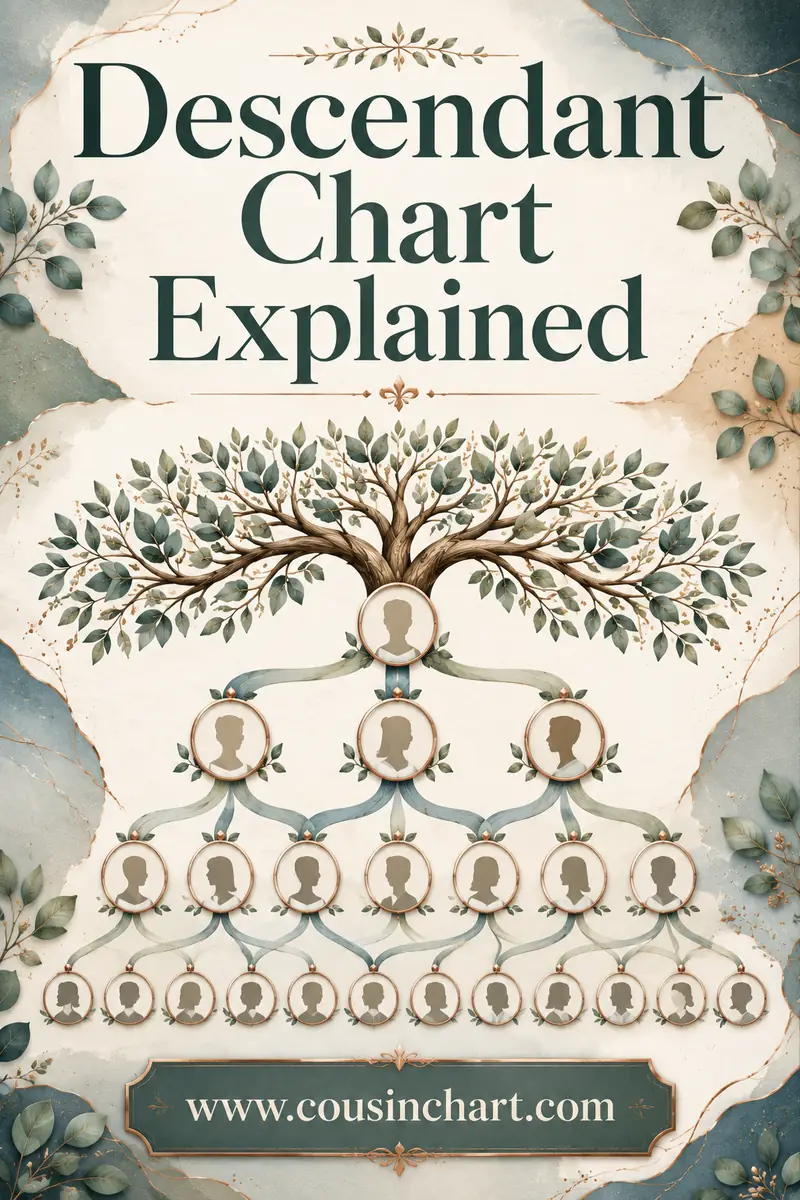
It's also why an accurate chart matters before anyone argues. Sketch the branches on a printable family tree or a descendant chart template, write the shares against each name, and the disagreement often resolves itself.
The two meanings of per capita
This is the detail that catches out even careful people, so it deserves its own section.
Per capita at each generation is the modern default in much of the United States. It pools the shares of everyone who died in a generation and divides them equally among the next generation's takers. Equal treatment within a generation, branch structure preserved between them.
Per capita with representation is a slightly older variant. The first division happens at the first generation with a living member, and each deceased person's share then passes down their own branch. In shallow families it gives the same answer as per capita at each generation; in deep ones it does not.
Pure per capita — "share and share alike" — is a will-drafting choice, not an intestacy default. It means everyone named in the class takes equally regardless of generation, so a grandchild takes as much as a child. It's uncommon precisely because most people don't intend that.
Which is why "per capita" alone is an ambiguous instruction. If you're drafting, spell out the mechanism in words as well as using the label. If you're reading someone else's will, look for the definition clause before assuming.
Courts interpret the document as a whole. A phrase that appears ambiguous in isolation is often resolved by other language in the will, which is a reason to bring the whole document to a lawyer rather than one sentence of it.
What happens when there is no will
Most estates split by branch don't split that way because someone chose it. They split that way because a statute said so.
Every state has an intestacy formula, and it specifies both who inherits and how the shares divide among them.
Most US states now use per capita at each generation, following the modern Uniform Probate Code approach. Several retain strict per stirpes. A handful use per capita with representation.
So the same family in two different states gets two different answers. Nina's $150,000-or-$60,000 example is not hypothetical — it is the practical effect of crossing a state line.
Which state applies depends on the deceased's domicile, with real property generally governed by the law where the land sits. That can mean two formulas in one estate.
Other countries are different again. England and Wales use a per stirpes structure for intestate descendants; civil law systems often have forced heirship rules that override choice entirely. Don't apply US assumptions abroad.
Check the statute rather than the summary — including this one. Intestacy formulas get amended, and the number that matters is the current one in the relevant state.
The traps that turn a clean clause into a dispute
Even a correctly labeled clause can produce an outcome nobody wanted. These are the recurring ones.
Naming individuals plus "per stirpes" is where it usually goes wrong. "To my children Ann, Brian and Clare, per stirpes" is fine while everyone lives. If Clare dies childless, does her third lapse into the residue, or split between Ann and Brian? The clause should say.
Anti-lapse statutes exist to catch this, and most states have one that redirects a deceased beneficiary's gift to their descendants. They vary in scope, and they don't cover every relationship or override contrary wording in the will.
Adopted children are generally treated as children in full in modern US law, for intestacy and usually for a will's class gifts. Stepchildren generally are not, unless named or adopted. Those two facts move real money.
Children born outside marriage inherit from a mother routinely and from a father where paternity is established. The rules for establishing it differ by state.
Half-blood relatives are treated as full relatives in most US states, but not all. In a sibling-level estate, that alone can change the count of branches.
And "issue", "descendants" and "heirs" are not interchangeable words. Each has a technical meaning that may not match what the person writing the will assumed. A clause defining the terms is worth more than any amount of careful phrasing without one.
What this means if you're the cousin
Practical steps, in the order that actually helps.
Establish the relationship precisely before anything else. Second cousin and first cousin once removed sit in different generations and can take under different rules — degrees of cousinship explained sorts that out in a couple of minutes.
Draw the branches, not the whole family. You need the deceased, the generation below, and every line down to living takers. Everyone else is noise.
Do the sums both ways. Calculate your share under strict per stirpes and under per capita at each generation. If the answer is the same — and often it is — there's nothing to argue about.
Read the actual will, not a description of it. Get the probated document from the court file. Our guide to wills and probate records covers how to obtain one, and probated wills are generally public.
Assemble your proof of relationship in parallel. Whichever formula applies, you still have to evidence that you're in the class, which is a separate documentary job set out in how to prove you're an heir.
And get advice before disputing anything. Contested distribution can consume more than the difference in shares, particularly in an estate of modest size. Knowing the numbers before you decide is the point of doing this arithmetic at all.
FAQ
What does per stirpes mean in a will?
Per stirpes means "by the branch". The estate is divided into equal shares at one generation — usually the deceased's children — and any share belonging to someone who died first passes whole to their own descendants, who split it between them. Branch size doesn't change the branch's share.
What is the difference between per stirpes and per capita?
Per stirpes divides by family branch, so each branch receives an equal amount however many people are in it. Per capita divides by head, so each eligible taker receives an equal amount regardless of branch. On identical facts the two can differ by a factor of two or more.
Which is more common, per stirpes or per capita?
Per stirpes is the more common wording in wills. For intestate estates, most US states now apply per capita at each generation, a hybrid that divides equally within a generation while still stepping down branch by branch. Several states retain strict per stirpes as their default.
If my parent died before the person leaving the estate, what do I get?
Under per stirpes you and your siblings share the amount your parent would have received, split equally between you — so four siblings each take a quarter of that branch share. Under per capita at each generation, the deceased members' shares are pooled and divided equally across your generation.
Do cousins inherit equally under per stirpes?
Not usually. Under strict per stirpes a cousin who was an only child inherits their late parent's whole branch share, while a cousin with three siblings takes a quarter of theirs. Equal cousin shares come from per capita divisions, not per stirpes ones.
What happens if a branch has no surviving descendants?
That branch drops out and the estate divides among the remaining branches, increasing everyone else's share. In a will, a lapsed gift may instead fall into the residue depending on the wording and the state's anti-lapse statute, so the outcome turns on the exact clause.
Do the arithmetic before you take a position
Almost every disagreement about per stirpes and per capita is really a disagreement about one number, and the fastest way to resolve it is to calculate that number both ways. Sketch the branches, count the living takers in each, and run the estate through both formulas. Sometimes the methods agree and the dispute evaporates. Sometimes, as with Nina's $150,000 against $60,000, they don't — and then at least everyone knows what's actually at stake, which is a much better conversation than a vague sense of unfairness. Before you draw a single branch, confirm exactly how each person connects using the cousin calculator.