Wills and Probate Records: A Genealogist's Goldmine
Probate records — wills, administrations, inventories, and guardianships — are among the few documents where an ancestor personally names family members and states how they're related: "my beloved daughter Sarah, wife of Thomas Reed." The largest free collection is FamilySearch.org, which has digitized probate files from courthouses across the United States, and the county courthouse that handled the estate still holds the originals.
Better yet, probate reaches centuries deeper than vital records. Most U.S. states didn't register deaths until the early 1900s, but county courts probated estates from the day the county was formed — sometimes back to the 1600s. This guide covers what's in a probate file, where to search free, and how to read the strange old terms. When a will hands you a tangle like "my nephew's daughter" or "my cousin-german," the free family relationship calculator at CousinChart converts it into a relationship you can actually place on the tree.
Which record should I search? Tap your situation and see the best free starting point.
Tap a situation above to see where to search.
Work out any family relationship →What probate is, in plain English
Probate is the court process of settling a dead person's affairs: proving the will (if there was one), paying debts, and distributing what's left to the heirs. Every step generated paper, and courts kept it. A single estate can produce a file spanning years — which is exactly why genealogists love it.
Two tracks matter:
- Testate — the person left a will. The court "proved" it with witnesses and recorded a copy in the county will book.
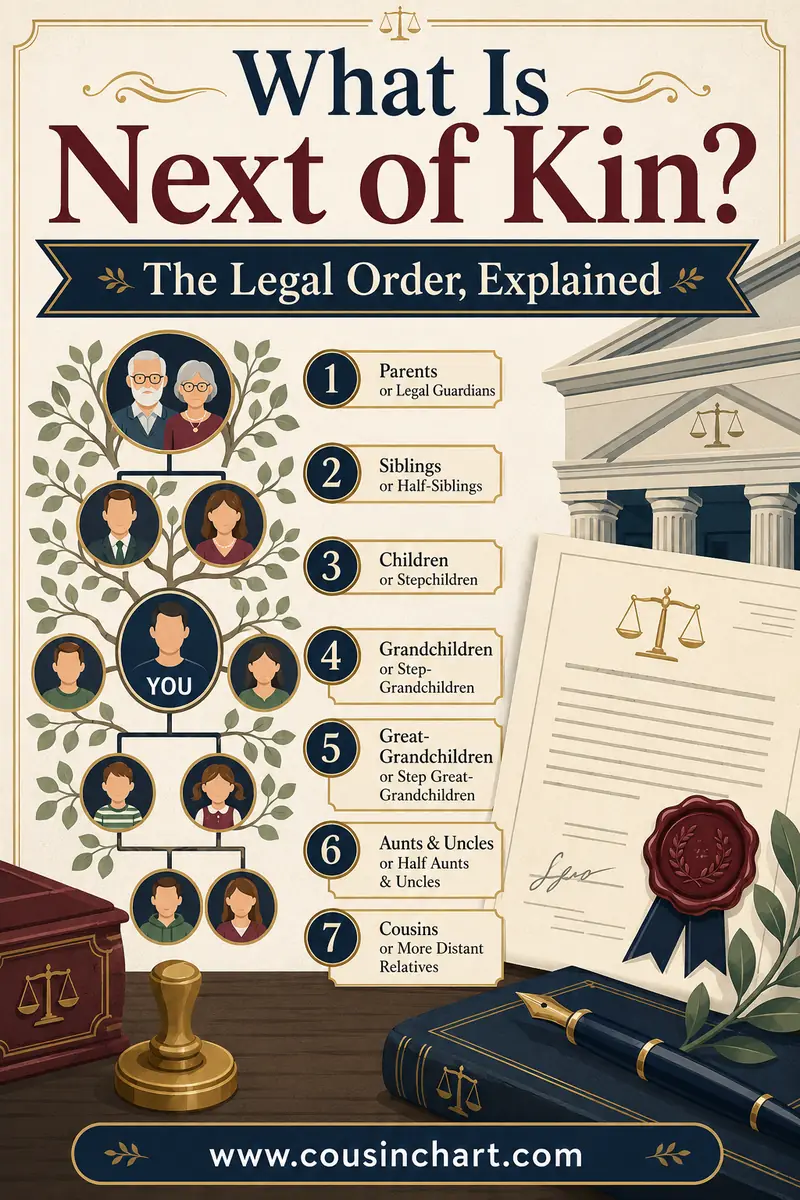
- Intestate — no will. The court appointed an administrator (often the widow or eldest son) and distributed the estate according to state law, which required identifying every legal heir by name.
That second track surprises beginners. An intestate file is frequently more useful than a will, because a will only names whoever the testator chose to mention, while the law forced an intestate distribution to list all the children — including the estranged son in Ohio nobody talked about.
What's inside a probate file
A full probate packet can contain a dozen record types. The ones worth reading closely:
| Document | What it tells you |
|---|---|
| Will | Relationships in the ancestor's own words; married names of daughters |
| Letters of administration | Who the court trusted — usually close kin |
| Inventory | Everything owned, room by room; a portrait of daily life |
| Estate sale account | Who bought each item — buyers were mostly neighbors and relatives |
| Widow's allowance / dower | The widow's name and what she received |
| Guardianship papers | Minor children listed with ages; the guardian is usually a relative |
| Final distribution | Each heir's name, share, and often their county or state of residence |
| Receipts and releases | Signatures of heirs — including sons-in-law signing for daughters |
The final distribution is the genealogical jackpot. When it says "one-seventh part to Nancy Weaver, formerly Nancy Miller, now of Putnam County, Indiana," you've just learned a daughter's married name and where she moved — two facts that might appear nowhere else on earth.
Where to search probate records free
FamilySearch is the free front door. Its "United States Probate Records" collections cover most states with digitized images of will books and probate case files. Two things to know:
- Much of it is browse-only. Millions of images were digitized but never name-indexed. That's fine — county clerks made their own indexes. Open the county's will book volume, and the first pages are almost always an alphabetical index that points you to the right page.
- Coverage varies by county. If your county's volumes aren't online, the records still exist — at the courthouse or the state archives.
Other routes:
- County courthouses. Probate records are public in most states. Call the probate clerk (or Surrogate's Court in New York, Orphans' Court in Pennsylvania and Maryland) and ask about their oldest indexes. Many will search a name for free or a small copy fee.
- State archives. Older probate volumes are often transferred there, and several state archives host free searchable will indexes online.
- Ancestry's probate collection — a massive indexed set of U.S. wills and probate records. It's a subscription product, but the Library Edition at thousands of public libraries includes it free. A practical trick: find the person in Ancestry's index at the library, note the county, volume, and page, then read the same pages free on FamilySearch at home.
How to run a probate search, step by step
- Establish a death date and county — from a death record, obituary, cemetery stone, or the person's disappearance between two censuses. Our free death records guide covers the fastest routes.
- Find the index. Search the county's probate/will index on FamilySearch (or at the courthouse). Check a few years after the death date — probate could open months or years later.
- Read the will book copy, then request the original loose papers. The packet often contains material the clerk never recorded: letters, receipts, disputed claims.
- Extract every name — heirs, witnesses, appraisers, buyers at the sale, bondsmen. Witnesses and bondsmen were commonly in-laws and cousins.
- Follow the land. If real estate changed hands, the deed books continue the story — see our guide to land and homestead records.
Reading old wills without misreading them
Wills come wrapped in legalese and period language that has tripped up generations of researchers:
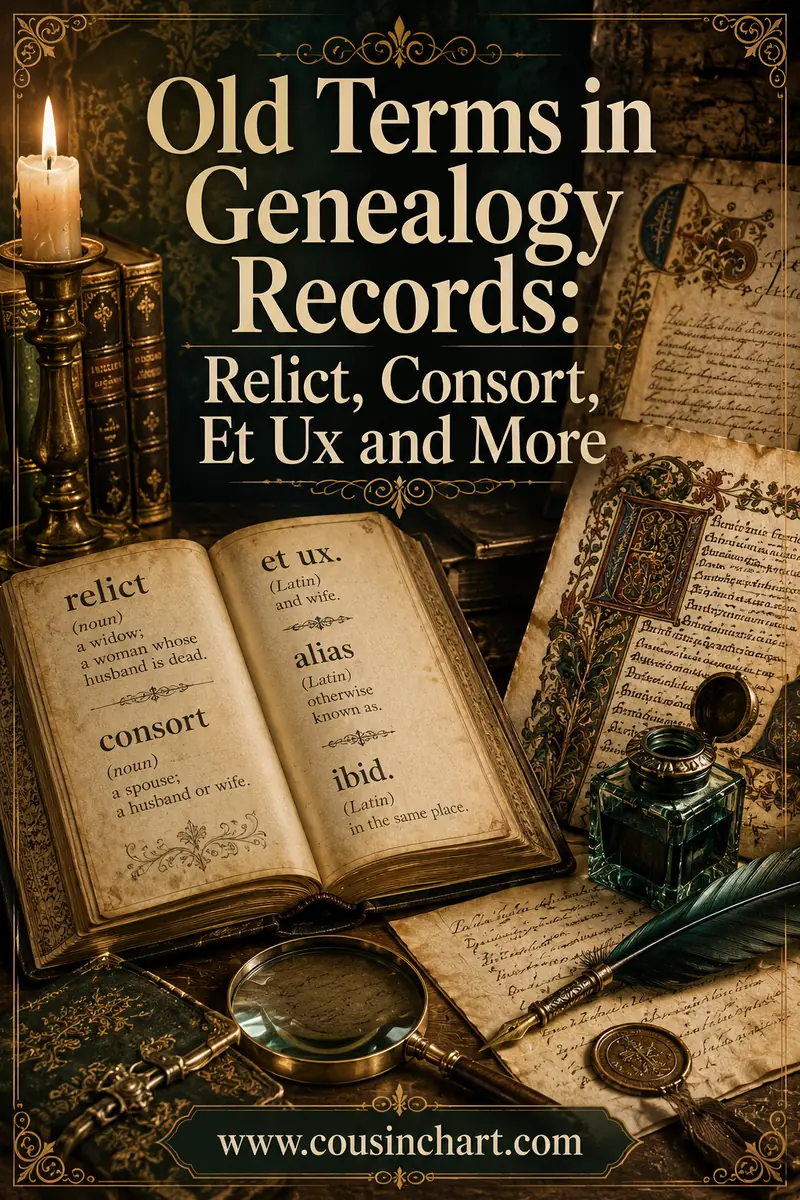
- "Relict" means widow. "Et ux." means "and wife." "Died s.p." means died without children. Our old genealogy terms guide decodes the full vocabulary.
- Birth order isn't guaranteed. Children are often listed in will order, not age order — and a child who already received land ("advancement") might get a token bequest of one shilling without being disinherited or disliked.
- "Son-in-law" could mean stepson in older records, and "cousin" was used loosely for nieces, nephews, and kin generally. Confirm relationships against other records before drawing the line on your chart.
- A missing child isn't proof of death. They may have been provided for earlier — check the deed books for gifts of land.
When a will does spell out a chain — "I give to Mary, daughter of my late brother Josiah" — you can translate it instantly: that's the testator's niece, and her children are the testator's grand-nieces and grand-nephews. For longer chains, the CousinChart calculator does the counting for you and tells you what those people are to you, generations later.
Why probate beats vital records for early ancestors
Statewide death registration is a 20th-century habit in most of the U.S.; wills go back to the colonies. For an ancestor who died in 1795, there is no death certificate — but there may well be a will, an inventory, and a distribution naming eight children with their spouses. Probate also:
- Proves maiden names, when a father's will names "my daughter Elizabeth Tanner."
- Sorts out same-name confusion — two John Smiths in a county become distinguishable once one leaves a will naming his particular children.
- Documents the poor as well as the rich more often than people assume. Even modest estates went through administration if there were debts to settle or land to divide.
- Names enslaved people in Southern estates — inventories and distributions are core sources for African American research before 1865.
FAQ
Are wills and probate records public?
Yes, with narrow exceptions — probate is a public court process in the United States, and historical probate files are open records. Courthouses, state archives, and FamilySearch's digitized collections all provide access.
How do I find a will for free?
Search FamilySearch's "United States Probate Records" collections free with a free account. If the county is browse-only, open the will book for the right era and use the alphabetical index in the front of the volume, then read the pages directly.
What if my ancestor died without a will?
Look for administration records in the same court. Intestate estates required the court to identify every legal heir, so the file often names all the children and the widow — sometimes with married names and current residences.
What's the difference between a will book copy and the original will?
The will book holds the clerk's handwritten (later typed) copy, made when the will was proved. The original, with the testator's actual signature, usually sits in a loose-papers probate packet at the courthouse or state archives — and the packet holds extra documents the book omits.
How long after death was an estate probated?
Usually within weeks or months, but contested or land-heavy estates could run for years, and probate occasionally opened decades later when heirs finally sold property. Search index years generously beyond the death date.
What does "relict" mean in a will?
Relict is the legal term for a widow — the surviving spouse. "Mary, relict of John Adams" means Mary was John's widow. Our old genealogy terms guide covers the rest of the probate vocabulary.
Put every named heir on the chart
One good probate file can name three generations: the testator, the children with their spouses, and a stray grandchild or two singled out for a keepsake. That's a chart's worth of relationships in a single record — in the ancestor's own words. As you extract each "daughter," "nephew," and "grandson of my brother," run the connection through the free CousinChart relationship calculator and see exactly how every heir in the file relates to you today.