Old Terms in Genealogy Records: Relict, Consort, Et Ux and More
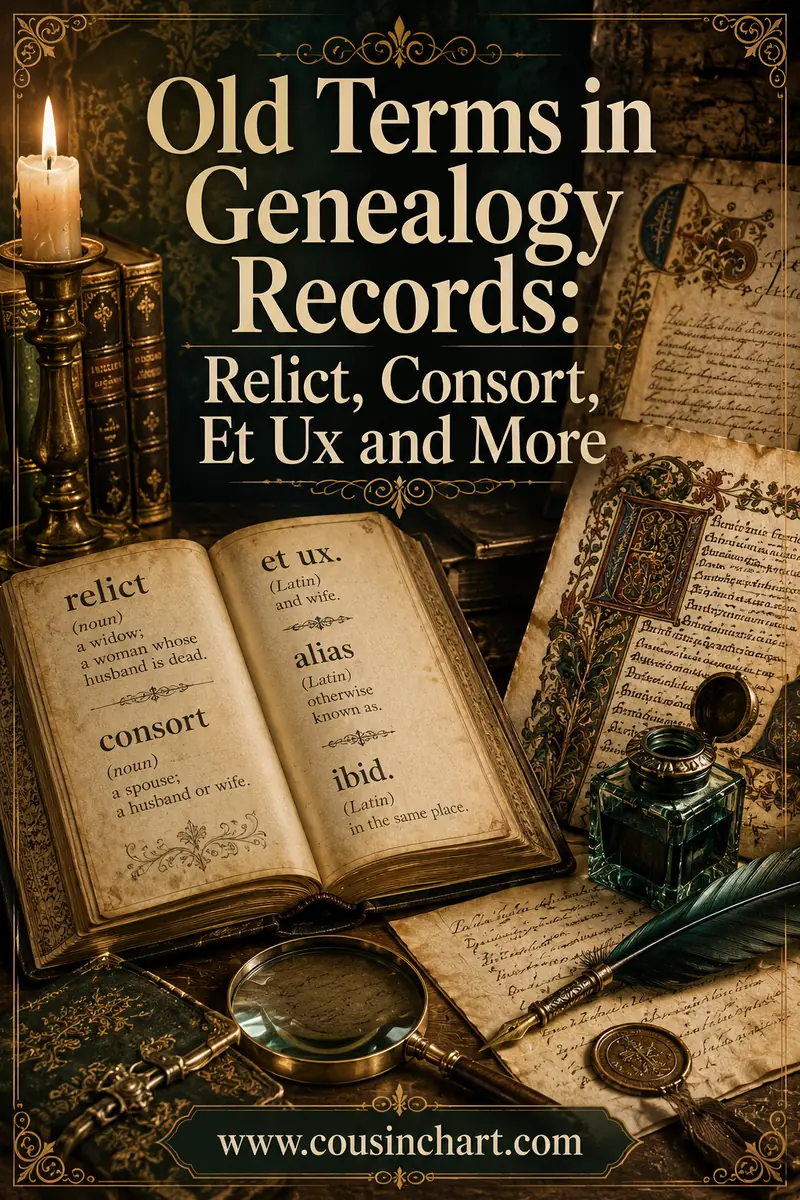
In old records, a relict is a widow, a consort is a spouse who died before their partner, and et ux. is Latin for "and wife." Those three alone unlock half the confusing lines in wills, deeds, and gravestones — but old documents are full of terms that meant something different (or much more specific) than they do today, and misreading one can graft a whole wrong branch onto your tree.
The stakes are real: "son-in-law" in a 1750 will might mean stepson, "cousin" might mean nephew, and "Mrs." might describe a woman who never married. This guide decodes the vocabulary you'll actually meet, record by record. And when a will finally does spell out a relationship — "my kinsman Thomas, son of my cousin-german" — the free family relationship calculator at CousinChart converts the old language into the exact modern relationship.
Which old term did you hit? Tap it and get the plain-English meaning.
Tap a term above for its real meaning.
Work out any family relationship →Terms for spouses and widows
Old documents are precise about marital status in ways we've forgotten:
- Relict — the surviving spouse, almost always a widow. "Hannah, relict of Josiah Pratt" tells you Josiah died first.
- Consort — a spouse who died before their partner. A gravestone reading "consort of" is quietly telling you the surviving spouse buried them — and probably remains findable in later records.
- Now wife — in a will, "my now wife Elizabeth" doesn't necessarily hint at a scandal; it usually just protected the estate language in case the testator remarried. But it can signal an earlier marriage — check for one.
- Dower / dower right — the widow's legal life interest in one-third of her husband's real estate. When she "released her dower" on a deed, that's why her name appears.
- Nee — born as; introduces a maiden name ("Mary Holt, nee Simmons").
- Spinster — an unmarried woman, with no age implication; a 19-year-old bride is called a spinster on her own marriage record. (Centuries earlier it was literally an occupation — one who spins.)
- Feme covert / feme sole — legal terms for a married woman (whose property rights merged with her husband's) and an unmarried or widowed woman (who could own property and sign contracts herself). This is why deeds and lawsuits treat women so differently depending on marital status.
Relationship words that don't mean what you think
This is where trees go wrong:
| Old term | What it often meant | Modern trap |
|---|---|---|
| Son-in-law / daughter-in-law | Stepson / stepdaughter (pre-1800s) | Assuming a marriage that never happened |
| Mother-in-law | Stepmother | Inventing a spouse's parent |
| Cousin | Any kin: niece, nephew, grandchild, kinsman | Forcing a literal first cousin |
| Cousin-german | Specifically a first cousin | Missing the precision when it IS used |
| Brother / sister | Also brother-in-law, half-brother, or fellow church member | Merging two families into one |
| Natural son | Biological son (as opposed to adopted or step) — sometimes, but not always, born outside marriage | Reading scandal into ordinary phrasing |
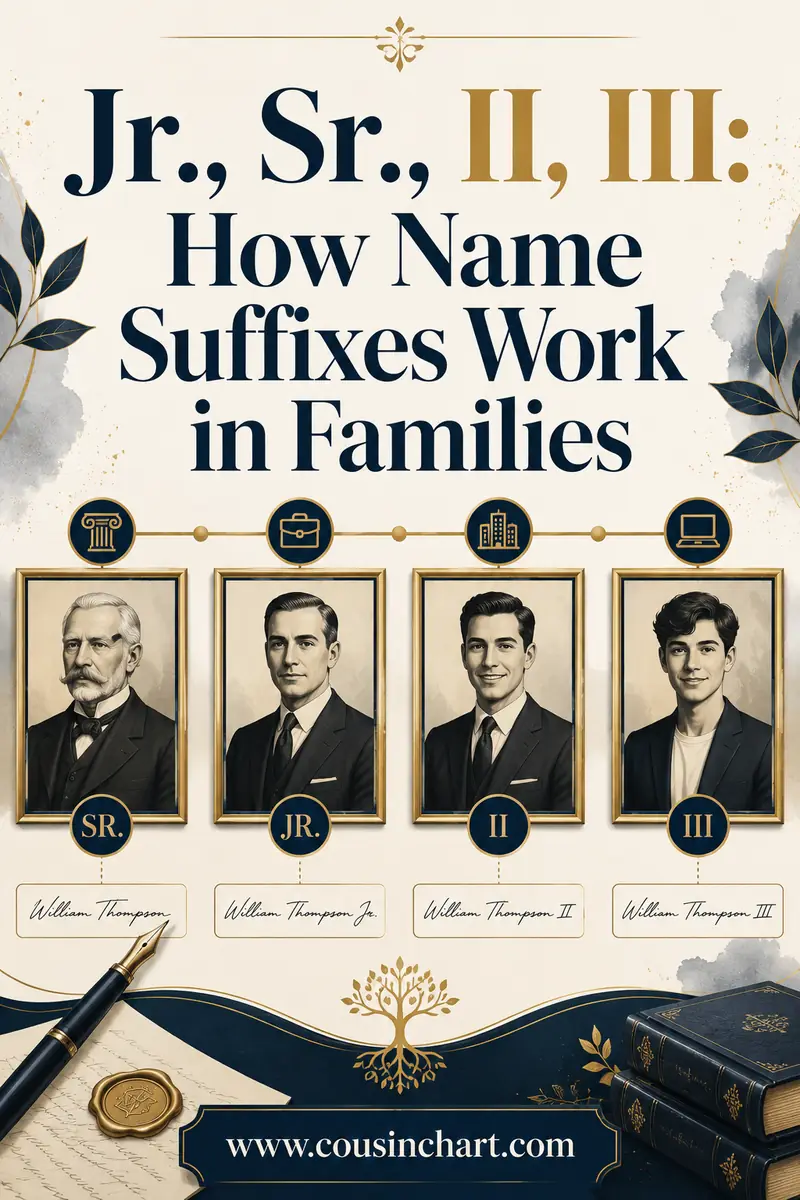
| Junior / Senior | The younger and elder of two same-named men in one place — often uncle/nephew or unrelated | Assuming father and son |
| Nephew / niece | Occasionally grandchild in very early records (from Latin nepos) | Skipping a generation |
The Junior/Senior trap deserves special mention: the labels weren't permanent parts of names — when "John Carter Sr." died, "John Carter Jr." often became Sr., and a third John became Jr. Our guide to name suffixes untangles the whole system.
When you're confident of the actual chain — say, the will's "cousin-german" really was a first cousin — use the CousinChart calculator to project it forward: your ancestor's first cousin's great-grandchildren are your third cousins, give or take a "removed" depending on the generations.
Latin and legal shorthand in probate and church records
A little Latin goes a long way in wills and probate and in Catholic church registers:
- Et ux. (et uxor) — and wife. Et al. — and others.
- D.s.p. (decessit sine prole) — died without children. Variants: d.s.p.l. (without legitimate children), d.v.p. (decessit vita patris — died in the father's lifetime, i.e., before inheriting).
- Testate / intestate — died with / without a will.
- Administrator (m.) / administratrix (f.) — the person the court appointed to settle an intestate estate; executor / executrix — the person the will named. The female forms tell you a widow or daughter was trusted with the job.
- Imprimis — firstly (opens the bequest list); item — likewise/next (each following bequest).
- Ibid. — same source as the previous entry.
- Filius / filia — son / daughter; uxor — wife; vidua — widow; obiit — died; circa (c./ca.) — about.
- Ye — just "the." The letter was a thorn (þ), pronounced "th" — your ancestors never said "yee olde."
Dates: instant, ultimo, and the 1752 calendar shift
Newspapers and letters loved month shorthand: instant (inst.) = this month, ultimo (ult.) = last month, proximo (prox.) = next month. An obituary dated 18 June saying the death occurred "on the 30th ult." means 30 May.
The bigger trap is double dating. Until 1752, England and its colonies began the legal year on 25 March (Lady Day). Dates from 1 January through 24 March belonged to the old year legally but the new year by our reckoning — so careful clerks wrote "16 February 1704/5." When Britain finally adopted the Gregorian calendar in September 1752, eleven days were also dropped (2 September was followed by 14 September). Practical rules:
- Transcribe double dates exactly as written (1704/5), never "corrected" silently.
- If a pre-1752 record between January and late March shows a single year, note that the modern-style year may be one higher.
- Don't panic over ancestors whose recorded birthday shifts by eleven days across 1752 — George Washington moved his own birthday from 11 to 22 February.
Occupations and status words that confuse
- Yeoman — a farmer who owned his land; husbandman — a farmer, typically a tenant, one rung down. The distinction was meaningful and consistently used.
- Goodman / Goodwife (Goody) — polite address for ordinary folk below "Mr./Mrs." rank in early New England.
- Esquire / gentleman — status claims, loosely enforced in America but still signals of local standing.
- Late of — formerly resided at ("John Byrne, late of County Wexford" = he used to live there); "the late" — deceased. Context separates them.
- Freeholder — owned land outright; often the qualification to vote or serve on juries, so freeholder lists work as census substitutes.
- Orphan — a minor whose father had died; the mother could be alive and remarried. Infant — anyone under the legal age of 21. Guardianship files are full of teenage "infant orphans" with living mothers.
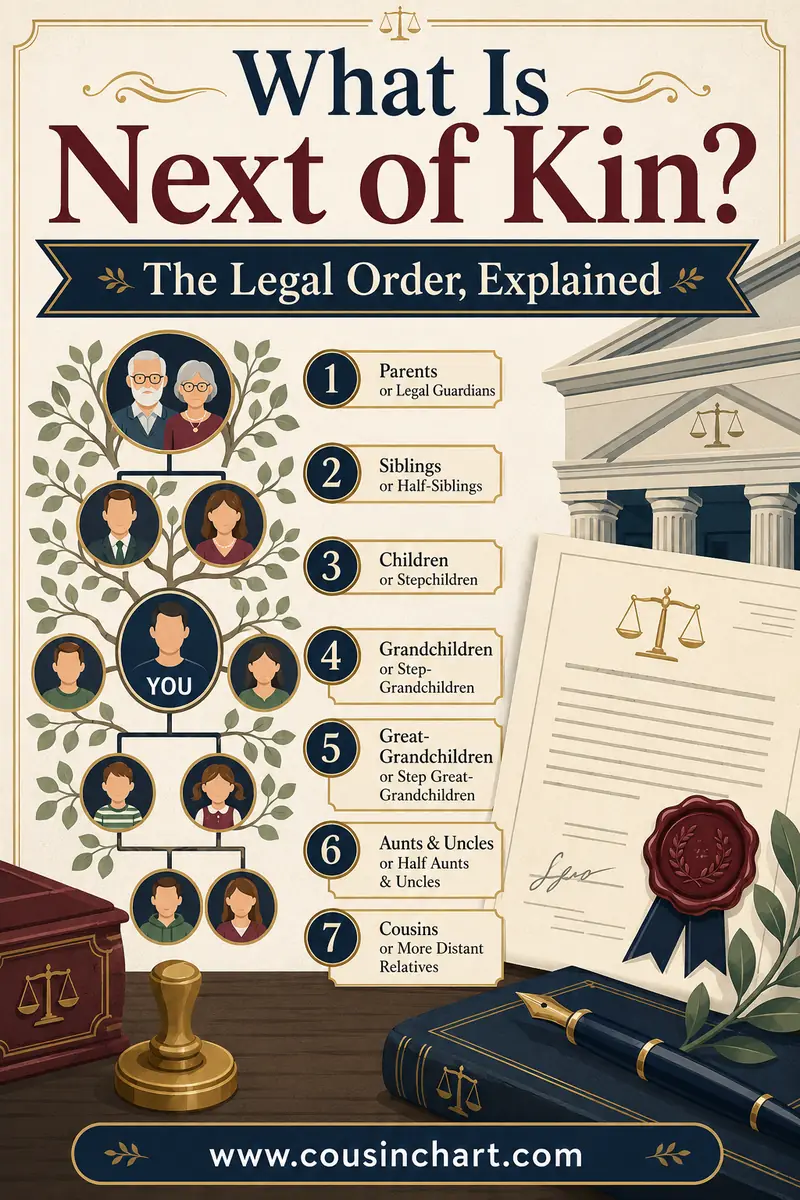
- Next of kin — the nearest blood relative(s) under law, a phrase courts still use; our next of kin guide explains the modern order of priority.
A working method for any baffling term
- Don't guess from modern usage — the whole lesson of this glossary.
- Read the term in context: who signs, who inherits, who's called what elsewhere in the same document.
- Check a period legal dictionary — free scans of old editions of standard law dictionaries are online, and they define terms as courts of that era used them.
- Compare parallel records: if the will's "son-in-law James" appears in the deed books as "James, son of my wife," you've confirmed the stepson reading.
- Translate to modern kinship and chart it. Once the old words resolve into an actual chain of parents, siblings, and spouses, the CousinChart relationship calculator names the modern relationship instantly.
FAQ
What does "relict" mean on a gravestone or in a will?
Widow. "Relict of Thomas Hale" identifies the woman as Thomas's surviving spouse. Its counterpart is "consort," which marks a spouse who died while the partner was still living.
What does "et ux" mean in old deeds?
It's Latin for "and wife." A deed from "William Carr et ux." was signed by William and his wife — and the deed body usually names her, which is often the only place her name survives.
Why does an old record call a stepson a "son-in-law"?
Before the 1800s, "in-law" meant related through law generally — including through a parent's remarriage. Son-in-law could mean stepson, mother-in-law could mean stepmother. Verify with ages and other records before assuming a marriage.
What does "d.s.p." mean in a pedigree?
Decessit sine prole — died without children. It tells you that person left no descendants, so any modern family claiming descent from them has a mistake in the line.
What is a double date like "11 February 1731/2"?
A pre-1752 date falling between 1 January and 24 March, when the English legal year still began on 25 March. It was 1731 by the old legal year and 1732 by the modern calendar. Keep both numbers when you transcribe.
Did "Mrs." always mean a married woman?
No. In early records "Mrs." abbreviated "Mistress," a mark of social rank — unmarried women of standing were routinely "Mrs." Don't invent a husband from the title alone; look for actual marriage evidence.
Old words, modern chart
Every one of these terms was precise in its own century — the records aren't vague, we've just lost the dialect. Keep this glossary beside the deed books and the gravestone photos, translate each "relict," "consort," and "cousin-german" back into a real link between real people, and then let the free CousinChart relationship calculator tell you exactly what every one of them is to you.