Jr., Sr., II, III: How Name Suffixes Work in Families
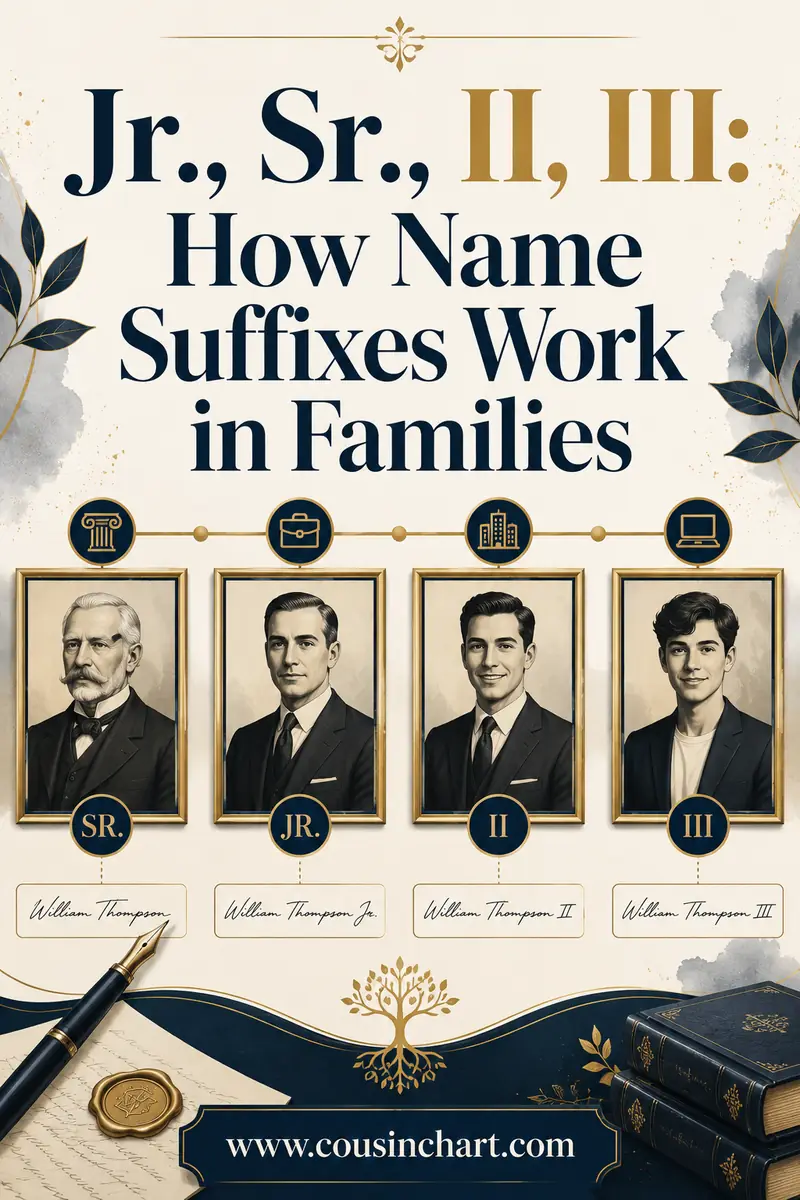
A name suffix shows which person in a family shares the same name. Jr. means a son with the exact same name as his father (who becomes Sr.). II, III, and IV (second, third, fourth) count people named after a relative who isn't their own father — like a grandfather or uncle. So the quick rule is: Jr. = named after Dad; II = named after someone else in the family.
That single distinction clears up most of the confusion. The rest of this guide covers who becomes "Sr." and when, what happens when the elder dies, why juniors sometimes turn into "II," and the etiquette around women and suffixes. If you're untangling a family tree full of repeated names, the free relationship calculator can help you keep the generations straight.
Relationship quick-check. Tap a naming situation to see which suffix fits:
The answer will appear here.
The Core Rule: Jr. vs. II
Here's the distinction that trips everyone up. Both Jr. and II mean "named after a relative" — but which relative decides the label:
- Jr. is used when a boy has the exact same full name as his father. The father then takes Sr. (Senior) to tell them apart.
- II ("the second") is used when a boy is named after any other relative — most often a grandfather, but also an uncle or cousin — as long as it isn't his own father.
So two boys can both be "John Michael Smith," and one is "John Michael Smith Jr." (dad is John Michael Smith) while the other is "John Michael Smith II" (grandpa or uncle is John Michael Smith). Same name, different suffix, because the source of the name is different.
The full name has to match for either suffix to apply. If a son is "John Andrew Smith" and his father is "John Michael Smith," he's technically not a Jr. at all — the middle names differ.
How the Numbers Climb: II, III, IV
After Jr. and II, families keep counting with Roman numerals. The number simply tracks how many people in the direct line have carried the name:
- III ("the third") — the son of a Jr. or a II who keeps the same name.
- IV ("the fourth"), V ("the fifth"), and beyond — each new generation advances the number by one.
A common pattern looks like this:
| Person | Name | Why |
|---|---|---|
| Grandfather | Robert Lee Grant | The original |
| Father | Robert Lee Grant Jr. | Named after his father |
| Son | Robert Lee Grant III | Named after father (a Jr.) |
| Grandson | Robert Lee Grant IV | Next in the same line |
Notice the son of a "Jr." becomes "III," not "II." That's because III just means the third living person to hold the name in that line — Grandpa was first, Jr. was second, so the next is third. Numbers count heads in the name line; they don't restart.
When Does "Sr." Appear?
Here's a subtle point: a man usually isn't "Sr." until his son shares his name. "Senior" is a relative term — it only exists to distinguish him from a "Junior." So your grandfather might have gone his whole early life as plain "James Carter," and only became "James Carter Sr." the day his son "James Carter Jr." was born.
And when the Sr. dies? Custom (not law) offers a few options:
- The Jr. may simply drop the suffix and become the sole bearer of the name.
- Some families shift everyone up — the former Jr. becomes the elder, a III becomes a "Jr." or "II," and so on. This is old-fashioned and now rare.
- Many families keep the suffixes frozen as they were, because paperwork, records, and habit make changing them a hassle.
There's no legal requirement either way. Suffixes are conventions that exist to reduce confusion, so families do whatever keeps things clearest.
Do the Numbers Only Follow Fathers?
Not necessarily. While Jr./Sr. is strictly a father-to-son pair, the Roman numerals can honor any relative. A boy named after his grandfather, great-uncle, or a distinguished cousin can take "II" even though his own father has a completely different name. The numeral honors the namesake, wherever they sit on the tree.
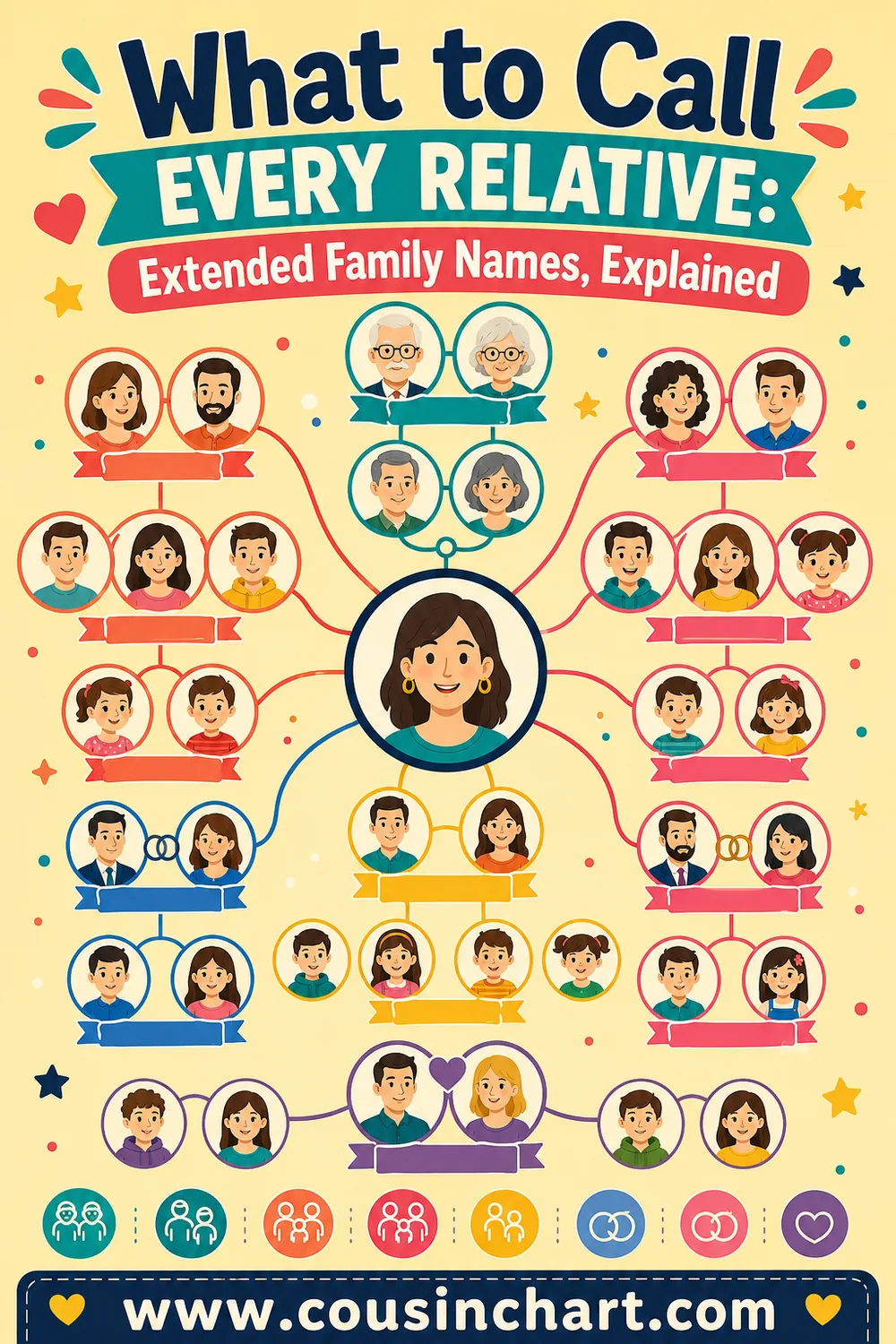
That's why numerals are popular in families that like to reuse a cherished name across branches. If you're tracing who was named for whom, seeing the generations laid out helps — our great-grandparents chart shows how the senior generations stack, and what to call every relative helps you place the namesake.
What About Women? And "II" for a Namesake
Traditionally, suffixes were a male convention — Jr., Sr., and the numerals almost always followed fathers and sons. But usage has loosened:
- Some women use Jr. when named identically after their mother, though it's still uncommon.
- Numerals like II are occasionally used for a daughter or granddaughter named after an aunt or grandmother, again as a personal choice rather than a fixed rule.
There's no official rulebook here — modern families set their own conventions. The suffix is a courtesy for clarity, so whatever helps people tell two same-named relatives apart is fair game.
Why Suffixes Matter for Genealogy
For family historians, suffixes are a gift and a trap. A gift, because "III" instantly tells you there were at least two same-named people before this person in the same line — a built-in clue about the family structure. A trap, because records are messy: a Jr. might be recorded without his suffix, two different men might both appear as "John Smith," and a suffix might quietly shift after a death.
The golden rule for genealogy: never assume two "John Smith Jr." entries are the same man, and never assume the "Sr." in one record is the same generation as the "Sr." in another. Suffixes point you in the right direction but don't replace dates and places. New to this kind of detective work? Our genealogy for beginners guide walks through verifying identities from scratch.
Punctuation and Formatting Conventions
Once you know who gets which suffix, a few small style questions come up. Here's how they're usually handled:
- Comma or no comma? Older American style put a comma before the suffix ("John Smith, Jr."), but modern usage increasingly drops it ("John Smith Jr."). Both are acceptable; just be consistent within a document.
- Periods on Jr./Sr. "Jr." and "Sr." traditionally take periods in American English and often none in British English ("Jr"). The Roman numerals (II, III, IV) never take a period.
- Which numeral style? The numbered suffixes are written as Roman numerals (II, III, IV), not "2nd" or "3rd," in formal usage.
These are conventions, not laws — but getting them consistent matters in genealogy records, where a stray comma or missing period can make two entries look like different people.
Suffixes Around the World
The Jr./Sr./III system is strongest in the United States and, to a lesser degree, Britain. Elsewhere, families honor namesakes differently:
- Many cultures reuse a grandparent's name for a grandchild without any suffix at all — the repetition is expected, and context tells everyone apart.
- Some traditions avoid naming a child after a living relative entirely, reserving the honor for someone who has passed, which sidesteps the Jr./Sr. problem altogether.
- Patronymic systems (names built from the father's name, like "-son" or "-sen" endings) encode the parent-child link right into the surname instead of using a suffix.
So if your family tree crosses cultures, don't expect suffixes everywhere. Their absence doesn't mean nobody was named after anyone — it often means a different, equally rich naming tradition was at work. Knowing that keeps you from misreading records from branches that never used Jr. or III in the first place.
FAQ
What's the difference between Jr. and II?
Jr. means a son has the exact same full name as his father. II ("the second") means a person is named after a different relative — usually a grandfather or uncle — not their own father. So Jr. always points to Dad; II points to someone else in the family.
Is the son of a Junior called II or III?
III. The number counts how many people in the direct line have held the name. The grandfather was first, the "Jr." was second, so the next same-named son is the third — written III, not II.
When does a father become "Sr."?
Only once his son shares his exact name. "Senior" exists purely to distinguish him from a "Junior," so a man typically isn't "Sr." until a same-named "Jr." comes along.
Do you drop the suffix when the Sr. dies?
It's optional. Some families have the Junior drop the suffix, some shift everyone up a step, and many simply keep the suffixes frozen for the sake of records and habit. There's no legal requirement either way.
Can a girl be a Jr. or II?
Traditionally suffixes followed fathers and sons, but modern usage has relaxed. Some women use Jr. when named identically after their mother, and numerals like II occasionally honor a daughter named after an aunt or grandmother. It's a personal choice, not a fixed rule.
Keep the Generations Straight
Repeated names are a family's way of honoring the people who came before — but they can turn a family tree into a puzzle. Once you know that Jr. points to a father and the numerals point to any namesake, the whole system clicks. And when a tree has three "Roberts" and two "Marys," the free family relationship calculator helps you sort out exactly how each generation connects, so the right person lands in the right spot.