How to Prove You're an Heir: Kinship Affidavits and Charts
Knowing you're the closest surviving relative and proving it are two completely different jobs. A court or an estate administrator will not accept that you are someone's first cousin because you say so — they want a document for every link between you and the person who died, with a certified certificate behind each one. That's the whole exercise: a chain of birth, marriage and death records running from the deceased, up to the common ancestor, and back down to you. Get the chain right and the claim is usually straightforward. Leave one link unevidenced and everything stops. The first step is being certain how the relationship actually runs, which is what the cousin calculator is for.
What are you being asked to prove? Tap the closest match.
Tap an option above. Every claim is a chain of certificates, one per link, up and back down.
This is general information, not legal advice. Probate procedure varies by state and country, and the evidence a particular court accepts is set locally — check with a probate attorney or the court's own clerk for the rules where the estate is being administered.
Proof of heirship is a paperwork job, not an argument
The single most useful reframing here: nobody is judging your story. They're auditing a chain.
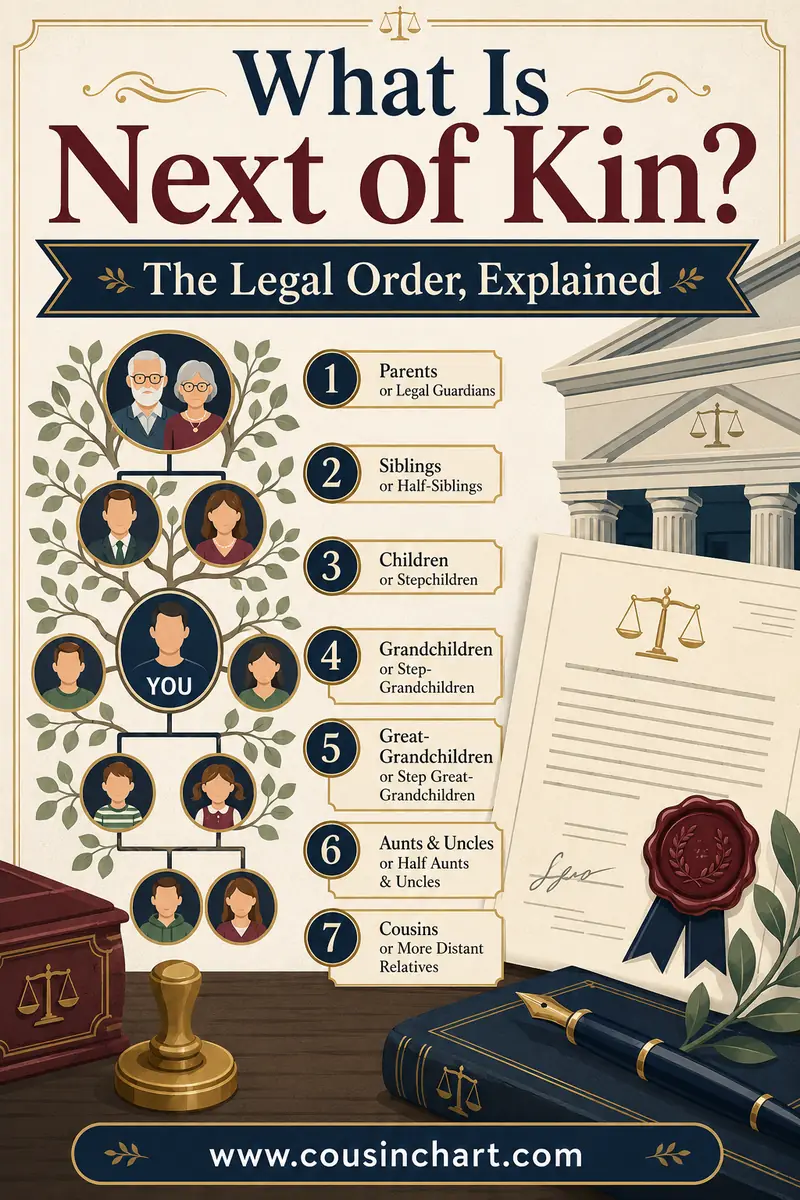
The rule of who inherits is separate from the evidence that you're that person. Which relatives inherit, and in what order, is set by the intestacy statute — our guide to next of kin and the legal order sets out how that ladder normally runs. This page is about the other half: showing you occupy a rung on it.
The unit of proof is the link, not the relationship. "First cousin" is a conclusion. The evidence is a series of parent-and-child links: your grandfather to your father, your father to you, your grandfather to your uncle, your uncle to the deceased.
Each link needs a document created by an authority, ideally at the time. A birth certificate naming both parents proves a link on its own. A marriage certificate proves a name change. A death certificate proves someone is out of the picture and often names their parents too.
Certified copies, not photocopies or screenshots. Courts and title companies generally want the copy issued and stamped by the registrar. If you're not sure what to order, what vital records are and how to get them covers the difference between an index entry and a certified long-form record.
Volume grows fast with distance. A child of the deceased may need two documents. A first cousin can easily need eight to twelve. A second cousin, more again.
Which is why organizing beats hurrying. Build the chain on paper first, list the certificate that proves each link, then order only what's missing. People routinely spend money on records that prove nothing they need.
Who asks for proof, and what each one wants
The standard varies with who's asking, and it's worth knowing which conversation you're in.
A probate court is the strictest. If someone died without a will, the court has to be satisfied about who the legal distributees are before it will authorise distribution. Distant kinship usually means a hearing and a full evidentiary file.
An estate administrator or executor asks next. They're personally exposed if they pay the wrong person, so they will ask for documents even when they personally know you're a cousin.
Title companies ask before real property can be sold. Land that passed to heirs without probate can't be sold cleanly until the heirs are established, which is where affidavits of heirship earn their keep.
Banks, pension schemes and insurers ask in their own formats. Each has a claim form and its own list, and their lists are frequently shorter than a court's.
State unclaimed property offices ask too. Dormant accounts eventually escheat to the state, and reclaiming one as an heir means proving the same chain, often years after the death.
Ask each of them, in writing, what they will accept. It takes one email, and it prevents the common trap of assembling a court-grade file for a bank that wanted three documents and a signature.
What proves each link
Here's the practical mapping. The left-hand column is the relationship you're claiming; the right-hand columns are what actually evidences it.
| Link you're proving | Best evidence | Workable substitutes if missing |
|---|---|---|
| Person died, and when | Certified death certificate | Cemetery record, funeral home record, probate file |
| You are X's child | Long-form birth certificate naming the parent | Baptismal record, adoption order, census with household, school record |
| Two people are siblings | Both birth certificates naming the same parents | Parents' marriage record plus census households, obituary listing survivors |
| A name changed | Marriage certificate, divorce decree, court name change order | Deed or will signed in both names |
| A branch ended | Death certificates with no surviving issue | Obituaries, cemetery plots, census across decades, sworn affidavits |
| Where a cousin sits | Kinship chart keyed to numbered exhibits | Prepared genealogical report with sources |
Long-form birth certificates are the ones that matter, because the short version often omits parents' names — and parents' names are precisely the thing you're proving.
Death certificates carry more than the death. They usually name the deceased's parents, which can prove a link a generation higher for free.
Obituaries are excellent supporting evidence and weak primary evidence. They list survivors in relationship terms, which is exactly what you want, but they're written by families and often wrong on details.
Census records are the standard corroboration for older links, because they show households with stated relationships across decades. They rarely stand alone but they hold a file together.
Wills and probate files from earlier deaths in the family are underrated. An earlier estate that named its heirs has effectively done part of your work already — see wills and probate records for how to find them.
Building a kinship chart the court will read
A well-made chart does more work than any single document, because it turns a stack of certificates into something a judge can grasp in ten seconds.
Put the deceased at the anchor point, not you. Everyone reads outwards from the person whose estate it is. Charts drawn from the claimant's point of view confuse everybody.
Show the common ancestor explicitly. For a cousin claim, that's the shared grandparent or great-grandparent. The chart's job is to make that junction visible.
Give every person their dates. Born, died, married. Blank dates are where a court's questions start, so if a date is unknown, say so on the chart rather than leaving a gap.
Number every person and key the numbers to your exhibits. "Exhibit 4 — birth certificate of person 7" is what turns a family tree into evidence. This is the difference between a genealogy chart and a kinship chart.
Mark the dead ends deliberately. A branch with no surviving descendants should say so — "d. 1961, no issue" — because that statement is doing legal work.
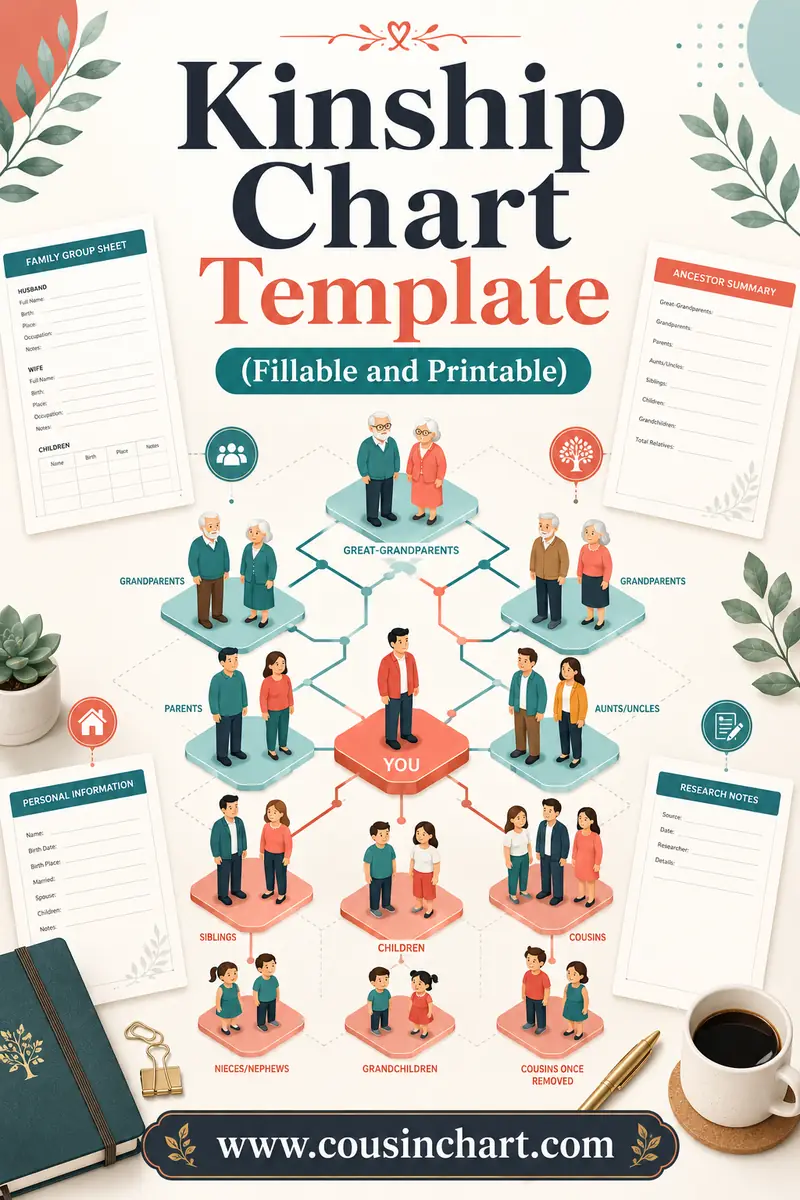
Keep it to one page if you possibly can. A printable family tree or a kinship chart template gives you the structure; the discipline is resisting the urge to include every relative who isn't relevant to the claim.
The hard part: proving nobody closer exists
Most claims fail here rather than on the claimant's own line. Proving you exist is easy; proving nobody nearer does is not.
Intestacy runs to the closest class of relatives, and stops. If a single surviving child exists, cousins get nothing. So the court doesn't just want your line — it wants confidence that the nearer branches are empty.
Negative proof is built from patterns, not from silence. You show a person's whole life in records — censuses across decades listing no children, an obituary naming siblings rather than descendants, a burial plot, a will leaving everything to a sibling.
Affidavits fill the gaps that records can't. A sworn statement from an older relative or a long-standing family friend who knew the household is real evidence, particularly where they had no financial interest in the outcome.
Adopted-out children and children born outside marriage complicate this, and they surface late and often. Modern law generally treats adopted children as children of the adoptive family, but the rules vary, and DNA testing has made these discoveries far more common than they used to be.
Some jurisdictions have a formal standard for this. In New York, for example, kinship proceedings expect a diligent search, and there are procedural mechanisms for closing off the possibility of unknown distributees after a documented search. Other states handle it through publication and notice.
Expect the court to appoint someone to represent the unknown. A guardian ad litem for unknown heirs is normal in distant-kinship estates, and their job is to test your evidence rather than to obstruct you.
Affidavits of heirship: useful, but not magic
The word "affidavit" gets used loosely here, and the two main types do different jobs.
An affidavit of heirship is a sworn statement of family facts, typically made by someone who knew the deceased and their family but stands to gain nothing from the estate. In several states it's filed in the county property records.
Its classic use is real property. Where land passed informally to heirs and now needs selling, an affidavit of heirship can establish the chain of title without full probate — subject to whether the title insurer will accept it.
Disinterested witnesses carry the weight. Two witnesses with no financial stake are the usual expectation, and a statement signed only by the people who inherit is worth far less.
A kinship affidavit in a probate proceeding is different. That's your own sworn account of the family structure, filed alongside the certificates and the chart, and it explains what the documents show rather than replacing them.
Neither type overrides a record. An affidavit is a bridge across a gap in the paper trail, not a substitute for a certificate that exists and could have been ordered.
Get the form right for the state. Requirements for notarisation, witnesses and recording differ, and a technically defective affidavit is worse than none because it invites a challenge.
Distant relatives, heir searches and what it all costs
When the closest surviving relatives are cousins, a different set of practicalities kicks in.
Estates with distant heirs take longer, full stop. The court is working through notice, searches and evidence. A year or more is unremarkable, and complex kinship cases run longer.
Professional heir search firms are common and largely legitimate. They locate missing heirs and take a percentage of what those heirs receive, typically under a signed agreement.
Read the percentage before you sign it. If you already know about the estate and can document your own line, you may not need them at all. If they found you and you'd otherwise never have known, the fee may be entirely fair. Ask what percentage, what they do for it, and whether you can decline and file yourself.
Budget for the records. Certified copies typically run to tens of dollars each, and a cousin-level claim can easily need a dozen. Court filing fees and, in a contested matter, an attorney, are the larger costs.
Consider a professional genealogist for a stubborn gap. In kinship cases they often produce the sourced report and the chart that the court actually relies on, and that's a narrow, well-defined job.
Find the living relatives early, too. Other heirs are not competitors so much as co-claimants, and co-operating on documents saves everyone money — how to find living relatives covers the practical methods.
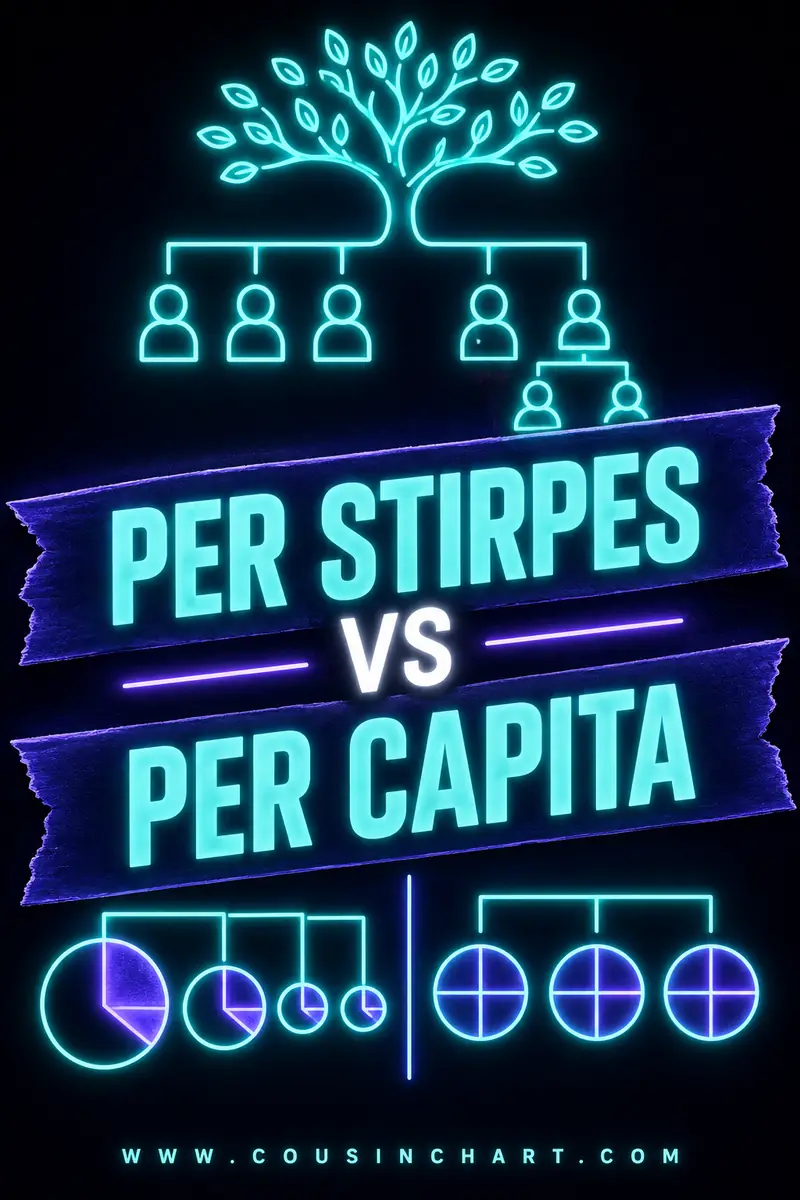
Then check the arithmetic of what a share is worth. Whether an estate divides by branch or by head changes cousin shares dramatically, which is set out in per stirpes vs per capita.
FAQ
What is proof of heirship?
Proof of heirship is the documentary evidence that you are legally entitled to inherit from someone who died — usually a chain of certified birth, marriage and death certificates linking you to the deceased through a common ancestor, presented with a kinship chart and, where needed, sworn affidavits.
What is a kinship affidavit?
A kinship affidavit is a sworn statement setting out the family relationships in an estate: who the deceased's relatives are, who has died, and who survives. It supports the certificates rather than replacing them, and statements from people with no financial interest carry the most weight.
What documents prove I am someone's cousin?
You prove the chain in both directions: your birth certificate and your parent's, showing descent from the shared grandparent, plus your cousin's birth certificate and their parent's, showing the same. Add marriage certificates for name changes and death certificates for everyone in between.
Do I need a lawyer to prove heirship?
Not always. Simple claims to a bank account or an insurance policy are often handled with a claim form and certificates. Distant kinship, contested estates and property transfers usually justify a probate attorney, because the evidence standard and the procedure are set locally.
How do you prove no closer heirs exist?
By documenting the nearer branches rather than ignoring them: death certificates showing branches ended, obituaries and census records showing no children, cemetery records, and sworn affidavits from people who knew the family. Courts commonly also require notice or publication to reach unknown relatives.
Is an affidavit of heirship enough to transfer property?
Sometimes, in states that recognize it and where the title company accepts it — most often for real property that passed informally without probate. It usually needs disinterested witnesses and recording in the county records. Where it isn't accepted, formal probate is required instead.
Build the chain before you build the case
Everything here comes back to the same discipline. Draw the line from the deceased up to the common ancestor and back down to you. Write next to every link the exact document that proves it. Then order only what's missing, put a certified copy behind each link, and present it as a numbered chart with numbered exhibits. That's what a probate clerk, an administrator or a title officer is looking for, and it's within reach of anyone patient enough to do it in order. Start by getting the relationship itself unambiguous — the cousin calculator will tell you exactly how you and the deceased connect before you spend a cent on certificates.