Does a Cousin Count for Bereavement Leave? Relationship Degrees Explained
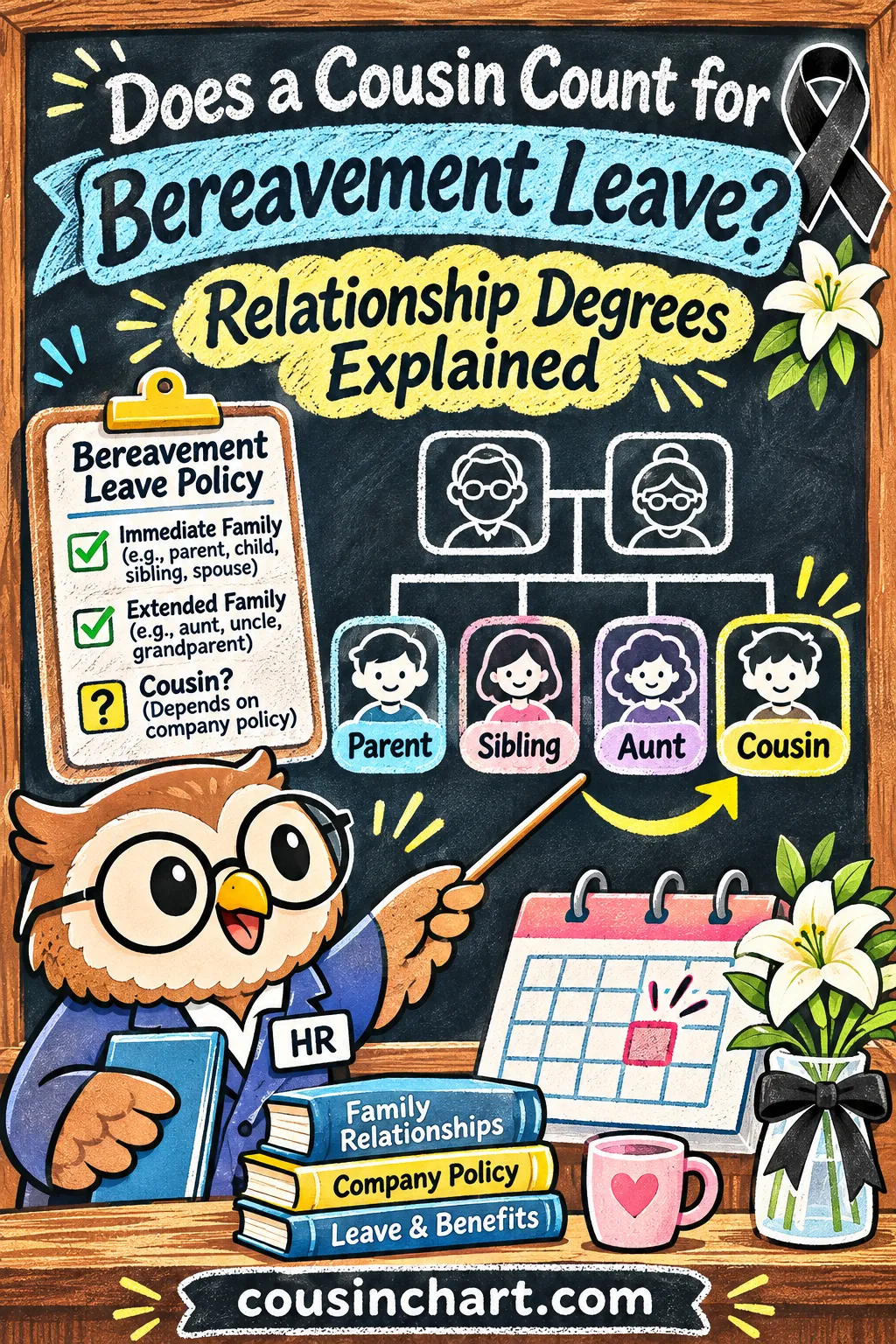
Whether a cousin counts for bereavement leave depends entirely on your employer's policy and the rules where you work, so the only sure answer is in your employee handbook or from HR. Many policies list specific relatives by name, and cousins are sometimes left off, while others cover extended family or allow leave at a manager's discretion. If the policy uses "degrees" of relationship, the free Cousin Chart relationship calculator helps you see exactly where your cousin falls.
If you're reading this because you've just lost someone, we're so sorry. This guide is laid out so you can jump to what you need: the short answer is above, the degree charts and worked examples are in the middle, and ready-to-use HR email wording is near the end.
▶ Work it out in the free calculator
Policies Vary, So Start With Your Handbook
There's no single bereavement rule that covers every job. Policies differ by employer, by state, and sometimes by union contract or job type. Some employers offer paid days, some offer unpaid time, and some leave it up to a manager.
Before anything else, look for:
- Your employee handbook. Search for "bereavement," "funeral leave" or "family death."
- Your HR portal or benefits site. Many companies post leave policies there.
- Your union contract, if you have one.
- Your HR contact or manager. When the written policy is unclear, ask.
This article explains the relationship terms those policies use. It isn't legal advice, and it can't tell you what your employer must offer. Laws and rules vary by state, so check with your HR team for what applies to you.
A two-minute search of your handbook
If you have the handbook as a document or web page, use your search function and try each of these words in turn. Policies use different labels for the same thing.
- bereavement
- funeral
- death in the family
- immediate family
- extended family
- relative
- degree
- household
- personal leave
Note the page or section for each hit. You'll want to quote the exact wording when you write to HR.
How Bereavement Policies Usually Describe Family
Most policies describe covered family in one of three ways. Knowing which one yours uses tells you where to look for "cousin."
1. A named list. The policy simply names who counts, such as spouse, child, parent, sibling, grandparent and grandchild. If "cousin" isn't on the list, it may not be covered under that section, though another section might still apply.
2. Immediate versus extended family. Some policies give one amount of leave for immediate family and a different amount for extended family. Cousins, if they appear, usually fall under extended family. The guide to immediate family vs. extended family explains how those two groups are commonly defined.
3. Degrees of relationship. A few policies say something like "relatives within the third degree." That's where the math below comes in.
Some policies also include in-laws, step-relatives or "any person living in your household." Read the whole section, not just the first line.
Decoding common policy wording
Here's what typical phrases usually point to, and the question worth asking if the wording leaves a cousin unclear. Your own policy's definitions always come first.
| Wording you might see | What it usually refers to | What to ask HR |
|---|---|---|
| Immediate family | A short list, often spouse, parents, children, siblings | Does any other section cover a cousin? |
| Extended family | A wider group that may include aunts, uncles, cousins | Are first cousins included? What about once removed? |
| Within the third degree | A degree count, legal or medical | Which counting method does the policy use? |
| Household member | Someone who lived with you | Does a cousin who lived with me qualify? |
| In loco parentis | Someone who acted as a parent, or a child you acted as a parent to | Does this cover the cousin who raised me, or the cousin I raised? |
| At management discretion | A manager can approve leave case by case | Who decides, and what should I send them? |
| Other leave may be used | Vacation, personal or sick time | Can I use it for travel to a funeral? |
What about a cousin's spouse or a step-cousin?
Relationships by marriage and step-relationships are handled differently from policy to policy. A few name in-laws or step-family directly. Others only cover blood and adoptive relatives, and some leave it to a manager.
If you lost your cousin's husband or wife, the relationship is "cousin by marriage" or "cousin-in-law." If you lost a step-cousin, there's no blood tie, but you may have grown up together. In both cases, tell HR the exact relationship and ask whether it's covered. Using the right term helps them find the right rule quickly. The difference between blood relatives and relatives by marriage is laid out in more detail if you want to be sure which group someone falls in.
Two Ways to Count Relationship Degrees
Here's the tricky part. "Degree" can mean two different things, and they give different numbers for a cousin.
Legal (civil) degree counting
This method counts each step from you up to the shared ancestor, then down to the relative. Every step is one degree.
For a first cousin:
- You up to your parent: 1
- Your parent up to your grandparent: 2
- Grandparent down to your aunt or uncle: 3
- Aunt or uncle down to your cousin: 4
So a first cousin is a fourth-degree relative by this count. This is the counting method often used in legal and HR language, and the guide to consanguinity covers it in more detail.
Medical (genetic) degree counting
Doctors and genetic counselors use a different scale based on how much DNA you share:
- First-degree: parents, children, full siblings
- Second-degree: grandparents, grandchildren, aunts, uncles, nieces, nephews, half siblings
- Third-degree: first cousins, great-grandparents, great-aunts and great-uncles
By this count, a first cousin is a third-degree relative. If your policy says "third degree," it matters a lot which method it means. The guide to first, second and third-degree relatives lays out the medical scale in full.
When a policy just says "degree" with no explanation, ask HR which counting method they use. Don't guess.
Why the two counts differ
The legal count measures distance on the family tree, one step per generation, up and down. The medical count groups relatives by how much DNA they're expected to share. Siblings sit two steps apart on the tree, but they share as much DNA on average as a parent and child, so the medical scale puts them together at first degree. That one-step shift carries down the line, which is why a first cousin lands at fourth by one count and third by the other.
Relationship Degrees at a Glance
This table shows both counts for common relatives. The "generations" column shows how many steps down you and the relative each are from the ancestor you share, which is what you'd enter in a relationship calculator.
| Relative | Shared ancestor | Generations (you, them) | Legal (civil) degree | Medical degree |
|---|---|---|---|---|
| Parent | (direct line) | n/a | 1st | 1st |
| Full sibling | Your parents | 1, 1 | 2nd | 1st |
| Grandparent | (direct line) | n/a | 2nd | 2nd |
| Aunt or uncle | Your grandparents | 2, 1 | 3rd | 2nd |
| Niece or nephew | Your parents | 1, 2 | 3rd | 2nd |
| First cousin | Your grandparents | 2, 2 | 4th | 3rd |
| First cousin once removed | Your grandparents or great-grandparents | 2, 3 or 3, 2 | 5th | 4th |
| Second cousin | Your great-grandparents | 3, 3 | 6th | 5th |
There's a handy shortcut in that table. For the legal count, just add your two generation numbers together. Two plus two gives four for a first cousin. Three plus three gives six for a second cousin.
More cousins and near-cousins, by legal degree
Cousin relationships go well beyond first and second. Here's the legal step count for the ones people ask about most. Add the two generation numbers to get the degree.
| Relative | Who that is | Generations (you, them) | Legal (civil) degree |
|---|---|---|---|
| Great-aunt or great-uncle | Your grandparent's sibling | 3, 1 | 4th |
| First cousin's child | Your cousin's son or daughter | 2, 3 | 5th |
| Parent's first cousin | Your mom's or dad's cousin | 3, 2 | 5th |
| First cousin twice removed | Your grandparent's cousin, or your cousin's grandchild | 4, 2 or 2, 4 | 6th |
| Second cousin once removed | Your parent's second cousin, or your second cousin's child | 4, 3 or 3, 4 | 7th |
| Third cousin | You share great-great-grandparents | 4, 4 | 8th |
The further you go, the less likely a written bereavement list is to reach the relative by name. That's where discretion and other leave types matter most.
Half, adopted, step and double cousins
Not every cousin fits the standard chart. Here's how these special cases usually work in terms of family relationships. How your employer treats each one is a policy question, so ask.
| Type of cousin | How the relationship works | What to tell HR |
|---|---|---|
| Half first cousin | Your parents are half-siblings, so you share one grandparent | "My half first cousin; our parents were half-siblings" |
| Adopted cousin | Joined the family by adoption | "My first cousin, adopted by my aunt" |
| Step-cousin | Your step-parent's niece or nephew, or your parent's stepsibling's child | "My step-cousin; no blood relation, but we grew up together" |
| Double first cousin | Your parents' siblings married each other's siblings, so you share both sets of grandparents | "My double first cousin" |
| Cousin-in-law | Your cousin's spouse, or your spouse's cousin | "My cousin's husband" or "my wife's first cousin" |
On the legal step count, a half cousin is the same number of steps away as a full cousin. Many policies treat legally adopted relatives the same as biological ones, but check yours. A double cousin is still a first cousin by the step count; they're simply related to you through two lines.
Worked Examples: Where Different Cousins Fit
Here's how the counting plays out with real situations.
Is my first cousin within the third degree?
Say your handbook reads: "Employees may take bereavement leave for relatives within the third degree of kinship." Your first cousin has died.
Step 1: Find the relationship. She's the daughter of your mom's sister. You share grandparents, so she's your first cousin.
Step 2: Count the legal degree. You're 2 generations down from your grandparents. So is she. Add them: 2 + 2 = 4. That's fourth degree by the legal count.
Step 3: Count the medical degree. First cousins are third-degree relatives in the medical sense.
Step 4: Ask HR. The two methods give different answers here. Under the legal count, she's outside the third degree. Under the medical count, she's inside it. Email HR, explain the relationship plainly, and ask which applies. A clear written answer protects you.
Even if a cousin isn't covered under bereavement leave, ask about other options. Some employers allow vacation, personal days or unpaid time for a funeral.
A cousin who was raised like a sibling
Your cousin Marcus lived with your family from age 8 and grew up in your house. On paper, he's your first cousin. In your heart, he's your brother.
Many policies look at the legal relationship first. But some also cover "a member of your household" or allow leave at a manager's discretion for someone who played a close family role.
Here's how to handle it:
- Read the policy for terms like "household member," "in loco parentis" or "other individual."
- Tell HR the plain facts: "He's my first cousin, and he lived with our family from childhood."
- Ask whether that changes what's available to you.
You don't need to prove how close you were. Just give HR the facts so they can apply the policy fairly.
My mom's cousin, who I barely knew
Now a different case. Your mom's first cousin, Aunt Carol as everyone called her, has died. Your mom wants you at the funeral, three states away.
Carol shares your mom's grandparents, which are your great-grandparents. She's 2 generations down from them, and you're 3. That makes her your first cousin once removed. By the legal count, 2 + 3 = 5, so she's a fifth-degree relative. In medical terms, she's usually called a fourth-degree relative.
Written bereavement lists don't always reach that far. But that doesn't mean you can't go. You might:
- Ask HR whether any part of the policy covers her.
- Request a personal day or vacation day for the travel.
- Explain that you're attending to support your mother, who lost her cousin.
Your mom, on the other hand, lost her first cousin. If she's still working, her own policy is the one to check for her.
My half cousin
Your dad and your Uncle Ray had the same mother but different fathers. Ray's son, Danny, has died.
Step 1: Name it. Your dad and Ray are half-brothers, so you and Danny share one grandparent, your grandmother. That makes Danny your half first cousin.
Step 2: Count the steps. You're 2 down from your grandmother. So is Danny. 2 + 2 = 4, the same step count as a full first cousin.
Step 3: Check the wording. If your policy names "cousin," a half cousin is still a cousin in everyday language. If it uses degrees, the step count is the same. If the policy is silent on half relatives, ask.
Most people never say "half cousin" out loud, and you don't need to in conversation. In a written request, though, the exact term avoids any later confusion.
My wife's cousin
Your wife's first cousin, Jen, has died. Your wife is devastated, and you want to be with her at the service.
Jen isn't related to you by blood. She's your cousin-in-law, or your wife's cousin. There's no degree to count on your side, because you share no ancestor.
What you can do:
- Check whether your policy covers in-laws, and how far that goes.
- If it doesn't, ask about vacation or a personal day, and explain that you're supporting your spouse.
- Your wife should check her own policy, where Jen is her first cousin.
A second cousin you grew up with
Your second cousin Lena lived down the street. Your families did every holiday together. Her grandmother and your grandmother were sisters.
Step 1: Name it. Sisters at the grandparent level means you share great-grandparents. You're 3 down; so is Lena. Second cousins.
Step 2: Count. 3 + 3 = 6 by the legal count. That's beyond most degree limits and is seldom named in a list.
Step 3: Ask anyway. Tell HR the relationship and how close your families were. Ask about discretionary leave and about using other time off. Some managers will work with you, even when the written list doesn't reach that far.
My cousin's child
Your first cousin's son, Tyler, has died at a young age. You're his first cousin once removed, the same relationship as the "mom's cousin" example above, just from the other direction.
- You're 2 down from your shared grandparents. Tyler is 3.
- Legal count: 2 + 3 = 5.
- Many people call this relative a niece or nephew informally, but on a form, "first cousin once removed" or "my cousin's son" is accurate.
If you're also attending to support your cousin, Tyler's parent, it's fine to say that too.
How to Check It With the Calculator
If you're not sure what to call the relationship, use the relationship calculator before you talk to HR. It gives you the exact name to use.
- Use a quick-pick if it fits. "My second cousin," "My dad's cousin" and "My cousin's child" are all one tap away.
- Or set the generations. Find the relative you both come from, like your grandparents. Set how many generations down you are, then how many down the other person is. For a first cousin, that's 2 and 2.
- Set the relation type. Choose blood, step or marriage. A cousin's spouse or a step-cousin may be treated differently by your policy.
- Turn on half relationship if it applies. If your parent and their parent were half-siblings, switch it on so the name reads "half first cousin."
- Read the result. You'll see "first cousin" with a chart. For the legal degree, add your two generation numbers yourself.
You can copy the result or print it if you'd like to share it with HR. It's a simple way to be clear about who the person was to you.
Settings for the cases in this guide
| Who died | Down to you | Down to them | Other settings | Result | Legal degree |
|---|---|---|---|---|---|
| Your first cousin | 2 | 2 | Blood | First cousin | 4th |
| Your mom's first cousin | 3 | 2 | Blood | First cousin once removed | 5th |
| Your cousin's child | 2 | 3 | Blood | First cousin once removed | 5th |
| Your half first cousin | 2 | 2 | Blood, half on | Half first cousin | 4th |
| Your second cousin | 3 | 3 | Blood | Second cousin | 6th |
| Your grandparent's sibling | 3 | 1 | Blood | Great-aunt or great-uncle | 4th |
For a cousin by marriage or a step-cousin, switch the relation type and the calculator shows the connection by marriage or step instead of a blood degree.
Tips for Talking to HR
- Ask early. Reach out as soon as you can, even before the funeral date is set.
- Use the exact relationship name. Say "my first cousin" or "my first cousin once removed," not just "my cousin." It helps HR apply the right rule.
- Ask about every type of leave. If bereavement leave doesn't cover a cousin, ask about personal days, vacation or unpaid time.
- Get it in writing. A short email reply saves confusion later.
- Be kind to yourself. Grief is hard. It's okay to ask a coworker or family member to help you sort out the details.
What to have ready before you write
- The person's name and your exact relationship.
- The date of the funeral or service, if you know it.
- Where it is, and how much travel time you'll need.
- The days you're asking for.
- The policy section you're asking about, if you found one.
Sample email to HR
Keep it short. HR teams handle these requests often, and a clear message gets a faster answer. Adjust the details to fit your situation.
Subject: Bereavement leave question, first cousin
Hi [name],
My first cousin passed away this week. The funeral is on [date] in [city]. I'd like to request [number] days off from [date] to [date].
The bereavement section of the handbook mentions relatives "within the third degree." Could you confirm whether a first cousin is covered? If not, I'd like to use [vacation / personal days / unpaid time] for those days instead.
Thank you, [Your name]
Sample message to your manager
Hi [name], my cousin passed away and the funeral is on [date]. I've asked HR about bereavement leave and will let you know what they say. I'm planning to be out [dates] either way and will make sure [project or shift] is covered.
If the answer is no
It's hard to hear, especially at a time like this. Some calm next steps:
- Ask whether any discretionary leave is possible, and who approves it.
- Ask to use vacation, personal days or unpaid time instead.
- Ask about shift swaps or working remotely for travel days, if your job allows it.
- Keep the written reply for your records.
Quick Answers by Situation
When you're tired and grieving, a quick lookup helps. Here's what to say and what to ask in the situations people write about most. The answer to "is it covered" always comes from your own policy.
| Your situation | Exact term to use | Best question for HR |
|---|---|---|
| Your aunt's or uncle's child died | First cousin | Is a first cousin covered, and under which section? |
| Your parent's cousin died | First cousin once removed | Does the policy reach past first cousins? |
| A cousin who lived with you died | First cousin, household member | Does household or in loco parentis language apply? |
| Your spouse's cousin died | Spouse's first cousin | Are in-laws covered, and how far does that go? |
| A step-cousin died | Step-cousin | Are step-relatives covered? |
| You're traveling to support a grieving parent | Name the parent's relationship to the person | Can I use vacation or personal time for travel? |
| Several relatives died close together | Name each one separately | How does the policy handle more than one loss? |
When the person was family but not on any chart
Some of the people we grieve hardest aren't on the family tree at all. A godparent, a lifelong family friend everyone called "cousin," or a former stepfamily member you stayed close to. A relationship calculator can't put a degree on those ties, because there's no shared ancestor or legal link to count.
That doesn't mean there's nothing to ask for. Tell HR plainly who the person was: "my godmother," "a family friend who was like an aunt to me." Then ask about discretionary leave or other time off. Being honest about the relationship is better than stretching a label, and it makes the conversation simpler for everyone.
A checklist for the first day
- Find the bereavement section and any household or discretionary wording.
- Use the calculator to get the exact relationship name.
- Note which degree method the policy uses, or ask.
- Send a short email to HR with the dates you need.
- Give your manager a heads-up so your work is covered.
- Save every reply in one folder or email label.
If you're the manager
If a team member brings you a request for a cousin, a few things help. Read the policy together if it's unclear, and route the degree question to HR rather than guessing. If the policy doesn't cover the relationship, point out the other leave the person can use. A short "I'm sorry for your loss, let's figure out the time off" goes a long way.
Common Mistakes to Avoid
- Saying only "my cousin." HR may assume a distant relative. Name the exact relationship.
- Guessing the degree method. If the policy says "third degree," the answer for a first cousin flips depending on the method. Ask which one applies.
- Reading only the bereavement section. Household member, in loco parentis and discretionary language can sit elsewhere in the handbook.
- Counting the wrong number of generations. Count steps from the shared ancestor, not people. Your grandparents are 2 steps above you.
- Forgetting your other leave. Even if bereavement leave doesn't apply, vacation or personal time often can.
- Waiting until after the funeral. Ask as early as you can, so there's time to sort out options.
Need the Exact Relationship Name?
Policies are easier to read when you know exactly who the person was to you. Open the free relationship calculator, set the generations, and you'll have the precise name, like "first cousin once removed," ready for your HR email.
▶ Work it out in the free calculator
Frequently Asked Questions
Is a cousin considered immediate family?
Usually not. Immediate family most often means spouse, parents, children and siblings, and sometimes grandparents. Cousins are typically counted as extended family, but your employer's policy has the final word.
What degree of relative is a first cousin?
It depends on the counting method. By the legal count, a first cousin is a fourth-degree relative. By the medical count, a first cousin is a third-degree relative.
Can I take bereavement leave for a cousin who wasn't on the list?
Possibly. Some employers allow leave at a manager's discretion, or let you use vacation, personal days or unpaid time instead. Ask HR what options you have.
Does bereavement leave cover a second cousin?
Policies vary by employer and by state, so check your handbook or ask HR. Second cousins are seldom named in written lists, but other time-off options may still be available to you.
Do in-laws and step-relatives count for bereavement leave?
Some policies include them, and some don't. Look for terms like "in-law," "step" or "household member" in your policy, and ask HR if you're unsure.
Will my employer ask for proof of the death?
Some do and some don't. Policies may ask for something like an obituary or a funeral program, while others take your word for it. Check your handbook or ask HR so you know what to keep handy.
Is a half cousin treated the same as a full cousin?
By the step count, a half first cousin is the same number of steps away as a full first cousin. Whether your employer treats them the same is a policy question, so if the handbook doesn't say, ask HR and use the exact term.
What should I say if my cousin was more like a sibling?
Give HR the plain facts, such as "He's my first cousin and lived with our family from childhood." Ask whether household member or discretionary language in the policy applies. You don't need to explain your feelings, only the relationship and living situation.