Christmas Table Who's Who Placemat: Help Kids Find Their Cousins
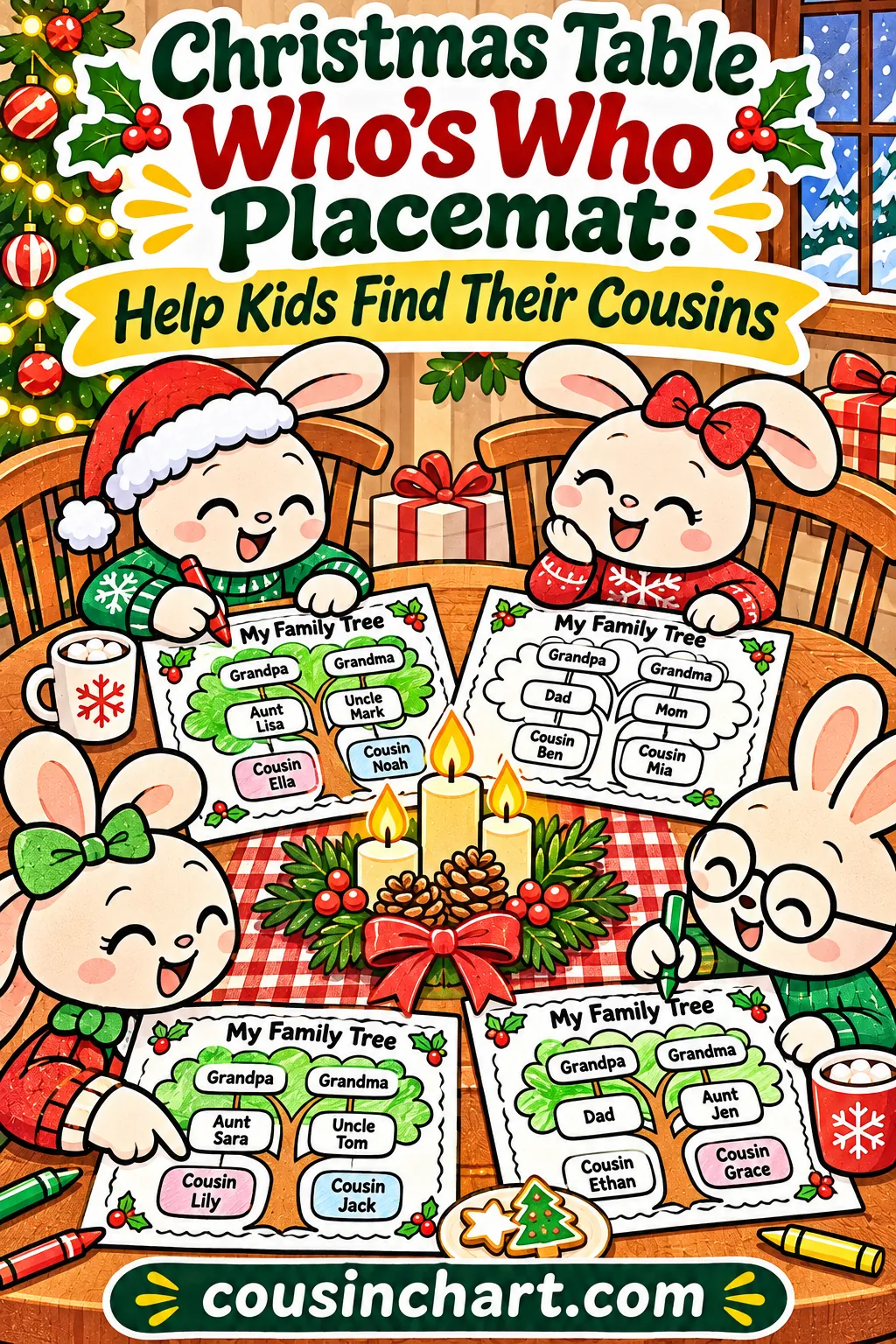
Print a small 3-generation family tree for every child's seat, fill in the grandparent boxes before dinner, and let each kid write their own name and their parents' names, then send them off to find which cousins share the same grandparents. It turns a long dinner into a game, and it quietly teaches kids how the whole family fits together. The free printable family tree makes each placemat in about a minute, with a 3-generation option, a family name title and photo circles you can fill in on screen.
Big Christmas dinners bring together people who only see each other once or twice a year. Kids sit next to "cousins" they've never really met, a new partner is trying to keep track of who belongs to whom, and somebody's great-aunt is being called "that lady in the red sweater." A who's who placemat fixes all of that gently. Kids get something to do while they wait for food, and the adults get an easy icebreaker. This guide covers exactly how to set up the placemat with the free tool, how to run the cousin detective game, a host's timeline for the week before Christmas, versions by age and family size, and what to do with tricky cases like step-relatives and divorced parents.
▶ Work it out in the free calculator
Why a Who's Who Placemat Works at Christmas Dinner
Most holiday tables have a simple problem: lots of relatives, not much shared knowledge. Kids often know their own grandparents but not that the boy across the table shares those same grandparents. Newcomers, such as a cousin's new spouse or a neighbor invited for the day, don't know anyone's connection at all.
A placemat works because it's right in front of everyone for an hour or more. It gives kids a job, sparks easy questions to adults ("Who's your grandma?"), and makes relationship words like "first cousin" and "great-aunt" concrete. Family history librarians and genealogy writers often suggest teaching kids relationship terms before a big gathering and turning it into a detective game, and reunion planners like to start with an icebreaker early because many guests don't know each other. The placemat does both at once.
Here's what it solves for each group at the table.
| Who's at the table | The usual problem | What the placemat does |
|---|---|---|
| Kids ages 5 to 12 | Bored waiting for food, shy with cousins | A task, a game and a reason to talk |
| Teens | Don't want to ask "who are you again?" | Lets them figure it out quietly |
| New partners and in-laws | Can't keep names and branches straight | A visual map of the family |
| Grandparents | Love sharing stories, rarely asked | Kids come to them with questions |
| The host | Worries about awkward silences | Built-in conversation starter |
What goes on each placemat
Each placemat is one sheet of paper with a small ancestor chart on it:
- You in the first box, the child sitting at that seat.
- Parents, the two boxes in the next column.
- Grandparents, the four boxes in the last column.
That's 7 boxes, the standard 3-generation layout. It's simple enough for a 6-year-old to fill in and detailed enough to make the cousin game work, because first cousins are the people who share a set of grandparents.
If you have older kids or a family that loves history, a 4-generation version adds the 8 great-grandparents, for 15 boxes. That's where second cousins come into play. More on that in the variations section.
How to Make the Placemats With the Free Printable Family Tree
The printable family tree tool draws a clean blank ancestor chart in your browser. Nothing gets uploaded, there's no sign-up and you can print as many as you want. Here's the exact setup for Christmas placemats.
Step-by-step settings
- Open the printable family tree page. Under "Choose your template," make sure Blank Family Tree is selected. It's the default.
- Click "3 generations." The page opens on 4 generations, so switch it. The chart now shows 7 boxes with column captions You, Parents and Grandparents, and the subtitle reads "3-Generation Ancestor Chart."
- Type the family name in the "Family name (optional)" box, up to 22 characters. Typing "Martinez" makes the title read "The Martinez Family Tree." If you type "Martinez Family," the tool trims the extra word so it doesn't say "Family" twice.
- Add grandparent photos, if you like. Tap any box to add a photo, and it's clipped to a circle. Photos stay on your device. Adding the grandparents' faces helps the youngest kids, who may not know Grandma's first name.
- Click "Print." Only the chart prints, and the rest of the page hides automatically. Print in landscape on letter or A4 paper.
- Or click "Download PNG" to save the image and print copies later, or send it to a print shop.
Each box has a dashed photo circle and a faint writing line for the name. The first box shows "(You)" when there's no photo in it, which is a handy prompt for kids.
One print setup per grandparent group
Here's the trick that saves a lot of time. All the kids who share the same grandparents also share the same grandparent boxes. So you can set up one chart per grandparent group, add those grandparents' photos and print a copy for every grandchild in that group.
For example, say Grandma Rose and Grandpa Luis have five grandkids coming to dinner. Set up one 3-generation chart, add Rose and Luis's photos to the right two grandparent boxes, and print five copies. Each kid writes their own name in You and their parents' names in the Parents boxes.
The other two grandparent boxes, the other side of the family, will be different for each child. Leave those blank for the kids to fill in, or ask parents to write them in before dinner.
What to write in ahead of time and what to leave blank
| Box | Fill in before dinner? | Why |
|---|---|---|
| Family name title | Yes, typed in the tool | Makes the placemat look finished |
| Shared grandparents (the hosting side) | Yes, with names or photos | This is the "clue" the game depends on |
| Other grandparents | Optional, by parents | Kids may not know these names |
| Parents | Leave blank | Kids write these, which is half the fun |
| You | Leave blank or add the name in fancy letters | Doubles as a place card |
The You box also works as a place card. Write each child's name in big letters, set the placemat at their seat, and you've solved the seating chart too.
The Cousin Detective Game: How to Play
Once everyone's seated and the placemats are filled in, the game is simple.
The goal: find everyone at the table who shares at least one grandparent with you, and figure out what to call them.
Basic rules
- Each player fills in their placemat: their own name, their parents, and as many grandparents as they know. They can ask any adult at the table for help.
- Players compare placemats with the people around them.
- Anyone with matching grandparent names is a first cousin (or a sibling, if the parents match too).
- Players write each cousin's name around the edge of their placemat.
- Bonus points for finding someone who's related in a trickier way, like a parent's cousin.
There's no need to keep score unless your kids love that. For many families, the fun is the hunt. If you want a winner, give a small prize to the first child who finds all their first cousins, and another to whoever correctly names the trickiest relationship at the table.
Clue cards for the hunt
Print or write a few clue cards and place them in the middle of the table. Kids pick one and try to solve it.
- "Find someone whose grandma is your grandma, but whose mom isn't your mom."
- "Find someone who calls your grandpa 'Dad.'"
- "Find the person at the table who is the oldest in their generation."
- "Find someone who's your mom's or dad's cousin."
- "Find someone who married into the family. Ask them how they met."
- "Find the person who has traveled the farthest to be here."
- "Find a great-aunt or great-uncle and ask what Christmas was like when they were your age."
These clues push kids to talk to adults, which is half the point. Grandparents and great-aunts often love being asked.
Scripts for kicking off the game
The host's first minute sets the tone. Keep it short, warm and clear. Here are a few lines you can borrow.
To start the game once everyone's seated: "Before we eat, everyone under 13 has a detective job. Your placemat is your family tree. Fill in your name and your parents, then find every person here who has the same grandma or grandpa as you. Grown-ups, you're allowed to help, but make them ask first."
For a shy child: "See that man in the green sweater? That's Uncle Ray. He's Grandpa's brother. Want to go ask him what Grandpa was like when he was a kid? I'll come with you."
For a teen who'd rather be on their phone: "You've got the hard version. Can you fill in all four great-grandparents on Mom's side before dessert? Aunt June is the only one who knows them all."
For a new partner or guest: "Here's a cheat sheet so you don't have to remember 30 names at once. The kids will probably quiz you, so consider yourself warned."
To wrap up before the food arrives: "Okay, detectives, show me your cousins. Who found the most? Who found the trickiest one?"
A little bit of drama goes a long way. Kids love being called detectives, and adults are usually happy to be interrupted with a good question.
Rules for the grown-ups
A quick word to the adults keeps the game fun:
- Answer, don't solve. Tell a child your name and how you're related to Grandma, but let them work out the cousin term.
- Share one short story. If a kid asks about a grandparent, give them one memory in a sentence or two.
- Don't correct a child in front of everyone. If a kid calls you a cousin when you're a great-aunt, gently show them the chart later.
Checking the answers with the cousin chart
Kids will get stuck on words like "once removed," and that's where the free relationship calculator on the CousinChart homepage helps. Tap a question that sounds like the puzzle, such as "My dad's cousin" or "My cousin's child," and it gives the exact term with a little chart. Older kids can use the plus and minus builders to work out unusual cases themselves.
For a table centerpiece, go back to the printable family tree page and choose Blank Cousin Chart instead. That prints the classic cousin relationship grid, with "Common Ancestor" in the corner and Child, Grandchild, Gt-Grandchild and so on down each side. Pin it in the middle of the table as the official answer key.
Relationship Words Kids Need Before Dinner
A few minutes of prep makes the game much more fun. Kids who already know four or five relationship words feel like real detectives, not lost. Go over these in the car on the way, or at breakfast on Christmas Eve.
The core words, explained for kids
| Word | Kid-friendly meaning | Example at the table |
|---|---|---|
| Sibling | Same parents as you | Your brother or sister |
| Aunt or uncle | Your mom's or dad's brother or sister | Mom's sister, Aunt Dana |
| First cousin | Your aunt's or uncle's kid. You share grandparents. | Aunt Dana's son |
| Great-aunt or great-uncle | Your grandma's or grandpa's sister or brother | Grandpa's sister, Aunt June |
| Second cousin | Your parent's cousin's kid. You share great-grandparents. | Aunt June's grandson |
| Once removed | One generation apart | Your mom's cousin, or your cousin's baby |
| By marriage | Family because someone married in, not by birth | Your aunt's husband |
| Step | Family because a parent remarried | Your stepdad's mom |
The one that confuses everyone, adults included, is "once removed." The simplest way to explain it to a child: "Removed means you're not in the same generation. Your mom's cousin is one step up, so she's your first cousin once removed. Your cousin's baby is one step down, and that baby is your first cousin once removed too." Our guide on how to explain cousins to kids has more ways to make it stick.
The one rule that solves most puzzles
Tell kids this: "Find the oldest person you both come from. If it's your grandparents, you're first cousins. If it's your great-grandparents, you're second cousins." Then, if the two people are in different generations, add "removed."
That single rule covers almost every cousin question at a typical Christmas table. Kids can test it on their placemats by finding matching boxes. Matching boxes in the Grandparents column means first cousins. Matching boxes in a Great-grandparents column, on a 4-generation chart, means second cousins.
A practice round before guests arrive
If your kids are young, run a quick practice with your own family. Point to your placemat and ask:
- "Whose name goes here?" (Pointing to the Parents boxes.)
- "Who's Grandma's mom?" (A great-grandparent. On a 3-generation chart, she isn't on the page, which is a fun thing to notice.)
- "If your cousin Max has the same Grandma and Grandpa as you, what is Max?" (A first cousin.)
- "What would Max's new baby sister be to you?" (Also a first cousin. Same grandparents.)
- "What would Max's future kids be to you?" (First cousins once removed.)
Five minutes of this, and your kids will be the ones explaining it to everyone else at dinner.
A Host's Timeline for the Week Before Christmas
Placemats take very little time to make, but a bit of planning keeps them from becoming a last-minute scramble.
| When | Task | Time needed |
|---|---|---|
| 7 to 10 days before | Get the guest list. Group kids by which grandparents they share. | 15 minutes |
| 7 to 10 days before | Ask parents for any missing names, like the other side's grandparents. | A few texts |
| 5 days before | Gather grandparent photos if you want them on the charts. | 15 minutes |
| 4 days before | Set up each chart in the tool and print a test copy. | 10 minutes per group |
| 3 days before | Print the final placemats, plus a few spares. | 15 minutes |
| 2 days before | Write clue cards and print a cousin chart answer key. | 20 minutes |
| Christmas Eve | Write names in the You boxes, if using them as place cards. Set out pens. | 15 minutes |
| Christmas Day | Set placemats at each seat, explain the game once everyone's seated. | 5 minutes |
| After dinner | Collect favorites or let kids take them home. | 5 minutes |
Supplies checklist
- Letter or A4 paper, plus a few heavier sheets for kids who want to keep theirs.
- A printer, or a print shop if you're making a lot.
- One pen or colored pencil per child, and a few spares. Pencils smear less than markers near gravy.
- Clue cards, written by hand or typed and printed.
- A printed cousin chart for the middle of the table.
- Small prizes, such as stickers or candy canes, if you're running the game with winners.
- A clear sheet protector or laminating pouch for each placemat, if you want to keep them clean and reuse them next year.
Keeping placemats clean
Paper placemats and Christmas dinner are a messy mix. Three easy fixes:
- Slide each one into a clear sheet protector. Kids can still write on them with a dry-erase marker, and spills wipe right off.
- Play the game before food comes out. Fill in the charts during appetizers, then swap placemats for plates when dinner arrives.
- Print two copies. One stays clean as a keepsake, and one lives at the table.
Variations by Age and Family Size
The basic setup works for most families, but you'll get more out of it if you match the version to your crowd.
By age
| Age group | Best setup | What they do |
|---|---|---|
| Ages 3 to 5 | 3 generations, photos in every box you can | Point to Grandma's photo, color the boxes, find kids with the same Grandma |
| Ages 6 to 8 | 3 generations, grandparent names filled in | Write own name and parents' names, find first cousins |
| Ages 9 to 12 | 3 or 4 generations | Fill in more names, solve clue cards, use the cousin chart |
| Teens | 4 or 5 generations | Interview great-aunts and uncles, fill in great-grandparents, find second cousins |
| Adults and newcomers | 3 generations, with the hosting family's names pre-filled | A quick map of who's who, no game required |
For the littlest kids, photos matter more than names. A 4-year-old won't recognize "Margaret" but will light up at a picture of Grandma. Add photos for every box you can before printing.
For teens, the bigger chart turns it into a real project. A 5-generation tree has 31 boxes, including 16 great-great-grandparents, and filling even half of them means a lot of questions to the oldest relatives at the table. Some teens end up with family stories nobody's told in years.
By family size
Small gathering (under 10 people): One chart for everyone may be enough. Print a single 4-generation tree for the table, and let kids fill it in together like a group puzzle.
Medium gathering (10 to 25 people): The standard plan. One placemat per child, grouped by grandparents, with the cousin game.
Large gathering (25 or more): Use color. Print each grandparent group's placemats on a different color of paper, or add a colored sticker. Kids with the same color share grandparents, so they're first cousins. Different colors mean a more distant relationship, which makes great detective work.
Mixed families with two sides at the table
Some Christmas dinners bring both sides together, such as Mom's parents and Dad's parents at the same table. That's a great setup for the game. Kids from one family may find they're first cousins with some children and not related at all to others, even though everyone calls everyone "cousin." Talk about that kindly. Being not related by blood doesn't make someone less welcome, and the game is a fun way to notice how two families have joined.
Tricky Family Situations, Handled Kindly
Real families aren't neat boxes, and a placemat should never make a child feel left out. Here's how to handle the common tricky spots.
Step-relatives and blended families
The standard ancestor chart shows birth or legal parents. For kids in blended families, offer choices. They can write a stepparent in a Parents box, add an extra name next to the box, or draw a small branch off the side. There's no wrong answer. The relationship calculator has a step setting next to blood and marriage, so older kids can check what to call a stepparent's relatives.
A simple line helps: "Families come together in lots of ways. Put the people who are your family on your tree."
Adopted children
Adopted kids belong in the family tree the same as anyone else. Their adoptive parents go in the Parents boxes, and their grandparents are the grandparents. If a child or their parents want to note birth family too, they can add a separate small branch, but never require it. Follow the family's lead.
Divorced or separated parents
If a child's parents are divorced, the child still fills in both parents. Grandparents on both sides stay grandparents. Avoid any clue card that asks kids to "find your parents' husband or wife," which could put a child on the spot.
Relatives who've passed away
Many families like to include grandparents or great-grandparents who've died, especially at Christmas. Photos of them on the placemat can lead to sweet stories. Just give a heads-up to anyone recently grieving, and let them decide whether they want that person's photo on every plate.
Guests who aren't related
Friends, neighbors and new partners deserve a placemat too. Give them a blank one and invite them to fill in their own family. Better yet, ask them to be a "detective helper" for a younger child. It's a warm way to welcome someone who might otherwise feel like an outsider.
Quick troubleshooting table
| Problem | Easy fix |
|---|---|
| A child doesn't know their grandparents' names | Have them ask a parent or grandparent at the table. That's part of the game. |
| Two kids argue about whether they're cousins | Find the shared grandparent together, then check on the cousin chart. |
| "Once removed" causes total confusion | Explain it as "one generation up or down," then show it with the calculator. |
| A newcomer feels left out | Give them a helper role or ask them about their own family. |
| A placemat gets a spill | Slide it into a sheet protector or print a spare. |
| A teen thinks it's babyish | Hand them a 5-generation chart and the job of interviewing the oldest relative. |
| The chart is too small to read | Print in landscape on letter or A4 paper, or use 3 generations instead of 4. |
| You run out of printed placemats | Use the Download PNG copy to print more from any printer. |
After Dinner: Keep the Family Map Going
The placemat doesn't have to end up in the recycling bin. A few ideas to keep it going:
- Make a family keepsake. Collect the placemats, stack them in a folder and label it with the year. In ten years, kids will love seeing their wobbly handwriting.
- Start a bigger family tree. Use the names kids gathered at dinner to fill in a 4- or 5-generation chart for the whole family. Our guide to family reunion games has more activities that use the same names.
- Write down the stories. If a great-uncle told a great story at dinner, write a line next to his name on the placemat.
- Do it again next year. Kids who played at age 6 will be ready for a 4-generation chart by age 9. Keep a copy of last year's to compare.
- Use it for thank-you notes. The placemat doubles as a list of who came to dinner, with names spelled right.
A sample 3-generation placemat, filled in
Here's how one child's placemat might look after dinner, written out in rows.
| Box | Name |
|---|---|
| You | Ava |
| Parent | Daniel |
| Parent | Priya |
| Grandparent (Dad's side) | Luis |
| Grandparent (Dad's side) | Rose |
| Grandparent (Mom's side) | Arjun |
| Grandparent (Mom's side) | Meera |
| Cousins found at dinner | Max, Sofia, Leo (share Luis and Rose) |
| Trickiest relative found | Aunt June, Grandpa Luis's sister, her great-aunt |
From this, Ava can see that Max, Sofia and Leo are first cousins on Dad's side, and that Aunt June is a great-aunt. If June's grandson is at the table too, he's Ava's second cousin, since they share great-grandparents: Luis and June's parents. That's the kind of "aha" moment that makes the game worth it.
Checking a mom's or dad's cousin
The relationship kids most often get wrong is a parent's cousin. They'll call that person "Aunt" or "cousin" and wonder which is right. The correct term is first cousin once removed. You can show them on the calculator by tapping "My dad's cousin," or read our article on what your mom's cousin is to you for a deeper explanation. In everyday life, plenty of families just say "Aunt" or "cousin" anyway, and that's fine at the dinner table.
Make Your Placemats Before the Big Day
A who's who placemat is one of the easiest Christmas activities you'll ever set up. It takes an hour of planning, a stack of paper and some pens, and it gives kids a reason to talk to relatives they barely know. Open the free printable family tree, choose 3 generations, add your family name and grandparents' photos, then print one for every seat. If a kid asks what a second cousin or a cousin once removed is, look it up together in the free cousin relationship calculator before the meal.
▶ Work it out in the free calculator
Frequently Asked Questions
How do I make a family tree placemat?
Open the free printable family tree, choose Blank Family Tree and click 3 generations. Type your family name, add photos to any boxes if you like, then print in landscape on letter or A4 paper. Each sheet becomes one placemat with 7 boxes: the child, two parents and four grandparents.
What age is the cousin detective game best for?
Kids ages 6 to 12 get the most out of the basic game, since they can write names and solve clue cards. Younger kids can play with photos instead of names. Teens do better with a 4- or 5-generation chart and the job of interviewing older relatives.
How do kids figure out who their first cousins are?
They compare the Grandparents column on their placemats. Anyone who shares a grandparent but has different parents is a first cousin. If they share great-grandparents but not grandparents, they're second cousins.
What does once removed mean, in simple words?
It means the two people are one generation apart. Your mom's first cousin is your first cousin once removed, and so is your first cousin's child. Twice removed means two generations apart.
Can I put photos on the printable family tree?
Yes. Tap any box on the printable family tree page to add a photo, and it's clipped to a circle. Photos stay on your device and aren't uploaded. They're especially helpful for young kids who don't know their grandparents' first names.
How many placemats should I print?
Print one for every child and any adult who wants one, plus three or four spares. If several kids share the same grandparents, set up one chart with those grandparents' photos and print a copy for each of them.
What if a child's family doesn't fit the standard tree?
Let them adapt it. Kids in blended families can add a stepparent, and adopted kids fill in their adoptive family like anyone else. Adding a small branch to the side of the chart is always fine, and no one should be required to share more than they want.
Is the printable family tree really free?
Yes. It's free with no account, no email and no watermark. The chart is drawn in your browser, so you can print or download as many copies as you need.