Are My Half-Brother's Cousins My Cousins?
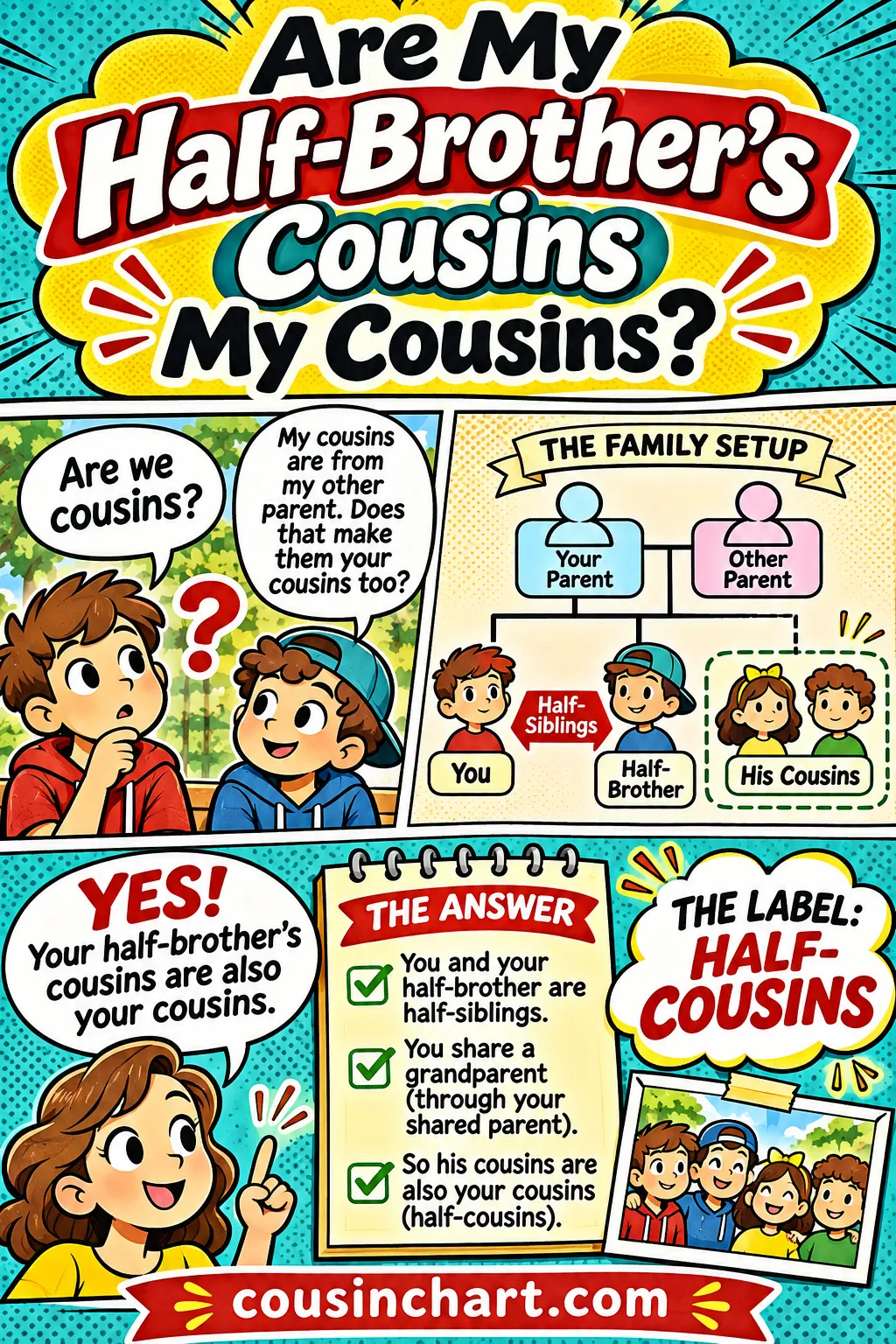
Your half-brother's cousins are your cousins only if they come through the parent you both share; cousins on his other parent's side aren't related to you by blood at all. It all depends on which side of his family they're on. You can check any of these links in seconds with the free Cousin Chart relationship calculator, which has a half-relationship option built in.
Half-sibling families are common, and the labels trip up almost everyone. You grow up calling someone your brother, and his family feels like your family. Then someone at a reunion asks, "So is she your cousin too?" and you're not sure. This guide sorts it out side by side, with worked examples, a quick-reference chart, the odd cases that break the usual pattern, and simple ways to explain it to kids and relatives.
▶ Work it out in the free calculator
The Short Answer: It Depends on the Side
Every half-sibling pair shares exactly one parent. That shared parent is the key to everything.
Picture it this way. You and your half-brother Jake share a mom. Jake's dad is a different man from your dad.
- Jake's cousins on your mom's side are the children of your mom's siblings. You share that mom, so those cousins are your first cousins too. Same aunts, same uncles, same grandparents.
- Jake's cousins on his dad's side are the children of his dad's siblings. You don't share that dad, so you don't share his parents or siblings either. Those cousins are Jake's family, but they're not related to you by blood.
That's the whole rule in two lines. The cousins on the shared side are yours. The cousins on the other side aren't.
Why the shared side gives you full cousins, not half cousins
A lot of people assume that because Jake is a half-brother, his cousins must be "half-cousins" to you. They aren't. Your mom's sister is your full aunt. Her kids are your full first cousins. Your half-brother being in the picture doesn't change your own line to your mom's family at all.
The word "half" describes the link between two people who share one parent. It doesn't spread sideways to every relative in the family.
The same rule works for half-sisters and shared dads
Nothing changes if your half-sibling is a sister, or if the parent you share is your dad. Swap the words and the logic holds:
- Share a dad? Your dad's nieces and nephews are first cousins to both of you.
- Your half-sister's mom's family is her family, not yours by blood.
The sex of the half-sibling never matters for cousin math. Only the shared parent does.
Who's Related to You and Who Isn't
Here's how the relatives line up when you share a mom with your half-brother. Flip "mom" and "dad" if you share a dad instead.
| His relative | Side | Generations from shared ancestor (you / them) | What they are to you | Typical shared DNA |
|---|---|---|---|---|
| His cousin through your shared mom | Shared | 2 / 2 from your mom's parents | First cousin | ~866 cM average |
| His cousin through his dad | Not shared | No common ancestor | Not related by blood | None expected |
| His dad's sister | Not shared | No common ancestor | Not related by blood | None expected |
| His son or daughter | Shared | 1 / 2 from your mom | Half-nephew or half-niece | About half of a full nephew |
| His kid and your kid | Shared | 2 / 2 from your mom | Half first cousins (to each other) | About half of full first cousins |
| His second cousin through your mom | Shared | 3 / 3 from great-grandparents | Second cousin | ~229 cM average |
DNA numbers are averages, and real matches vary a lot. Ranges for different relationships overlap, so a single number never proves one exact label.
A longer quick-reference chart for the whole family
Most questions aren't only about cousins. Once you start sorting a half-sibling's family, you'll want to place grandparents, aunts and in-laws too. This chart assumes you share a mom with Jake.
| Jake's relative | Through which parent | Blood relative of yours? | Your label |
|---|---|---|---|
| Jake's maternal grandma | Shared mom | Yes | Your grandma |
| Jake's paternal grandma | His dad | No | Jake's grandma only |
| Jake's maternal aunt | Shared mom | Yes | Your aunt |
| Jake's paternal uncle | His dad | No | Jake's uncle only |
| Jake's dad | His dad | No | Stepdad if he married your mom; otherwise no family title |
| Jake's paternal half-sister | His dad | No | Your half-brother's half-sister |
| Jake's wife | Marriage | No | Your sister-in-law |
| Jake's grandson | Shared mom | Yes | Your half-great-nephew |
| Your mom's first cousin's child | Shared mom | Yes | Second cousin to both of you |
That row about Jake's paternal half-sister surprises people. She's Jake's sister, and Jake is your brother, but you don't share a single parent with her. You aren't siblings, and you aren't blood relatives at all. More on that below.
Worked Examples With Real Family Math
Relationship names come from one question: who's the closest ancestor you both descend from, and how many generations down is each of you? Let's run a few.
Example 1: Jake's cousin Maya, on your mom's side
Maya's mother is your mom's sister. The closest ancestors you and Maya share are your mom's parents, your grandparents.
- From your grandparents down to you: grandparents → your mom → you. That's 2 generations.
- From your grandparents down to Maya: grandparents → Maya's mom → Maya. Also 2.
Two and two means first cousins. Jake gets the same answer, because he's also 2 generations down from those grandparents. Maya is a first cousin to both of you.
Example 2: Jake's cousin Theo, on his dad's side
Theo's father is the brother of Jake's dad. Theo and Jake share Jake's paternal grandparents.
Now try to find an ancestor you and Theo share. Your mom isn't related to Theo's family. Your dad isn't either. There's no common ancestor, so there's no blood relationship to name.
Theo is still someone you might see at Jake's birthday parties every year. Plenty of families call that kind of person a cousin out of affection, and that's fine. It's just not a genealogical cousin.
Example 3: Jake's daughter Lily
Your shared mom is the closest common ancestor here. You're 1 generation down from her. Lily is 2 generations down (mom → Jake → Lily). One and two is an aunt or uncle and niece or nephew.
Because the shared link runs through only one parent, Lily is your half-niece and you're her half-aunt or half-uncle. Day to day, most people just say niece and aunt. The half part matters most for DNA and for family tree records. There's a full walkthrough of what your half-sibling's child is to you if you want more on that one link.
Example 4: Your son and Jake's daughter
Your son and Lily are both 2 generations down from your shared mom. Two and two is first cousins. Because their parents are half-siblings, they're half first cousins. They share one grandparent, not a pair of grandparents.
Example 5: Maya's daughter and you
Now go one step further. Maya (your shared-side first cousin) has a daughter named Rosie. Who is Rosie to you, and is the answer different for Jake?
- Closest common ancestors: your mom's parents.
- You: 2 generations down.
- Rosie: 3 generations down (grandparents → Maya's mom → Maya → Rosie).
Two and three is first cousin once removed. The gap of one generation is the "once removed." Jake is also 2 generations down from those same grandparents, so Rosie is his first cousin once removed too. No half label, because Maya's mom and your mom are full sisters.
Example 6: Theo's son and Jake's son
This one's a check on the other side. Theo (Jake's paternal cousin) has a son, Eli. Jake has a son, Max.
- Closest common ancestors: Jake's paternal grandparents.
- Max: 3 generations down (grandparents → Jake's dad → Jake → Max).
- Eli: 3 generations down (grandparents → Theo's dad → Theo → Eli).
Three and three is second cousins. Max and Eli are second cousins. Your own son, though, has no link to Eli at all, since nobody on your side descends from Jake's paternal grandparents. Two kids who might be in the same family photo can have completely different answers depending on whose child they are.
Example 7: The half-sister you don't share
Jake's dad had a daughter, Nora, with another partner. So Jake has two half-siblings: you (through his mom) and Nora (through his dad).
Look for an ancestor you and Nora share. Her parents are Jake's dad and someone else. Your parents are your mom and your dad. No overlap anywhere. You and Nora aren't related by blood, even though you each call Jake your brother.
This setup is more common than people think, and it's worth putting on a family tree carefully. Jake sits in the middle of two separate families that touch only through him.
What "Half" Means When You Do the Math
A half relationship means two people share only one ancestor at the top of the path instead of a couple. Full siblings share both parents. Half-siblings share one. Full first cousins share both grandparents on one side. Half first cousins share just one.
That single missing ancestor cuts the expected DNA roughly in half. Full siblings share about 2,613 cM on average. Half-siblings share around the same range as a grandparent or an aunt. Full first cousins average about 866 cM, and half first cousins land around half of that.
The name stays almost the same, though. You just put "half" in front. There's a full guide to what a half-cousin is if you want to see how the label works further down the tree.
Half doesn't stack sideways
Here's where people get stuck. If you and Jake share a mom, then:
- Jake to you: half-brother.
- Jake's kids to you: half-nieces and half-nephews.
- Your mom's sister's kids to you: full first cousins.
- Your mom's sister's kids to Jake: also full first cousins.
The half label only applies along the path that runs through your shared parent and then down through one of you. It doesn't change how either of you relates to your mom's own family.
Half does carry straight down
While "half" doesn't spread sideways, it does follow the line downward. Every descendant of Jake keeps the half label in relation to you:
| Jake's descendant | Generations from your mom (you / them) | Label to you |
|---|---|---|
| Jake's child | 1 / 2 | Half-niece or half-nephew |
| Jake's grandchild | 1 / 3 | Half-grandniece or half-grandnephew |
| Jake's great-grandchild | 1 / 4 | Half-great-grandniece or half-great-grandnephew |
And between your descendants and his, it stays too:
| Pair | Generations from your mom | Label to each other |
|---|---|---|
| Your child and his child | 2 / 2 | Half first cousins |
| Your child and his grandchild | 2 / 3 | Half first cousins once removed |
| Your grandchild and his grandchild | 3 / 3 | Half second cousins |
Each of those half relationships is expected to share about half the DNA of the full version. Once you're out at half second cousins, the expected amount is small enough that the two people may not show up as a match at all.
Half-Siblings vs. Step-Siblings: Don't Mix Them Up
Half-siblings share a biological parent. Step-siblings don't share any parent; their parents married each other. That difference changes the cousin question completely.
| Situation | Cousins through their parent's family | Label |
|---|---|---|
| Half-sibling, shared side | Related by blood | Your first cousins |
| Half-sibling, other side | Not related by blood | Your sibling's cousins |
| Step-sibling, their side | Not related by blood | Often called step-cousins |
| Step-sibling, your side | Related to you only | Your first cousins |
If your mom married Jake's dad after you were born, and they later had Jake, then Jake is your half-brother and his dad is your stepdad. Jake's cousins on his dad's side are your stepdad's nieces and nephews. Some families call them step-cousins. There's still no blood tie.
The comparison of half-siblings vs. step-siblings walks through more of these blended-family setups.
When a stepdad becomes the link
Blended families often stack these layers. Say your mom married Rick when you were four. Rick had a daughter, Ava, from before. Then your mom and Rick had Jake.
- Ava to you: stepsister. No shared parent.
- Jake to you: half-brother. Shared mom.
- Jake to Ava: half-brother. Shared dad (Rick).
- Rick's sister's kids to Jake: first cousins.
- Rick's sister's kids to Ava: first cousins.
- Rick's sister's kids to you: step-cousins at most. No blood tie.
In that house, Jake is the one person who's a blood relative of everyone. You and Ava are each related to Jake, but not to each other, and each of you has a separate set of blood cousins.
Edge Cases That Change the Answer
The usual rule covers most families. A few setups break the pattern, and they're worth knowing because they show up in DNA results and family trees.
The two dads are brothers
Suppose your mom had you with Dan, and later had Jake with Dan's brother, Matt. You and Jake share a mom, so you're at least half-siblings. But your dads are also brothers, so you share your paternal grandparents too.
That makes you more than half-siblings. People often call this three-quarter siblings, and you'd be expected to share more DNA than typical half-siblings, though less than full siblings. In this case, Jake's paternal cousins (the kids of Dan and Matt's other siblings) are your paternal first cousins as well. The "other side" isn't other at all. The guide on what a three-quarter sibling is covers how that works.
The two families were already related
Small towns, close communities and long family histories sometimes mean Jake's dad's family and your dad's family share an ancestor several generations back. If so, you may share a distant cousin link with Jake's paternal cousins, entirely separate from Jake.
That doesn't make Theo your first cousin. It might make him, say, a fourth cousin through an older line. You'd work it out from that older shared ancestor, not through Jake.
Double cousins on the shared side
If two of your mom's siblings married two siblings from another family, their kids are double first cousins to each other. That doesn't change anything for you and Jake. Those kids are still your full first cousins through your mom, and Jake's too. The "double" part describes the cousins' link to each other.
An adopted half-sibling
If your mom adopted a child with a new partner, that child is your sibling in every legal and family sense. In terms of genealogy and DNA, though, the child doesn't share your mom's blood line, so your mom's nieces and nephews are that child's cousins by adoption, not by blood. Use the word the family uses every day, and note the adoption on the tree where it matters for medical or DNA records.
Donor-conceived half-siblings
Some people find half-siblings through a shared sperm or egg donor. You share a biological parent with them, so the shared-side rule still applies: the donor's nieces and nephews would be first cousins to all of the donor's children. You'd often have no contact with those families, and that's normal. The cousins through each half-sibling's other parent aren't related to you.
How to Check It With the Calculator
The relationship calculator works by asking for the relative you both come from, then how many generations down each of you is. Here's how to set it up for the common half-sibling questions.
Your half-brother's cousin on your shared parent's side
- Think of your shared parent's parents as the ancestors you both come from.
- Set generations down to you: 2.
- Set generations down to the cousin: 2.
- Leave the half option off, since your shared parent and the cousin's parent are full siblings.
- Result: first cousin.
Your half-brother's child
- Your shared parent is the relative you both come from.
- Set generations down to you: 1.
- Set generations down to the child: 2.
- Turn on the half relationship option, because you and your half-brother share only one parent.
- Pick the other person's sex if you want "niece" or "nephew" instead of the neutral term.
- Result: half-niece or half-nephew.
Your child and your half-brother's child
- Your shared parent is still the top of the path.
- Set 2 generations down for each child.
- Turn on half.
- Result: half first cousins.
Your half-brother's grandchild
- Your shared parent is the top of the path.
- Set generations down to you: 1.
- Set generations down to the grandchild: 3.
- Turn on half.
- Result: half-grandniece or half-grandnephew, depending on the sex you pick.
Your shared-side cousin's child
- Your shared parent's parents are the top.
- Set generations down to you: 2.
- Set generations down to the cousin's child: 3.
- Leave half off.
- Result: first cousin once removed.
A cousin on your half-brother's other side
There's no ancestor you both come from, so there's nothing to enter as a blood relationship. If the families are joined by a marriage, the relation type setting lets you look at step or marriage links instead of blood.
Once you've got a result, you can copy it, download the chart, or print it for a family tree project.
Calculator settings at a glance
| Question | Down to you | Down to them | Half option | Expected result |
|---|---|---|---|---|
| Half-brother himself | 1 | 1 | On | Half-brother |
| His shared-side cousin | 2 | 2 | Off | First cousin |
| His child | 1 | 2 | On | Half-niece or half-nephew |
| His grandchild | 1 | 3 | On | Half-grandniece or half-grandnephew |
| Your kid and his kid | 2 | 2 | On | Half first cousins |
| Shared-side cousin's child | 2 | 3 | Off | First cousin once removed |
| His other-side cousin | None | None | n/a | Not related by blood |
Mistakes people make with the settings
- Turning on half for shared-side cousins. The half option belongs only where the path runs through a single shared parent. Your mom and her sister are full siblings, so cousins through them are full.
- Counting from Jake instead of the common ancestor. The calculator needs the relative you both come from at the top. Start from your shared parent or her parents, never from your half-brother.
- Counting the wrong number of generations. Count steps, not people. You are 1 step down from your mom and 2 from her parents.
- Using blood when the link is a marriage. For a stepdad's relatives, switch the relation type to step or marriage. A blood setting can't find a link that isn't there.
When Families Use "Cousin" Anyway
Labels on paper and labels at the dinner table aren't always the same, and that's okay. Kids who spend every holiday together often call each other cousins whether or not they share blood. In blended families, it can feel unkind to correct a child who says "my cousin Theo."
A good approach:
- Use whatever word the family's comfortable with in daily life.
- Use the exact genealogical label in family trees, DNA notes and medical history.
- When you're unsure, describe the path: "my half-brother's cousin on his dad's side."
That last phrase is clear to everyone, and it doesn't claim more or less than the truth.
What to say when someone asks
Here are a few short scripts for common moments. Change the names to fit.
- At a reunion: "Theo's Jake's cousin on his dad's side, so we're not actually related, but we've known each other forever."
- To a curious kid: "Jake and I have the same mom, so Grandma's family belongs to both of us. Jake's dad has his own family, and Theo is part of that one."
- On a medical form: "Half-brother, shared mother." For cousins, list only the shared-side ones as blood relatives.
- To a DNA match: "I share a mother with my half-brother, so I'd expect to match his maternal cousins but not his paternal ones."
- If someone insists you're cousins: "We call each other cousins, and I love that. On the family tree, though, we're connected through Jake."
Explaining it to children
Kids handle this better with pictures than with rules. Draw two boxes for the two families that touch at your shared parent. Put the shared parent in the middle. Everyone above and beside that parent belongs to both of you. Everyone on the other side belongs to just one of you.
You don't need to correct a young child's use of "cousin" right away. When they're curious, a simple drawing and the words "shared side" and "other side" usually do the job. Keep it short and let their questions lead.
Putting Half-Sibling Families on a Family Tree
A clean family tree makes the cousin question obvious at a glance. A messy one hides it. A few habits help:
- Draw both of the half-sibling's parents. Even if you don't know much about Jake's dad, put him on the tree as a separate partner of your mom. That shows Jake's paternal side branches off on its own.
- Show each partnership as its own line. Your mom with your dad on one line, your mom with Jake's dad on another, with each child under the right pair.
- Label the half-siblings. A small "half" note under each child's name saves confusion later.
- Keep the other side short. You can add Jake's paternal cousins for completeness, but mark them as Jake's relatives so nobody assumes a blood tie to you.
- Note adoptions and donors. If a sibling was adopted or donor-conceived, a short note helps anyone using the tree for health or DNA work.
Checklist before you share the tree
- Every child sits under the correct pair of parents.
- Half-siblings are marked as half.
- Cousins through the shared parent appear under that parent's siblings.
- Cousins through the other parent are tied only to that parent's family.
- Step-relatives are shown with a different line style or a "step" note.
Common Mistakes to Avoid
- Calling the shared-side cousins half-cousins. They're your full first cousins. Only cousins whose parents are half-siblings get the half label.
- Assuming the other side is "a little related." It isn't. No common ancestor means no blood relationship, however close the family feels.
- Expecting a DNA match with his paternal cousins. If you both test and see no match with his dad's side, that's normal, not a mistake.
- Forgetting the half for your nieces and nephews. For DNA work, a half-niece shares roughly half what a full niece does, and that matters when you're sorting matches.
- Treating your half-sibling's other half-siblings as your siblings. If they come through his other parent, you share no parent with them. They're not your siblings or your blood relatives.
- Ignoring the edge cases. If the two dads are brothers, or the families were related before, the usual rule may not hold. When a DNA match looks too big or too small, check for one of those setups.
How DNA Results Show the Split
If you, Jake and a few cousins have taken DNA tests, the results usually draw the line for you.
- You and Jake should match at a half-sibling level.
- You and Maya (shared side) should match at a first cousin level.
- Jake and Maya should also match at a first cousin level.
- Jake and Theo (his dad's side) should match at a first cousin level.
- You and Theo should show no match.
That pattern is a good sanity check. If you match Theo at a meaningful level, something else is going on, maybe one of the edge cases above. If you don't match Maya at all, that's worth a second look, since full first cousins essentially always share detectable DNA. Ranges overlap, so you'll want more than one match to confirm any surprise.
Got a half-sibling puzzle of your own? Pop the generations into the free relationship calculator, switch on the half option if you share one parent, and you'll have the right label and a chart to keep.
▶ Work it out in the free calculator
Frequently Asked Questions
Are my half-brother's cousins related to me?
Only the ones on the side you share. If you share his mom, his cousins through her siblings are your first cousins too. His cousins through his other parent aren't related to you by blood.
Is my half-sister's aunt my aunt?
If the aunt is a sister of the parent you share, she's your full aunt. If she's a sister of your half-sister's other parent, she isn't related to you by blood, though some families still call her aunt.
What are my kids to my half-brother's kids?
They're half first cousins. Their parents are half-siblings, so the kids share one grandparent instead of a grandparent couple. They'll usually share around half the DNA that full first cousins do.
Do half-siblings have the same cousins?
On the side they share, yes, and those cousins are full first cousins to both of them. On each sibling's other side, they have separate cousins who aren't related to the other sibling.
Would I match my half-brother's paternal cousins on a DNA test?
You shouldn't, if you only share a mother. You have no common ancestor with his father's family. If you do match them, it may point to a separate family connection worth looking into.
Is my half-brother's half-sister my sister?
Only if you share a parent with her. If she's his sister through his other parent, you have no parent in common, so she isn't your sister or your blood relative. You're both connected to him, not to each other.
Are my half-brother's paternal grandparents my grandparents?
No. They're the parents of his dad, and you don't share his dad. Some families invite everyone to call them Grandma and Grandpa, which is a kind gesture, but there's no blood tie.
What if our dads are brothers?
Then you share more than one parent's family. You're often called three-quarter siblings, and his paternal cousins are your paternal first cousins too. Expect more shared DNA than ordinary half-siblings, though ranges overlap.