Ancestry Says We're Second Cousins but We Share No Great-Grandparents: Why?
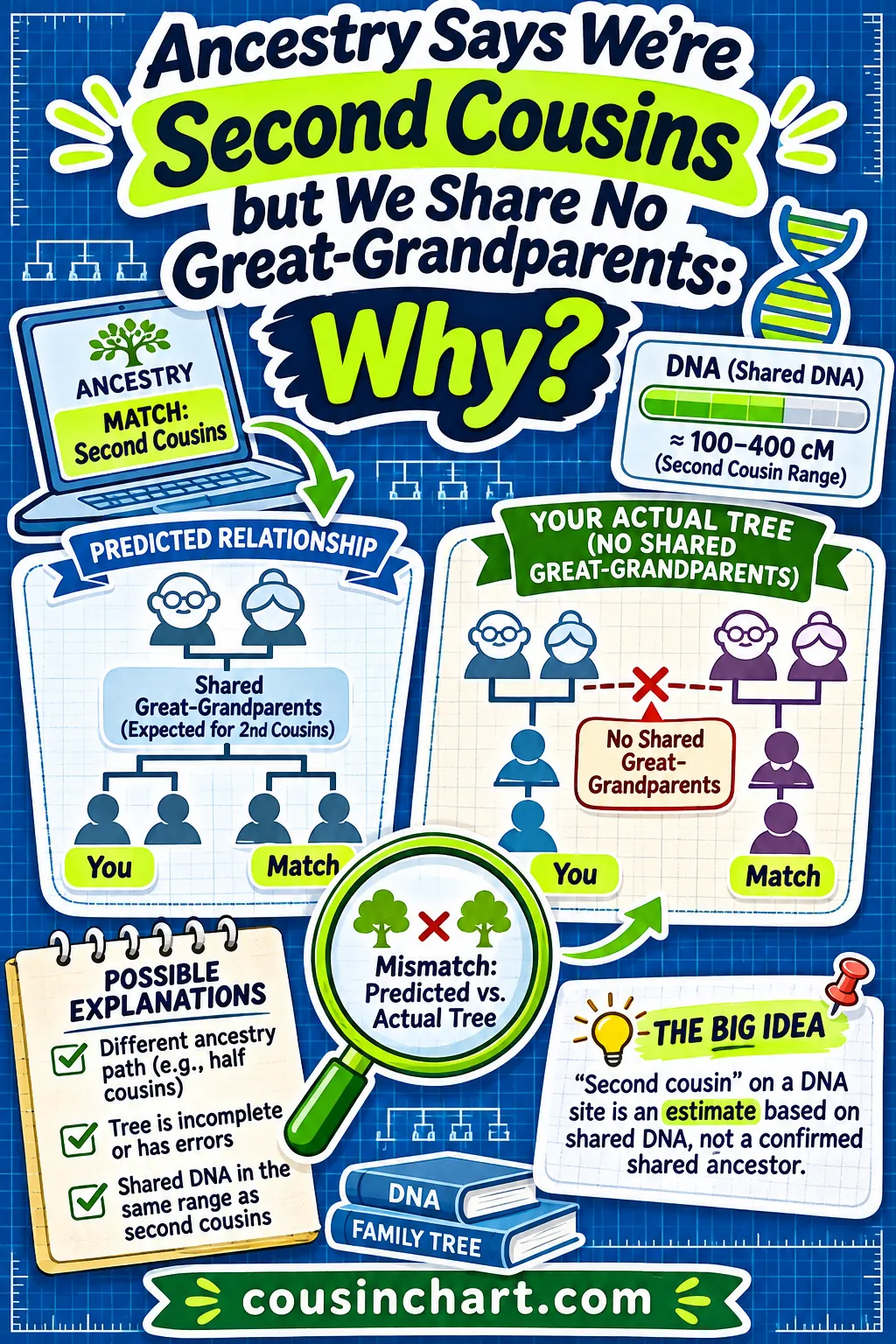
When Ancestry says second cousin but not in your tree, it's usually because the label is a prediction from the amount of DNA you share, and several other relationships share that same amount. A first cousin twice removed, a half first cousin once removed or a second cousin once removed can all look like a second cousin on paper. Plug your shared centimorgans into the free DNA match calculator to see every relationship that fits your number.
So the label isn't exactly wrong. It's just one guess out of a short list. Your job is to work out which item on that list matches the paper trail, and this guide shows you how. You'll find the six most common reasons, worked examples with real generation math, a step-by-step workflow, a message you can send the match, and the mistakes that send people down the wrong branch.
▶ Work it out in the free calculator
What the "Second Cousin" Label Really Means
DNA testing companies don't know your family tree when they label a match. They measure how much DNA the two of you share, in centimorgans (cM), and compare it to the amounts that known relatives tend to share. Then they show the relationship that's most likely for that amount.
Full second cousins share about 229 cM on average. But that's an average, not a fixed number. Real second cousins land well above and below it, because DNA gets shuffled each generation in a random way.
Here's the catch. Other relationships share amounts in that same zone:
| Relationship to you | Shared ancestors | Generations down (you / match) | Typical shared DNA |
|---|---|---|---|
| Second cousin | A great-grandparent couple | 3 / 3 | About 229 cM on average |
| First cousin twice removed | Your 2nd-great-grandparents | 4 / 2 | Similar to a second cousin |
| Half first cousin once removed | One great-grandparent (or one grandparent) | 3 / 2 or 2 / 3 | Similar to a second cousin |
| Second cousin once removed | Your 2nd-great-grandparents or great-grandparents | 4 / 3 or 3 / 4 | Lower on average, wide overlap |
| Half second cousin | One great-grandparent | 3 / 3 | About half of a full second cousin, on average |
| Third cousin | Your 2nd-great-grandparents | 4 / 4 | About 73 cM on average; rarely reaches this zone |
Ranges vary and overlap, so treat every number above as a rough guide, not a rule. A match at 200 cM could be any of the first four rows. The label just picks the most common one.
For a fuller picture of how much DNA different cousins share, see the guide to how much DNA cousins share.
Why the overlap exists
Each time DNA passes from parent to child, it's split and shuffled at random. Two second cousins might get lucky and inherit lots of the same pieces from their shared great-grandparents, or unlucky and inherit very few. A first cousin twice removed sits on a different path to the same kind of number. Once you add up enough random shuffles, the ranges for neighboring relationships pile on top of each other. That's not a flaw in the test. It's how inheritance works.
Before You Start: Gather Five Facts
You'll solve this faster if you collect a few details first. Write them down in one place.
- The shared cM. The total amount you share with the match.
- The match's approximate age or birth year. From their profile, their tree or their own message.
- Their tree, as far back as it goes. Note the names, places and birth years of their parents, grandparents and great-grandparents.
- Your own tree, one generation further back than you think you need. Go to your 2nd-great-grandparents on every line if you can.
- Your shared matches. The people who match both of you, and which side of your family each one comes from.
If the match has no tree, don't give up. Shared matches and age can still narrow things a lot.
Reason 1: You're Once or Twice Removed
This is the most common answer. "Removed" means the two of you sit in different generations from the shared ancestor. The DNA amount for a removed cousin can look a lot like a full cousin of a different degree.
Worked example: your grandma's first cousin
Say your match is 82 years old and you're 35. Ancestry labels her your second cousin. You look at her tree and see none of your great-grandparents.
Now look one step further back. Her grandparents are Peter and Anna. Peter and Anna are also your grandmother's grandparents, which makes them your 2nd-great-grandparents.
Count it out:
- From Peter and Anna down to your match: 2 generations (her parent, then her).
- From Peter and Anna down to you: 4 generations (grandma's parent, grandma, your parent, you).
The smaller count is 2, so the cousin degree is 2 − 1 = first cousin. The gap is 4 − 2 = 2, so she's twice removed. She's your grandma's first cousin, your first cousin twice removed.
You don't share great-grandparents. You share 2nd-great-grandparents. And the DNA you share is right in second-cousin territory, which is why the label said what it did.
Worked example: your parent's second cousin
Now say your match is your dad's age. If your common ancestors turn out to be your 2nd-great-grandparents, and your match is 3 generations down from them while you're 4, that's a second cousin once removed. On average, that's less DNA than a full second cousin, but a lucky match can easily land in the second-cousin range.
The guide to second cousin vs. second cousin once removed covers how to tell these two apart on a tree.
Worked example: your second cousin's child, in the other direction
Removed works both ways. Say the match is 20 years younger than you, and the shared couple turn out to be your great-grandparents. You're 3 generations down, and the match is 4. That's also a second cousin once removed, but this time the match is the younger one: your second cousin's child.
If you only looked for the shared couple in your great-grandparents' generation of the match's tree, you'd miss it. For this match, the same couple sit at their 2nd-great-grandparents. Always check one generation further back on the side of the younger person.
Reason 2: It's a Half Relationship
A half relationship means you share only one ancestor instead of a couple. This happens with second marriages, earlier relationships or a parent who had children with more than one partner.
Half first cousin once removed
Say your great-grandfather had a child with his first wife, then remarried and had your grandmother. Your match descends from that first-wife child. Your grandmother and the match's parent are half siblings.
That makes the match a half first cousin once removed if she's your parent's half first cousin. Half relationships share roughly half the DNA of the full version, so a half first cousin once removed often shares about the same amount as a full second cousin.
You may not "see" the shared great-grandparent because your tree only lists him with his second wife. Look for earlier marriages.
Half second cousin
If you and the match are both great-grandchildren of the same man but by different wives, you're half second cousins. On average, half second cousins share about half as much as full second cousins. A high-end match could still get labeled as a second cousin, though it's less common.
The page on half second cousins walks through how to draw this on a tree.
Worked example: the widower's two families
Here's a full case. Your match, Diane, shares 214 cM with you and is labeled a second cousin. She's about 25 years older than you. Her tree shows her mother as Ruth Hale, and Ruth's parents as Walter Hale and Edna Price. Your great-grandparents on that line are Walter Hale and Lillian Moore.
The same Walter appears in both trees, with a different wife. Records show Edna died young, and Walter remarried Lillian.
Count from Walter alone:
- Walter to Diane: Ruth (1), Diane (2). That's 2 generations.
- Walter to you: your grandfather (1), your parent (2), you (3). That's 3 generations.
The smaller count is 2, so the base is first cousin. The gap is 1, so once removed. Because you share only Walter, it's a half first cousin once removed. Diane is your parent's half first cousin. At 214 cM, the number fits the half relationship well, and the age gap fits a generation difference.
Without the second marriage in your tree, you'd never find this. Ruth Hale was your grandfather's half sister, and the family may simply never have mentioned her.
Reason 3: You're Related More Than One Way
Sometimes the DNA total is really two smaller connections added together. If your families come from the same small town, island, religious community or immigrant group, you may share ancestors on two or three lines.
Here's how it can play out. A third cousin on your dad's side who's also a fourth cousin on your mom's side might share more DNA than a typical third cousin. The total can look like a closer relationship than either line alone.
This pattern is called endogamy when it runs through a whole community. If your family tree shows the same surnames marrying in over and over, read up on what endogamy is before you trust any predicted label.
Signs you're looking at a double connection
- The match shows up in your shared matches with cousins from both your mom's side and your dad's side.
- Your tree and theirs have several surnames in common, not just one.
- Both families lived in the same small area for generations.
- The match shares a lot of small segments rather than a few big ones, if your testing site shows segment counts.
When you see these signs, look for each connection separately. Expect each one to be more distant than the label suggests.
Worked example: two third-cousin links
Your match, Tomas, shares 168 cM and is labeled a second cousin. He's your age. Your families both come from the same small fishing village, and you share three surnames between your trees.
After some digging, you find two connections. On your dad's side, you and Tomas both descend from the Silva couple, who are your 2nd-great-grandparents and his. That's 4 generations down for each of you, so third cousins. On your mom's side, you both descend from the Costa couple, also 2nd-great-grandparents to each of you. That's a second third-cousin link.
Third cousins share about 73 cM on average. Two separate third-cousin links could add up to something in the range of 140 to 150 cM on average, and your 168 cM sits not far above that. The label guessed one closer relationship because it saw one total. The truth is two more distant ones.
In the relationship calculator, check each link on its own: 4 and 4 for the Silva line, 4 and 4 for the Costa line. Both read third cousin. Write them down as "double third cousins" in your notes so you don't lose track of either path.
Reason 4: The Tree Has a Gap or an Error
This one needs a gentle hand. Sometimes the tree you're comparing against isn't complete or isn't right.
Common causes:
- A mistake in an online tree. Someone attached the wrong parents to an ancestor, and others copied it.
- A missing generation. Two people with the same name got merged into one.
- An unknown adoption. A child was raised by relatives, and the paperwork never made it into the family story.
- A different biological parent. A surprise in a past generation can mean the real shared couple isn't the one on paper.
Go gently with surprises
If the evidence starts pointing to an adoption or a different parent, slow down. The people involved may still be living, or their children may be. A discovery like this can mean a lot to someone, in good and hard ways.
A few steps help:
- Keep your notes private until you're sure.
- Look for a second and third piece of evidence before drawing a conclusion.
- Think about who would want to know first, and how.
You don't have to resolve it all at once. Sometimes the kindest path is to confirm the facts quietly and decide later what, if anything, to share.
None of these make the DNA wrong. They mean the tree needs another look. Check every generation between you and your likely shared ancestors against original records, not just other people's trees.
How to spot a tree error
- Impossible dates. A mother who was 9 or 62 at a child's birth, or a child born after a parent's death by more than a year.
- Copied trees with no sources. If ten trees agree but none cites a record, they may all trace back to one guess.
- Same name, same place. Two men named John Miller in one county can easily get merged into one person.
- A shared match pattern that doesn't fit. If your known cousins on one branch don't match the person at all, the branch on paper may not be the real one.
Worked example: a grandparent raised by an aunt
Your match, Helen, shares 241 cM and is your age. Neither tree shows a shared great-grandparent. But all of your shared matches with Helen come from your mom's father's side, and none come from his mother's family, the Greens.
Your grandfather's records list his parents as Frank and Mae Green. Digging into an old census, you find him at age 2 living with Frank and Mae, listed as "nephew," not "son." Mae's sister, Clara, had given birth to him the year before and later married and moved away.
So your grandfather's birth mother was Clara, not Mae. Helen descends from Clara's later marriage, which makes her Clara's great-grandchild. Clara is your great-grandmother too. You're both 3 generations down from her, and you share only her, so you're half second cousins. At 241 cM, Helen is on the high side for a half second cousin, but within reach.
This kind of finding can be tender for the family. Your grandfather may never have known, or may have known and kept it quiet. Take your time deciding what to share, and with whom.
Reason 5: You're Looking at the Wrong Half of Their Tree
This one's simple but easy to miss. Most people check the match's tree for their own surnames and stop at the first familiar name. But the connection may be on the match's other parent's side, a branch they haven't filled in yet.
If their father's side is full and their mother's side is blank, the real link may sit on the blank side. Your shared matches can tell you which. If the mystery match shares DNA with a known cousin of yours whose own tree overlaps only the match's mother's family, that's your clue.
Worked example: the blank maternal side
Your match, Marcus, shares 232 cM and is close to your age. His tree has four generations on his father's side and only his mother's name, Linda Ortiz, on the other. You spend an evening comparing his father's side to yours and find nothing.
Then you look at your shared matches. Marcus shares DNA with two known second cousins from your mom's Ortiz line. So you build Linda's family down from your own records instead of waiting for Marcus to fill it in. Linda turns out to be the daughter of your grandmother's brother, Ray Ortiz.
That makes Linda your mom's first cousin. Marcus is Linda's son, so he's your mom's first cousin once removed and your second cousin. The label was right all along. The answer was just on the half of his tree he hadn't built yet.
Reason 6: The Kit Belongs to Someone Else
Many people manage DNA kits for parents, grandparents or other relatives. The name you see on the profile, and sometimes the tree attached to it, may belong to the manager rather than the person who actually tested.
So a match shown as "J. Brooks, age 40" might really be a kit for J. Brooks's 78-year-old mother. That changes the generation math completely. A 78-year-old second cousin once removed (one generation above you) shares DNA in the same zone as a second cousin.
If the age and tree don't add up, ask the match politely: "Is this your own test, or do you manage it for a relative?" The answer often settles everything.
Worked example: the manager's tree
You match "Kevin R." at 226 cM, labeled a second cousin. His profile looks like a man in his 40s, and his attached tree is full of names you've never seen. You message him, and he replies that the kit is his mother-in-law's. He attached his own tree by mistake.
His mother-in-law, Joan, is 79. Her real tree shows her grandparents as Albert and Rose Dunn. Albert and Rose are your 2nd-great-grandparents. Joan is 2 generations down from them, and you're 4. That makes her your first cousin twice removed, your grandparent's first cousin.
Nothing was wrong with the DNA or with your tree. The profile just pointed you at the wrong person. Once you knew whose DNA it was, the answer took five minutes.
Quick Reference: Which Candidate Fits?
Use the age gap and your tree to pick the most likely candidate. This table assumes a shared cM near the second-cousin average.
| What you notice | Most likely relationship | Where to look for the shared ancestor |
|---|---|---|
| Match is your age, tree is bare | Second cousin | Ask for their grandparents' names |
| Match is your age, one shared ancestor | Half second cousin | Your great-grandparents' other marriages |
| Match is about a generation older | Second cousin once removed or half first cousin once removed | Their great-grandparents, your 2nd-great-grandparents, and earlier marriages |
| Match is about two generations older | First cousin twice removed | Their grandparents, your 2nd-great-grandparents |
| Match is about a generation younger | Second cousin once removed | Their 2nd-great-grandparents, your great-grandparents |
| Match connects on both your mom's and dad's side | Two smaller connections | Each side separately |
| Nothing fits on either tree | Tree gap or kit managed for someone else | Check records and ask the match |
How to Check It With the Calculator
The free DNA match calculator is built for exactly this. It shows every relationship that fits a cM number, not just the top guess.
Here's how to use it:
- Find your shared cM. Open the match on your testing site and note the total shared DNA in centimorgans.
- Enter the number. Type it into the DNA match calculator.
- Read the full list. You'll see likely relationships for that amount. For a number near 229 cM, expect second cousin to sit alongside once-removed and half relationships.
- Match the list against the tree. Go through each option and ask whether the ages and generations make sense.
A worked example from start to finish
Say your match shares 238 cM, and the testing site labels them a second cousin. Their tree lists their grandparents as Joseph Kowalski and Helen Nowak. Neither name appears among your great-grandparents.
You enter 238 in the calculator. Second cousin is on the list, but so are first cousin twice removed, half first cousin once removed and second cousin once removed.
Next, you check ages. The match was born in 1951, and you were born in 1989. A 38-year gap makes a same-generation second cousin less likely.
Then you look one generation further back. Joseph Kowalski's parents were Jan and Maria Kowalski. Your great-grandmother, Sophie, was also a daughter of Jan and Maria. So Joseph and Sophie were siblings.
Count it: the match is 2 down from Jan and Maria, and you're 4 down. That's first cousin twice removed. The DNA fits, the ages fit and the tree fits.
Use ages to narrow it down
Ages do a lot of work here. If your match is 40 years older than you, a once- or twice-removed relationship is far more likely than a same-generation second cousin. If you're the same age, a half second cousin or a full second cousin fits better.
Confirm the label with the relationship calculator
Once you've picked a candidate shared ancestor, check the name of the relationship with the Cousin Chart relationship calculator. Set how many generations down from that ancestor you are and how many the match is. For the grandma's-cousin example, set yourself at 4 and the match at 2, and you'll see first cousin twice removed. If the shared ancestor is just one person, turn on the half relationship option.
Calculator settings for every candidate
| Candidate | Your generations | Match's generations | Half option | Name you'll see |
|---|---|---|---|---|
| Second cousin | 3 | 3 | Off | Second cousin |
| Half second cousin | 3 | 3 | On | Half second cousin |
| First cousin twice removed | 4 | 2 | Off | First cousin twice removed |
| Half first cousin once removed | 3 | 2 | On | Half first cousin once removed |
| Second cousin once removed (match older) | 4 | 3 | Off | Second cousin once removed |
| Second cousin once removed (match younger) | 3 | 4 | Off | Second cousin once removed |
Use Copy result or Download my chart to save the chart for whichever candidate fits. Keeping the chart with your notes makes it easy to explain the connection to the match later.
Use Shared Matches to Find the Right Branch
Your shared matches are your best clue to which branch this person sits on. If the mystery match also matches several known cousins from your grandmother's side, you know where to look.
Try these steps:
- List the shared matches you already know.
- Note which of your grandparents' lines each known match comes from.
- See which line shows up most.
- Search that line one or two generations further back than you'd expect.
If the shared matches all point to one great-grandparent couple, but the match isn't descended from them, check their parents and siblings next. That's where the removed cousins and half relationships tend to hide.
The guide to shared DNA matches explains how to group them and read the pattern.
A Step-by-Step Workflow
When a second-cousin label doesn't fit your tree, work through these steps in order.
- Enter the cM in the DNA match calculator and write down every likely relationship.
- Check the age gap. Cross off candidates that don't fit the generations.
- Sort the match to a side using shared matches: mom's side, dad's side or both.
- Narrow it to one grandparent's line using shared matches with known cousins.
- Extend that line back to your 2nd-great-grandparents, including siblings and every marriage.
- Build the match's tree down from the candidate couple if their own tree is thin.
- Look for the overlap and count the generations on both sides.
- Confirm the name in the relationship calculator, with the half option if needed.
- Test it against a second match. Another cousin from the same couple should also fit.
Step 9 matters. One match can fit a theory by chance. Two or three matches from the same couple make it solid. The guide on how to confirm a DNA match covers this in more detail.
What to Say to the Match
A short, friendly message often solves the mystery in a day. Here's a template you can adapt.
Hi! DNA says we're close cousins, and I'm trying to work out the connection. My grandparents on this side are [names], from [place]. Do any of these names sound familiar? If you're able to share your grandparents' names, I'd be glad to compare notes. Thanks for any help!
A few tips:
- Lead with your own names so they don't feel quizzed.
- Ask one simple question, not five.
- If you suspect they manage the kit for someone else, ask kindly.
- Don't mention a possible adoption or surprise parent in a first message. Wait until you're sure, and think about how it might land.
Common Mistakes and How to Fix Them
| Mistake | What goes wrong | The fix |
|---|---|---|
| Trusting the label as the answer | You search only your great-grandparents | Check every candidate in the calculator |
| Stopping at great-grandparents | You miss removed cousins | Go one generation further back on every line |
| Ignoring the age gap | Same-generation guesses for a much older match | Let age cross off candidates first |
| Listing each ancestor with only one spouse | Half relationships disappear | Search for earlier and later marriages |
| Checking only one side of the match's tree | The real link is on their blank side | Use shared matches to pick their side |
| Assuming the profile is the tester | Wrong age, wrong generation | Ask if the kit is managed for someone else |
| Drawing a conclusion from one match | A coincidence looks like proof | Confirm with two or more matches from the same couple |
When the Label Is Probably Right After All
Sometimes the label is right and the tree is just incomplete. If the match is about your age, shares close to the 229 cM average, and has a bare tree, there's a fair chance you really are second cousins.
In that case, ask the match about their grandparents. Second cousins share great-grandparents, so learning the match's grandparents' names is often enough to make the connection. A friendly, short message works best. Explain who you are, name your grandparents and ask if any names ring a bell.
Get the full list of possibilities
A predicted label is a starting point, not an answer. Run your shared cM through the free DNA match calculator, compare each option with ages and shared matches, and you'll usually find the real connection hiding one generation back or on a half line.
▶ Work it out in the free calculator
Frequently Asked Questions
Why does Ancestry say second cousin when we don't share great-grandparents?
The label is based only on how much DNA you share. Several relationships share about the same amount, including first cousin twice removed, half first cousin once removed and second cousin once removed. Your real shared ancestors may be one generation further back, or just one person instead of a couple.
Can a second cousin once removed show up as a second cousin?
Yes. Second cousins once removed share less DNA than second cousins on average, but the ranges overlap a lot. A match on the high end can easily get the closer label.
How much DNA do second cousins share?
Second cousins share about 229 cM on average. Real amounts vary widely above and below that, and they overlap with several other relationships. That's why it's best to look at the full list of possibilities, not just one label.
Could my match be a half second cousin?
Yes, if you share one great-grandparent but descend from different partners. Half second cousins share about half as much DNA as full second cousins on average. Check for earlier or later marriages in your great-grandparents' generation.
What if the DNA doesn't fit my tree at all?
Double-check each generation of your tree against original records. Online trees can have copied mistakes, and some families have adoptions or parent changes that were never written down. Shared matches can point you to the branch where the real connection sits.
Is the predicted relationship ever exactly right?
Often, yes. If the match is your age and shares close to the average for second cousins, the label may be correct and the tree just needs filling in. Ask the match for their grandparents' names to confirm it.
Could the match be managing someone else's DNA kit?
Yes, and it's common. People often manage kits for parents or grandparents, so the name, age and tree you see may belong to the manager. Ask politely whose test it is before you work out the generations.
Can a third cousin be labeled a second cousin?
It's rare for a single connection, since third cousins share about 73 cM on average. It happens more often when you're related through two lines or come from an endogamous community. Look for a second connection before you accept the closer label.
My match is much older. Which relationship is most likely?
A large age gap points to a removed relationship. A match about two generations older often turns out to be a first cousin twice removed, and one generation older often a second cousin once removed or half first cousin once removed. Check their grandparents and great-grandparents against your 2nd-great-grandparents.