Second Cousin vs Second Cousin Once Removed
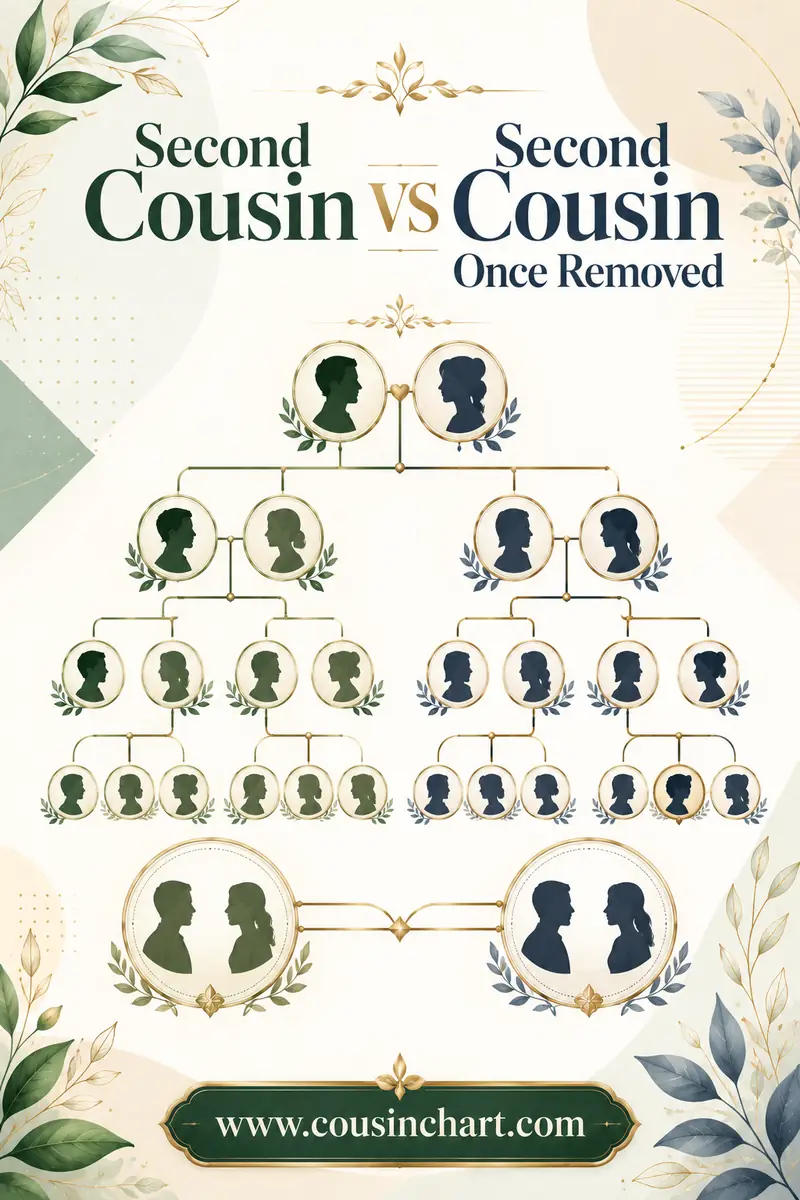
A second cousin is someone your own age-tier who shares great-grandparents with you. A second cousin once removed is that same relationship shifted by one generation — either your second cousin's child, or your parent's second cousin. The "once removed" simply means one of you sits a generation higher or lower on the family tree. Same branch, different floor.
That's the entire difference. This guide makes it stick with a side-by-side chart, real examples, and the DNA numbers that trip people up on testing sites. If you've ever squinted at a match labeled "2C1R" and wondered what it meant, you're in the right place. And whenever you'd rather skip the counting, the free relationship calculator names the tie for you instantly.
Relationship quick-check. Tap a relative to see whether they’re a second cousin or once removed:
The answer will appear here.
The Core Difference in One Line
Here it is, stripped to the essentials:
- Second cousin = same generation as you, sharing great-grandparents.
- Second cousin once removed = one generation apart, but still on that same second-cousin branch.
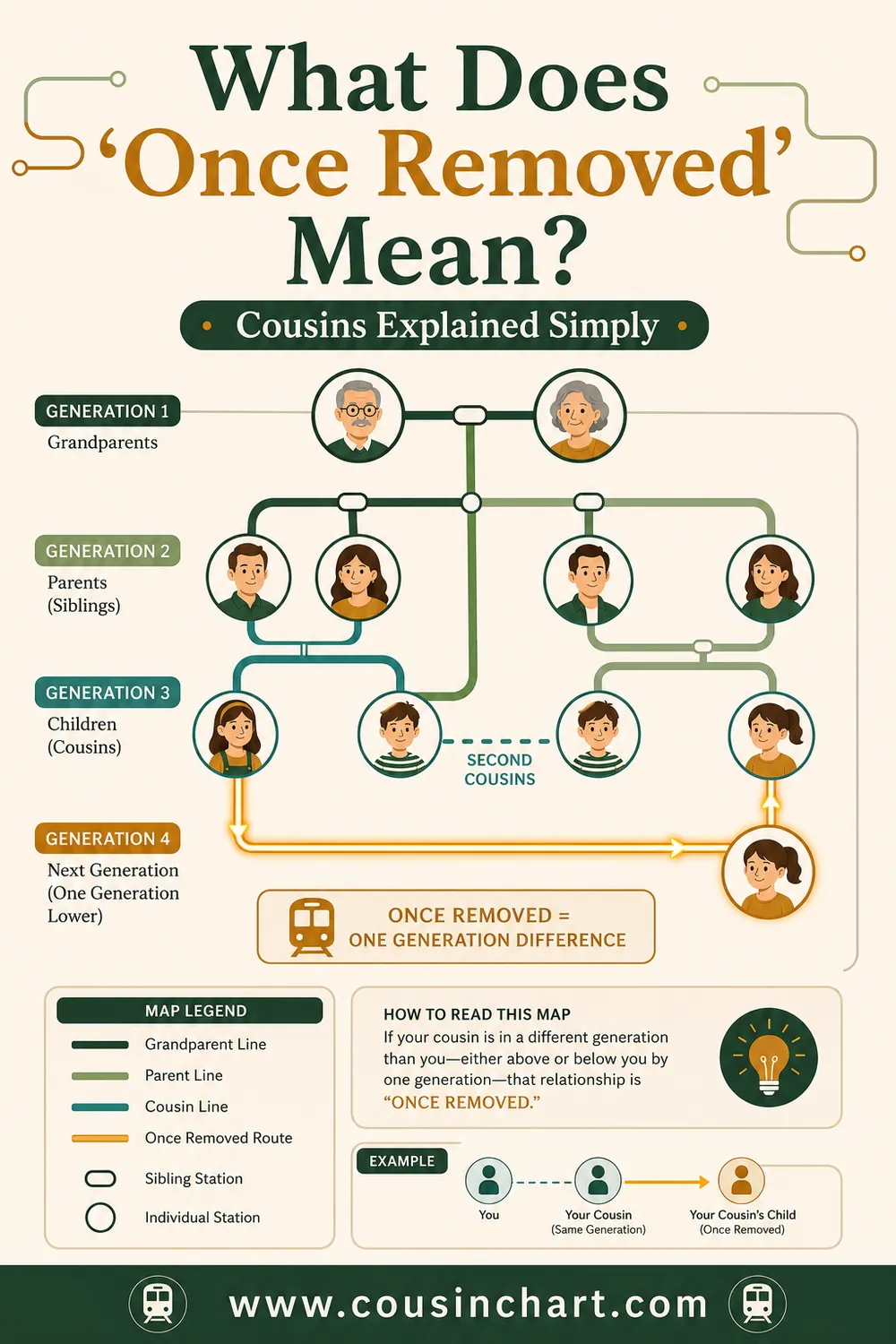
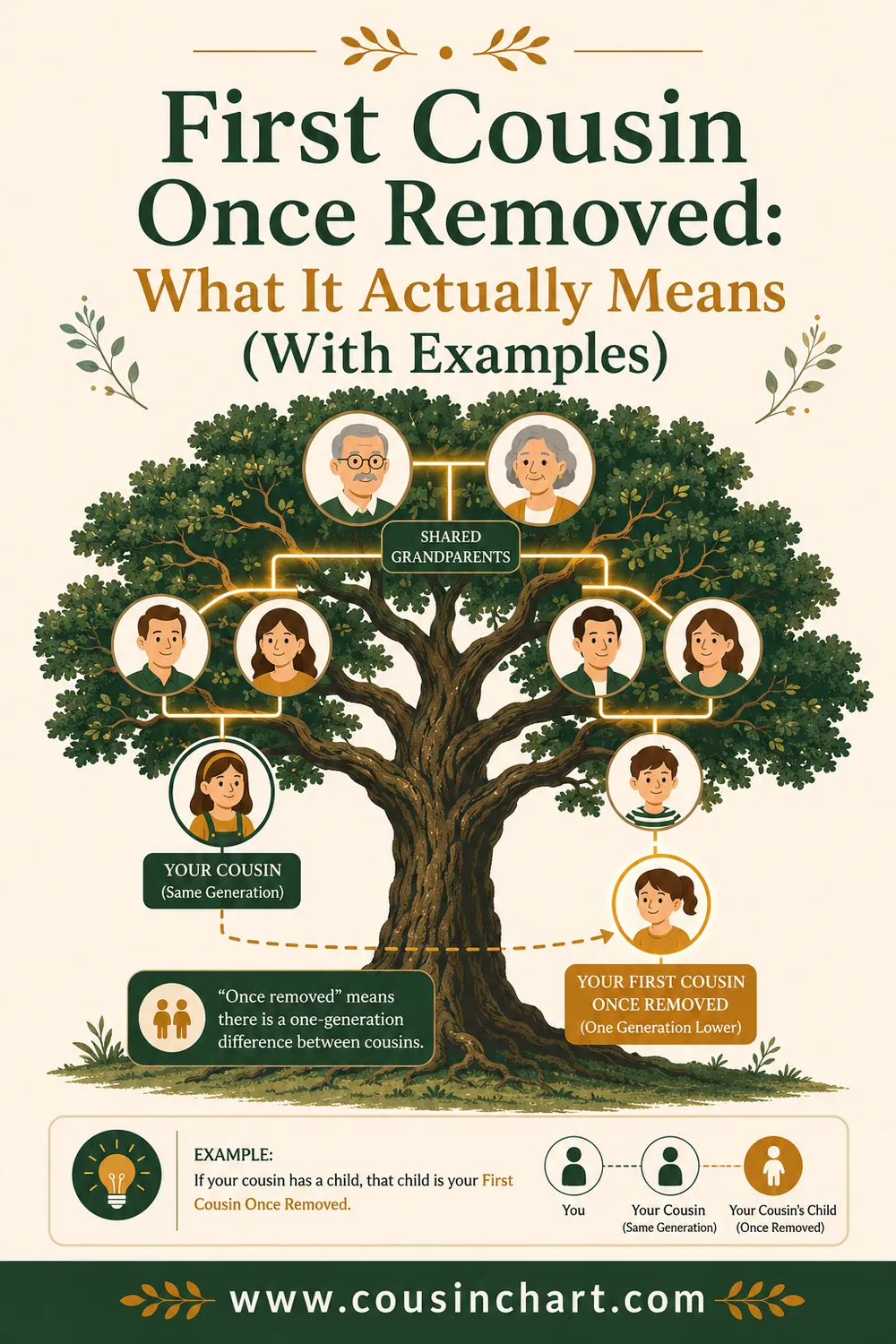
The "second" never changes — it tells you the branch, set by your closest shared ancestor (great-grandparents). The "removed" is a separate measurement entirely: it counts the generation gap between the two of you. Zero gap, no "removed." One-generation gap, "once removed." Two generations, "twice removed." That's the whole system, and it applies to every cousin degree, not just second cousins. We break the "removed" half down fully in what does once removed mean.
Side-by-Side Comparison
| Second cousin | Second cousin once removed | |
|---|---|---|
| Generation | Same as you | One above or below you |
| Who they are | Your parent's cousin's child | Your second cousin's child, or your parent's second cousin |
| Closest shared ancestor | Your great-grandparents | Their great-grandparents are your 2nd-great-grandparents (or vice versa) |
| Average DNA shared | ~3.125% | ~1.5% |
| Shorthand | 2C | 2C1R |
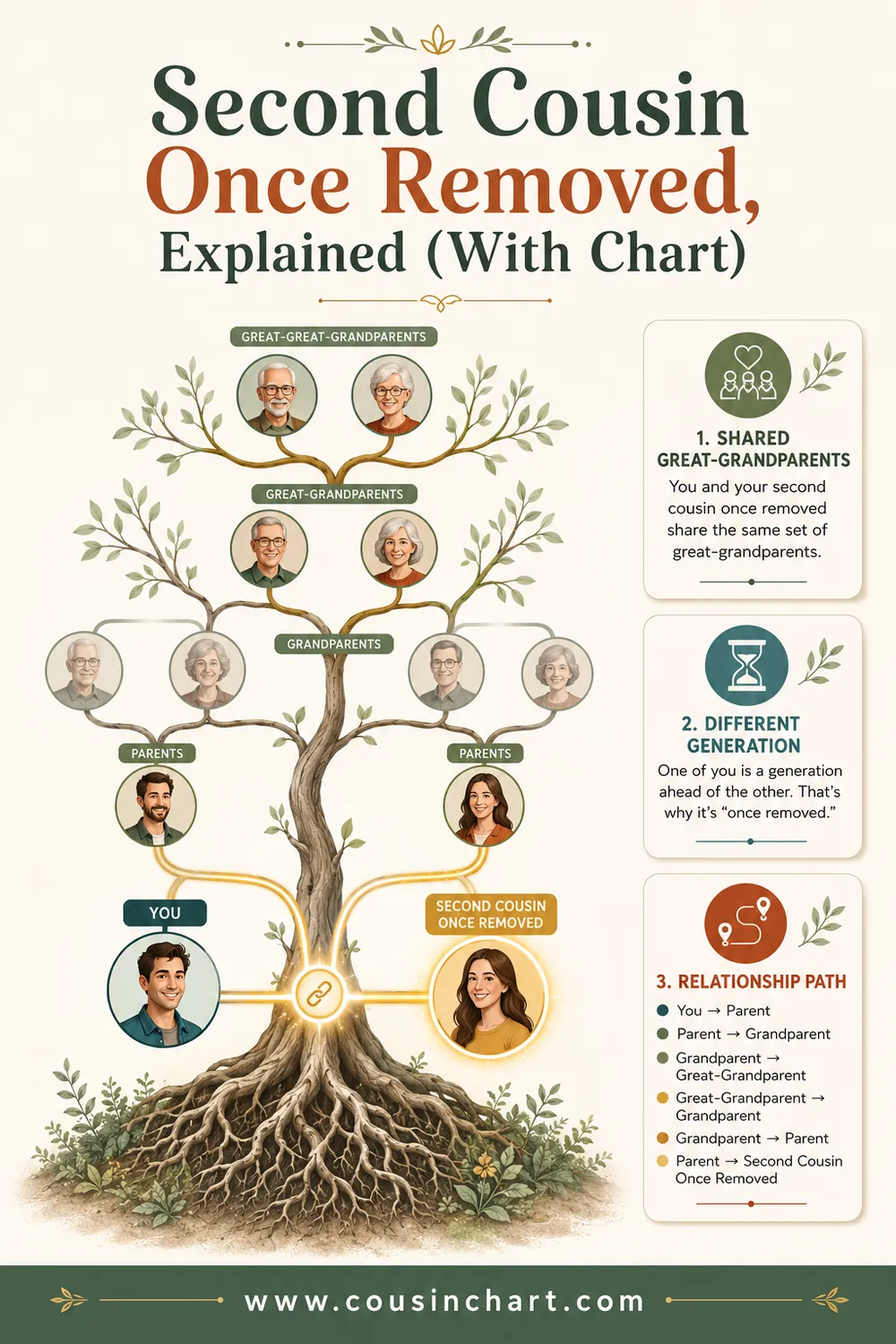
The key row is "who they are." A second cousin sits neatly across from you on the tree. A second cousin once removed is that person's child (drop a floor) or your parent's second cousin (go up a floor). Notice the great-grandparent link shifts: your great-grandparents are your second cousin's great-grandparents too, but for a second cousin once removed, that same couple is a great-great-grandparent to one of you. The generation offset is the whole difference.
Where "Second Cousin" Comes From
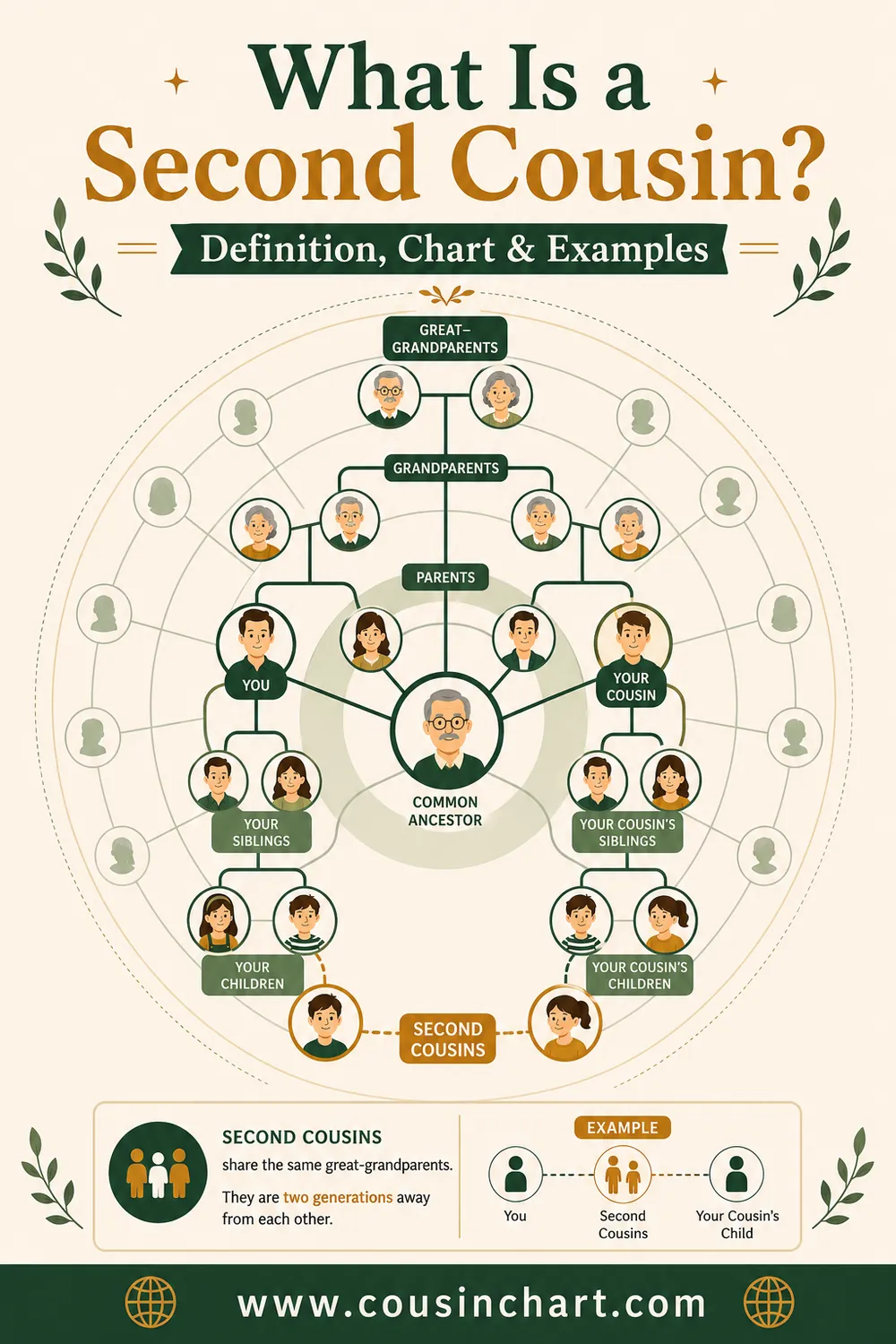
To keep the two straight, it helps to nail down the plain second cousin first. You and your second cousin share great-grandparents. Trace it: your grandparent and your second cousin's grandparent were siblings (first cousins would share grandparents; go one generation further back for second cousins). That makes your parents second cousins to... no — your parents are first cousins once removed to your second cousin, but you and your second cousin land on the same generation, sharing that great-grandparent couple.
Simplest version: the grandchildren of two siblings are first cousins; the great-grandchildren of two siblings are second cousins. Same generation, one step further back than first cousins. Our dedicated explainer what is a second cousin walks the whole chain if you want it slowed down.
How the "Removed" Happens
Now shift a generation and watch "once removed" appear. Two ways to get there:
Going down: Your second cousin has a child. You and that child are no longer the same generation — there's a one-generation gap. The branch is still "second cousin," so the child is your second cousin once removed. And here's a favorite gotcha: that child and your own child are back on the same generation, sharing 2nd-great-grandparents — which makes them third cousins. The relationship slides down a notch each generation.
Going up: Your parent has a second cousin. You're one generation below that person, so they're your second cousin once removed too — same label, opposite direction. English uses one term for both the up and down versions, which is exactly why a quick chart (or the homepage calculator) beats mental gymnastics. For the deep dive on this specific relationship, see second cousin once removed.
The DNA Angle
DNA testing is where this distinction gets practical, because sites like AncestryDNA and 23andMe label matches by these exact terms. On average:
- Second cousins share about 3.125% of their DNA — usually a comfortable, detectable amount.
- Second cousins once removed share about 1.5% — still typically detectable, but less, because the extra generation halves the inherited share.
Two cautions. First, these are averages — real shared DNA varies a lot because inheritance is random. Second, DNA alone often can't distinguish a second cousin once removed from other relationships with similar percentages (like a third cousin). That's why testing companies report a range of possible relationships rather than one exact label, and why a paper trail settles what the DNA can't. The generation offset — the "removed" — is precisely the thing chromosomes struggle to pin down.
Quick Rules So You Never Mix Them Up
Three pocket rules cover every case:
- Same generation, shared great-grandparents → second cousin. No "removed."
- One generation apart on that branch → second cousin once removed. Two apart → twice removed.
- When in doubt, name the path out loud. "My second cousin's kid" or "my mom's second cousin" is instantly clear to everyone, no jargon required — and it sidesteps the ambiguity of a bare "2C1R" every time.
And remember the sliding rule: your second cousin's children are once removed to you but plain third cousins to your own children. Each generation reshuffles the labels, which is why the same family can contain second cousins, second cousins once removed, and third cousins all describing overlapping people.
A Three-Generation Worked Example
Nothing cements the difference like following one real family down the generations. Meet the shared great-grandparents, Otto and Greta, and trace two of their descendant lines:
- Otto and Greta had two children: Hans and Ingrid.
- Hans's line: Hans → his son Karl → Karl's daughter you.
- Ingrid's line: Ingrid → her daughter Petra → Petra's son Lars.
You and Lars are both great-grandchildren of Otto and Greta, sitting on the same generation, so you're second cousins. Now extend each line one more step:
- You have a daughter, Mia.
- Lars has a son, Erik.
Watch what happens to the labels:
- You and Erik (Lars's son): Erik is one generation below you on the second-cousin branch, so he's your second cousin once removed.
- Mia and Erik (your daughter and Lars's son): both are 2nd-great-grandchildren of Otto and Greta, back on the same generation — so they're third cousins.
- You and Mia: still just mother and daughter, of course.
One shared couple, and depending on which two descendants you pick, you get second cousins, second cousins once removed, or third cousins. The "removed" is never about how close you feel — it's purely which floor of the tree each person stands on. Sketch this four-name ladder once on paper and the whole system stops feeling slippery: the cousin number tracks the shared ancestor, and the removal tracks the generation gap, every single time.
FAQ
What's the difference between a second cousin and a second cousin once removed?
A second cousin is on your generation and shares great-grandparents with you. A second cousin once removed is one generation apart on that same branch — either your second cousin's child or your parent's second cousin. The "removed" marks the one-generation gap; the "second" stays the same.
Is my second cousin's child my second cousin once removed or my third cousin?
Your second cousin once removed. They're one generation below you on the second-cousin branch. Your own child and your second cousin's child, however, are third cousins, because they're back on the same generation and share 2nd-great-grandparents.
How much DNA do second cousins once removed share?
About 1.5% on average, compared with roughly 3.125% for plain second cousins. The extra generation halves the shared amount. Because these are averages and inheritance is random, DNA tests usually give a range of possible relationships rather than one exact answer.
Does "once removed" mean we're less related?
Not less related in a meaningful sense — "removed" only describes a generation difference, not distance of affection or a weaker bond. A second cousin once removed is a genuine blood relative connected through the same great-grandparent line, just a generation up or down from you.
Can someone be my second cousin once removed in two different ways?
Yes, and it happens more than people expect. "Second cousin once removed" covers both directions: the person can be one generation below you (your second cousin's child) or one generation above you (your parent's second cousin). English reuses the same label for both, so knowing the term alone doesn't tell you whether they're older or younger than you — only that one generation separates you on the second-cousin branch. Naming the actual path ("my mom's second cousin") clears it up instantly.
What does 2C1R mean?
2C1R is genealogy shorthand for "second cousin once removed." The number is the cousin degree, "C" stands for cousin, and "1R" means removed once — one generation apart. You'll also see 1C1R (first cousin once removed), 2C (second cousin), 3C (third cousin), and so on.
Let the Tool Do the Counting
Second cousin versus second cousin once removed comes down to one question: are you on the same generation, or one apart? Same generation, plain second cousins; one generation off, once removed. Once that clicks, every "removed" relationship in your family makes sense. And on the days you'd rather not trace generations by hand, the free family relationship calculator reads the two people and names the exact relationship — great-grandparents, removals, and all — in about five seconds.