Ancestor Ornaments: Label Each Family Photo With the Right Relationship
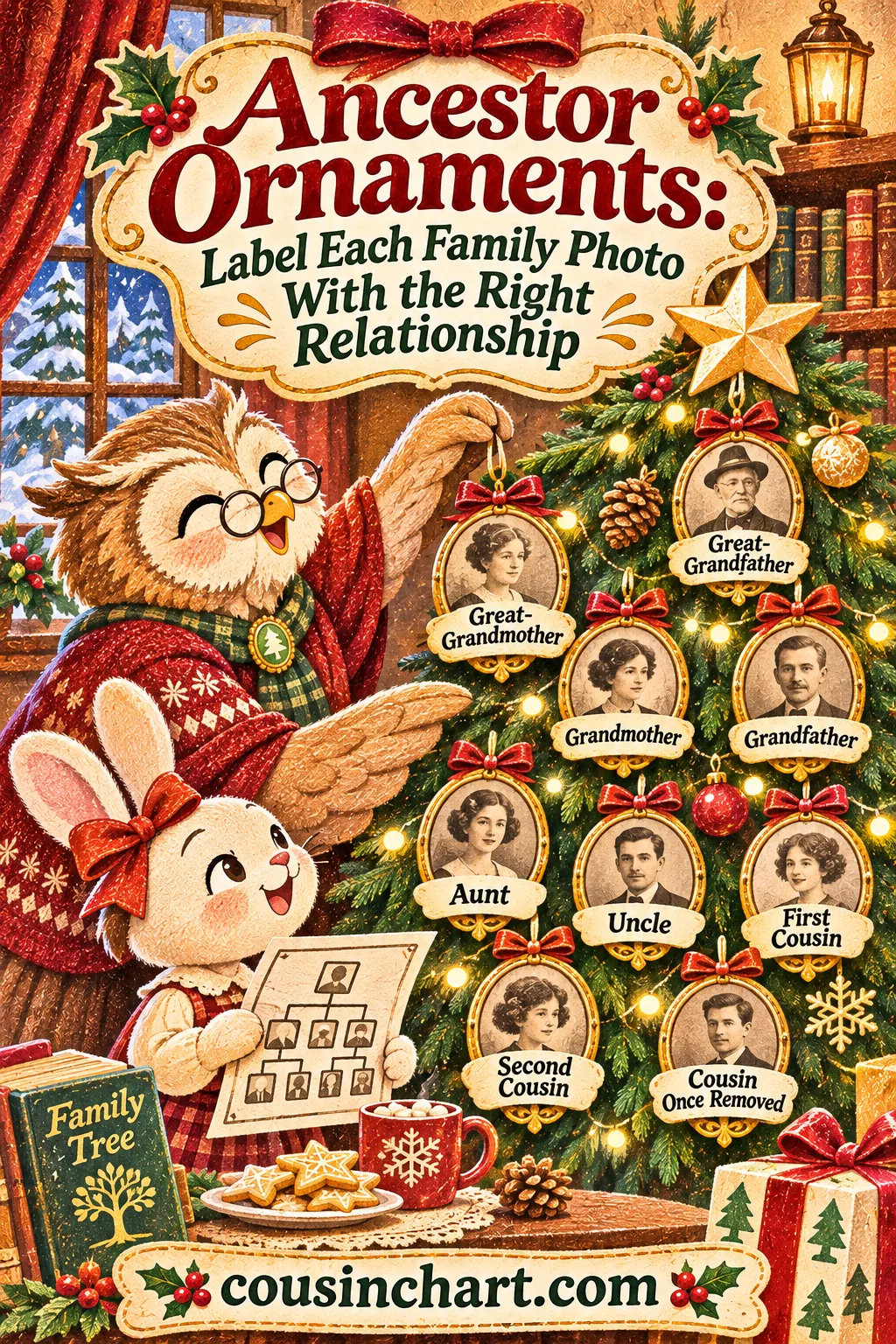
To label ancestor ornaments correctly, count how many generations each person sits above the person you're labeling for, add one "great" for every step past grandparent, and write the side of the family on the back: your grandma's mother is your great-grandmother (Mom's side), and her mother is your great-great-grandmother. Great-aunts and cousins follow their own pattern, which trips people up most. The free Cousin Chart relationship calculator names any of these titles in a couple of seconds, so every ornament gets the right words before the glue dries.
Ancestor ornaments are small photo ornaments, one for each grandparent, great-grandparent or relative who came before you. They're a lovely way to bring family history onto the Christmas tree, and they get kids asking questions. The tricky part isn't the craft. It's the label. This guide gives you the titles, a plan for how many ornaments to make, exact calculator settings, label formats for the back, a craft timeline and fixes for the awkward cases.
▶ Work it out in the free calculator
The Right Title for Every Direct Ancestor
Your direct ancestors are the people you descend from in a straight line: parents, grandparents, great-grandparents and so on. Their titles follow one simple rule. Past grandparent, add one "great" for every generation you go back.
| Generations back | Title | Also written as | People in that generation | Running total |
|---|---|---|---|---|
| 1 | Parent | Mom, Dad | 2 | 2 |
| 2 | Grandparent | Grandma, Grandpa | 4 | 6 |
| 3 | Great-grandparent | 1st great-grandparent | 8 | 14 |
| 4 | Great-great-grandparent | 2nd great-grandparent | 16 | 30 |
| 5 | Great-great-great-grandparent | 3rd great-grandparent | 32 | 62 |
| 6 | 4th great-grandparent | 4x great-grandparent | 64 | 126 |
The number of people doubles every generation, because everyone has two parents. That's useful when you plan the ornament set, and it's also why most families stop at great-grandparents or great-great-grandparents. If you'd like to see the full pattern laid out further back, the great-grandparents chart shows each level with its title.
Numbered "greats" vs spelled-out "greats"
Once you get past two greats, the words pile up. "Great-great-great-grandmother" barely fits on a 3-inch ornament. Genealogists solve this with numbers: a 3rd great-grandmother is the same person as a great-great-great-grandmother.
The trick to the numbers is that the count matches the number of greats. So:
- Great-grandmother = 1st great-grandmother (one great)
- Great-great-grandmother = 2nd great-grandmother (two greats)
- Great-great-great-grandmother = 3rd great-grandmother (three greats)
Pick one style and use it on every ornament in the set. Mixing "2nd great" on one ornament and "great-great" on the next makes the set look like two different projects.
Titles change depending on who's reading
Here's the part that catches almost everyone. A title only makes sense from one person's point of view. The woman who is great-grandmother to your kids is grandmother to you, and mother to your mom.
If three generations will look at the same ornaments, decide who the labels are "for" before you write anything. Most families label for the youngest children in the house, since they're the ones asking "who's that?" Others anchor each ornament to a person by name, such as "Grandma Rose's father," which never goes out of date. We'll look at both formats later.
Great-Aunts, Great-Uncles and Cousins: The Side Branches
Not every relative on your ornament list is a direct ancestor. Great-aunts, great-uncles and older cousins sit on side branches of the tree. Genealogists call them collateral relatives. Their titles follow a different pattern, and this is where most labeling mistakes happen.
The key difference: a great-aunt is your grandparent's sister, not your great-grandparent. She's on your grandparent's level, and her title has one fewer "great" than the direct-line title you might guess.
| Who they are | Correct title | The calculator shows | Common mix-up |
|---|---|---|---|
| Your parent's sister or brother | Aunt or uncle | Aunt or uncle | None, usually |
| Your grandparent's sister or brother | Great-aunt or great-uncle | Grandaunt or granduncle | Calling her great-great-aunt |
| Your great-grandparent's sister or brother | Great-great-aunt or great-great-uncle | Great-grandaunt or great-granduncle | Calling her great-great-great-aunt |
| Your parent's first cousin | First cousin once removed | 1st cousin once removed | Calling them second cousin |
| Your grandparent's first cousin | First cousin twice removed | 1st cousin twice removed | Calling them third cousin |
| Your great-aunt's husband | Great-uncle by marriage | Granduncle-in-law (marriage setting) | Labeling him as a blood relative |
Great-aunt or grandaunt?
Both words mean the same person: your grandparent's sibling. "Great-aunt" is what most American families say out loud. "Grandaunt" is the older, more exact form, and it's the one the calculator uses because it lines up neatly with "grandparent." Neither is wrong. If you're curious why the two exist, the guide to grand-aunt vs great-aunt walks through the history.
On an ornament, use whatever your family says. If your kids already call her "Great-Aunt June," keep it. Just be consistent, and make sure the number of greats matches the generation. Your great-grandparent's sister is a great-great-aunt in everyday speech, or a great-grandaunt in the calculator's terms. There's more on that exact relative in what is a great-great-aunt.
Should side branches get ornaments at all?
They often deserve one. A great-aunt who never had children, a great-uncle who served overseas, a cousin who lived with your grandparents for years: these are people with stories, and nobody else may remember them. Many families give them ornaments in the same style as direct ancestors, with the title making it clear where they fit.
If you want to keep the set focused, give side-branch relatives a smaller ornament or a different ribbon color. That way kids can tell at a glance who's a direct ancestor and who's a great-aunt or cousin.
How to Do It With the Free Tool
You don't have to work out any of these titles in your head. The free relationship calculator names the relationship between any two blood relatives and shows a small chart of the path. Here's how to use it for an ornament set.
Step 1: Read a direct ancestor's title from the YOU side
The calculator has two builders: YOU and THEM. Each one asks how far up the tree the shared relative sits. The YOU builder has a label under it that names that relative for you as you tap + or −.
- Under YOU, tap + or − until the label shows the generation you want.
- Read the title straight off the label. Set to 3, it reads great-grandparent. Set to 4, it reads great-great-grandparent. Set to 5, it reads great-great-great-grandparent.
- Beyond that the label switches to numbers, like 4× great-grandparent. That matches the "4th great-grandparent" style in the table above.
That's the quickest way to check how many greats belong on an ornament. Count generations up from the person you're labeling for, set the YOU stepper to that number, and copy the word.
Step 2: Name a side-branch relative
For great-aunts, great-uncles and cousins, use both builders. The shared relative is the ancestor you both come from.
- Grandpa's sister (great-aunt): tap the Grandpa's sister quick-pick button, or set YOU to 3 (great-grandparent) and THEM to 1 (parent). The result reads Grandaunt or granduncle.
- Great-grandpa's sister (great-great-aunt): set YOU to 4 and THEM to 1. Your shared relative is your great-great-grandparent, and it's her parent. The result reads Great-grandaunt or granduncle.
- Mom's first cousin: set YOU to 3 and THEM to 2, or tap My dad's cousin, which uses the same settings. The result reads 1st cousin once removed.
- Grandma's first cousin: set YOU to 4 and THEM to 2. The result reads 1st cousin twice removed.
Step 3: Pick the sex for the exact word
Under They are, tap female or male. The result changes from "grandaunt or granduncle" to grandaunt or granduncle, which is the word you'll actually write on the ornament. Leave it on either if you're only checking the generation.
Step 4: Leave the other settings alone for most ornaments
- Half relationship? Only tick it if the two people share one ancestor rather than a couple. For example, Grandpa's half-sister shares only one parent with him. Tick it and she becomes a half grandaunt.
- Related by: keep blood for ancestors and their siblings. Switch to marriage for a great-aunt's husband, and the result adds "-in-law," as in granduncle-in-law. Most families write "great-uncle by marriage" on the ornament instead.
- step: use this for a step-great-grandparent who joined the family through a remarriage.
Step 5: Put names on the chart and save it
Open Make it yours under the result. You can type a name for each person on the chart, up to 18 characters each, and add a photo from your device. The page notes that photos stay on your device, since everything happens in your browser.
Then use the buttons under the result:
- Copy result copies the relationship so you can paste it into your ornament list.
- Download my chart saves a picture of the chart with your names. It's handy to print small and tuck into the ornament box, so next year's helper knows who's who.
- Print this result gives you a paper copy to keep next to the craft table.
A quick worked check: say the ornament is for Walter's sister June, and you're labeling for your kids. Walter is the kids' great-grandfather. June's parents are the kids' great-great-grandparents, four generations up. Set YOU to 4, THEM to 1, pick female, and the result reads Great-grandaunt. In everyday words, that's "Great-Great-Aunt June."
Plan Your Ornament Set: How Many to Make
Before you print a single photo, decide how far back the set goes. The doubling math from the first table tells you exactly how many direct ancestors you're signing up for.
| Set | Who's included | Ornaments (direct line only) | Good for |
|---|---|---|---|
| Starter set | Your 4 grandparents | 4 | A first year, young kids, a small tree |
| Classic set | Grandparents and great-grandparents | 12 | Most families, a full-size tree |
| Deep set | Grandparents through great-great-grandparents | 28 | Genealogy fans with lots of photos |
| One-side set | One parent's line through great-great-grandparents | 14 | Honoring one branch, or a gift for one grandparent |
Those counts assume one ornament per person. Add one for each step-grandparent, great-aunt or cousin you want to include. If both of your parents are on the tree too, add 2 to each row.
Worked example: the Delgado family's ornament list
Here's a made-up family to show how the planning works. Carla and Ben Delgado have two kids, Maya (9) and Owen (6). Carla wants a classic set labeled for the kids, plus a few side-branch relatives with good stories.
Carla's side:
- Grandma Rose Martin (Carla's mom), born Rose Hall
- Grandpa Jim Martin (Carla's dad)
- Walter Hall and Edith (Price) Hall, Rose's parents
- The Martin great-grandparents, Jim's parents
- June Hall, Walter's sister, who never married and spent every Christmas with them
- Samuel Hall, Walter and June's father, from a single old studio portrait
Ben's side:
- Grandpa Lou Delgado and Grandma Teresa Delgado (Ben's parents)
- Lou's parents and Teresa's parents
- Tomas Ruiz, Lou's first cousin, who lived with Lou's family as a teenager
Here's how a few of the ornaments get labeled, from the kids' point of view and from Carla's:
| Ornament | To Maya and Owen | To Carla | Side | Calculator check |
|---|---|---|---|---|
| Rose Martin | Grandmother | Mother | Mom's side | YOU 2, label reads grandparent |
| Walter Hall | Great-grandfather | Grandfather | Mom's side | YOU 3, label reads great-grandparent |
| Edith Price Hall | Great-grandmother | Grandmother | Mom's side | YOU 3 |
| June Hall | Great-great-aunt | Great-aunt | Mom's side | YOU 4, THEM 1, female |
| Samuel Hall | Great-great-grandfather | Great-grandfather | Mom's side | YOU 4, label reads great-great-grandparent |
| Lou Delgado | Grandfather | Father-in-law | Dad's side | YOU 2 |
| Tomas Ruiz | First cousin twice removed | Husband's first cousin once removed | Dad's side | YOU 4, THEM 2 |
The full set is 12 direct-line ornaments for the four grandparents and eight great-grandparents, plus June, Samuel and Tomas. Fifteen in all. Carla's list shows two things worth copying. First, Samuel is a great-great-grandfather, a bonus from the deeper set, added because a photo exists. Second, Tomas isn't a direct ancestor, but he earns an ornament because of his story, and his label makes it clear he's a cousin.
Notice how different the titles look in the two columns. That's why you choose the "reader" before writing anything.
Start with the people you have photos of
Most families don't have a photo of every great-grandparent. That's normal. Start with the people you can picture, then fill gaps over the years. A missing photo doesn't have to mean a missing ornament, though. The troubleshooting section below has ways to honor someone with no picture.
A practical way to sort your list:
- Write every name in the set you picked, in generation order.
- Mark each one: photo in hand, photo somewhere in the family, or no known photo.
- Make this year's ornaments from the first group.
- Send a short message to relatives asking about the second group. Plenty of great-grandparent photos are sitting in a cousin's closet.
Here's a message you can copy:
"Hi Aunt Lisa! I'm making photo ornaments of our ancestors for Christmas. I'm missing a picture of Great-Grandma Edith. Do you have one I could borrow or photograph? I'll only use a copy, and I'm happy to make you an ornament too."
That last line tends to get a quick yes. Relatives love being included, and it often turns into a shared project.
Balance the two sides
If one parent's family kept every photo and the other's kept almost none, the tree can end up lopsided. Kids notice. A few ways to even things out:
- Make a name-only ornament for the missing people on the quieter side, so the count matches.
- Use a photo of a place instead, like the town or farm where that branch lived.
- Make the same number of ornaments per side this year, and add the extras next year.
What to Write on the Back of Each Ornament
The back of an ornament is small. A 3-inch round has room for about four short lines in neat handwriting. That's plenty if you plan the words.
The four-line label
This format fits on most round ornaments and answers every question a kid or visitor will ask:
- Full name, with the birth surname for married women if you know it
- Years, birth to death
- Title, from the reader's point of view
- Side or anchor, like "Mom's side" or "Grandma Rose's father"
For June Hall, the back would read:
June Hall 1921 to 2004 Great-great-aunt Grandma Rose's aunt, Mom's side
Three label styles to choose from
| Style | Example | Best for | Watch out for |
|---|---|---|---|
| Title for the kids | Great-grandmother Edith, Mom's side | Families with young children | The title is wrong if a grown-up reads it |
| Anchored to a name | Edith Price Hall, mother of Grandma Rose | Mixed ages, sets meant to last | Kids still need to know who Grandma Rose is |
| Both | Edith Price Hall, 1924 to 2011, great-grandmother, Grandma Rose's mother | The most complete set | Needs neat, small writing |
The anchored style ages best. Kids grow up, have children of their own, and every title shifts by a generation. "Grandma Rose's mother" will still be true in 50 years. "Great-grandmother" won't be, from the next reader's point of view. If you expect the set to be passed down, include the anchor line on every ornament.
Writing maiden names and married names
Old photos often show a woman under her married name, while records list her birth surname. On an ornament, put both if there's room. Common ways to write it:
- Edith Price Hall
- Edith (Price) Hall
- Edith Hall, born Price
Pick one and use it for every woman in the set. The parentheses version reads clearly to kids. If you don't know a birth surname, just leave it out rather than guess.
Writing the side of the family
Kids rarely know which grandparent belongs to which parent. Adding the side to every ornament fixes that for good. Use words your family already uses:
- "Mom's side" and "Dad's side"
- The family surname, like "Hall family" or "Delgado family"
- The grandparent the branch runs through, like "Grandma Rose's line"
If you'd like a quick explainer on mother's-side and father's-side lines for older kids, the guide to maternal vs paternal relatives lays it out simply.
If you can't write on the ornament itself
Some ornaments, like clear fillable balls, have no flat back. In that case, tie a small paper tag to the hanger. Cut tags from cardstock about 1 by 2 inches, punch a hole and loop them on with the ribbon. Tags also let you rewrite a label later without remaking the ornament.
Making the Ornaments: Materials, Steps and a Holiday Timeline
The craft itself is simple. The most important rule is the first one: never use an original photo. Old prints are often the only copy, and glue, heat from tree lights and years in an ornament box can ruin them. Scan or photograph each original, print a copy and keep the original safely stored. The guide on how to preserve old family photos covers safe storage once you've made your copies.
Pick an ornament style
| Style | What you need | Label goes | Skill level |
|---|---|---|---|
| Clear fillable ball | Clear plastic ball ornaments, photo copies, a chopstick or pencil | A paper tag on the hanger | Easy, kids can help |
| Wood slice | Wood slices about 3 inches across, photo copies, glue for paper | Written right on the back | Easy |
| Cardstock disc | Heavy cardstock, a 3-inch circle cutter or scissors, ribbon | Written right on the back | Easiest, great for big sets |
| Mini frame | Small ornament frames, photo copies trimmed to fit | A sticker or tag on the back | Easy, looks polished |
| Fabric or felt round | Felt circles, printable fabric sheets or a sewn-on photo copy | A stitched or written label | Takes longer |
Clear plastic is a safer choice than glass if little hands will be hanging them. Whatever you pick, use the same style for the whole set so it looks like one collection.
Step-by-step: cardstock or wood ornaments
- Scan or photograph each original. Use good light, hold your phone straight above the photo and fill the frame.
- Crop each face. You want the head and shoulders. A face about 1.5 to 2 inches tall looks good on a 3-inch ornament.
- Print the copies. Regular printer paper works for wood and cardstock. Photo paper looks richer but is harder to glue flat.
- Cut the photos into circles a little smaller than your ornament, so a thin border shows.
- Glue the photo to the front. Spread glue thinly and press out bubbles from the center.
- Let it dry overnight.
- Write the label on the back with a fine-tip permanent pen. Pencil in the lines first if you're nervous.
- Punch a hole and add a ribbon, or screw in a small hook for wood slices.
Step-by-step: clear fillable balls
- Print the photo copy so it's about the width of the ball.
- Remove the ball's cap.
- Roll the photo gently around a pencil, slide it inside and let it unroll.
- Nudge it flat against the side with a chopstick.
- Add a little filler behind it if you like, such as shredded paper or a scrap of fabric, so the photo stays put.
- Replace the cap and tie on a cardstock tag with the label.
A four-week holiday timeline
Ancestor ornaments take longer than people expect, mostly because of the hunt for photos and the time spent checking names. Here's a comfortable plan if you start in late November:
| When | What to do |
|---|---|
| Week 1 | Pick your set, list every name in generation order, check each title with the calculator, send photo requests to relatives |
| Week 2 | Scan or photograph every original, crop and print copies, gather ornament supplies |
| Week 3 | Assemble the ornaments, let them dry, write the labels |
| Week 4 | Hang them, take a photo of the full set, hold a short story night with the kids |
The one-weekend version
Started late? You can still make a starter set in a weekend.
- Saturday morning: list the four grandparents, check the titles, find a photo of each.
- Saturday afternoon: scan, crop, print and glue.
- Saturday night: let them dry.
- Sunday: write the labels, add ribbons and hang them.
Four ornaments done well beat 20 rushed ones. You can add great-grandparents next year.
Mailing ornaments to relatives
If you're sending a set to a grandparent or a cousin's household, pack each ornament in tissue and use a sturdy box. Check your carrier's official holiday shipping dates before you plan the last day to mail, since deadlines change every year. Tuck a printed key inside with each person's name, title and side, so the recipient can hang them without guessing.
Troubleshooting: Awkward Cases and How to Label Them
Real families are messy, and old families are messier. Here are the situations that come up most, with a simple fix for each.
| Problem | What to do |
|---|---|
| No photo exists of an ancestor | Make a name-only ornament with their name, years and title, or use a photo of their hometown, church or a family object |
| You're not sure who's in a photo | Ask the oldest relatives first. Clothing, hairstyles and the type of print can also narrow down the era |
| Two ancestors share a name | Add years and the anchor line, such as "Walter Hall, 1890 to 1961, Grandpa Walter's father" |
| A great-grandparent married twice | Make an ornament for each spouse you want to honor. Label the second as step-great-grandparent if they aren't a blood ancestor |
| A grandparent was adopted | Use their adoptive family for the ornaments if that's the family they knew. Add birth-family ornaments only if they'd like that |
| A relative is estranged or hurt someone | You don't have to make an ornament for everyone. Leaving someone off a craft project is a personal choice |
| Your ornaments say great-great-great and won't fit | Switch to the numbered style, like 3rd great-grandmother, on every ornament in the set |
| A kid labels Great-Aunt June as great-grandma | Show them on the calculator chart that June branches off sideways. She's a sibling of a great-grandparent, not a parent of one |
| Cousins in two households want the same set | Make one master list of names, years and titles, then each household labels from it |
When the calculator and your family say different words
This happens a lot with aunts and uncles. The calculator says grandaunt, your family says great-aunt. The calculator says great-grandaunt, your family says great-great-aunt. These pairs always mean the same person. The calculator uses the "grand" form because it stays consistent with grandparent and grandchild. On the ornament, write what your family says. Just double-check the number of generations with the calculator, because that's the part that matters.
Variations by Family Size and Age
The same project works for a toddler's first Christmas and for a 40-person reunion. Adjust the size and wording.
Young kids (ages 3 to 6)
- Make a starter set of four grandparents.
- Use the titles they already say, like "Grandma Rose" and "Papa Lou."
- Skip years and long labels. A name and "Mom's side" is plenty.
- Let them choose where each ornament hangs.
Older kids (ages 7 to 12)
- Go up to great-grandparents.
- Teach the "add a great" rule and let them check titles on the calculator themselves.
- Give them the job of writing the side on each label.
- Ask them to find one fact about each ancestor to share on story night.
Big families and reunions
- Make one set per household, all from the same master list.
- Give each branch a ribbon color, so you can see at a glance which line an ornament belongs to.
- Hold an ornament swap at a holiday gathering, where each household brings one ancestor ornament for another branch.
Blended families
Blended families often have more than four grandparents. Count everyone the kids call Grandma or Grandpa, including step-grandparents, and make an ornament for each. The label can say "step-grandmother" or simply "Grandma Kay," depending on what the family uses. For a stepparent's own parents, the calculator's step setting gives you the formal title if you want it.
How to hang the set
A few layouts that help kids see the family's shape:
- By generation: grandparents at eye level, great-grandparents above them, great-great-grandparents near the top.
- By side: Mom's side on one half of the tree, Dad's side on the other.
- As a cluster: all the ancestor ornaments together on one branch or a small tabletop tree of their own.
Hanging by generation works especially well with kids. The higher up the tree, the further back in time.
Story night
Once they're hung, pick one evening for a short story night. Each person picks an ornament and shares one thing about that ancestor, like where they lived, what work they did or a funny family story. Older relatives usually do most of the talking, and that's the point. Keep a phone handy to record what they say.
Start Your First Ornament Set
Pick your set size, list the names in generation order and check each title before you write a single label. The free Cousin Chart calculator names every great-grandparent, great-aunt and cousin in seconds, and the chart you download makes a handy key for the ornament box. Start with four grandparents if that's what you have time for. You can add a new generation every Christmas, and in a few years the tree will hold the whole family story.
▶ Work it out in the free calculator
Frequently Asked Questions
What are ancestor ornaments?
Ancestor ornaments are Christmas ornaments made with a photo or the name of a family member who came before you, such as a grandparent or great-grandparent. Most families make one per person and label the back with the name, years and relationship. They're a simple way to bring family history onto the tree.
What do I call my grandmother's mother?
She's your great-grandmother. Each generation past grandparent adds one "great," so her mother is your great-great-grandmother, also written 2nd great-grandmother. In the calculator, set the YOU stepper to 3 and the label reads great-grandparent.
Is my grandpa's sister my great-aunt or my great-great-aunt?
She's your great-aunt, also called a grandaunt. She's on your grandparent's level, so she has one fewer "great" than you might guess. Your great-grandparent's sister is the one who's your great-great-aunt.
How many ancestor ornaments should I make?
Four covers your grandparents, and 12 covers grandparents plus great-grandparents. Going back to great-great-grandparents takes 28. Most families start with the grandparents and add a generation each year as photos turn up.
Should I put the relationship from my point of view or my kids'?
Pick one reader and stick with it for the whole set. Most families label for the youngest kids, since they ask the most questions. If you want the set to last for generations, add an anchor line like "Grandma Rose's mother," which stays true no matter who's reading.
Can I use original old photos on the ornaments?
It's best not to. Glue, light and heat can damage old prints, and many are the only copy. Scan or photograph the original, print a copy for the ornament and store the original somewhere cool, dry and dark.
How do I label a step-grandparent or an adopted ancestor?
Adoptive ancestors get the same title as any other grandparent or great-grandparent. Step-grandparents can be labeled "step-grandmother" or simply by the name the kids use, such as "Grandma Kay." Go with whatever your family says out loud.
What if I don't have a photo of an ancestor?
Make a name-only ornament with their name, years and title, or use a photo of a place or object tied to them, like their hometown or a family quilt. Ask older relatives too. Missing photos often turn up once people know you're looking.