Slang for Cousin
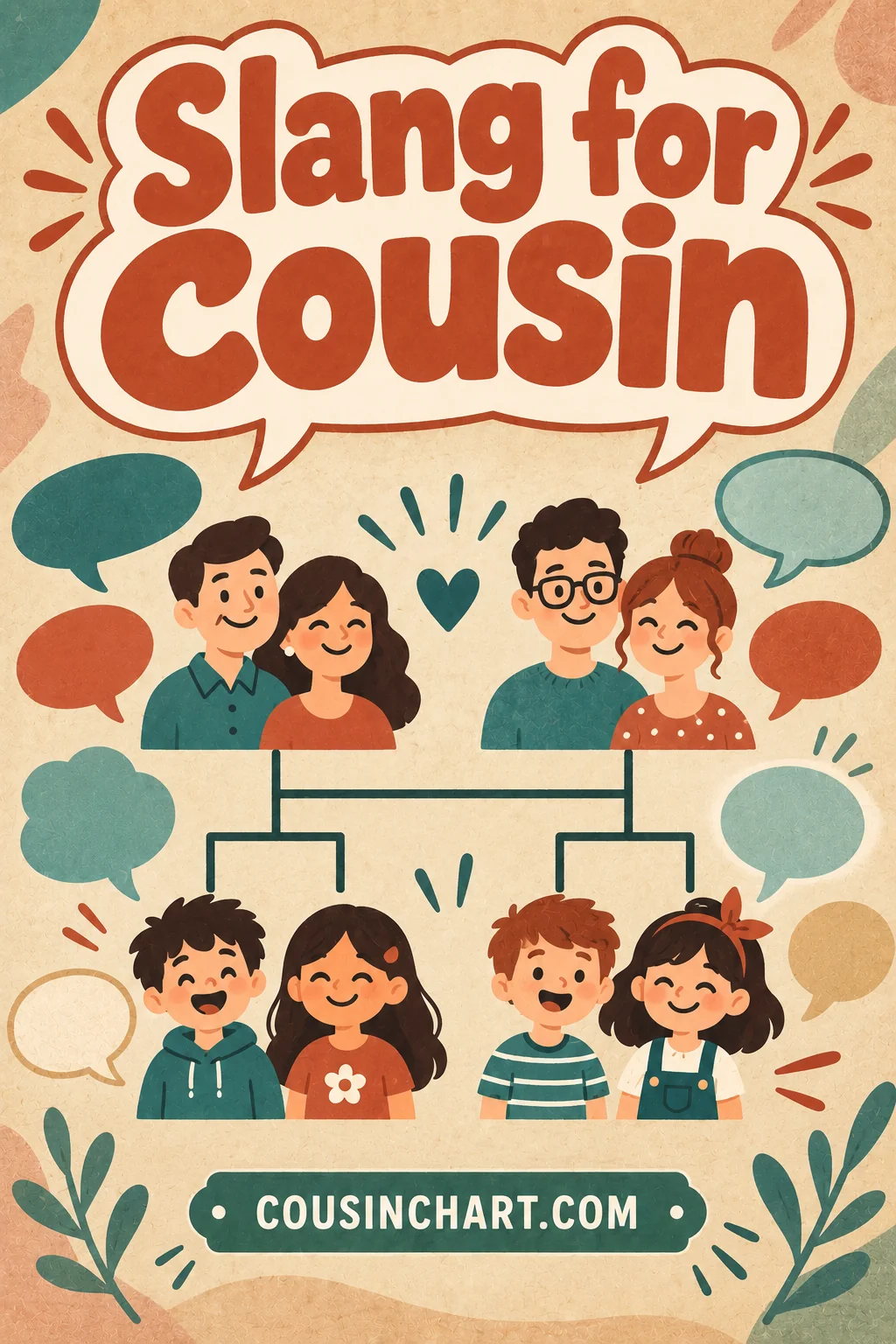
The most widely used slang for cousin in English is cuz, with cuzzo, cuzzy, cuzzy bro, cous, cousin bro and cousin sister, and the borrowed primo and prima all in regular use depending on where you are. The more interesting fact is that in several English-speaking communities, none of these words reliably means a blood relative at all, because cousin doubles as a warm term of address for a close friend.
That second layer is what makes the topic worth a full guide rather than a list. If someone introduces a person as their cousin, you may be hearing a precise genealogical claim, or you may be hearing the equivalent of my guy, depending on the speaker, the region, and the setting. Knowing which is not a small thing when you are mapping a family or trying to work out who is actually related to whom.
What Is a Cousin, Before the Slang
A cousin is a relative who shares an ancestor with you but is not your sibling, parent, grandparent, aunt, uncle, niece, or nephew. First cousins share a set of grandparents. Second cousins share a set of great-grandparents. The word removed adds a generation gap: your first cousin's child is your first cousin once removed.
That precision is worth stating up front because the slang does not carry any of it. Searches for what is a cousin and what is cousin are usually asking for exactly this definition, and they are asking it because English uses one word where several other languages use many. English lumps together maternal and paternal, older and younger, male and female, first and fourth. Every piece of slang in this guide is, in one way or another, an attempt to put back something the plain word leaves out.
Cuz and Its Spellings
Cuz is the default. It is understood everywhere English is spoken, it works in speech and in text, and it carries no regional signal on its own.
The spelling varies more than the pronunciation does. Cuz is the most common. Coz turns up frequently in British and Australian writing and is the older spelling, appearing in English literature centuries before the current usage. Cous and couz show up occasionally, usually from people who want the spelling to look closer to the full word.
One thing to watch: cuz is also a common written shortening of because. Context separates them without effort in almost every case, since one is a noun of address and the other is a conjunction, but it is the reason the word looks ambiguous in isolation.
Cuz is also where the two meanings split. Used to an actual relative it means what it says. Used to a friend it is a marker of closeness, and that usage is common enough in several dialects that it cannot be treated as a mistake.
Regional Slang for Cousin Across the English-Speaking World
| Term | Where it is common | What it adds |
|---|---|---|
| Cuz, coz | Everywhere English is spoken | Informality, closeness |
| Cuzzo | African American English, widely borrowed | Warmth, playfulness |
| Cuzzy, cuzzy bro, cuz bro | New Zealand, especially Maori and Pasifika communities | Deep familiarity, often extended to friends |
| Cousin brother, cousin sister | Indian English and South Asian families worldwide | Gender, and sibling-level closeness |
| Cousin bro | Same communities, shortened | Gender plus affection |
| Primo, prima | Spanish-speaking families, borrowed into US English | Gender |
| Cugino | Italian American families | Gender, heritage marker |
| Cous, cus | Casual US and UK speech | Nothing beyond brevity |
| Kin, kinfolk | Parts of the American South and Appalachia | Relation without specifying which |
Cuzzo originates in African American English and has spread widely through music and everyday speech. It is affectionate rather than precise, and like cuz it is regularly used for people who are not related.
Cuzzy and cuzzy bro are strongly associated with New Zealand, and particularly with Maori and Pasifika speech, where extended family relationships are socially central and the term reflects that. In that context the word carries real warmth and is frequently extended to close friends and community members. It is worth knowing that it is a specific cultural register rather than a generic slang word.
Cousin brother and cousin sister are standard in Indian English and among South Asian families internationally. They are not errors, and they are not redundant. They do two jobs the English word cannot: they mark gender, and they signal that the cousin was raised close enough to count as a sibling. Many South Asian families use the word brother or sister alone for a first cousin, and cousin brother when they need to clarify the exact relationship for someone outside the family.
Primo and prima are borrowed straight from Spanish and Portuguese by bilingual families, and they get used in otherwise entirely English sentences for the same reason as cousin brother: the English word drops the gender, and the Spanish one does not.
In parts of the American South, cousin and cuz are used broadly for extended family whose exact relationship nobody has ever worked out, and often for family friends of long standing. Kinfolk covers the same ground without committing to a degree.
In Caribbean English, cousin similarly stretches to cover a wide circle, and the word is often used as a friendly form of address between people who share a community rather than an ancestor.
When Cousin Does Not Mean Cousin
In a lot of the English-speaking world, calling someone your cousin is a statement about closeness, not about descent. Anthropologists call this fictive kin: family language applied to a relationship that is not biological.
It is worth taking seriously rather than treating as loose talk, because the pattern is consistent and it appears independently in many places:
- Family friends who have always been around. The children of your parents' closest friends are often introduced as cousins for a lifetime, because auntie and uncle were used for the parents.
- Community and church relationships, where an entire congregation or neighborhood uses family terms as a matter of course.
- Diaspora communities, where the people who arrived together function as extended family and the vocabulary follows the function.
- Village or hometown ties, where everyone is related somehow and nobody is going to trace it.
- Friendship, plainly. Cuz and cuzzo are used between friends the same way brother and sis are.
None of this is imprecision for its own sake. It usually reflects a culture where the extended family, rather than the household, is the basic social unit. If your day-to-day life includes forty relatives, the useful distinction is not first cousin versus second cousin, it is family versus not family, and the language settles where the usefulness is.
The practical consequence matters for anyone doing family research. When an older relative says the word cousin, ask a follow-up question. Whose child were they? How was your mother related to them? A great deal of genealogical confusion comes from a fictive cousin who was recorded as an actual one, or from a real second cousin who was described so casually that nobody wrote the connection down.
Cousin It, and the Pop Culture Question
Search for cousin it and you will not find a term for a relative. Cousin It is the fictional Addams Family character, a small figure covered head to foot in long hair, and the name is a joke rather than a family term. It gets searched constantly, and it also gets used as an affectionate nickname for anything shaggy, including a few trailing houseplants and quite a lot of dogs.
It is worth separating from the real slang because the two get mixed together in search results. Nobody has ever called an actual relative their cousin it in the sense of a family word. The phrase belongs to entertainment, not to kinship vocabulary.
Music and film have done far more to spread the genuine terms. Cuz and cuzzo traveled through popular music into general use, and cuzzy bro is instantly recognizable to anyone who has watched New Zealand comedy. Every slang cousin term in this guide spread the same way any slang spreads: through people who use it naturally, then through the media that records them.
Cousin in Slang Online and in Texting
Written usage follows speech, with a few habits of its own. The word cousin in slang online is nearly always spelled phonetically. Cuz dominates, cuzzo appears where the writer wants more warmth, and full spellings are reserved for clarity.
A few conventions that hold up:
- Cousin appears in full when the relationship is the point. My cousin got engaged. The information is the relationship, so the word is not shortened.
- Cuz appears when the person is the point. Out with cuz. Here the word functions almost as a name.
- Genealogy shorthand is different again. On family trees and in research notes, 1C means first cousin, 1C1R means first cousin once removed, and 2C means second cousin. This is a written abbreviation system rather than slang, and it is understood across genealogy platforms. Our guide to a short word for cousin covers those written forms in more detail.
- Emoji and nicknames often replace the word entirely in group chats, especially in families with a lot of cousins who need distinguishing.
What Is Your Cousins Cousin to You
This phrasing gets searched a lot, and it has a real answer that surprises people: your cousin's cousin may be your cousin, or may be no relation to you whatsoever, and which one depends on which side of their family they come from.
Think about where the shared ancestor sits. You and your first cousin share a set of grandparents through one of your parents. Your cousin also has a whole other set of grandparents, through their other parent, and you are not descended from those people at all. Any cousin who comes to them through that side is a stranger to you genetically, however familiar they may be at family gatherings.
So there are two cases:
They come through the side you share. Then you and they are related, usually as first or second cousins, through the same common ancestors you and your cousin share.
They come through the other side. Then you and they have no shared ancestor and no relationship. You may have known them your whole life, you may both attend the same family holidays, and you are still not relatives in any genealogical sense.
This is exactly the situation where the loose usage discussed above takes over. Two people who meet constantly at family events will call each other cousins regardless of whether a chart supports it, and that is a perfectly reasonable thing for them to do socially. If you need the technical answer instead, a cousin chart will show you where each person sits once you know which common ancestor you actually share.
Using the Slang Respectfully
A short note, because it comes up. Some of these terms are general property and some carry a specific cultural home.
Cuz, coz, and cous are broadly neutral. Anyone can use them without it reading as an imitation of anyone.
Cuzzo, cuzzy bro, cousin brother, and primo all sit inside particular communities. Used by people from those communities they are natural. Used by outsiders trying on the accent they read as mimicry, and that is the thing to avoid. Understanding what your cousin means when they say cuzzy bro is entirely different from adopting the phrase yourself, and the first is what this guide is for.
The other courtesy worth extending is not correcting people. When someone from a culture with looser family vocabulary calls a family friend their cousin, they are not making a mistake, they are using their language correctly. If you are recording a family history and you need the technical relationship, ask for the connection rather than challenging the word.
Frequently Asked Questions
What is the most common slang for cousin? Cuz, by a wide margin, and it is understood in essentially every English-speaking region. Cuzzo is the next most recognizable, and cuzzy or cuzzy bro is dominant in New Zealand, where it also carries a stronger sense of closeness than the plain word does.
Is cousin brother correct English? It is correct in Indian English and in South Asian families internationally, where it is a standard term rather than an error. It fills a gap that standard British and American English leave open, since it specifies both the cousin's gender and the fact that the relationship is sibling-close.
Why do some people call friends their cousin? Because in several English-speaking cultures, family vocabulary marks closeness rather than descent. The pattern shows up in the American South, the Caribbean, New Zealand, parts of Africa, and many diaspora communities, and it usually reflects a social structure built around extended family rather than the household.
Does slang change what a cousin technically is? No. Whatever people call each other, the genealogical relationship is fixed by which ancestors two people share. Slang tells you how close two people feel, and a chart tells you how they are related, and the two answers are frequently different in ways that matter for family research.