Same Last Name, Different Branch: Are We Actually Related?
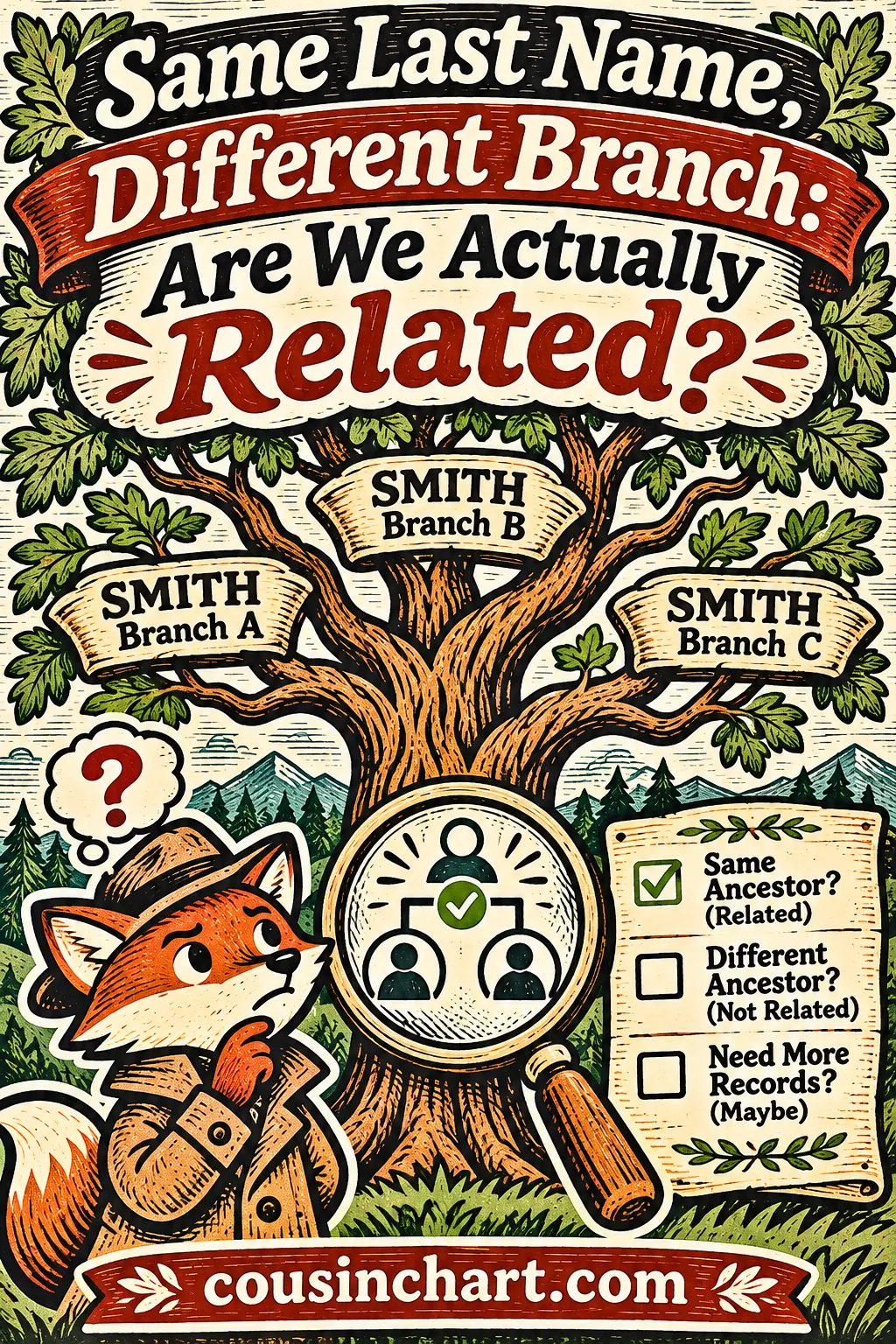
If you share a last name and wonder, "Same last name, are we related?", the honest answer is maybe: a shared surname is a clue, not proof, and you only know once you trace both family lines back to the same ancestor. Common names like Smith or Garcia were taken up by thousands of unrelated families, while a rare name in the same small town is a much stronger lead. Once you find the shared ancestor, the free Cousin Chart relationship calculator tells you exactly what kind of cousins you are.
This guide covers why surnames repeat, how to tell a real lead from a coincidence, and a simple way to trace both lines until they meet.
▶ Work it out in the free calculator
Why Unrelated People Share Surnames
Surnames didn't start with one family per name. In many parts of Europe, ordinary people took fixed last names over several centuries, and lots of families picked the same kinds of names at the same time.
Most surnames come from a handful of sources:
- Jobs. Smith, Miller, Baker, Taylor and their versions in other languages started in thousands of separate villages. Every village had a smith.
- Father's name. Johnson, Peterson, Fernández and MacDonald mean "son of." Any man named John could have sons called Johnson. The guide to patronymic surnames explains how these spread.
- Places. Names like Hill, Wood or a village name were given to people who lived near those features or came from that town.
- Nicknames. Brown, Young, Long and similar names described a person.
So two families named Miller in different states are more likely to be unrelated than related. The same is true across countries. A Müller from Germany and a Miller from Scotland share a meaning, not necessarily a family. Translated names can look alike for the same reason: they describe the same job or feature. Their ancestors were simply millers in different places.
A place name can be a stronger clue than a job name, since fewer people came from one small village than worked as millers. But even place names repeat. Many villages shared names, and anyone who left one of them might have been called after it. If you want to learn where your own name started, the guide to what country your last name is from is a good first stop.
Names that changed along the way
Surnames also shift over time. A family may have:
- Changed the spelling when they moved to a new country.
- Shortened a long name to make it easier to say.
- Taken a stepfather's name.
- Picked up a different name through adoption.
That works both ways. Two families with different spellings may be one family, and two families with the same spelling may have ended up there by chance. The guide to surname spelling variations shows how to search all the versions.
Naming customs that break the pattern
Some traditions don't pass one surname straight down the male line, and that changes how much a shared name can tell you.
- Scandinavian patronymics. In older Norwegian, Swedish and Danish records, a man named Lars Andersen might have a son called Peter Larsen. The surname changed each generation, so a shared "Larsen" between two modern families may come from two unrelated men named Lars.
- Spanish double surnames. Many people from Spain and Latin America carry both a father's and a mother's surname. Two people who share a "second" surname may connect through a maternal line, not a paternal one.
- Hyphenated and kept names. In recent generations, some women kept their own name or hyphenated it. A cousin through a woman's line can share your surname even though the name didn't come from your father's father.
- Clan and region names. In some places, many unrelated families used the name of a clan, a landowner or a district. A shared name there points to a shared place more than a shared ancestor.
If your family comes from one of these traditions, look at the full naming pattern before you count a shared surname as a clue.
How Strong Is the Surname Clue?
Not every shared surname means the same thing. Use this table as a rough way to judge your lead.
| Your situation | How strong a clue is it? | What to do next |
|---|---|---|
| Very common name, different regions | Weak | Don't assume anything; build both trees first |
| Common name, same small town | Moderate | Check local church, land and census records |
| Rare name, any location | Strong | Trace both lines back; they often meet |
| Rare name, same town or county | Very strong | Look for siblings or cousins in old records |
| Same name plus shared first names | Strong | Families often repeated given names; compare lists |
How to tell if your name is rare
"Rare" is a feeling until you check it. A few simple ways to get a sense of how common your surname is:
- Look at an early census. Search the surname alone in a census from the 1800s for your state or county. If a few households turn up, it's rare there. If hundreds do, it isn't.
- Count the spellings. A name with one spelling and few holders is a tighter lead than one with ten spellings and many holders.
- Check the local cemetery. In a small town, a rare name often fills one corner of one cemetery. That's a sign of one family, not many.
- Ask older relatives. People who grew up in the area often know whether "the other Hargroves" were kin or just shared the name.
A name can be common in one country and rare in another. Kowalski is a common name in Poland, but in a small Midwestern town in 1900, two Kowalski households may well have been brothers.
Signs two same-name families connect
Some patterns show up again and again when two same-surname families really are kin:
- Repeated first names. If both families have a run of Josiahs, Elizas and Ezekiels, that's worth a closer look. Many families named children after grandparents, so the same names echo down each line.
- Neighbors in old records. Two households with your surname living side by side in an early census often turn out to be brothers or a father and his grown son.
- Shared witnesses. When the same people show up as witnesses at baptisms and weddings for both families, they may have been relatives.
- Same church or cemetery. Families tended to stay near their kin, and they were often buried together.
None of these prove a link alone. Together, they tell you where the records are most likely to connect.
Even a "very strong" lead still needs records. A clue tells you where to look. It doesn't tell you the answer.
Most of Your Relatives Don't Share Your Last Name
Here's something people forget. In families where women took their husband's name at marriage, most of your cousins have different last names from you.
Think about your grandparents. You have four of them, and in most traditional US families, only one passed down your surname. Your cousins through your mom, through your dad's sisters, and through your grandmothers' families mostly carry other names.
That means a surname match only tells you about one line out of many. Your strongest family connections may be with people whose names look nothing like yours. The guide to maternal vs. paternal relatives explains how the sides of the family split.
Go back further and the share gets even smaller. You have eight great-grandparents and sixteen 2nd-great-grandparents. In a traditional naming pattern, only one man in each of those generations passed down your surname. So by the time you reach your third cousins, the ones who share your last name are a small slice of the whole group.
Step by Step: Trace Both Lines Until They Meet
The only reliable way to answer the question is to build both family lines back until you find the same person on each. Here's how to go about it.
Step 1: Write down what you each know
Start with yourself and the other person. Each of you lists your parents, grandparents and great-grandparents, with birth years and places if you know them. Fill in as much as you can from family memory.
Step 2: Follow the surname line back
Since the surname is the clue, follow the line that carries it. For most families, that's the father's father's father, and so on. Look for:
- Census records listing the household, which show parents and children together.
- Birth, marriage and death records that name parents.
- Obituaries, which often list siblings and where they lived.
If you're new to census work, the guide on how to search census records covers the basics, including how to search by surname alone in a single county.
When the surname line goes quiet
Sometimes the trail stops. A record burned, a family moved or a name was spelled a new way. When that happens, switch to the siblings. Brothers and sisters of your ancestor may have left better records, such as a detailed obituary or a will that names the whole family. One sibling's paperwork can carry you back a generation when your own direct line can't.
Step 3: Look for the place where the lines cross
As you go back, compare the two lines generation by generation. You're looking for:
- The same town or county at the same time.
- Two men with your surname who were about the same age, which may mean brothers or cousins.
- Shared first names that the family used over and over.
Step 4: Confirm with a record that links them
When you think the lines meet, find a record that proves it. A baptism naming the parents, a will naming children, or a census showing two brothers in the same house all work. One record that links the generations is worth more than any number of shared names.
Step 5: Count the generations
Once you have the shared ancestor, count down from that person to each of you. Write the two numbers side by side. Those two numbers are all you need to name the relationship, by hand or with the calculator.
Worked Example: Two Hargroves in Ohio
Here's a made-up example to show the process.
You're Dana Hargrove. At a work conference, you meet Mike Hargrove from the same part of Ohio. Hargrove isn't a very common name, so you both wonder.
Dana's line: Dana → father Paul (born 1958) → grandfather Robert (born 1930) → great-grandfather Walter (born 1901).
Mike's line: Mike → father Dennis (born 1962) → grandfather James (born 1935) → great-grandfather Harold (born 1904).
So far, no match. Then you both look at the 1910 census for the county. Walter and Harold appear in the same household. Their father is George Hargrove, born 1875.
Now count:
- From George down to Dana: Walter (1), Robert (2), Paul (3), Dana (4). Dana is 4 down.
- From George down to Mike: Harold (1), James (2), Dennis (3), Mike (4). Mike is 4 down.
Both are 4 down. Smaller count minus 1 is 3, so third cousins. The difference is 0, so not removed. Dana and Mike are third cousins.
How the census bridged the gap
Notice what made the link. Neither Dana nor Mike knew the name George. The breakthrough came from a single household record that put Walter and Harold under the same roof as brothers. That's typical. The connection usually sits one or two generations past what living family remembers, and a census, a will or an obituary is what ties the two lines together.
If no census had shown them together, the next places to try would be Walter's and Harold's death records, which often name parents, and local newspaper obituaries, which often list surviving brothers.
What if the generations didn't match?
Say Mike were one generation older, a son of James, making him 3 down. Then the smaller count is 3, minus 1 is 2, so second cousins. The difference is 1. They'd be second cousins once removed.
Worked Example: Same Grandfather, Different Grandmothers
Here's a twist that comes up more often than people expect.
Grace Okafor and Tom Okafor both know their families came from the same county in Texas. Grace's grandfather was Samuel, born 1925. Tom's grandfather was Henry, born 1941. The family story says Samuel and Henry were "brothers," but they were 16 years apart and never talked much.
The records tell the rest. Their father, Isaac Okafor, married twice. Samuel was the son of his first wife, who died young. Henry was the son of his second wife.
Now count from Isaac:
- Isaac → Samuel (1) → Grace's father (2) → Grace (3). Grace is 3 down.
- Isaac → Henry (1) → Tom's father (2) → Tom (3). Tom is 3 down.
Same number, so no removal. 3 − 1 = 2, so second cousins. But they share only one ancestor, Isaac, not a couple. That makes them half second cousins.
Notice how the family story got it half right. Samuel and Henry really were brothers, just half brothers. Big age gaps between "brothers" are often a sign of a second marriage, so it's worth checking whether a father had more than one wife before you assume a full relationship.
On the calculator, you'd set 3 and 3, then switch on the half relationship option. If Grace and Tom ever take a DNA test, they'd expect to share less than full second cousins usually do, roughly half as much.
Worked Example: Same Name, No Link
Not every story ends with a cousin. Here's what a "not related" result looks like.
Chris Johnson grew up in Minnesota. Jordan Johnson grew up in Georgia. They meet in college and joke about being cousins.
- Chris traces his line back to a Swedish immigrant, Johan Johansson, who changed the name to Johnson after arriving in the 1880s.
- Jordan traces his line back through Georgia records to a family who used Johnson in the 1830s.
The two lines are on different continents in the same period, and Chris's name only became Johnson after his family arrived. There's no point where they could have shared an ancestor within the reach of the records. The honest answer: they share a name, not a family.
That's a real result, and a useful one. Both of them now know where their own Johnson line started.
Quick Reference: Where Your Lines Meet
Once you know the shared ancestor and each person's generation count, this table gives you the answer at a glance.
| Shared ancestor | Generations down (you, them) | Relationship |
|---|---|---|
| Your grandparents | 2, 2 | First cousins |
| Your grandparents | 2, 3 | First cousins once removed |
| Your great-grandparents | 3, 3 | Second cousins |
| Your great-grandparents | 3, 4 | Second cousins once removed |
| Your great-grandparents | 3, 2 | First cousins once removed |
| Your 2nd-great-grandparents | 4, 4 | Third cousins |
| Your 2nd-great-grandparents | 4, 5 | Third cousins once removed |
| Your 2nd-great-grandparents | 4, 6 | Third cousins twice removed |
| Your 3rd-great-grandparents | 5, 5 | Fourth cousins |
The rule behind the table never changes: the smaller count minus 1 gives the cousin number, and the difference between the two counts gives the removal. If you share only one ancestor rather than a couple, put "half" in front.
How to Check It With the Calculator
Once you've found the shared ancestor, the relationship calculator gives you the name in seconds.
- Find the relative you both come from. In the example, that's George.
- Set how many generations down you are. Dana is 4.
- Set how many generations down the other person is. Mike is also 4.
- Read the result: third cousin.
You can also use the quick-pick buttons for common cases, like "My second cousin" or "My dad's cousin." If you descend from the same man but different wives, switch on the half relationship option. If the connection comes through marriage instead of blood, change the relation type.
Tap Copy result to text it to your new cousin, or Download my chart to keep a picture of the path.
Here are the exact settings for each example in this guide:
| Example | Generations to you | Generations to them | Half | Result |
|---|---|---|---|---|
| Dana and Mike Hargrove | 4 | 4 | Off | Third cousins |
| Dana and an older Mike | 4 | 3 | Off | Second cousins once removed |
| Grace and Tom Okafor | 3 | 3 | On | Half second cousins |
| You and your dad's first cousin | 3 | 2 | Off | First cousins once removed |
If the person turns out to be related only through a marriage, for example your cousin's wife who happens to share your surname by chance, change the relation type to marriage. The calculator will show it as an in-law style relationship instead of a cousin.
Common Mistakes When Comparing Surnames
These slips trip up a lot of new researchers. Each one has an easy fix.
| Mistake | Why it's a problem | How to fix it |
|---|---|---|
| Treating the name as proof | Unrelated families share names all the time | Find a record that names a shared ancestor |
| Copying someone else's online tree | Errors spread fast between trees | Check each generation against an original record |
| Searching only one spelling | You miss records under other spellings | Search every version of the name |
| Jumping generations | Two men named John get merged into one | Compare birth years, wives and children's names |
| Ignoring the women's lines | Most of your cousins carry other surnames | Trace the mothers and grandmothers too |
| Assuming same town means same family | Neighbors often shared common names by chance | Look for a household, will or baptism that links them |
The fourth one causes the most trouble. Families reused first names, so a county could have three John Hargroves born within ten years of each other. Before you link two records, make sure the age, the spouse and the children all line up.
What to Say When You Meet Someone With Your Name
It's fun to meet a stranger with your surname. A light, friendly approach makes it easy to compare notes without pressure.
In person:
"Hargrove? That's my name too! Do you know where your family was from? Mine goes back to Ross County, Ohio."
By message or email:
"Hi, I noticed we share the Hargrove surname. My line goes back to Walter Hargrove, born around 1901 in Ross County, Ohio. Do you know your great-grandparents' names? I'd love to see if our trees connect, and I'm happy to share what I've found."
A few tips:
- Lead with a place and a name. "Ross County" and "Walter" give the other person something to check.
- Offer before you ask. Sharing a bit of your tree makes people more willing to share theirs.
- Keep it light. Some people aren't into family history. A friendly "No worries if not!" goes a long way.
- Swap notes in writing. Names and dates are easier to compare in a message than from memory.
Your Same-Surname Research Checklist
Use this list to keep your search on track:
- Write down your line back to at least your great-grandparents.
- Ask the other person to do the same.
- Note how common the surname is in the area and time you're looking at.
- List every spelling variation you've seen.
- Search early census records for the name in the shared county.
- Compare first names, towns and dates generation by generation.
- Look for a household, will, baptism or obituary that links the two lines.
- Count generations from the shared ancestor to each of you.
- Check the relationship with the calculator, using half if needed.
- Save the chart and share it with your new cousin.
What About DNA?
A DNA test can add evidence, but it works best with a paper trail. Autosomal tests, the kind most people take, look at DNA from all your ancestral lines. If two people are close cousins, they'll usually share a measurable amount of DNA. Distant cousins sometimes don't share any, even when the family tree is correct.
For surname questions, Y-DNA is the test genealogists often talk about. In many families, it passes from father to son along with the surname, so two men with the same name can compare their direct paternal lines. The guide to Y-DNA vs. mtDNA vs. autosomal tests explains what each type can and can't show.
Whatever test you use, you'll still want to name the relationship once you find the link. That's where the calculator comes back in.
As a rough guide, autosomal tests show how close a link might be. On average, second cousins share about 229 cM and third cousins about 73 cM. Fourth cousins share about 35 cM, and some share none at all. Ranges vary widely and overlap, so a number points you toward a few possible relationships, not one answer.
Worked example: a surname match that also shows up in DNA
Say you and a man named Eli share the rare surname Vandergriff, and you also appear on each other's DNA match lists at 81 cM. Your trees go back to two brothers named Vandergriff in the same Tennessee county in 1850.
- The brothers' parents are your shared ancestors.
- You're 5 generations down from them. Eli is 4.
- Smaller count minus 1 is 3, so third cousins. The difference is 1, so once removed.
You're third cousins once removed. Is 81 cM a sensible number for that? It's on the high side, since third cousins average about 73 cM and a removal usually means a bit less. But the ranges are wide, so it fits. If the number had been far higher, say 400 cM, you'd suspect a much closer link the records hadn't shown yet.
That's how the paper trail and the DNA support each other. The records name the ancestor, and the DNA confirms the link is real and roughly the right distance.
Where to Look for the Missing Link
When two same-surname lines seem to stall one generation apart, the record that joins them is usually in one of a few places. Here's what each type tends to show.
| Record type | What it can prove | Best for |
|---|---|---|
| Census household | Parents and children living together | Linking brothers in the 1850s and later |
| Will or probate file | Every child an ancestor named as an heir | Families who owned land or goods |
| Church baptism | Parents' names, sometimes grandparents | Earlier generations and immigrant families |
| Marriage record | Parents of the bride and groom | Women's lines and name changes |
| Obituary | Surviving siblings and where they lived | Brothers who moved to different states |
| Land deed | Heirs selling a parent's land together | Rural families who stayed put |
| Gravestone or burial plot | Family groups buried side by side | Small towns and church cemeteries |
Start with the record type that fits your family's time and place. A rural family in 1860 left land and probate records. A city family in 1920 left obituaries and directories. Check the siblings' records too, not just your direct ancestors'.
When the Answer Is "Not Related"
Sometimes you trace both lines back several generations and they never meet. That's a real answer, and it's common. It usually means:
- The name arose separately in two places.
- The connection, if any, is so far back that records don't reach it.
- One line changed its name, so the shared surname is a coincidence.
There's nothing wrong with that outcome. You've learned more about your own line along the way, and you may have made a friend. Lots of surname researchers stay in touch long after they learn they aren't cousins.
A "not related" result can still help both of you. A few ways to keep it useful:
- Swap research tips. If you searched the same county, you've probably found the same record sets. Share what worked.
- Watch for each other's ancestors. While searching your own line, you may spot records for theirs. Pass them along.
- Keep your notes. If new records turn up later, you may find a link after all, further back than you first looked.
- Leave the door open. A friendly "Let me know if you find anything new" costs nothing.
Find the name for your connection
Shared surnames are a great reason to start digging. When you find the ancestor who links your lines, run the counts through the free relationship calculator and you'll know exactly what to call each other.
▶ Work it out in the free calculator
Frequently Asked Questions
Does having the same last name mean we're related?
No, not on its own. Many surnames came from jobs, places or a father's first name, and thousands of unrelated families took the same ones. You need records that trace both lines to the same ancestor before you know you're related.
How can I tell if someone with my last name is a relative?
Build both family lines back, generation by generation, and look for the same person on each. Compare towns, dates and first names along the way. When the lines meet, use the generation counts to name the relationship.
Are people with rare surnames usually related?
They're more likely to be, especially if they come from the same area. A rare name in one county often traces back to one family. Still, check the records, because names can change or arise separately.
Can I be related to someone with a different last name?
Yes, and most of your relatives probably have a different last name than you. In families where women took their husband's surname, cousins through your mother and grandmothers carry other names. A surname only follows one of your many lines.
Can a DNA test tell me if we're related through our surname?
It can add evidence. Y-DNA usually follows the direct father-to-son line, which often matches the surname, so it can help two men compare. You'll still want a paper trail to find the exact ancestor you share.
What if we share a surname but spell it differently?
You may still be one family. Spellings shifted with moves, clerks and changing habits, so Hargrove and Hargrave could be the same line. Trace both back and see whether the spellings meet at one household.
We descend from the same man but different wives. What are we?
You're half cousins. For example, if your grandfathers were half brothers, you're half second cousins. On the calculator, set your generation counts and switch on the half relationship option.
How far back do I need to go to find a link?
It depends on the family. Many same-surname links show up within four or five generations, often in an old census or a will. If you get back to the 1700s without a meeting point, the link may be too old for records to show.