Surname Spelling Variations: Why Old Records Spell Names Differently
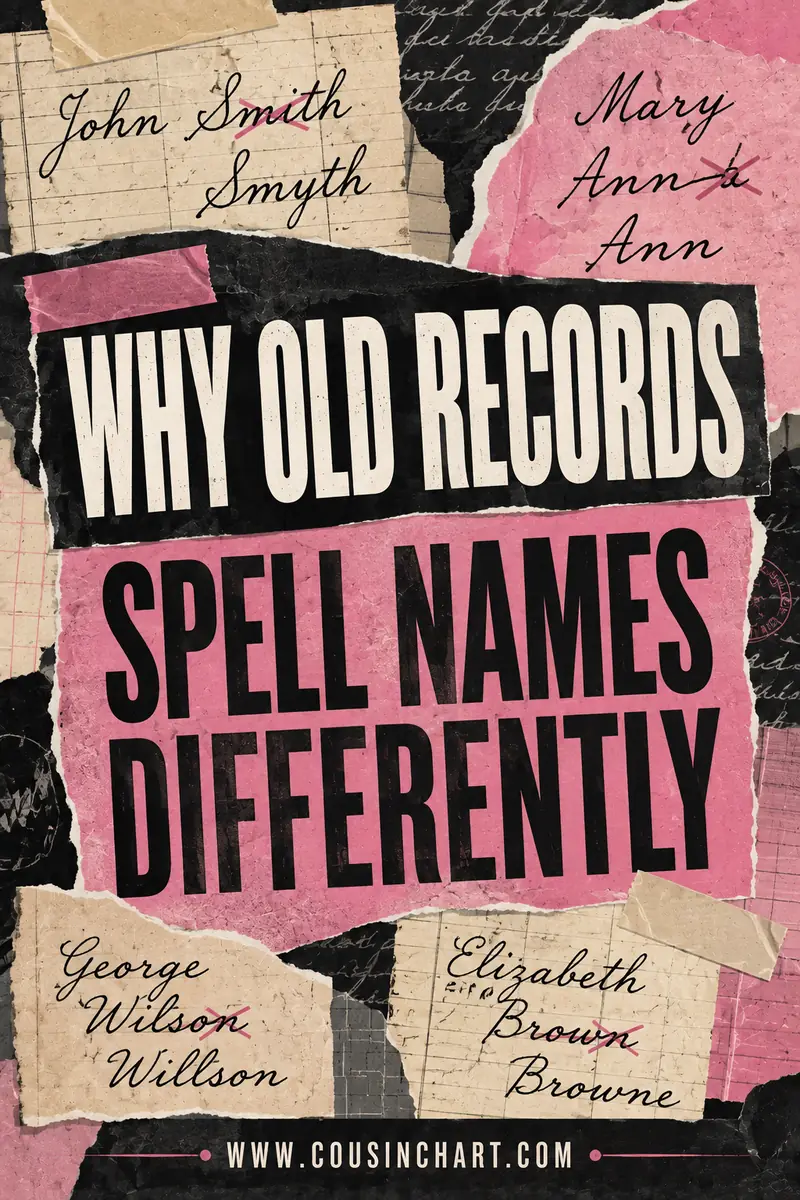
The reframe that solves this permanently: before standardised literacy there was no correct spelling of anything, so a variant is not an error and your ancestor did not "change" the name. A man in 1650 could not spell his own surname, because the concept barely existed. He said it; a clerk wrote down what he heard, in whatever convention that clerk used, and the next clerk wrote something else. Finding your family recorded as Wolfe, Woolf, Wolff and Wulf across four documents is not a mystery and not evidence of a name change — it is the normal condition of records before roughly 1800. Once you accept that, the search technique changes completely, and this page covers both halves. To place the relatives you find under all those spellings, use the cousin calculator.
What is going wrong with your search? Tap the closest match.
Tap an option above. Search for how the name sounded, not how it is spelled now.
There was never a correct spelling
The historical fact that dissolves the whole problem.
Standardised English spelling is a late arrival. Printing began to fix conventions from the late fifteenth century, dictionaries pushed further in the eighteenth, and compulsory schooling completed the job only in the nineteenth. Personal names were the last thing to settle.
Educated people varied their own spelling freely. Shakespeare's surviving signatures do not agree with one another. Nobody at the time regarded this as remarkable.
Most people could not read at all. Literacy rates in early modern England hovered around a third for men and much lower for women, and rural areas lagged further. A name existed as a sound, not a string of letters.
The name belonged to the speaker; the spelling belonged to the clerk. That division is the heart of it. The person being recorded had no say in how their name was written and often never saw the entry.
So "the family changed the spelling in 1782" is almost always a misreading. What changed was which clerk was writing.
Fixed spelling arrived with bureaucracy. Civil registration, compulsory schooling, passports and standardised forms are what froze surnames into single official versions, mostly during the nineteenth century.
Clerks wrote what they heard
The single largest source of variation, and the one that tells you how to search.
The interaction was almost always oral. A man appeared before a clerk, said his name, and the clerk wrote it. No document was handed over and no spelling was checked.
The clerk used his own conventions. Two clerks in the same parish, hearing the same name, could reasonably produce different spellings, and often did.
Handwriting compounded it. Secretary hand, in use into the seventeenth century, makes several letters near-identical, and later transcribers propagated the ambiguity — the reading conventions are covered in old genealogy terms.
Word boundaries drifted too. Prepositions and prefixes attached and detached at will: Attwood and At Wood, Van der Berg and Vandenberg, Mac Donald and McDonald and Macdonald.
Terminal letters were flexible by convention. A final -e was decorative and could be added or dropped; -s and -es alternated freely; doubled consonants were a matter of taste.
All of which means the reliable search key is the sound. Say the name aloud with the accent the family would have had, then imagine what an unfamiliar clerk would have written down.
Dialect, accent and the sounds a clerk could not hear
Variation is not random; it follows the sound systems of the people involved.
Regional accents drove regional spellings. A rhotic west-country speaker, a Yorkshire speaker and a Londoner saying the same name gave three clerks three different things to write.
Unfamiliar sounds got substituted. English clerks recording Gaelic, Welsh, Polish or Yiddish names had no letters for several of the sounds and reached for the closest English approximation.
Initial consonant clusters were simplified. The Kn- in Knight was still pronounced in Middle English and later fell silent, so Knight and Night both appear; likewise Wright and Right.
Vowels are the least stable part of any name. They shift with accent more than consonants do, which is why wildcard searching that leaves vowels open is so effective.
Aspirated and unaspirated pairs swap constantly. B and P, D and T, V and F, G and K, S and Z. Where a language distinguishes them differently from English, the swap is guaranteed rather than occasional.
And the same family could sound different by generation. Children raised in a new region acquired the local accent, and their names were recorded accordingly, even with no deliberate change.
Latin, and the formal register of registers
An entire category of variation created by the clerk's professional habit rather than by sound.
Parish registers before the mid-eighteenth century are frequently in Latin. Baptisms, marriages and burials all use Latin formulas, and names are Latinised as a matter of course.
Given names take Latin endings. Willelmus, Johannes, Ricardus, Maria, Elizabetha. These are not what the family called anyone.
Relationship words are Latin too. Filius (son of), filia (daughter of), uxor (wife), vidua (widow), sepultus (buried). Reading them as part of the name is a classic early error.
Occupational surnames were sometimes translated outright. Fabri for Smith, Molendinarius for Miller, Carpentarius for Carpenter, Sartor for Taylor, Pistor for Baker.
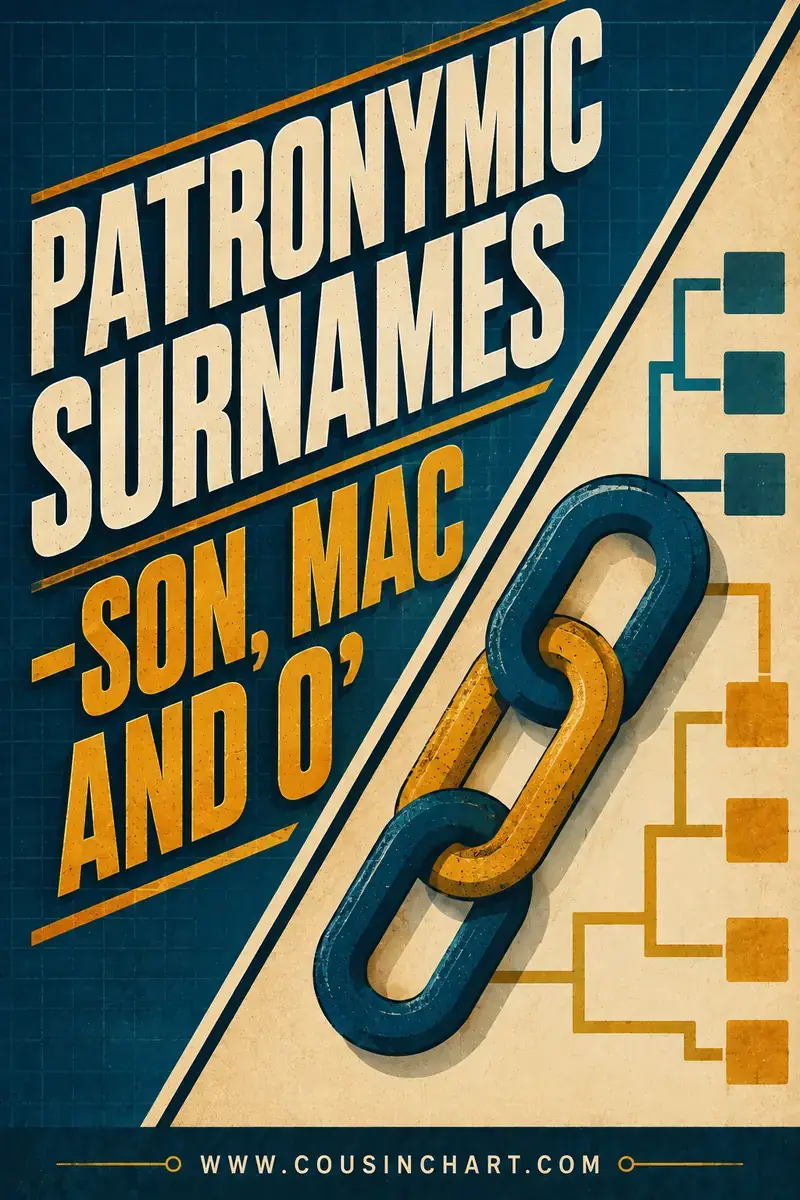
Latinised patronymics obscure the surname entirely. Willelmus filius Johannis may be recorded elsewhere as William Johnson, and the two entries look nothing alike — the mechanics of that system are in patronymic surnames.
Other countries have their own register languages. German records in Latin or Kurrent script, Polish records in Russian after the partitions, Hungarian records in Latin well into the nineteenth century. Knowing which language governed which region and decade is part of the puzzle described in what country is my last name from.
Transcription and indexing: the modern layer
A distinct problem from historic variation, and often the actual reason a search fails.
Every online index is a modern transcription of an old document. Someone read handwriting and typed what they thought it said, sometimes at speed, sometimes without knowing the local names.
Error rates are meaningful. For difficult handwriting, a noticeable fraction of surname entries in any large index will be wrong, and that fraction rises for unusual names and poor images.
Certain letter pairs are misread constantly. Long s read as f, u and n, c and e, r and z, and capital I, J and T. In older hands, double f (ff) is simply a capital F.
Automated handwriting recognition adds its own errors, different in character from human ones and sometimes stranger.
The fix is to browse the original images. If you know the parish and the approximate date, page through the register rather than trusting the index — the practical approach to that is in how to search census records.
And record which version you found where. When a name appears three ways across three sources, the citation is what lets you or anyone else re-check it later; the conventions are in how to cite genealogy sources.
Deliberate change, and what actually happened on migration
A smaller category than folklore suggests, but a real one.
Names were not changed at immigration desks. Officials worked from passenger manifests written at the port of departure by shipping clerks who spoke the emigrant's language. The Ellis Island story is a myth that has survived on sheer repetition.
Change happened afterwards, gradually, and by choice. Employers, teachers, neighbors and the family itself did the work over years.
Four patterns cover most of it. Phonetic respelling (Bauer to Bower), translation (Schwarz to Black, Zimmermann to Carpenter), truncation (Wojciechowski to Wojcik) and substitution of a familiar name that merely sounded similar.
Diacritics were dropped universally. Ó, ä, ü, ø, ł, ő, ç and the Irish fada do not survive English-language records, which alters both the appearance and the pronunciation.
Some changes were deliberate concealment, by families escaping debt, conscription, a conviction or persecution. Those leave no linking paper trail by design, and they are a genuine research wall rather than a personal failure — the wider strategy for such walls is in how to break through a brick wall.
Look for the overlap years. Almost every family used both forms for a decade or two. Finding the same household under each is the proof that links them.
Phonetic substitutions worth searching
The patterns that repeat most often in English-language records. Search both sides of every row.
| Pattern | Swaps | Examples |
|---|---|---|
| voiced / unvoiced | b↔p, d↔t, g↔k, v↔f, z↔s | Bower / Power, Bader / Bater |
| silent initial cluster | kn↔n, wr↔r, gn↔n | Knight / Night, Wright / Right |
| c / k / ch / q | any of these | Cathcart / Kathcart, Cane / Kane |
| i / y / j / ei | vowel substitution | Smith / Smyth, Meyer / Meier / Mayer |
| s / c before e, i | s↔c | Sisson / Cisson |
| ph / f | ph↔f | Phillips / Fillips |
| th / t / d | th↔t, th↔d | Smith / Smit, Booth / Boot |
| doubled consonants | ll↔l, tt↔t, nn↔n | Bennett / Benet, Wall / Wal |
| terminal -s / -es / -z | any | Davies / Davis, Gomes / Gomez |
| terminal -e added or lost | ±e | Clark / Clarke, Brown / Browne |
| -son / -sen / -sson | any | Anderson / Andersen / Andersson |
| gh silent or hardened | gh↔ff, gh↔ø | Clough / Cluff, Haigh / Hay |
| prefix attached or split | Mc/Mac/M', O'/O, Van/van der | McLeod / MacLeod, O'Neil / Oneil |
| vowel wholly unstable | a↔e↔i↔o↔u | Jonson / Johnson / Johnston |
Run wildcards rather than typing every combination. Most search sites accept `` for any run of characters and `?` for exactly one, usually requiring at least three fixed letters first. `Sm?th` catches Smith, Smyth, Smithe, Smythe and Smithers in one query.
Soundex codes a name by sound. It keeps the first letter and reduces the rest to three digits using consonant groups, so Smith and Smyth are both S530. It is built into several major search platforms.
Soundex has one serious blind spot: the first letter. It will never match Kelly to O'Kelly, or Smith to Schmidt. Where a prefix may have been dropped, search both with and without it.
Daitch-Mokotoff Soundex was designed for Slavic and Yiddish names and handles the sound systems that standard Soundex mangles. Use it for eastern and central European surnames.
Building a variant list that actually works
Six steps that turn scattered spellings into a research tool.
One: write down every spelling you have ever seen — in records, on gravestones, in family papers and in family memory. This list is the asset.
Two: say the name aloud in the original accent and write down every plausible English rendering of that sound, whether or not you have seen it.
Three: apply the substitution table above to each spelling you have, generating candidates systematically rather than by inspiration.
Four: search every variant in every source, including the ones that look wrong. Records do not know what looks right.
Five: record where each variant appeared, with source, date and place. Variants often cluster geographically, which can itself point at the branch you are following.
Six: never assume two spellings are two families, or that one spelling is one. Both errors are common. Prove the link with evidence — a shared address, an identical age, the same spouse or a named relative — using the categorising method in how to find your last name's origin.
FAQ
Did my ancestors change the spelling of our surname?
Almost certainly not deliberately. Before standardised spelling, a name existed as a sound, and clerks wrote whatever they heard using their own conventions. What looks like a change is usually a different clerk, a different accent or a different decade's habits.
How many spellings can one surname have?
Dozens, routinely. A moderately common English name can appear in fifteen or twenty forms across four centuries of records, and names transliterated from another alphabet or another language often have more. Uncommon and foreign-origin names generate the most.
What is Soundex and should I use it?
Soundex is a code that groups names by sound: it keeps the first letter and reduces the rest to three digits, so Smith and Smyth are both S530. It is genuinely useful, but it cannot match names whose first letter differs, so it fails on dropped prefixes like O' and Mac.
Why do parish registers use Latin names?
Because Latin was the formal language of church record-keeping for centuries. Clerks wrote Willelmus for William and filius for son of as a matter of professional convention. The Latin form is the clerk's register style, not anything the family ever used.
Were names really changed at Ellis Island?
No. Inspectors worked from manifests written at the port of departure and had no authority to rename anyone. Changes happened later, chosen by families over a period of years, which is why both forms usually appear in records for a decade or two.
How do I search when I do not know the spelling?
Use wildcards around the unstable parts, try Soundex where the first letter is reliable, and search by other fields entirely — a place, a birth year, a spouse's name or an occupation. Finding the household first and reading the surname afterwards often works better.
Searching for the sound, not the spelling
The habit worth building is to stop treating your modern spelling as the real one. It is the last version in a long series, fixed by nineteenth-century bureaucracy rather than by your family. Every earlier form is equally legitimate, and the family who used them would have been puzzled by the question. Say the name aloud in the accent it was said in, generate variants systematically with the substitution patterns above, search with wildcards rather than exact strings, and reach for Soundex where the first letter holds. Then prove the connections with evidence rather than assumption — a shared household, an age, a spouse — and use the cousin calculator to work out how the people behind all those spellings actually relate to one another.