Family Relationship Calculator: How Am I Related to Them?
A family relationship calculator answers "how am I related to this person?" by asking you one thing: how each of you descends from the ancestor you share. Tell it that your grandmother is the other person's great-grandmother, and it returns the exact term — first cousin once removed — along with an estimate of how much DNA you'd expect to share. No family tree upload, no account, no guessing.
You can try the relationship calculator right now if you already know the shared ancestor. If you're not sure what that means, or your situation involves steps, in-laws, or adoption, keep reading — this guide covers what the tool can answer, how to feed it the right information, and where it genuinely can't help.
How am I related? Tap the connection you’re trying to name:
Your answer will appear here.
What Does a Family Relationship Calculator Actually Do?
It converts positions on a family tree into a name.
Every blood relationship in your family can be described as a path: up from you to an ancestor you share, then back down to the other person. A relationship calculator takes the length of each leg of that path and looks up what the resulting shape is called in English. Two steps up, two steps down? First cousins. Three up, one down? Great-aunt. One up, two down? Niece or nephew.
That's why the tool asks about generations rather than names. It doesn't need to know that your great-grandmother was called Edna. It needs to know she's three generations above you and two generations above the person you're asking about.
The output has two parts:
- The relationship term — the genealogically correct name, the one a professional researcher or a court document would use.
- A shared-DNA estimate — a typical range in centimorgans (cM), the unit DNA testing companies use to measure how much genetic material two people have in common.
Both are useful, and they're useful for different reasons. The term settles arguments at family gatherings. The DNA range helps you sanity-check a match list from a testing company.
What Is a "Shared Ancestor" and Why Does It Matter So Much?
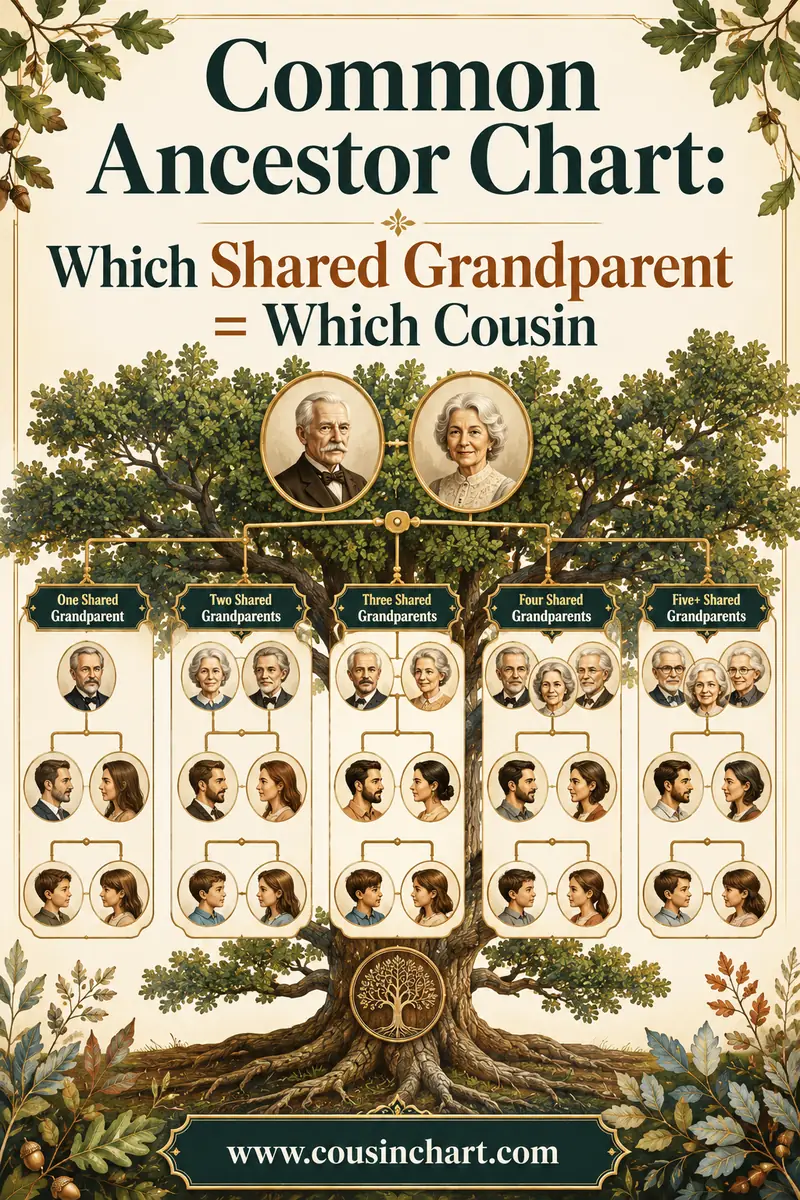
The shared ancestor — properly, the most recent common ancestor — is the closest person both of you descend from. It's the single input the whole calculation rests on, and it's the part people most often get wrong.
Some ground rules:
- Closest wins. You and your second cousin share great-grandparents. You also share every ancestor above them. The relationship is named from the nearest pair only.
- It's often a couple. Full blood relationships descend from both members of an ancestral couple. When only one ancestor is shared — a grandfather who had children with two different partners, say — you get a "half" relationship, with roughly half the expected DNA.
- Count links, not people. From you to your parent is one generation. You to your grandparent is two. You don't count yourself, and you don't count the ancestor as a step.
- Direct lines aren't cousin lines. If the other person is your ancestor, or you're theirs, you're not cousins at all — you're lineal relatives, and the terms are parent, grandparent, great-grandparent, and so on.
If tracing the connection is the hard part, our common ancestor chart lays out how to find the meeting point between two branches without building a full tree first.
The quickest way to find it
Ask the other person one question: "How are you connected to the family?" Almost everyone can name a link — "my grandmother was your grandfather's sister," or "my dad grew up with your mom, they were cousins." From that single sentence, you can usually count both legs of the path.
How Do You Use the Relationship Calculator Step by Step?
The whole process takes under a minute.
- Identify the shared ancestor. Get to the nearest one. If you land on a couple, note that both are shared — it matters for the DNA estimate.
- Count your own generations. Step up from yourself: parent is 1, grandparent is 2, great-grandparent is 3, and so on until you reach the shared ancestor.
- Count the other person's generations. Same process from their side.
- Enter both numbers in the calculator. You're telling it how each of you descends.
- Read the result. You'll get the relationship term and a typical DNA range for it.
The tool handles the tricky part — the rules that turn two generation counts into a name — but it can only work with what you give it. If you tell it the shared ancestor is three generations back when it's really two, you'll get a confident, wrong answer. Spend the extra ten seconds on step one.
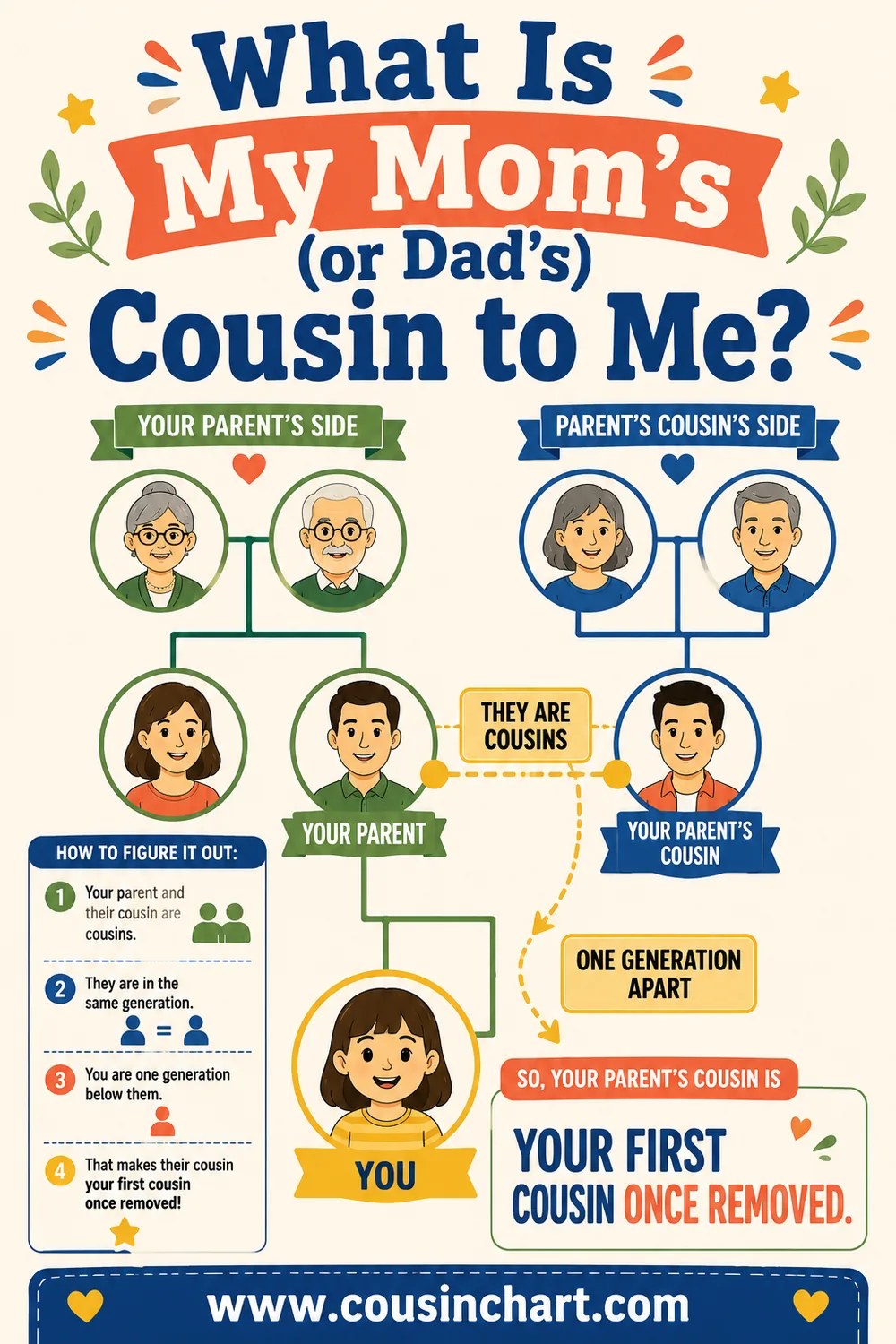
Worked Example: Your Mom's Cousin
This is the single most-asked relationship question, so let's do it properly.
Your mother has a cousin named Linda. Their mothers were sisters. What is Linda to you?
- Shared ancestor: your mother and Linda are first cousins, so their shared ancestors are your great-grandparents.
- Your generations: you → mother (1) → grandmother (2) → great-grandmother (3). So 3.
- Linda's generations: Linda → her mother (1) → her grandmother (2). So 2.
- Cousin number: take the smaller count (2), subtract one → first cousin.
- Removal: 3 − 2 = 1 → once removed.
Linda is your first cousin once removed. Most families just call her "Aunt Linda," which is warm, sensible, and technically wrong — and that's fine. A calculator gives the genealogical term; families give the term that fits the relationship they actually have. Our guide to what your mom's cousin is to you covers this exact scenario in more depth, including what Linda's children are to you (second cousins).
Worked Example: Comparing Both Sides of the Family
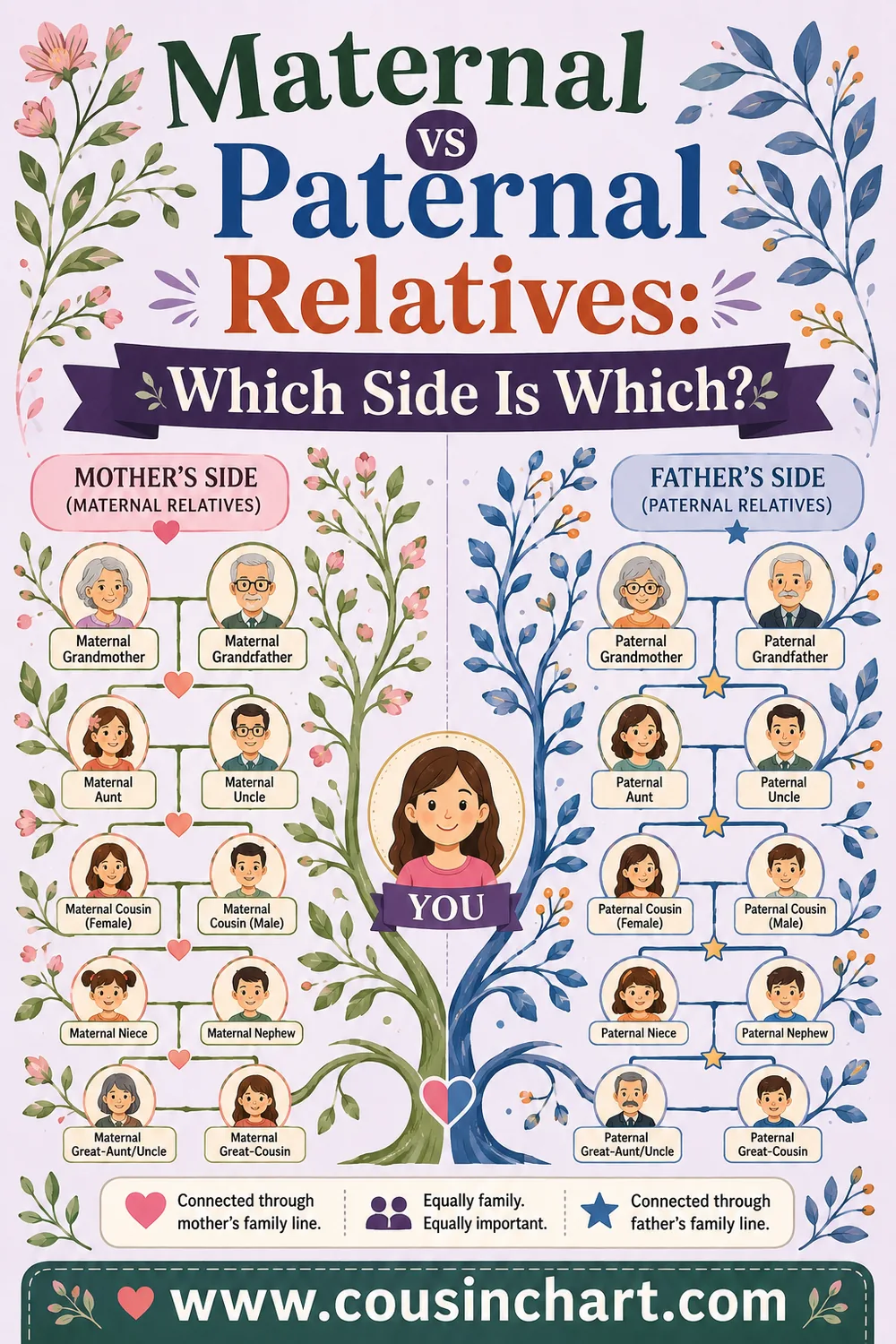
Relationship calculators don't care which side of the family a person is on. That surprises people, so it's worth showing.
Say you have two relatives:
- Marcus, on your father's side: your father's father's brother's grandson.
- Priya, on your mother's side: your mother's mother's sister's grandson's daughter.
Marcus first. Your father's father's brother means the shared ancestors are your great-grandparents (your grandfather's parents). You're three generations from them. Marcus is: great-grandparent → his grandfather (1) → his father (2) → Marcus (3). Equal counts, so nothing is removed, and 3 − 1 = second cousin. Marcus is your second cousin.
Now Priya. Your mother's mother's sister puts the shared ancestors at your great-grandparents again — three generations for you. Priya's line: great-grandparent → her grandmother's generation... count down: her grandmother (1), her father (2), Priya (3), plus one more level because she's the grandson's daughter — so 4. Smaller count is 3, minus one = second cousin. Difference is 4 − 3 = 1. Priya is your second cousin once removed.
The maternal or paternal label changes nothing about the math. It matters for X-chromosome inheritance and for some cultural naming systems, but not for the English relationship term or the autosomal DNA estimate. Our comparison of maternal vs paternal relatives explains where the distinction genuinely does make a difference.
Worked Example: Two People Who Aren't You
A relationship calculator isn't limited to relationships involving you. You can point it at any two people in a tree, which is genuinely useful when you're organizing research or explaining a family diagram to someone else.
Say you want to know what your grandmother is to your husband's nephew. That one's a trap — there's no blood relationship at all, because the connection runs through a marriage. A calculator will have nothing to compute.
Now a workable example: what is your daughter to your first cousin? Your cousin is two generations from the grandparents you share. Count from your daughter: her parent is you (1), her grandparent is your parent (2), her great-grandparent is your grandparent (3). So she's at 3. Smaller count is 2, minus one → first cousin. Difference is 3 − 2 = 1 → once removed. Your daughter is your cousin's first cousin once removed.
That mirror-image quality is the thing to remember: your cousin's child and your parent's cousin get the same label, because removal measures the gap, not the direction.
What Does the Shared DNA Estimate Mean?
The DNA figure is a statistical expectation, not a prediction about you specifically. It answers "what do people in this relationship usually share?" — not "what will you two share?"
Here's the reference range for common relationships, drawn from the Shared cM Project hosted at DNA Painter:
| Relationship | Shared ancestor level | Typical shared DNA |
|---|---|---|
| Full siblings | Parents | ~2,300–3,400 cM |
| Grandparent / half-sibling / aunt or uncle | Varies | ~1,300–2,300 cM |
| First cousins | Grandparents | ~550–1,300 cM |
| First cousin once removed | Grandparents | ~200–650 cM |
| Second cousins | Great-grandparents | ~75–360 cM |
| Second cousin once removed | Great-grandparents | ~30–215 cM |
| Third cousins | Great-great-grandparents | ~0–220 cM |
| Fourth cousins and beyond | Further back | Frequently zero |
Three things this table teaches you:
- The ranges are wide. DNA is shuffled randomly at every generation. Two genuine second cousins might share 340 cM or 80 cM, and both are perfectly normal.
- The ranges overlap. A 250 cM match could be a first cousin once removed, a second cousin, or a half first cousin. DNA narrows your options; it rarely picks one.
- Zero is not proof of nothing. Beyond third cousins, real cousins routinely share no detectable DNA. A documented paper-trail relationship isn't invalidated by an empty DNA result.
If you're working backwards from a testing company's match list rather than forwards from a known tree, our shared cM chart guide explains how to handle overlapping ranges without jumping to conclusions.
When Can a Relationship Calculator Not Answer Your Question?
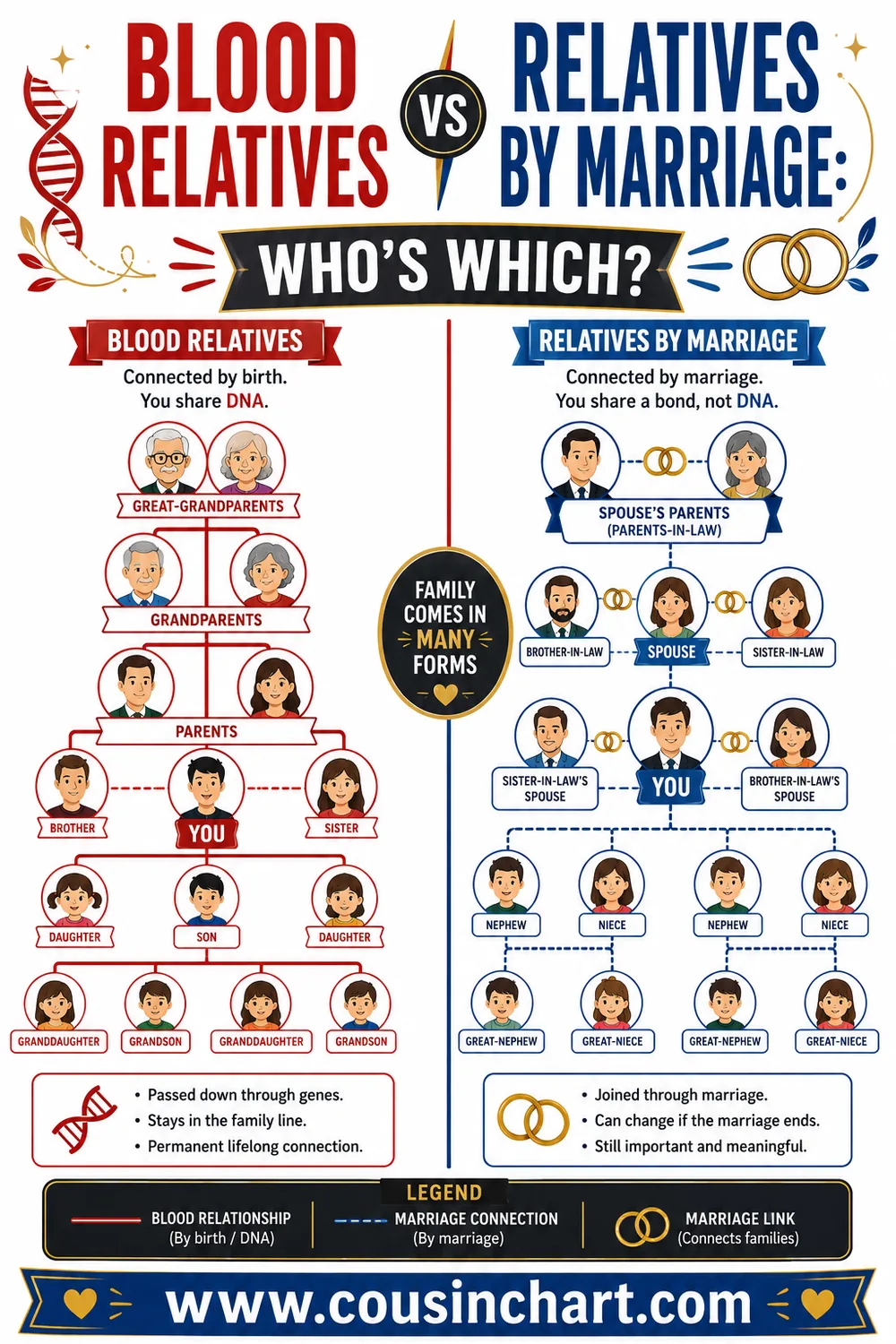
A calculator computes descent. If descent isn't what connects two people, it has no input to work with. Three big categories:
Step-relationships
Your stepfather's sister, your stepsister's daughter, your mom's husband's parents — these connections are created by a marriage, not by a shared ancestor. There's nothing to count.
The practical answer is usually whatever your family already says. Many people call a stepparent's sibling "aunt" or "uncle" without a second thought, and that's a complete and correct answer socially. Genealogically, the honest label is "no blood relationship, connected by marriage."
In-laws
Same story. Your cousin's wife, your sibling's spouse's parents, your spouse's cousin — all connections through marriage. Some of these have standard English terms (brother-in-law, mother-in-law), and some don't. "Cousin-in-law" is widely understood but purely conversational; there's no formal definition and no consistent rule about where the term stops applying.
Our what do I call them tool is built specifically for these — the in-law and step terms that a descent calculator can't touch. And the blood relatives vs relatives by marriage guide draws the line clearly if you want the underlying distinction.
Adoption
Adopted family members are fully family — legally, socially, and in most genealogical records. The relationship terms apply exactly as they would for a biological relative: your adopted cousin is your cousin, full stop.
What doesn't apply is the DNA estimate. A calculator that shows "first cousins, ~550–1,300 cM" is describing genetic inheritance, and that particular number won't hold. The relationship name is still right. Treat the DNA figure as the part that doesn't transfer, and everything else stands.
What If You Don't Know the Shared Ancestor?
Sometimes the whole reason you're asking is that you can't trace the connection. A few approaches:
- Ask the oldest willing relative. One conversation with an aunt or great-uncle usually collapses three generations of confusion. Ask specifically: "How was Grandma related to them?"
- Work from a known third person. If you both know how you relate to a mutual relative, you can bridge through them.
- Use surnames and locations. Two branches from the same small town with the same surname usually meet within a few generations.
- Let DNA suggest a range. If you've both tested, the shared cM figure tells you roughly how close the connection is, which tells you how far back to look.
- Build out sideways, not up. Instead of chasing your direct line further back, document the siblings of your known ancestors. Cousins descend from those siblings, and that's where the connection will be found.
Tips That Keep the Answer Accurate
- Don't count yourself. You're generation zero.
- Use the nearest shared ancestor. Going further back inflates both counts and produces a more distant-sounding relationship than reality.
- Check whether both ancestors are shared. One shared grandparent instead of two means a half relationship and roughly half the DNA.
- Ignore age entirely. Removals measure generations. A cousin once removed can be older or younger than you.
- Separate the term from the DNA. The relationship name is fixed by the tree. The DNA is a probability.
- Accept that families overrule genealogy. If everyone calls her Aunt Linda, she's Aunt Linda. The calculator tells you the formal term; it doesn't tell you what to say out loud.
FAQ
How does a family relationship calculator work?
It takes two numbers — how many generations you are from your shared ancestor, and how many generations the other person is — and applies the standard genealogical rules to produce a relationship name. The smaller count determines whether you're first, second, or third cousins; the difference between the counts determines the removal.
What is a most recent common ancestor?
It's the closest ancestor two people both descend from. First cousins share grandparents; second cousins share great-grandparents. You always name a relationship from the nearest shared ancestor, even though you also share every ancestor above them.
Does it matter whether the relative is on my mom's side or my dad's side?
Not for the relationship name or the autosomal DNA estimate — the math is identical on both sides. The maternal or paternal distinction matters for X-chromosome inheritance patterns and in some cultures that use separate terms for each side, but the English term and the cM range are the same.
Can a relationship calculator handle in-laws and step-family?
No, because those relationships come from marriage rather than shared descent, so there are no generations to count. Terms like "cousin-in-law" and "step-cousin" are conversational and vary by family. Our what do I call them tool is built for those instead.
Why does my DNA test show a different amount than the calculator estimates?
Because the estimate is an average range, not a measurement. DNA is inherited randomly, so two people in the same relationship can share very different amounts. Falling outside the typical range for one relationship usually just means you're at the edge of normal, not that the relationship is wrong.
Does a relationship calculator work for adopted family members?
The relationship term works perfectly — an adopted cousin is a cousin. The shared-DNA estimate is the part that won't apply, since that figure describes genetic inheritance. Read the name as accurate and treat the cM range as not relevant in that case.
Find Out How You're Related
Most family relationship questions come down to one thing: finding the ancestor you have in common and counting from there. Get that right and the naming takes care of itself.
The free family relationship calculator handles the counting the moment you know the shared ancestor — exact term, typical DNA range, no signup. And when the connection runs through a marriage or a stepfamily instead, the what do I call them tool picks up where the math leaves off.