The Genealogy Research Checklist: A Plan That Actually Finds Answers
A genealogy research plan works like this: pick one specific question you could actually answer ("Where was John Smith born?" — not "research the Smiths"), write down what you already know and how you know it, list the record types that could answer that question, search the free sources first, log every single search including the ones that find nothing, then weigh what you found and write down your conclusion.
That's the whole cycle. Then you do it again with the next question. Everything below is that loop in detail, plus a printable-style checklist you can work through and the Genealogical Proof Standard explained in plain words. Before you start, print a blank chart from our free printable family tree pack — seeing the empty boxes is usually the fastest way to spot which question is worth asking first.
Free printables for this page
Download a blank PDF (US Letter or A4) — free, no sign-up — or customize it in the maker above before printing.
 5-Generation Pedigree Chart
 Research Log
 Family Group Sheet
 Family Interview Worksheet
Where are you stuck? Tap the situation that fits and get your next step.
Tap a situation above to see your next step.
Print a blank chart to plan around →Why do you need a research plan at all?
Because searching isn't the same as researching, and most people only ever do the first one.
Searching is typing a name into a box and seeing what comes back. It has no memory — six years of it leaves you with a pile of hints, no citations, and no idea what you've already tried. Research is deciding in advance what you want to know, going where that answer would live, and recording the result whether or not you liked it.
The difference shows up in three places:
- You stop repeating yourself. Most genealogists have re-searched the same collection three or four times without realizing it.
- You start finding the hard stuff. Easy records are indexed and will find you; the record that breaks your brick wall is usually unindexed, misspelled or sitting in a courthouse.
- Your tree becomes defensible. When a cousin asks "how do you know Mary's father was Jacob?", you have an answer instead of a shrug.
Step 1: What makes a good research question?
A good research question has exactly one answer, names one person, and is anchored to a place and a rough time.
Compare these:
| Weak question | Strong question |
|---|---|
| Research the Miller family | Who were the parents of Jacob Miller, born about 1820 in Ohio? |
| Find out about great-grandma | What was Mary Adams's maiden name at her 1868 marriage in Stark County, Ohio? |
| Where did we come from? | Which port and year did Johann Mueller arrive at in the United States? |
| Learn more about John Smith | Where and when did John Smith, of Summit County, Ohio, die? |
The strong versions share one shape: one person, one fact, one place, one approximate date. That shape is what lets you name the records that could answer it, which is Step 3.
Write the question at the top of the page
Literally — notebook, document or printed form, the question goes at the top and stays there. Two hours of searching drift onto a different family more often than you'd think, and the written question is what pulls you back.
You'll spot other things while you work: an interesting neighbor with your surname, a promising index for another branch. Don't chase them. Write them on your to-do list. Chasing every thread is how people end up with fourteen half-finished branches and no proven ones.
Step 2: What do you already know, and how do you know it?
Before you search anything, write out everything you believe about this person, and beside each item, where it came from. You'll usually find three categories:
- Documented facts — you have a record, and you can cite it.
- Family knowledge — Grandma said it. Often right, sometimes garbled, occasionally invented.
- Borrowed facts — copied from an online tree or a hint you accepted. These are the dangerous ones, because they feel like documented facts.
Anything in the second and third groups is a hypothesis, not a fact. Marking them honestly here saves you from building three generations on somebody else's guess. Our guide to organizing genealogy research covers the filing, naming and citation habits that make this step take two minutes instead of an evening.
Know the historical context too
Which country, state and county was this place in, in that year? County boundaries moved constantly in the 1800s, so a record created in "your" county may now sit in the courthouse next door. Was there a war, a famine, a land opening? Did the courthouse burn? Ten minutes on local history changes where you search.
Step 3: Which records could actually answer the question?
This is the step almost everyone skips, and it's the one that does the most work.
Don't ask "where should I search?" Ask: what event created a record, who created it, and where would that paper be now?
| If you want to know… | Records that could tell you |
|---|---|
| Birth date and place | Birth certificate, baptism register, census age, delayed birth record, Social Security application, death record, obituary, gravestone |
| Parents' names | Marriage record, death certificate, baptism record, probate/will, guardianship papers, obituary |
| Maiden name | Marriage record, children's birth records, death certificate, church records, cemetery plot ownership |
| Where a family lived | Census, land deeds, tax lists, city directories, church membership, voter rolls |
| Immigration and origin | Passenger list, naturalization papers, passport applications, church records in the home country, obituary |
| Death date and place | Death certificate, burial register, gravestone, probate file, newspaper notice, cemetery records |
| Military service | Service records, pension files, draft registrations, veterans' grave markers |
Two rules for using a table like this:
- Prefer records created at the time of the event by someone who was there. A baptism entry written the week of the birth beats a death certificate's birth date written sixty years later by a grieving son.
- List several records, not one. If the courthouse burned or the certificate never existed, you want the backup plan already written down.
Then write beside each record type where you'd actually get it — FamilySearch, the state archive, the county clerk, a named newspaper site. That turns a wish list into a to-do list.
Step 4: Why should you search free sources first?
Because an enormous share of what you need is free, and because paying before you've exhausted the free options is how genealogy budgets vanish.
Work in this order:
- FamilySearch — free with an account, and the largest collection of digitized and indexed records available at no cost. Some images are viewable only at a family history center; the index is still free.
- Chronicling America — the Library of Congress's free historic newspaper archive. Obituaries, marriage notices, court reports, local gossip naming relatives.
- Find a Grave and BillionGraves — volunteer-photographed headstones with dates and often family links.
- State and county archives — most states put death, land or vital records indexes online for free. Chronically underused.
- Public library access — many library cards include free at-home access to subscription databases. Ask; you may already be paying for it.
- Then paid subscriptions, once you know which collection you need. A targeted month costs less than a year of drifting.
Our roundup of ways to trace your family tree for free covers which free site is best for which record, and the census research guide covers the collection you'll use in almost every cycle.
Step 5: How do you log searches properly?
You record every search you run, whether it worked or not, in one place.
A workable log has these columns:
| Date | Question | Source searched | Search terms used | Result | Next step |
|---|---|---|---|---|---|
| 2026-03-04 | Jacob Miller's parents | FamilySearch, Ohio marriages 1810–1850 | Miller, Jacob, Stark Co. | Nothing under Miller | Try Mueller, Muller, Millar |
| 2026-03-04 | Jacob Miller's parents | Ohio county probate index | Miller, Stark Co., 1840–1870 | Will of Adam Miller 1861 | Order probate packet |
The column people leave out is "Result: nothing." Negative results are findings. "Searched the 1880 census for Stark County under four spellings, not there" tells you he moved, died, or was recorded under a name you haven't guessed — and stops you burning another evening on it next year.
The other one people skip is "search terms used." Finding nothing under Miller means nothing if the clerk wrote Mueller. Without your exact terms, a log can't say what's genuinely been ruled out.
Our genealogy research log guide has a ready-made structure and shows how to keep it without it becoming a second hobby.
Step 6: How do you weigh what you found?
You have documents. Now you have to decide what they're worth, and that's a different skill from finding them.
Ask three questions about every record:
- How close was the informant? A witness beats a relative; a relative beats a neighbor; a neighbor beats a clerk copying a list.
- How close in time? Same week beats same decade beats sixty years later.
- Original or copy? An indexed transcription can drop a letter, a middle name, or a mother entirely. Look at the image whenever there is one.
Resolving conflicts
Sources will disagree — that's normal. Four census records can give four different birth years for the same man; none is lying exactly, they're repeating whatever somebody guessed on the doorstep.
Don't quietly pick the one you like. Write out the conflict and explain your choice: "the 1855 baptism gives 12 March 1852; the 1900 census implies 1853; I favor the baptism, written within weeks by the officiating minister." Ninety seconds, and it's what separates a tree from a guess.
Correlate instead of collecting
One record rarely proves a relationship alone. What proves it is several independent records pointing the same way — a will naming a son, a census with the right household, a marriage witness with the right surname, a burial in the same plot. Lay them side by side and see whether they tell one coherent story.
Step 7: Why write the conclusion down?
Because an unwritten conclusion isn't finished, and because writing is where you find the hole in your own reasoning.
You don't need a formal report. A paragraph in your notes will do:
Jacob Miller (b. abt. 1820, Ohio) was the son of Adam Miller of Stark County. Adam's 1861 will names "my son Jacob"; the 1830 and 1840 censuses show a boy of matching age in Adam's household; Jacob's 1911 death certificate names his father as Adam Miller. No other Adam Miller appears in Stark County tax lists in this period. Jacob's mother's maiden name is still unproven — the marriage record hasn't been located.
That paragraph states the conclusion, cites the evidence, and is honest about what's still open. The open item becomes your next research question, and the cycle starts again.
The genealogy checklist, step by step
Here's the whole plan as a checklist you can work down. Copy it into your notes, or print it and tick as you go.
| # | Step | What "done" looks like |
|---|---|---|
| 1 | Write one specific research question | One person, one fact, one place, one approximate date |
| 2 | List what you know and how you know it | Every fact marked as documented, family knowledge or borrowed |
| 3 | Check the historical context | County boundaries, courthouse fires, wars, migration routes noted |
| 4 | List record types that could answer it | At least three, ranked by how close to the event they were created |
| 5 | Note where each record lives | A named website, archive or office beside each record type |
| 6 | Search free sources first | FamilySearch, newspapers, gravestones, state archives worked through |
| 7 | Search name variants and spellings | At least three spellings, plus initials-only and wildcard searches |
| 8 | Log every search, including the empty ones | Date, source, exact terms, result, next step |
| 9 | Save and cite every document at the moment you find it | File renamed, citation captured, source noted in your tree |
| 10 | Analyze and compare the evidence | Informant, timing and originality assessed for each record |
| 11 | Resolve any conflicts in writing | The disagreement stated, your choice explained |
| 12 | Write a short conclusion | Answer, evidence, and what remains unproven |
| 13 | Update the tree and start the next question | New questions added to the to-do list |
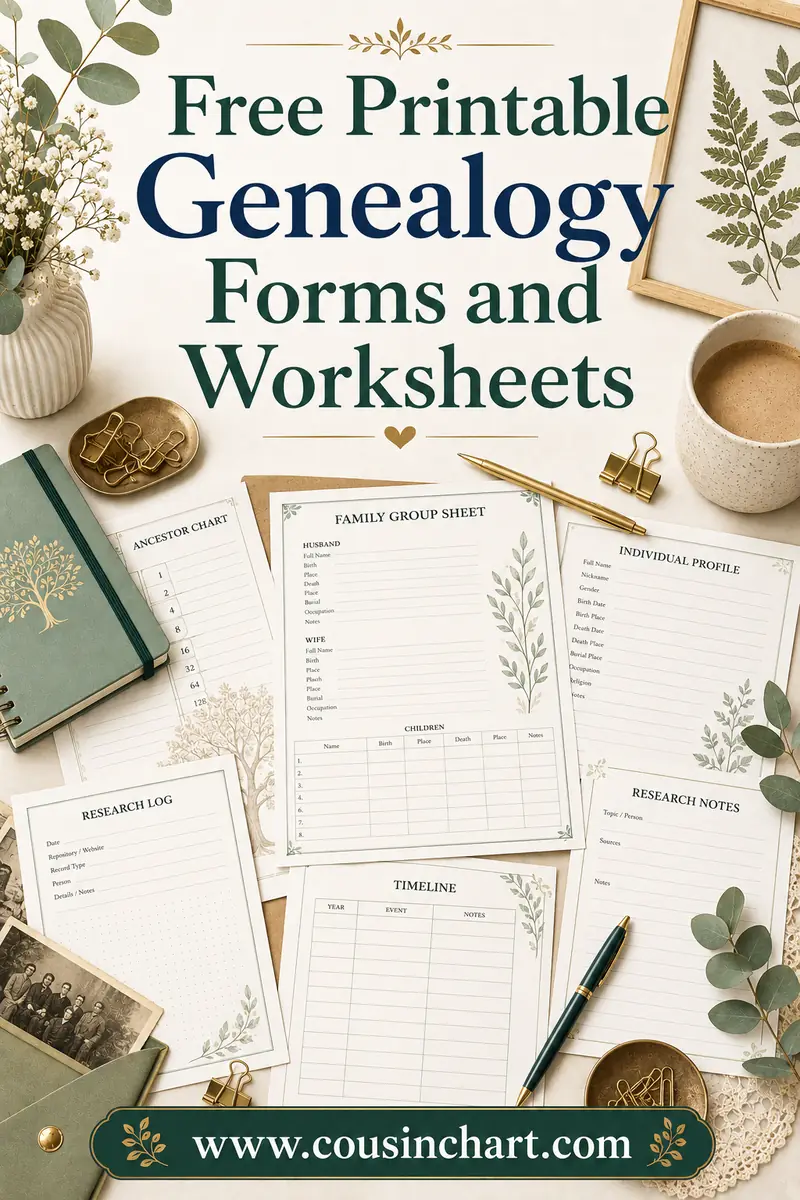
If you like working on paper, our free printable genealogy forms collection includes research logs and family group sheets that slot straight into this workflow.
What is the Genealogical Proof Standard?
The Genealogical Proof Standard is the recognized benchmark for a sound genealogical conclusion. It has five parts:
- A reasonably exhaustive search. You looked at the range of sources likely to answer the question — not just the first convenient one, and not just what was indexed on the site you happened to be logged into.
- Complete and accurate source citations. Every piece of evidence can be traced back to exactly where it came from, so somebody else could check it.
- Analysis and correlation of the evidence. You assessed what each source is actually worth and compared them against one another.
- Resolution of conflicting evidence. Where sources disagree, you explained which you favored and why, rather than silently choosing.
- A soundly reasoned, coherently written conclusion. You wrote the reasoning down, not just the answer.
You don't have to be certified to work this way, and you don't have to apply it to every twig on your tree. But apply it to the load-bearing links — the parent-child connections everything above them depends on — and your tree stops being a collection of hopeful guesses.
Notice how much of the standard is just the checklist above: "reasonably exhaustive" is Step 4 plus a log, "complete citations" is Step 9, "resolution of conflicts" is Step 6. Work the plan and most of it happens automatically.
What goes wrong most often?
A few failure patterns show up again and again.
- Name collection instead of family reconstruction. Grabbing every same-surname person from an index and hoping they're related. They usually aren't.
- Accepting hints without looking at them. A hint is an algorithm's suggestion, not evidence. Open the image, check the details, then attach.
- Copying online trees. Four trees saying the same thing is often one guess copied four times, not four confirmations.
- Searching only exact spellings. Clerks spelled phonetically and indexers misread handwriting. Try variants, initials, and the surname alone within a county.
- Ignoring the siblings. Your ancestor's records may be silent about his parents while his sister's marriage record names them outright.
- Assuming a fact because the dates fit. Two men of the right age in the right county aren't the same man until something ties them together.
How long should one cycle take, and when do you give up?
A well-framed question often resolves in one or two sessions. If you've been on the same one for months, it's too broad — "who were Jacob's parents?" might become "is the Adam Miller in the 1861 Stark County probate index Jacob's father?", settleable in an evening.
And some questions genuinely can't be answered. The records burned, were never created, or the person deliberately disappeared. It's honest to park a question with a note saying what you tried and what would need to turn up; new collections get digitized constantly, so a question parked today may be answerable in two years. Just make the note detailed enough that future-you doesn't start from zero.
If you're at the very beginning, work through our guide to building your family tree first — it covers the order to research generations in, which is the frame this checklist hangs on.
FAQ
What should be on a genealogy research checklist?
One specific research question; what you already know and its source; the historical context of the place; the record types that could answer the question; where each record lives; free sources searched first; name variants tried; a log of every search including empty ones; citations captured as you save; analysis and conflict resolution; and a short written conclusion.
How do I write a genealogy research plan?
Start with one answerable question about one person, in one place, at one approximate time. Write down what you know and how you know it. List the records that could answer it, ranked by how close they were created to the event, and note where each is held. Then search, log, analyze and write your conclusion — and let what's left unproven become the next question.
Should I use free genealogy sites before paying for a subscription?
Yes. FamilySearch, Chronicling America, Find a Grave and state archive sites cover a huge share of common research needs at no cost, and many library cards include free access to paid databases. Work through those first, then buy a targeted subscription month once you know which collection you need.
Why should I record searches that found nothing?
Because a negative result is a finding. Recording that you searched an 1880 census under four spellings and found nobody tells you the person moved, died or was recorded differently — and stops you repeating that exact search next year. Without the log, empty searches are the ones you're guaranteed to redo.
What is the Genealogical Proof Standard in simple terms?
It's the accepted benchmark for a credible conclusion: a reasonably exhaustive search, complete and accurate source citations, analysis and correlation of the evidence, resolution of any conflicting evidence, and a soundly reasoned written conclusion. Apply it at least to the parent-child links the rest of your tree depends on.
What do I do when two records disagree?
Weigh them rather than choosing quietly. Ask which record was created closer to the event, and whether the informant actually knew. A baptism register written days after a birth outweighs a birth year implied by a census fifty years later. Then write the conflict and your reasoning down so the decision is visible.
Work the plan, one question at a time
The difference between a tree that grows and a tree that stalls rarely comes down to talent or luck. It comes down to asking one answerable question at a time, searching deliberately, and writing down what happened.
Pick your question tonight. Print a blank chart from our free printable family tree collection to see exactly which box you're filling, start a log, and run the cycle once. And when a new record hands you a relative whose exact connection isn't obvious, the family relationship calculator will name it in a couple of clicks.