The Genealogical Proof Standard (GPS): A Plain-English Guide With Examples
The genealogical proof standard (GPS) is the test genealogists use to decide whether a family-history conclusion is proved. It has five parts: reasonably exhaustive research, complete and accurate citations, thorough analysis and correlation, resolution of conflicting evidence, and a soundly written conclusion. If your work meets all five, other researchers can trust it. If it skips one, it's still a hypothesis.
The standard comes from the Board for Certification of Genealogists (BCG), the group that certifies professional genealogists in the United States. You don't need to be a professional to use it, though. Anyone building a family tree can use the same five steps to avoid the classic mistakes: grafting the wrong John Smith onto your tree, trusting a death certificate that got the parents' names wrong, or copying someone else's online tree without checking it.
This guide walks through each element in plain English, shows the vocabulary you need, and then works one full example from start to finish. In it, two records disagree about a woman's parents and her birth year, and we use the GPS to settle both questions.
What the Genealogical Proof Standard Is (and Isn't)
The GPS is a standard of proof, not a research method. It doesn't tell you which archive to visit first. It tells you what your finished work has to look like before you can honestly call a fact "proved."
The BCG lists the five elements on its ethics and standards page in this order:
- Reasonably exhaustive research. You looked in all the places a competent researcher would expect to find an answer.
- Complete and accurate source citations. Every fact points to where it came from, so someone else can check it.
- Thorough analysis and correlation. You judged how reliable each record is and compared the records against each other.
- Resolution of conflicting evidence. When records disagree, you explained why one answer wins.
- A soundly written conclusion based on the strongest evidence. You wrote down the answer and the reasoning behind it.
The FamilySearch Research Wiki's GPS page describes the same five points as the minimum a genealogist must meet for work to be credible. It also makes an important point: any proved conclusion can be looked at again if new evidence turns up. "Proved" in genealogy doesn't mean "certain forever." It means "the best answer the evidence supports, shown in a way others can check."
Here's what the GPS is not:
- It's not a records checklist. There's no list of "the 12 records you must find." What counts as reasonably exhaustive depends on your question, time and place.
- It's not a vote. Three records that copy the same mistake don't beat one good original record.
- It's not only for hard cases. A simple fact with one solid original record can meet the GPS in a sentence and a footnote.
- It's not only for professionals. It's the same logic a careful hobbyist already uses, written down so it can be checked.
Why Genealogists Need a Proof Standard
Family history runs on old records, and old records are full of honest errors. A census taker guessed at a spelling. A grieving son gave the wrong maiden name on his mother's death certificate. A county clerk copied a will into the deed book and skipped a line. Online trees then copy these errors thousands of times.
Without a standard, it's easy to accept the first record that answers your question and stop there. That's how trees end up with a woman giving birth at age six, or a man living in two states at once. A proof standard forces you to slow down at exactly the moment you're tempted to say "found it."
It also makes your work useful to other people. If you hand a cousin a tree with no citations, they can't tell your solid facts from your guesses. If you hand them a tree where each key link is cited and explained, they can build on it. That matters on a site like CousinChart, where people use their trees to work out how they're related to someone. A wrong link two generations back changes every cousin relationship below it.
Key Terms: Sources, Information and Evidence
Before the five elements make sense, you need three pairs of words that genealogists use very precisely. The BCG article "Grains of Salt: Analyzing Sources, Information, and Evidence" by Alice Hoyt Veen lays them out clearly. The big idea is that you rate three different things separately: the container (the source), each statement inside it (the information), and how that statement relates to your question (the evidence).
| Term | Plain meaning | Example |
|---|---|---|
| Original source | The first time the information was recorded, not copied from something earlier | The handwritten parish marriage register |
| Derivative source | A copy, transcription, abstract, index or translation of an earlier record | A typed index of that register on a website |
| Authored narrative | Someone's conclusions built from several sources | A county history book, an article or an online family tree |
| Primary information | Given by someone with first-hand knowledge of the event | The bride and groom's own names on their marriage record |
| Secondary information | Given by someone who heard it from someone else, often years later | A grandson giving a birthplace on a death certificate |
| Undetermined information | You can't tell who supplied it | A census entry where the informant isn't named |
| Direct evidence | Answers your question on its own | A birth record that names the child's father |
| Indirect evidence | Only answers the question when combined with other evidence | A will that names "my daughter Catherine Doyle" plus a marriage record showing Catherine married a Doyle |
| Negative evidence | The absence of something that should be there, which itself points to an answer | A man missing from a tax list he would have to appear on if he were alive and in the county |
Two things trip people up here. First, one source can hold both primary and secondary information. A death certificate has primary information about the death (the doctor was there) and usually secondary information about the birth (the informant wasn't). Second, "evidence" only exists in relation to a question. The same will is direct evidence for "Did Michael Ward have a daughter named Catherine?" and only indirect evidence for "Who were Catherine Doyle's parents?"
Element 1: Reasonably Exhaustive Research
The first element asks whether you've looked hard enough. In "What Is 'Reasonably Exhaustive' Research?", Judy Kellar Fox explains that the research question sets the scope. You need to know the time and place well enough to understand which records were created, where they ended up, how county lines shifted, and which migration routes people used. She also points out that a person's life touched many kinds of records: legal, religious, military, financial and social.
What "reasonably exhaustive" looks like in practice
- Start from a clear question. "Who were the parents of Catherine Ward, who married Thomas Doyle in Albany, New York, in 1872?" is a question. "Find everything on the Wards" isn't.
- Prefer originals made close to the event. Look at the image of the register, not just the index entry.
- Cover every record type that could answer the question. For parentage, that usually means vital records, church registers, every census year the person lived through, probate, land, newspapers and cemetery records.
- Follow every person in the household. Siblings' records often name the parents when your ancestor's own records don't.
- Widen the circle when you get stuck. Fox notes that if the evidence is thin, you research the subject's family, associates and neighbors. Genealogists call that the FAN club method, short for friends, associates and neighbors.
How do you know when to stop?
"Reasonably" is the key word. Thomas W. Jones, in the BCG article "The Genealogical Proof Standard: How Simple Can It Be?", argues that a complete search isn't required, and that where you stop depends on the question and what you've found. His worked example uses seven sources, which he treats as reasonable for that question.
A good rule of thumb: you can stop when new sources keep confirming what you already have, when you've checked the record types most likely to contain a contradiction, and when you can name what's left unchecked and explain why it probably wouldn't change the answer. If you can't say what you haven't looked at, you probably haven't looked enough.
Element 2: Complete and Accurate Source Citations
A citation is the address of a fact. It tells the reader exactly where you saw it, so they can go look for themselves. In genealogy, a good citation does three jobs:
- It lets someone find the record again. Name, date, volume, page, entry number, and where you viewed it (archive, microfilm, website and image number).
- It tells the reader what kind of source it is. "Parish register, original" and "index entry, transcribed 1990s" carry very different weight.
- It shows who supplied the information when you know. "Informant: Mrs. J. Reilly, daughter" changes how much you trust a death certificate.
Jones's example in the BCG article shows how citations can carry analysis: they make clear that the sources are originals, that they came from independent origins, and who the informants and record creators were. That's the real point. A citation isn't just a formality at the bottom of the page. It's part of the argument.
Here's a quick comparison of weak and strong citations for the same record:
| Weak citation | Strong citation | What the strong version adds |
|---|---|---|
| "Census, 1860" | 1860 U.S. census, Albany County, New York, population schedule, Ward 10, page 54, dwelling 402, family 517, Michael Ward household; image viewed on a named website, with the National Archives microfilm number | Exact place, page, household and where to see the image |
| "Ancestry tree" | An online tree by a named owner, viewed on a stated date, citing no sources for the Ward parents | Flags it as an authored work with no support |
| "Death cert" | New York State death certificate no. (number), Catherine Doyle, 1918, informant Mrs. J. Reilly (daughter), viewed as an image at the state archives | Identifies the informant, so you can judge the birth and parent details |
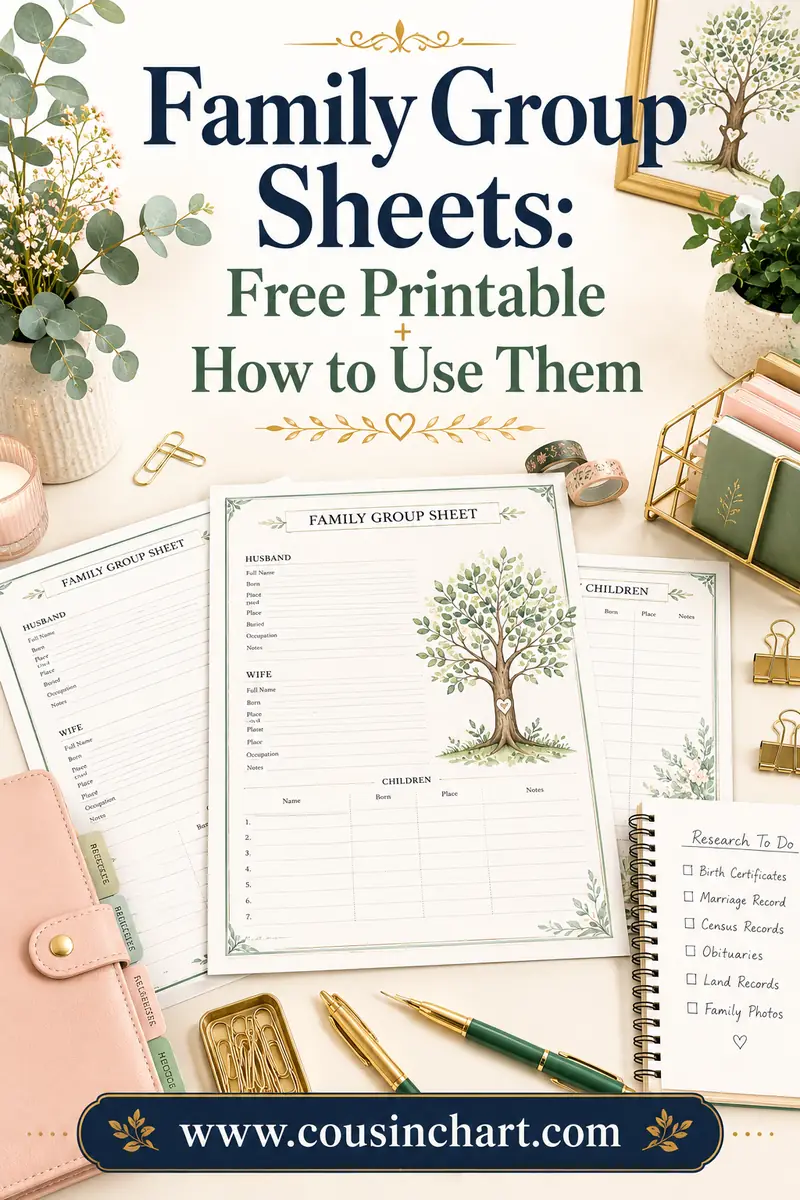
Save each citation the moment you find the record. Rebuilding citations later is slow and error-prone. A family group sheet with a source column for every date and place is a simple way to build the habit.
Element 3: Thorough Analysis and Correlation
This element has two halves. Analysis means judging each record on its own: Is it original or derivative? Is each piece of information primary, secondary or undetermined? Was it made close to the event? Did the person who wrote it have any reason to get it wrong?
Correlation means comparing records against each other. In "Evidence Correlation," Stefani Evans quotes BCG Standard 20, which describes correlation as comparing information items to find connections and contradictions. Her examples set a death certificate, an obituary and photo captions side by side, and use a table that lines up each proposed family member against the 1840 census, the obituary and the captions. Correlation often produces a hypothesis, which then has to be tested against independent sources.
Simple correlation tools you can use
- A comparison table. One row per record, one column per fact (name, age, birthplace, parents, spouse). Disagreements jump out.
- A timeline. List every record in date order with place. Gaps and impossibilities, like a baptism before the parents' marriage in a different state, become obvious.
- A household grid. Track each person in a household across census years. Ages should rise about ten years each decade. A child who drops out may have died, married or moved.
- A map. Plot where each record puts the person. Two records 300 miles apart in the same month usually mean two different people.
Independent versus dependent records
One of the most useful questions in correlation is "Did these records come from the same informant?" An obituary and a death certificate often share an informant, so their agreement is less impressive than it looks. A church marriage register from 1872 and a will written in 1889 by a different person are independent. When independent records agree, that agreement carries real weight.
Element 4: Resolution of Conflicting Evidence
Records disagree all the time. The fourth element doesn't ask you to find perfect records. It asks you to explain the disagreements you find. Jones's BCG article puts it simply: proof resolves conflicts by setting aside information that's unreliable or that doesn't apply to the question.
Common ways to resolve a conflict
- Weigh the quality of each record. Original beats derivative. Primary beats secondary. Made at the time beats made decades later. An informant with a reason to know beats one without.
- Look for a reason for the error. If you can explain how the wrong answer came about, the conflict is much more convincingly resolved. A death certificate informant might have confused a grandfather and a brother with the same name, for example.
- Check whether the records are even about the same person. Many "conflicts" disappear once you realize there were two people with the same name in the same area.
- Find a new, independent record. Sometimes the best move is more research (back to element 1), aimed right at the point of disagreement.
What doesn't resolve a conflict
- Counting records. Five online trees that all copied the same death certificate count as one source, not five.
- Picking the answer you like. Family stories about a famous ancestor are the classic trap.
- Ignoring the odd record. If you leave a conflicting record out of your write-up, the conflict isn't resolved. It's hidden, and the next researcher will find it.
If you can't resolve a conflict, say so. "The evidence is evenly split" is an honest conclusion, and it's far more useful than a false certainty.
Element 5: A Soundly Written Conclusion
The last element is putting it in writing. That sounds like paperwork, but writing is often where you discover a gap in your logic. If you can't explain in a paragraph why Catherine's father was Michael and not Patrick, you're not done.
The BCG's Jones article notes that the write-up should match the complexity of the case. A simple case may only need a sentence and a footnote. A complex one may need pages. Genealogists usually use three formats:
| Format | When to use it | What it looks like |
|---|---|---|
| Proof statement | Direct evidence, no meaningful conflict | One sentence with a citation: "Thomas Doyle married Catherine Ward on 12 May 1872 at St. Joseph's, Albany." |
| Proof summary | Several pieces of evidence that agree, little or no conflict | A short list or paragraph of the supporting records, each cited, with a one-line conclusion |
| Proof argument | Indirect evidence or real conflicts | A full essay that states the question, presents every relevant record, explains how conflicts were resolved, and ends with the conclusion |
A good written conclusion also states its limits. If a source you'd like to see was destroyed or is closed to the public, say so. If new evidence could change the answer, that's fine. The FamilySearch Wiki is clear that proved conclusions stay open to re-evaluation.
Worked Example: Using the Genealogical Proof Standard to Resolve a Conflict
Here's a full example that runs through all five elements. The people are made up, but the records and problems are the kind you'll meet in real research in the United States. Follow along and notice how each element shapes the next step.
The question
Catherine Doyle died in Albany, New York, in 1918. Her family tree on a popular website says her parents were Patrick Ward and Mary Kane and that she was born in 1850. Your question is: Who were the parents of Catherine (Ward) Doyle, and when was she born?
Step 1: The first records (and the first conflict)
You start with her death certificate. It gives her birth as 1850 in Albany, her father as Patrick Ward and her mother as Mary Kane. The informant was her son-in-law, Mr. J. Reilly. That's secondary information for the parents and the birth. He married into the family decades after Catherine was born.
Next you find her marriage in the register of a Catholic parish in Albany. On 12 May 1872, Thomas Doyle married Catherine Ward, "daughter of Michael Ward and Bridget Kane." The register is an original source, and the bride herself was present, so the parents' names are close to primary information, or at least information from people who knew her parents personally.
Now you have a conflict. Is her father Patrick or Michael? Is her mother Mary or Bridget?
Step 2: Reasonably exhaustive research
You don't stop to argue yet. You widen the search to every record type that could answer the question:
- 1860 U.S. census: Michael Ward, 40, laborer, born Ireland; Bridget, 36; Patrick, 12; Catherine, 9; John, 5. All in Albany.
- 1870 U.S. census: Michael Ward, 50; Bridget, 46; Patrick, 22; Catherine, 19; John, 15. Same ward of the city.
- 1880 U.S. census: Thomas Doyle, Catherine (age 29) and three children, two doors from a Patrick Ward, 32, with his wife Mary.
- Baptism of Catherine's first child, 1873: sponsors were John Ward and Bridget Ward.
- Will of Michael Ward, written 1889, probated 1891: leaves property to "my wife Bridget," "my son Patrick," "my son John" and "my daughter Catherine Doyle."
- 1900 U.S. census: Catherine Doyle, widow, born March 1851.
- Gravestone: "Catherine Doyle, 1852-1918," placed by her children.
- Searches for a second Catherine Ward: You check the city directories and the 1860 and 1870 census indexes for any other Catherine Ward of the right age in Albany. You find one, age 4 in 1860, too young to be the 1872 bride.
Step 3: Citations
You cite each of these properly, noting which are originals (parish registers, census images, the probate file) and which are derivative (an index of the gravestones). You note the informant wherever one is known. That's what lets you weigh them in the next step.
Step 4: Analysis and correlation
Now you line up the records. The comparison table makes the pattern clear:
| Record | Father | Mother | Implied birth year | Quality notes |
|---|---|---|---|---|
| Marriage register, 1872 | Michael Ward | Bridget Kane | Not stated | Original; informants present and knew the parents |
| 1860 census | Michael (head) | Bridget | About 1851 (age 9) | Original; informant unknown; relationships implied, not stated |
| 1870 census | Michael (head) | Bridget | About 1851 (age 19) | Original; informant unknown |
| 1873 baptism sponsors | Not stated | Not stated | Not stated | Shows close ties to John and Bridget Ward |
| Michael Ward's will, 1889 | Michael (names her as daughter) | Not stated | Not stated | Original; primary, written by the father himself |
| 1900 census | Not stated | Not stated | March 1851 | Catherine likely the informant herself |
| Death certificate, 1918 | Patrick Ward | Mary Kane | 1850 | Original record, secondary information; son-in-law informant |
| Gravestone | Not stated | Not stated | 1852 | Placed later by children; secondary |
Look at the independence of the records. The marriage register, the censuses, the baptism and the will were created by different people over almost 30 years. They all point to Michael and Bridget. The death certificate stands alone, and it came from the person least likely to know.
Step 5: Resolving the conflicts
The parents. The strongest evidence is the father's own will, which names "my daughter Catherine Doyle," and the 1872 marriage register. Together with the two census households, they're independent and consistent. The death certificate's "Patrick Ward and Mary Kane" also has a clear explanation: Patrick was Catherine's older brother, and his wife was named Mary. In 1880 they lived two doors from Catherine. A son-in-law filling out a form in 1918 could easily have mixed up the brother's family with the parents, then combined the brother's first name with the mother's maiden name. Because you can explain the error, the conflict is resolved, not just outvoted.
The birth year. You have 1850, 1851 (three times) and 1852. The 1860 and 1870 census ages both point to about 1851. Census ages are often off by a year, depending on when in the year a birthday falls relative to the census day, so taken alone they're soft. The 1900 census, though, gives a month and year, and Catherine was alive and likely the informant. The 1850 death certificate figure came from her son-in-law, and the 1852 gravestone was carved by children after her death. The best-supported answer is March 1851, with the honest note that no birth or baptism record has been found yet.
Can you do better than "about"? A reasonably exhaustive search for the birth year would include the baptism registers of the Albany parishes for 1850 to 1852. If you find a baptism, it may settle the date. If the registers for that parish are lost, say so in your write-up.
Step 6: The written conclusion
Because the case involves conflicting evidence, a proof argument is the right format. A short version might read:
Catherine (Ward) Doyle, who died in Albany in 1918, was the daughter of Michael Ward and Bridget Kane, and was born about March 1851. Her 1872 marriage register names Michael and Bridget as her parents. She appears as a child in their household in the 1860 and 1870 censuses, and Michael's 1889 will names her as "my daughter Catherine Doyle." Her 1918 death certificate names Patrick Ward and Mary Kane instead, but the informant was her son-in-law, and Patrick Ward and his wife Mary were her brother and sister-in-law, who lived two doors away in 1880. The conflicting birth years (1850 on the death certificate and 1852 on the gravestone) come from later, secondhand informants. The censuses of 1860 and 1870 and her own likely report in 1900 point to March 1851. No baptism record has yet been found.
Each sentence in the real version would carry a footnote citing the record. That's the GPS in action: every element done, every conflict explained, and the limits stated plainly.
Common Mistakes When Applying the Genealogical Proof Standard
Even careful researchers fall into these traps. Most of them come from rushing one of the five elements.
| Mistake | Which element it breaks | Better approach |
|---|---|---|
| Stopping at the first record that answers the question | 1. Reasonably exhaustive research | Keep going until you've checked the record types most likely to contradict you |
| Citing "Ancestry" or "FamilySearch" as the source | 2. Citations | Cite the underlying record, then where you viewed it |
| Treating an index or abstract like the original | 3. Analysis | View the image of the original whenever it exists |
| Counting matching online trees as independent confirmation | 3. Correlation | Ask where each tree got its information; most share one source |
| Leaving out the record that doesn't fit | 4. Conflict resolution | Include it and explain why it's wrong or about someone else |
| Merging two people with the same name | 3 and 4 | Build a separate timeline for each candidate before merging |
| Writing only "proved" in your tree software, with no explanation | 5. Written conclusion | Add a proof summary or argument in the notes field |
| Treating "proved" as permanent | 5. Written conclusion | Revisit when new records come online |
The same-name trap deserves its own warning
Most bad links in family trees come from one cause: two people with the same name living in the same area at the same time. In the worked example, the second Catherine Ward was four years old in 1860, which ruled her out. That check only took a few minutes, but it's the step people most often skip. Before you attach a record to your ancestor, ask, "Could this be someone else with the same name?" If the answer is "maybe," your FAN club research (neighbors, witnesses, godparents) is usually what tells them apart.
How the GPS Works With DNA Evidence
DNA testing hasn't replaced the GPS. Consumer DNA tests have simply become one more kind of evidence, and the same five elements apply to it. Nothing about a test result skips the need for research, citations, correlation, conflict resolution and a written conclusion.
In practice, DNA usually works as indirect evidence. A match tells you that you and another person share DNA, and the amount, measured in centimorgans, suggests a range of possible relationships. It doesn't name an ancestor by itself. You still need documents to show which couple you both descend from.
Here's how each GPS element shows up in a DNA case:
- Reasonably exhaustive research: testing the right people, such as more than one descendant of the couple in question, and checking matches from both sides of a family.
- Citations: recording the testing company, kit owner (with permission), date and shared amount for each match you rely on.
- Analysis and correlation: comparing shared amounts against possible relationships, checking that matches' trees are documented, and looking at triangulated groups and shared matches.
- Conflict resolution: explaining when a match's shared amount fits more than one relationship, or when a paper trail and DNA seem to disagree.
- Written conclusion: stating the DNA findings alongside the documents, not as a replacement for them.
If you're new to this, our guide to confirming a DNA match walks through the paper-trail side step by step.
A Genealogical Proof Standard Checklist
Use this before you attach a new parent, spouse or child to your tree. If you can answer yes to every question, you're applying the GPS. If not, the "no" tells you exactly where to go next.
| Element | Question to ask yourself |
|---|---|
| 1. Research | Have I written down a clear research question? |
| 1. Research | Have I checked every record type likely to answer it for this time and place? |
| 1. Research | Have I looked at siblings, in-laws and neighbors, not only my ancestor? |
| 1. Research | Have I ruled out other people with the same name nearby? |
| 2. Citations | Does every fact in my conclusion have a full citation someone else could follow? |
| 3. Analysis | Have I labeled each source as original, derivative or authored? |
| 3. Analysis | Do I know who gave each key piece of information, and whether they were there? |
| 3. Correlation | Have I compared all the records in one table or timeline? |
| 3. Correlation | Do I know which records are independent of each other? |
| 4. Conflicts | Have I listed every disagreement between records? |
| 4. Conflicts | Can I explain how each wrong answer probably came about? |
| 5. Conclusion | Have I written a proof statement, summary or argument that matches how complex the case is? |
| 5. Conclusion | Have I noted what I couldn't find and what might change the answer? |
Try it yourself
Pick one link in your tree that you've never really checked, such as a great-grandmother's maiden name. Write the research question at the top of a page. List every record you have that mentions her maiden name, with who gave the information. Then ask: Do they agree? Are any of them independent? If they disagree, which one has the best informant? You'll likely find at least one fact you'd copied without checking. That's normal, and that's the GPS doing its job.
How the GPS Fits Into Building Your Family Tree
You don't need to write a full proof argument for every date in your tree. Most researchers save the formal write-up for the links that matter most: each new generation back, any parent-child link based on indirect evidence, and any spot where records conflict.
A practical workflow looks like this:
- Collect as you go. Record every source with a citation when you find it, even if it seems minor.
- Keep hypotheses separate. Many tree programs let you mark a relationship as "unproven" or keep a research log. Use that until a link meets the standard.
- Apply the GPS at each generation. Before you research a person's parents, make sure the person is proved. A wrong link here sends every later step down the wrong family.
- Write the proof in your notes. A short paragraph per key link is enough for most families.
- Share it. When a cousin asks how you know, you can send them the argument, not just the answer.
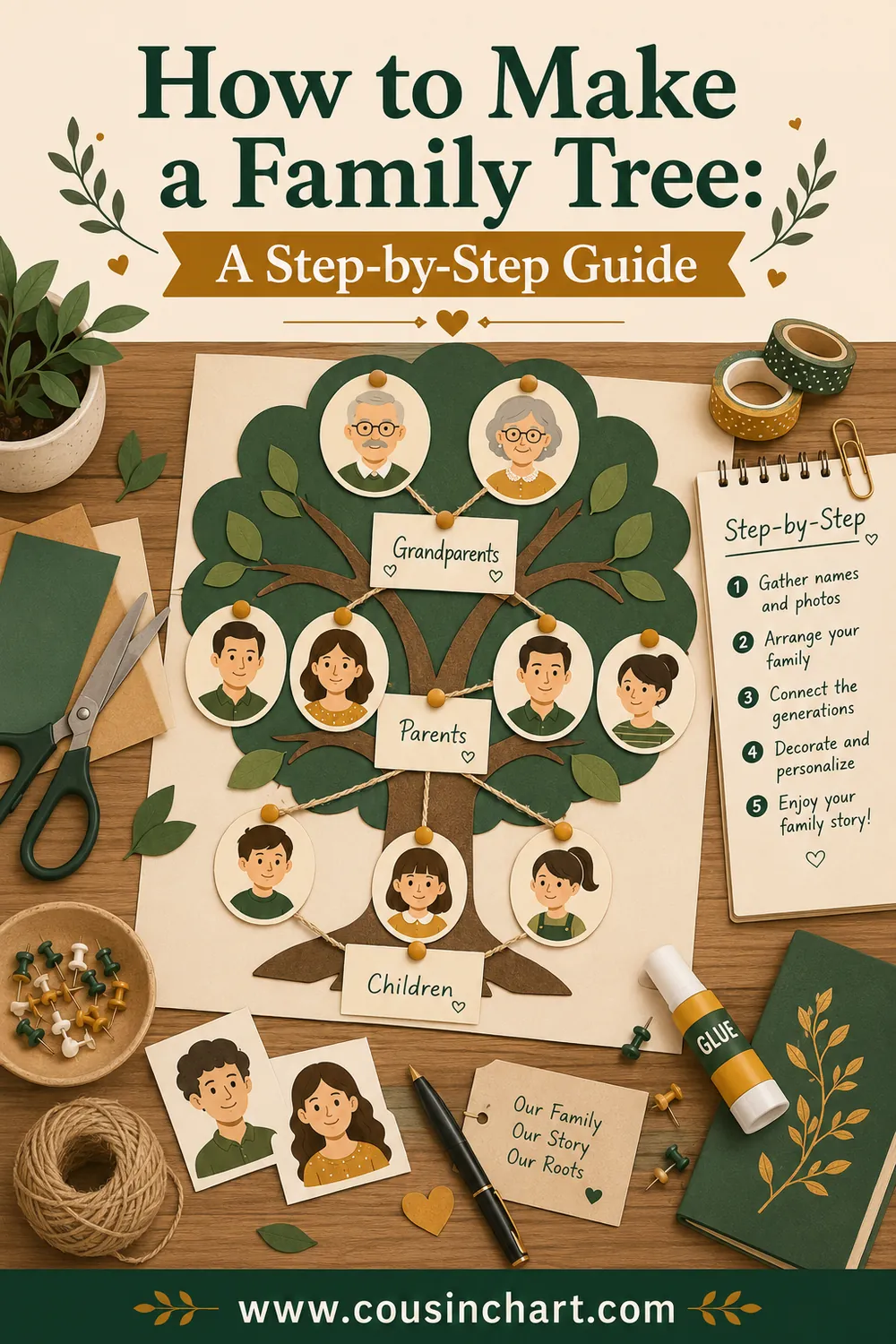
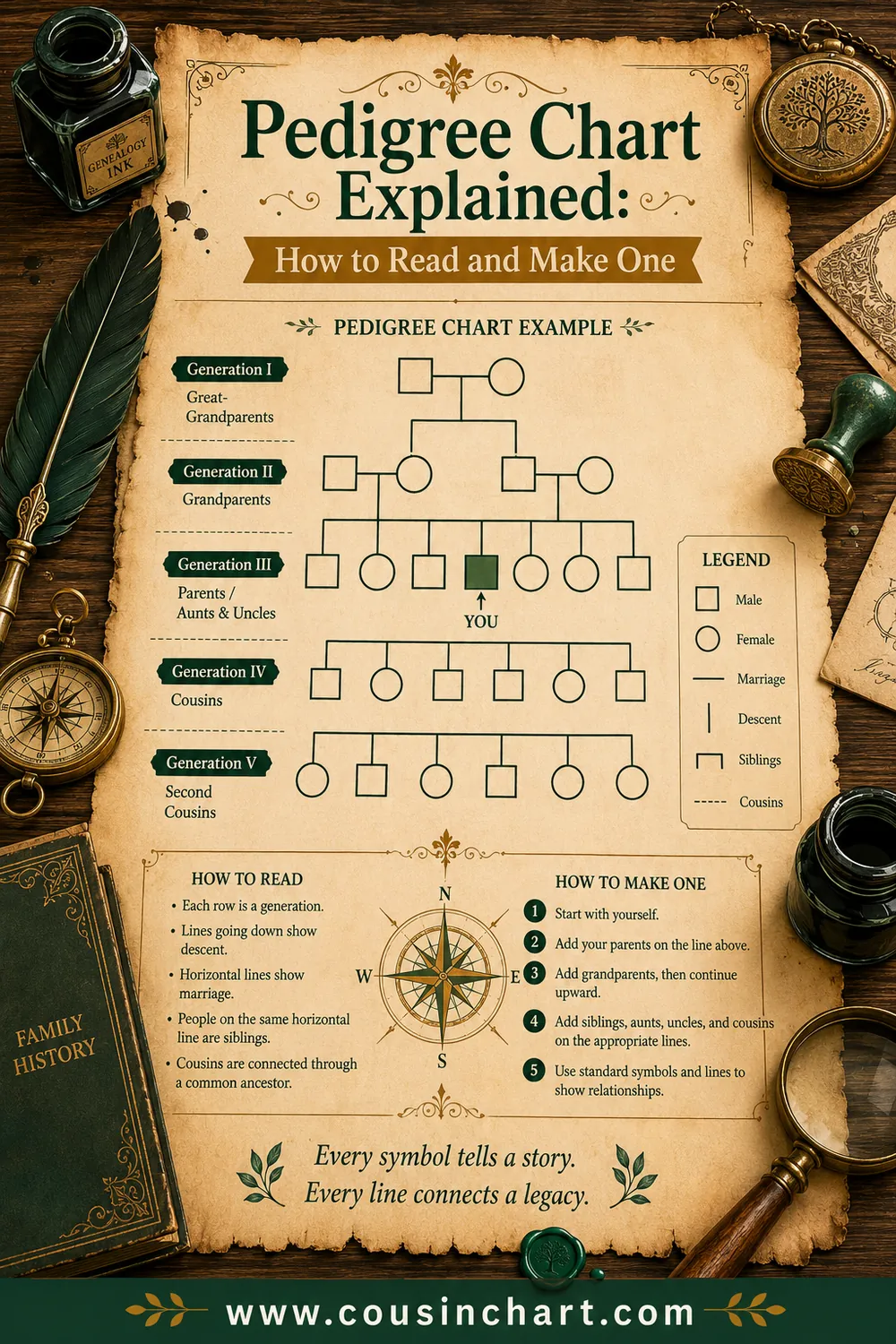
If you're just starting, our guide on how to make a family tree covers the basics, and a pedigree chart is a simple way to see which ancestors you've proved and which are still guesses.
Wrapping Up
The genealogical proof standard boils down to five habits: look widely, cite everything, compare carefully, explain disagreements, and write it down. None of them needs special training. Together, they turn a pile of records into a conclusion that other people can trust and check.
Once you've proved the links in your tree, you can work out exactly how any two people in it are related. Try our free family relationship calculator to name the relationship, from first cousins to third cousins twice removed.
Frequently Asked Questions
What are the 5 elements of the genealogical proof standard?
The Board for Certification of Genealogists lists five elements: reasonably exhaustive research, complete and accurate source citations, thorough analysis and correlation, resolution of conflicting evidence, and a soundly written conclusion based on the strongest evidence. A conclusion meets the standard only when all five are done. If you skip one, such as ignoring a record that disagrees with your answer, the conclusion is still a hypothesis rather than a proof. The five elements work as a set, and each one usually feeds back into the others as you research.
Who created the genealogical proof standard?
The genealogical proof standard is published and maintained by the Board for Certification of Genealogists, the US organization that tests and certifies professional genealogists. It grew out of earlier discussions in the field about how genealogists should weigh evidence, and it is explained in the board's book Genealogy Standards and in Thomas W. Jones's book Mastering Genealogical Proof. Today it's used by professionals, by genealogical societies and journals, and by many hobbyists who want their family trees to hold up to scrutiny.
Does the genealogical proof standard mean something is 100 percent certain?
No. In genealogy, proved means the conclusion is the best answer the available evidence supports, presented so others can check it. It doesn't mean certain forever. The FamilySearch Research Wiki notes that any proved conclusion can be re-evaluated if new evidence appears. A newly digitized record, a DNA match or a rediscovered family Bible can overturn a well-reasoned conclusion. That's why a good write-up states what was searched, what wasn't found, and what might change the answer.
How many sources do I need to meet the genealogical proof standard?
There's no fixed number. The standard asks for reasonably exhaustive research, and what counts as reasonable depends on the question, the time and place, and how much the records disagree. A simple fact backed by one clear original record with a knowledgeable informant may need little more. A parentage question built on indirect evidence may need a dozen records. Thomas W. Jones's BCG article uses an example with seven sources. The real test is whether new records keep confirming your answer and whether you've checked the likeliest places for a contradiction.
What is the difference between direct and indirect evidence?
Direct evidence answers your research question by itself. A birth record naming a child's father is direct evidence of who the father was. Indirect evidence only answers the question when you combine it with other information. A will naming my daughter Catherine Doyle plus a marriage record showing Catherine Ward married Thomas Doyle together show that the testator was Catherine's father, even though neither record says so alone. Both kinds can meet the genealogical proof standard. Indirect evidence just needs a fuller written explanation.
Can I meet the GPS using only online records and family trees?
You can use online images of original records, such as census pages, parish registers and probate files, just as you would use them at an archive, as long as you cite them properly. Online family trees are different. They are authored works, meaning someone else's conclusions, and most don't cite sources. Use them as leads that point you toward records, not as evidence. Five trees that agree usually copied the same source, so they don't add up to independent confirmation.
What is a proof argument in genealogy?
A proof argument is a written explanation of how you reached a conclusion when the evidence is indirect or conflicting. It states the research question, presents each relevant record with a citation, explains how you weighed them, shows how you resolved disagreements, and ends with the conclusion. It can run from a few paragraphs to many pages. Simpler cases can use a proof statement, which is one cited sentence, or a proof summary, which is a short cited list of agreeing evidence.
How do I resolve conflicting dates in genealogy records?
List every record that gives the date and note who supplied it, when, and whether they had first-hand knowledge. Records made at the time by people who were there usually outweigh later records from secondhand informants. Look for an explanation for each wrong date, such as an informant who was guessing or a census age taken near a birthday. Then check whether a better record, like a baptism register, exists. If the evidence still doesn't settle it, give a range and say why.
Does DNA evidence have to meet the genealogical proof standard?
Yes, in the sense that DNA is evidence like any other and should be handled with the same five elements. A DNA match shows that two people share DNA and suggests a range of possible relationships, but it doesn't name a common ancestor by itself. You still need documented trees, citations for the test results you rely on, comparison with other matches, an explanation of anything that seems to conflict, and a written conclusion that ties the DNA to the documents.
Sources
We checked every source below while writing this guide. Last reviewed October 30, 2026, by Joan Ramos.
- Ethics and Standards (Board for Certification of Genealogists)
- Genealogical Proof Standard (FamilySearch Research Wiki)
- Grains of Salt: Analyzing Sources, Information, and Evidence (Alice Hoyt Veen) (Board for Certification of Genealogists)
- Ten-Minute Methodology: What Is 'Reasonably Exhaustive' Research? (Judy Kellar Fox) (Board for Certification of Genealogists)
- The Genealogical Proof Standard: How Simple Can It Be? (Thomas W. Jones) (Board for Certification of Genealogists)
- Evidence Correlation (Stefani Evans) (Board for Certification of Genealogists)