How to Find Your Ancestor's Hometown: 6 Proven Strategies
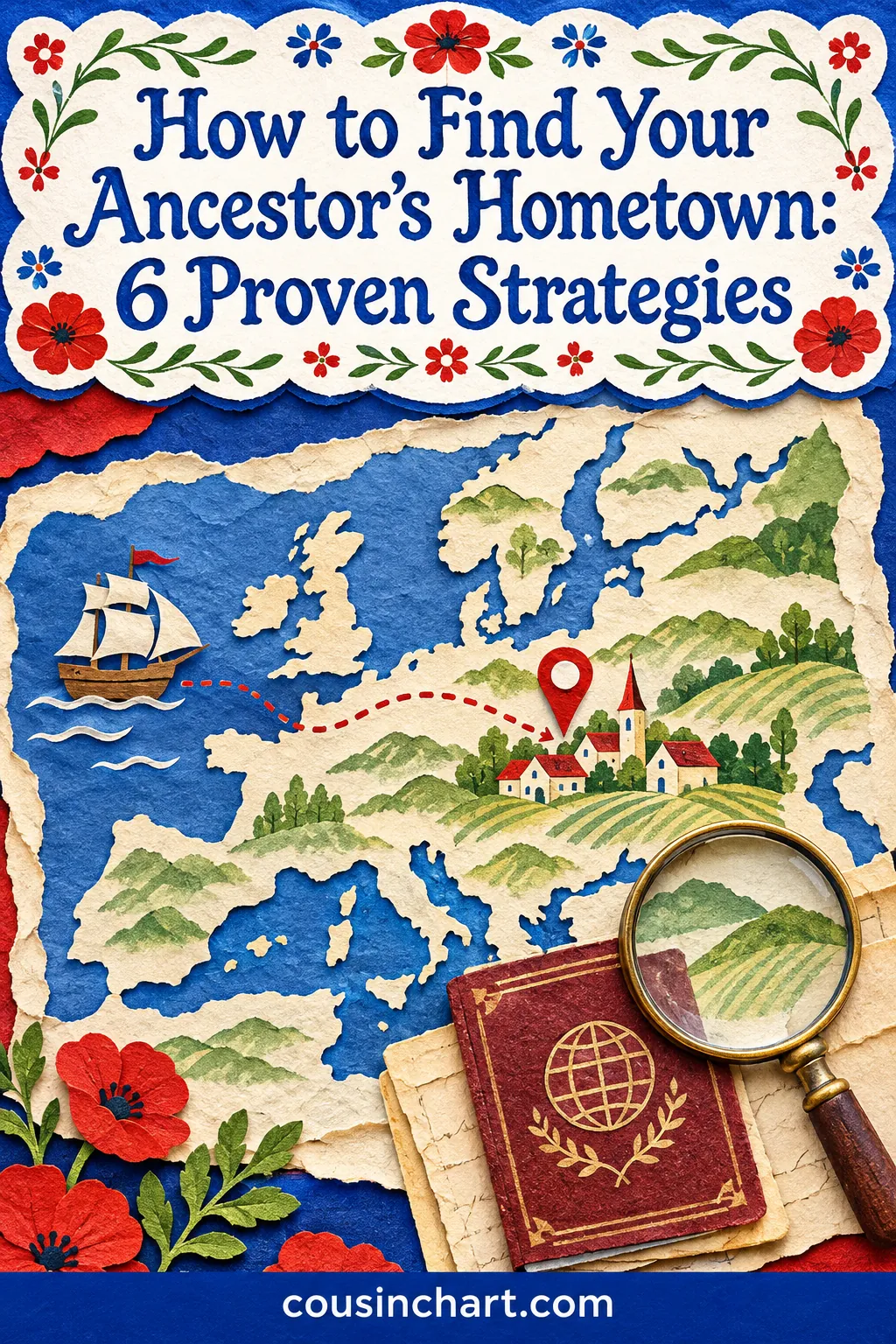
To learn how to find your ancestor's hometown, use six proven strategies: squeeze the clues you already have, order naturalization papers, find the passenger list, search immigrant church and community records, check draft cards, gravestones and obituaries, and then confirm the village in gazetteers and European records. The US paper trail is where the exact village name usually hides, and records back in Europe are filed by town or parish, so until you know the village, you cannot search them.
That is the problem nearly every immigrant family runs into. The census says "Germany," "Italy," "Ireland" or "Poland," and that is it. The good news is that your ancestor almost certainly wrote or said the name of their hometown somewhere in the US paper trail. The six strategies below work across countries: they move from the broadest records to the most specific, collecting every place clue along the way.
How to Find Your Ancestor's Hometown: Which Records Name the Village
Not every record asks for a birthplace, and not every one that asks gets a town name. These are the records most likely to give you a village, and the strategy below where each one is covered.
| Record | Why it helps | Years when it is most useful | Strategy |
|---|---|---|---|
| Family papers and letters | Envelopes, passports, prayer books and certificates | Any era | 1 |
| Naturalization papers (declaration and petition) | Later forms asked for town and country of birth | Strongest after the 1906 federal form change | 2 |
| US passport and alien registration forms | Asked for place of birth | 1900s onward; alien registration in 1940 | 2 |
| Passenger arrival lists | Later lists asked for last residence, birthplace and a relative back home | Strongest from about 1906 onward | 3 |
| US church registers | Immigrant priests and pastors often wrote the home parish | Any era; especially ethnic congregations | 4 |
| Fraternal society and mutual aid records | Many were organized by home region or village | Late 1800s to mid-1900s | 4 |
| Draft registration cards | Some registrations asked for town or city of birth | World War I and the 1942 registration | 5 |
| Social Security application | Asked for place of birth | 1936 onward | 5 |
| Gravestones and obituaries | Often name the home town, sometimes in the home language | Any era | 5 |
| Historical gazetteers and European parish books | Confirm the village and its parish | Any era | 6 |
Search all of them. Different records sometimes give different spellings or different nearby places, and comparing them is how you land on the right village.
Strategy 1: Squeeze the Clues You Already Have
The first rule of how to find your ancestor's hometown is to squeeze what you already have. Before searching anything new, write down every place clue you can find, even vague ones:
- Country of birth from each census
- Native language listed in later censuses
- Year of immigration and the port, if known
- Religion, which tells you which church records to search
- Names of fellow immigrants who lived nearby or appear as witnesses and sponsors
- Family stories, even ones that sound garbled
A story that "Grandpa came from near the big lake" or "a town that sounds like Bad-something" can become meaningful later, once you have a short list of candidate villages.
Look through family papers
Then go through whatever papers survive in the family. Look at the back of old photos for a studio name and town, at prayer books and hymnals, at letters and envelopes from relatives overseas, and at any document brought over on the journey, such as a baptism certificate, work book or military discharge. Ask cousins in other branches to look too. The trunk that came over on the ship rarely stayed with just one child.
Strategy 2: Order the Naturalization Papers
For many families, naturalization records are the best single source. After a federal form change in 1906, the declaration of intention and the petition for naturalization generally asked for the applicant's town and country of birth, plus details of their arrival, including the ship and date.
Earlier naturalization papers vary a lot. Some list only the country. Some list nothing about birthplace at all. Still, they may name a ship or arrival date that leads you to a passenger list.
Also check:
- Spouses. Before 1922, a wife's citizenship generally followed her husband's, but after that date she usually had to naturalize separately, so she may have her own file.
- Children who naturalized as adults. Their papers may name the family's hometown.
- Siblings. If the brother naturalized after 1906, his papers may name the village even if your ancestor's earlier papers do not.
The naturalization records guide explains where these files are kept, how to tell which court handled them and how to request copies.
Two related papers worth ordering
US passport applications. Naturalized citizens who traveled back to visit family applied for passports, and those applications usually asked for the town of birth.
Alien registration forms. Noncitizens living in the US in 1940 had to register, and the forms asked for place of birth. These are held by the federal government and can be requested. They are especially useful for ancestors who never naturalized at all.
Strategy 3: Find the Passenger List
Passenger arrival lists changed over time. Early lists often gave little more than name, age and country. Lists from the early 1900s onward added columns for last residence, and by around 1907 many asked for the name and address of a close relative in the home country and a town of birth.
That relative-at-home column is one of the most valuable entries in immigration research. It may say "father, Giuseppe Rossi, Castelnuovo," which gives you both a village and a parent.
Search tips:
- Search by surname plus approximate age, not just exact given names, which were often recorded in the home language.
- Search family members and neighbors who may have traveled together.
- Read the whole entry, which may run across two facing pages.
- Check departure lists in European port records where they survive.
For more on the arrival records themselves, see free immigration records. If your family came through New York, the guide to Ellis Island passenger lists covers search tricks for that port.
Strategy 4: Search Immigrant Church and Community Records
Immigrant communities often built their own churches, and their clergy were usually immigrants too. Many of them recorded the home parish of people they baptized, married and buried, because they knew it mattered.
- Marriage records are the best bet. They often list both partners' birthplaces and sometimes their parents' names.
- Baptism records of children may name the parents' home towns.
- Burial records sometimes list the birthplace.
- Sponsor and witness names can point to relatives or neighbors from the same village.
Find out which congregation your ancestors attended using obituaries, city directories and the location of their home. Then contact the church or the regional church archive. The guide to church records in genealogy covers how to request records from different denominations.
Fraternal and mutual aid societies
Many immigrant groups formed clubs organized around a home province or even a single village. Membership lists, insurance claims and anniversary booklets may name it. Look for society names in obituaries, on gravestones and in local newspapers, then ask the local library or historical society whether any of their records survive.
Follow the neighbors
People rarely emigrated alone. They followed relatives and neighbors from the same village to the same American town, street and church. This pattern is called chain migration, and it is one of the best tools for finding a hometown. If your ancestor's own records only say a country:
- List the people around them: neighbors in the census, sponsors at baptisms, witnesses at weddings, fellow boarders.
- Search those people's naturalization, passenger and church records.
- If several of them came from the same village, your ancestor probably did too.
This works especially well for small immigrant settlements where most families came from one region.
Strategy 5: Check Draft Cards, Gravestones, Obituaries and Social Security
When the main immigration records come up short, these four sources often fill the gap.
Draft registrations. The World War I registration cards asked many men for their place of birth, and the first registration in June 1917 often recorded a town. The 1942 registration of older men also asked for town or county of birth. Men who never served still had to register, so many immigrant ancestors appear. The guide to WWI and WWII draft cards explains which registration asked what.
Gravestones. In ethnic cemeteries, headstones sometimes give a birthplace, sometimes in the home language. Photograph the whole stone, including the back.
Obituaries. Obituaries in ethnic and foreign-language newspapers often named the home village, because the readers knew the area. English-language obituaries in small towns sometimes did too. Search both.
Social Security applications. The application form introduced in 1936 asked for place of birth. Many immigrants wrote only a country, but some wrote a town. Children's applications list their parents' names, which can confirm a family group.
Strategy 6: Confirm the Village in Gazetteers and European Records
Once you have a candidate village name, you need to confirm it exists, find which parish and civil district it belonged to, and then test it against the records in Europe.
Check the name against gazetteers and maps
- Spelling. The name may be spelled phonetically by an English-speaking clerk. Sound it out in the home language.
- Duplicates. Many countries have dozens of villages with the same name. Use other clues, such as a nearby large town or a region, to narrow it down.
- Border changes. A village recorded as being in "Austria" in 1900 may be in Poland, Czechia or Ukraine today.
- Parish and civil district. Small villages usually did not have their own church or registry office. Records are filed under the parish or district that covered them.
Historical gazetteers, published place directories for each country, list villages with their parish and district. Old maps help you see neighboring places that might match a misspelled name.
Read the handwriting and spelling carefully
Village names are easy to misread. A clerk may have written what he heard, and old handwriting styles turn some letters into others. Before you decide a place does not exist, try these checks:
- Write out the name letter by letter and list every letter you are unsure of.
- Swap common confusions, such as u and n, e and c, or long s and f.
- Sound the name out in the home language, not in English.
- Compare the spelling with the same village name in other records.
The guide to reading old handwriting covers the letter forms that trip up most researchers, and surname spelling variations explains the same sound-it-out approach for family names, which often helps you spot the right family in a village's church book.
Search the records in the home country
Once you have the village and its parish, records in Europe open up: baptisms, marriages, burials, civil registrations, emigration lists and sometimes local population registers. Country-specific guides on this site explain where those records sit:
Search for your ancestor's baptism in the right year. If the parents' names match what you found in American records, you have confirmed the hometown.
Common Mistakes to Avoid
- Trusting a single record. One clerk's guess at an unfamiliar name can send you to the wrong village. Look for two or more records that agree.
- Searching only your direct ancestor. Siblings, cousins and neighbors may have far better records.
- Assuming modern borders. Check which country controlled the area at the time.
- Confusing the port with the hometown. A passenger list or family story may name the port city, not the village.
- Ignoring the language. Village names may be written in a different alphabet or language on different records.
Organizing Your Place Clues
Keep a simple table with every place clue you find: the record, its date, the exact spelling as written, and your interpretation. When you lay them side by side, patterns appear. Three records with slightly different spellings of the same village are far more convincing than one perfectly spelled entry. This table is the core of how to find your ancestor's hometown when no single record is clear.
Add a column for which of the six strategies produced each clue. If every clue so far came from one kind of record, you know which strategies you have not tried yet.
FAQ
How do I find my ancestor's hometown if the census only lists a country?
Search the records created after arrival: naturalization papers, passenger lists, church registers, draft cards, gravestones and obituaries. Those are the records most likely to name a town or village.
Which immigration record is most likely to name the village?
For arrivals from around 1906 onward, naturalization papers and passenger lists are usually the best sources, because their forms asked for a town of birth or last residence. For earlier arrivals, US church records are often more helpful.
What if my ancestor arrived before 1900?
Earlier passenger lists and naturalization papers often give only a country. Focus on US church records, gravestones, obituaries and the records of siblings and neighbors who may have arrived later.
How do I find a village that has changed its name?
Use historical gazetteers and old maps from the right era. Many gazetteers list former and alternate names. Searching nearby larger towns can also help you find it on a modern map.
What if there are several villages with the same name?
Look for other clues, such as a nearby larger town, a region or a parish name. Then check which candidate's church records include a baptism matching your ancestor's name, birth date and parents.
Do I need to know the village to search European records?
In most cases, yes. Most European church and civil records are kept by parish or town, not in a national index. That is why learning how to find your ancestor's hometown is the key step before searching overseas.