How to Read Old Handwriting in Genealogy Records
Almost everyone tries to read an old document the same wrong way: one letter at a time, starting at the top left, getting stuck on the third word and staying stuck. The method that actually works is the opposite — read the whole document first for its shape, because wills, deeds and parish registers follow fixed formulas, and once you know the formula you can predict most of the words before you have deciphered a single letter. Then you build an alphabet from words you already know and use it on the words you don't. The famous puzzles — the long s that looks like an f, the bar over a letter, the y that is really th — take about ten minutes to learn once. If the document turns out to be a will full of half-named relatives, the cousin calculator will place them for you.
What is stopping you? Tap the closest match.
Tap an option above. Read the document for its pattern before you fight any single word.
Start with the document, not the letters
The whole difficulty changes once you stop treating the page as a puzzle and start treating it as a form.
Old legal documents are templates. A will begins "In the name of God, Amen", names the testator and their parish, states they are "sick and weak in body but of perfect mind and memory", commits the soul to God and the body to the earth, directs that debts be paid, makes bequests, names executors, and ends with a date and witnesses. Every will you read follows that skeleton.
Deeds, bonds and inventories are the same. Deeds run: date, parties, consideration, description of land, the covenants, the signature and the witnesses. Parish registers repeat one line per event, all year.
So read the first page for shape before you read it for content. Where does each clause begin? Where are the names? Where are the numbers? You will find you can locate the bequests without being able to read them yet.
That gives you predicted words. If the clause is where a will normally says "unto my beloved daughter", then the smudge that follows is almost certainly a daughter's name — and reading a name you half expect is far easier than reading one from nothing.
Read the printed version of the formula once. Find any transcribed will from the same county and decade, read it properly, and the shape of the thing will be in your head before you open the original. Our page on wills and probate records sets out the standard clauses in order.
The letters that are not what they look like
A short list covers almost all of it.
The long s. Written like an f without a full crossbar, used at the beginning and middle of words until about 1800. "Congreſs", "Miſs", "buſineſs". A double s is often written as a long s followed by a normal one, which is why old print looks like it is full of "fs".
Tell it from f by the crossbar. An f has a bar right through the stem. A long s has a small nub on the left side only, or nothing.
e in secretary hand. In sixteenth- and seventeenth-century English hands, a lowercase e is often a small closed circle with a tail, looking more like an o or a Greek epsilon than a modern e. It is the single most disorienting letter for beginners.
c that looks like an r, and r that looks like a 2 or a w. Both are normal in secretary hand and both become obvious once you have seen them ten times.
h and p with big loops below the line. Descenders were exuberant, and a looped p can be read as a g by an untrained eye.
Double f for a capital F. "ffrancis Hall" is Francis Hall. There is no lost family called ffrancis.
Capitals are the worst of all. Capital L, S, T and I were highly decorated and vary between clerks. Learn the capitals last, from the names you already know.
Build an alphabet from words you already know
This is the technique that turns an impossible page into a slow but certain one.
Find your anchors first. The names you already know, the place name, the month, the year, the word "witness". You can read those because you know what they say.
Copy each letter out as this clerk forms it. Take a sheet of paper and write the modern letter, then draw the clerk's version beside it. You are building that individual's alphabet, not a general one — hands vary far more between people than between centuries.
Use the alphabet on the difficult words. Compare the shape in the hard word to the shapes in your table. Nine times in ten the letter is already there.
Never guess letter by letter without context. A letter shape in isolation is ambiguous; a letter shape inside a word you can half predict is not.
Work in short sessions. Twenty minutes at a time. Palaeography is a pattern-recognition skill and it consolidates while you are away from the page, which is why the second sitting is always easier than the first.
Abbreviations and the marks above the line
| What you see | What it means | Example |
|---|---|---|
| Long s (like an f, no full crossbar) | The letter s | "Miſs" is Miss |
| A bar or squiggle over a letter | A doubled letter, or an omitted m or n | "coīttee" is committee |
| ye, yt, ym | the, that, them — the y is a thorn, standing for th | "ye said John" is "the said John" |
| Superscript letters | A contraction | Wm = William, Jno = John, Thos = Thomas, Robt = Robert |
| ff at the start of a name | A capital F | ffrancis = Francis |
| Xpher, Xtian | Christopher, Christian — the X is the Greek chi | Xmas comes from the same habit |
| do or ditto | Repeat the entry above | Common in tax lists and registers |
| &c | Etcetera | "goods, chattels &c" |
| inst, ult, prox | This month, last month, next month | "the 3rd inst" |
| p with a stroke through the descender | per, par, pro | "p annum" is per annum |
The bar is the one to memorize. It is not decoration and it is not a stray pen mark. It changes the word.
Superscript contractions are personal names most of the time. Jno for John is the classic trap, because it looks like Jon or Ino and is neither.
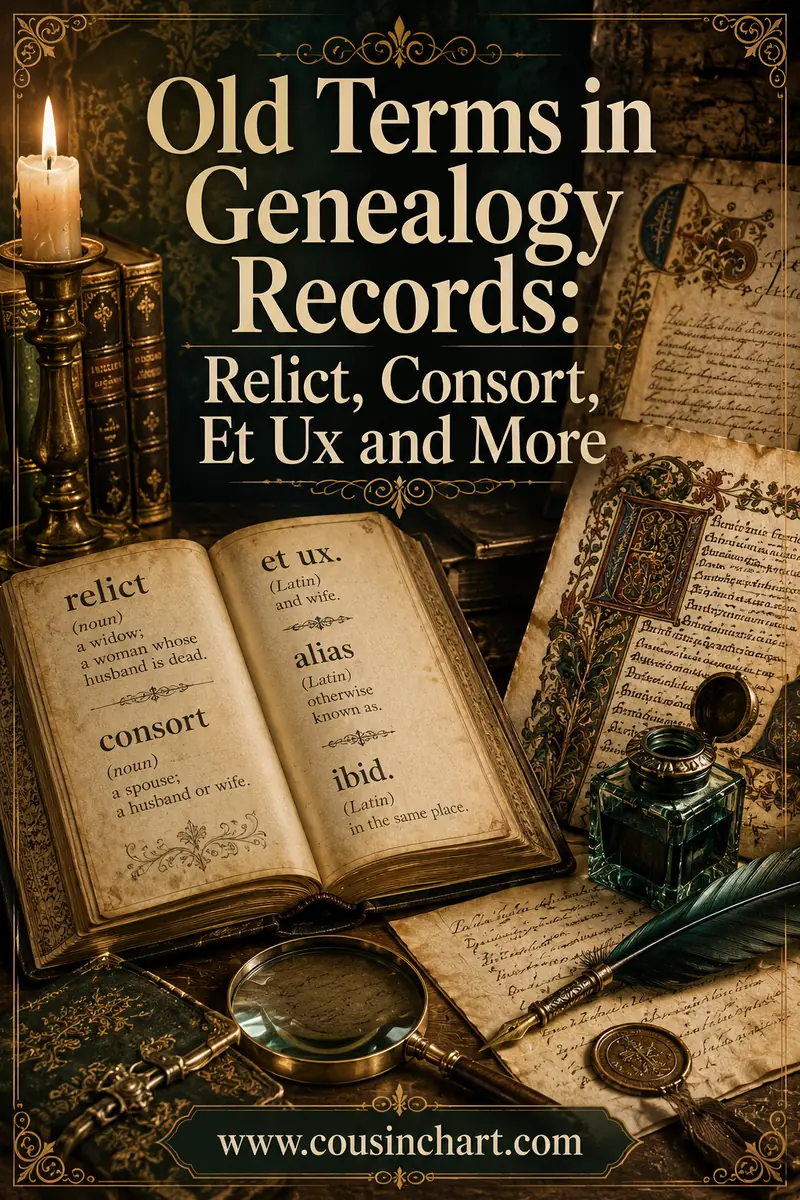
And Latin creeps in everywhere. Parish registers, wills and court records use a fixed set of Latin and legal words that our guide to old genealogy terms decodes — relict, infant, et ux, natus, sepultus.
Numbers, dates and the year that started in March
Numbers cause more misreadings than letters, because a wrong digit looks plausible.
1 is often written like a j, and a final Roman numeral i is written as a j — so iij is three, not "iij".
7 frequently carries a bar and can look like an F or a 4.
4 is often open at the top, like a modern handwritten y with a crossbar.
Old Style dating is the big one. In Britain and its colonies until 1752, the legal year began on 25 March, not 1 January. So the day after 24 March 1720 was 25 March 1721.
That is why you see dates like "1 February 1720/21". The clerk is telling you it was 1720 by the old reckoning and 1721 by the new. Record dual dates exactly as written; do not tidy them.
Quaker records number the months instead of naming them. Before 1752, "the 1st month" is March; after 1752, it is January. Getting this backwards shifts a birth by two months and has caused a lot of duplicated children in published trees.
Ages are approximations. "Aged about 60" means the clerk asked and wrote down what he was told, and church burial registers in particular round hard — a point worth remembering when a stated age contradicts a christening in the same parish register.
Spelling was never standardised
Modern eyes expect consistency that simply did not exist.
Clerks wrote what they heard. A surname could be spelled three ways in one document by one hand, and none of them is "wrong".
Vowels are the least reliable part of a name. Consonant skeletons are far more stable — Smyth, Smithe and Smith are the same family; so are Reid, Reed and Read.
Regional accents got baked into the record. A Scottish or Irish name recorded by an English clerk, or an Irish name recorded by an American one, changes shape at the point of hearing.
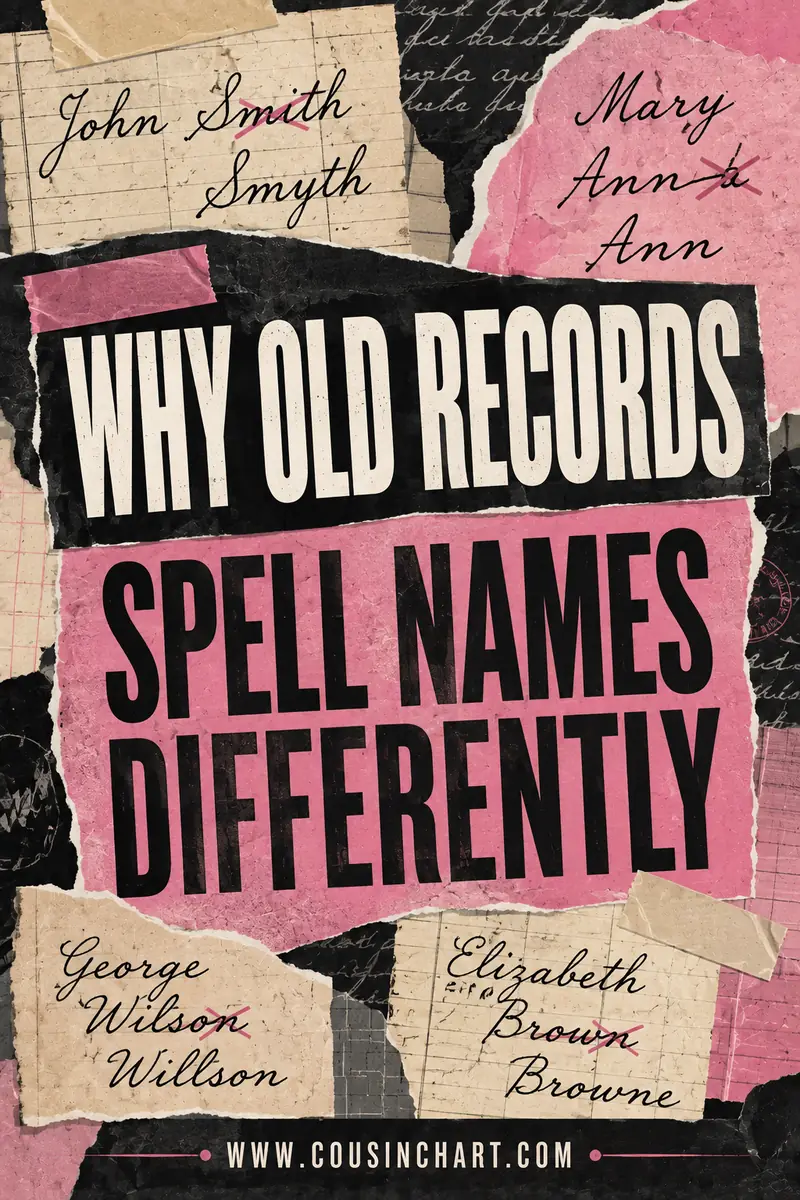
So search by sound, not by spelling. This is exactly what our page on surname spelling variations is for, and it matters more in handwritten records than anywhere else.
Transcribe literally, then interpret separately. Write down what is on the page, including the odd spelling, and put your reading in square brackets. Six months later you will want to know which was which.
A working method, start to finish
One: photograph or download the best image you have. Zoom, adjust the contrast, and try inverting it to white on black — iron gall ink that has faded or bled through often reads better inverted.
Two: read the whole thing for shape. Clauses, names, numbers, signature block.
Three: transcribe what you can, leaving gaps. Use square brackets with a question mark for uncertain readings and a row of dots for illegible stretches. Never fill a gap with a plausible word; that is how invented ancestors happen.
Four: build the clerk's alphabet from the words you got.
Five: go back and attack the gaps with the alphabet and the formula together.
Six: read the whole transcription aloud. Your ear catches sense that your eye misses, especially with phonetic spelling.
Seven: keep both versions. The literal transcription and your interpretation, with a note of the source. The habit costs nothing and saves you from citing your own guess as evidence, which is a real risk in court and courthouse records where a single word can change a relationship.
And practice deliberately. The UK National Archives publishes a free online palaeography tutorial with graded documents and answers; Brigham Young University's script tutorials cover English, German, Spanish, Italian and Dutch hands; the Scottish Handwriting site covers Scots records. An hour on a graded exercise is worth ten hours of grinding at your own difficult page.
FAQ
Why do old documents look like they have f instead of s?
That is the long s, a form of the letter s used at the start and in the middle of words until roughly 1800. Distinguish it from f by the crossbar: an f has a bar all the way through the stem, while a long s has only a small nub on the left, or none.
What does a line or bar over a letter mean?
It is an abbreviation mark. It usually means the letter beneath it is doubled, or that an m or n has been left out to save space. So a barred m in "comitted" gives committed, and "Wm" with a stroke expands to William.
Does "ye olde" really mean "yee olde"?
No. The y is a printer's substitute for the Old English letter thorn, which stood for th, so "ye" is simply "the" and was always pronounced that way. The same applies to "yt" for that and "ym" for them.
What is a date written as 1720/21?
Dual dating. Until 1752 in Britain and its colonies the legal year began on 25 March, so any date between 1 January and 24 March fell in one year by the old reckoning and the next by the new. Record such dates exactly as written.
How do I read a document when the ink has faded?
Work from the best digital image you can get, then zoom in and adjust contrast, brightness and levels. Inverting the image to white text on a dark background often makes faded iron gall ink legible. Compare doubtful letters against clear examples elsewhere on the same page.
Where can I practice reading old handwriting for free?
The UK National Archives runs a free graded palaeography tutorial with model answers, Brigham Young University's script tutorials cover several European languages and hands, and the Scottish Handwriting site teaches Scots records. Short, regular sessions build the skill far faster than long ones.
Getting fluent faster than you expect
Palaeography feels impossible for about two documents and then quietly becomes normal. The reason is that you are not learning a script — you are learning a small set of conventions and then learning one clerk at a time. Get the formula in your head, build the alphabet from words you already know, memorize the long s and the abbreviation bar, and treat every uncertain word as uncertain in your notes rather than resolving it for convenience. Death records are a special case worth preparing for separately, because the cause of death is usually the hardest word on the page and often an obsolete term — our guide to old disease names on death records decodes those. And when a will finally gives up its list of legatees, drop them into the cousin calculator to see how the family fits together.