WWI and WWII Draft Cards: Finding Your Ancestor's Registration
Draft registration cards are free to view on FamilySearch.org — both the WWI cards (about 24 million men, registered 1917–1918) and the WWII cards (tens of millions more, from 1940 onward, including the famous 1942 "Old Man's Draft"). If a male ancestor was anywhere from his late teens to his mid-sixties during either world war, there is very likely a card with his exact birth date, home address, employer, next of kin, and signature — whether or not he ever served a day.
That last point is the magic: registration was a legal requirement for entire age ranges of the male population, so draft cards document civilians — farmers, grandfathers, factory hands — who left few other federal records. This guide covers who registered when, what each card says, and how to find yours free. And since a card hands you a household's exact address, it pairs beautifully with census address searching — and with the free relationship calculator once the "nearest relative" line names someone you can't place.
Which record should I search? Tap your ancestor’s situation and see which draft record covers him — all free on FamilySearch.
Tap a button above to get a starting point.
Map how you're related to them →WWI: three registrations, 24 million men
After entering the war in April 1917, the US ran three draft registrations under the Selective Service Act:
| Registration | Date | Who registered |
|---|---|---|
| First | June 5, 1917 | Ages 21–31 (born ~1886–1896) |
| Second | June 5, 1918 (+Aug. supplement) | Men who had turned 21 since 1917 |
| Third | September 12, 1918 | Ages 18–45 (born ~1873–1900) |
Together they captured about 24 million men — nearly a quarter of the US population — including immigrants who weren't citizens (aliens registered too, marking their citizenship status; a bonus clue for naturalization research).
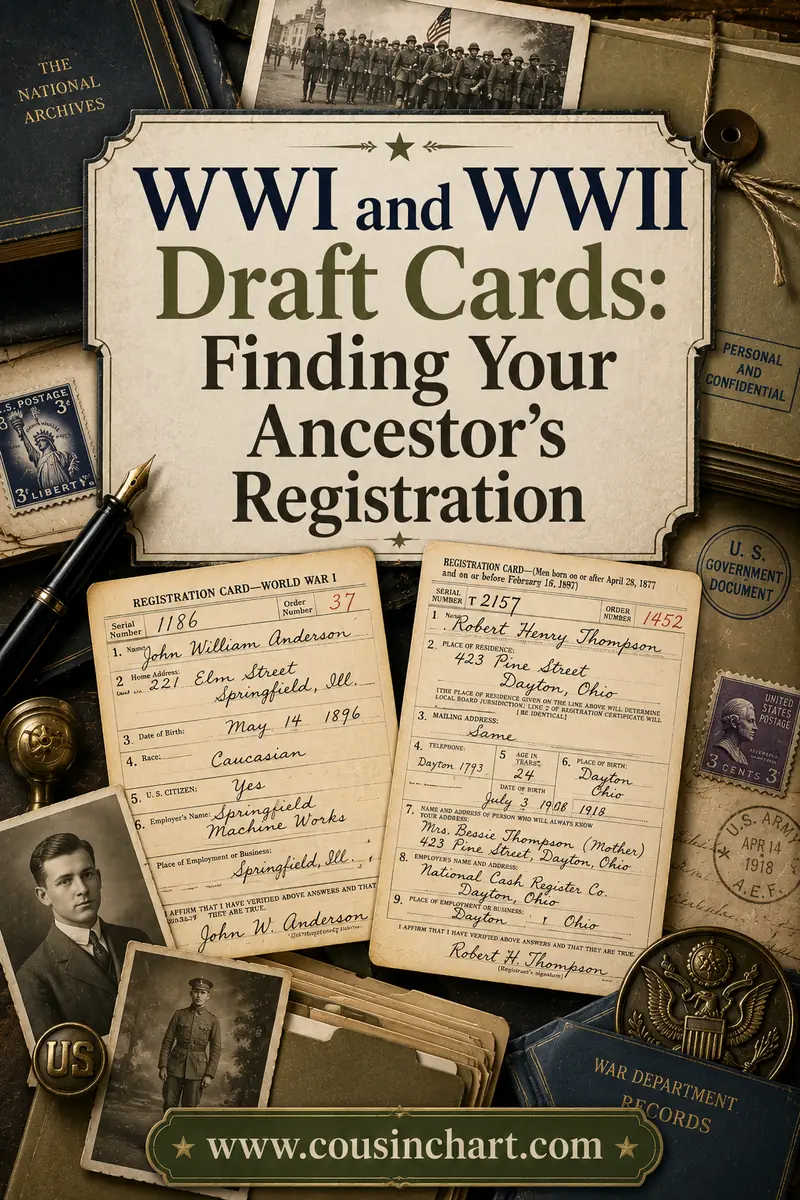
What a WWI card gives you: full name, home address, exact date of birth (first registration also asked birthplace), age, race, citizenship status, occupation and employer with address, nearest relative (third registration) or dependents (first), physical description on the reverse — height, build, eye and hair color, disabilities — and his signature. For millions of immigrant and rural families, this card is the earliest document stating a precise birth date.
The original cards are held by the National Archives in Atlanta; free digitized images are on FamilySearch, with copies also on Ancestry and Fold3.
WWII: seven registrations, including the Old Man's Draft
The 1940 Selective Training and Service Act — America's first peacetime draft — began a series of registrations that continued through 1947, covering men born from the late 1870s to the late 1920s.
The registration researchers love is the Fourth, April 27, 1942: the "Old Man's Draft," covering men born between April 28, 1877 and February 16, 1897 — ages 45 to 64. These men were never going to fight; the government was inventorying civilian manpower. The result is a gift: an entire generation of grandfathers, documented with birth dates, addresses, employers, and descriptions. One heartbreak: fourth-registration cards for several Southeastern states were destroyed decades ago (including Alabama, Florida, Georgia, Mississippi, North and South Carolina, and Tennessee), so coverage there is lost.
The younger men's registrations (1940–1947) have been progressively digitized and indexed — FamilySearch and the National Archives are the free routes; Ancestry and Fold3 host large image sets. Cards of men who actually served typically followed them into their service files, so a "missing" card can itself hint that he enlisted.
What a WWII card gives you: name, residence, mailing address, telephone, exact birth date and birthplace, employer and place of employment, name and address of a person who will always know your whereabouts (often the wife or mother, relationship stated), plus the physical description panel.
How to search, step by step
- Search FamilySearch free. Look for the collections "United States World War I Draft Registration Cards, 1917–1918" and the WWII draft registration card collections; search by name plus birth year or state.
- Use the exact birth date as your anchor. Cards state it precisely — when a card's birth date matches your family record, you've got your man even with a common name.
- Can't find him? Search the address. Registration was filed by local draft board, and boards were geographic. City directory address → likely board → browse. (The Steve Morse site has WWI draft board finders for big cities.)
- Read the back of the card. The physical description is easy to miss on the second image frame.
- Chain the discoveries. The address feeds a census address search; the birth date targets birth records; the employer opens city directory and newspaper searches; the nearest relative confirms family structure — the 1940 census household should match.
Registration is not service
Worth repeating, because families over-read these cards both ways: a draft card proves a man registered, as the law required — not that he served, was drafted, or was even eligible. Conversely, no card doesn't mean no service: volunteers who enlisted early sometimes registered differently, and servicemen's cards traveled with their files. For actual service, discharge, and unit history, see our military service records guide — and for the generation before these wars, the Civil War records path.
The "nearest relative" line deserves special affection: it's a dated, signed, government-witnessed statement of a family relationship. When it says "nearest relative: Mrs. Ida Kowalski, mother" at an address, you've confirmed a parent-child link — and when it names someone whose connection you can't work out, run the path through the free CousinChart calculator before guessing.
Which cards exist for a man born in...?
The fastest way to know what to search is your ancestor's birth year:
| Born | WWI cards | WWII cards |
|---|---|---|
| Before 1873 | None — too old | None |
| 1873–1876 | Third registration (Sept. 1918) | None — too old for the 1942 cutoff |
| 1877–1886 | Third registration | Old Man's Draft (1942) |
| 1887–1896 | First and/or second registration | Old Man's Draft (1942) |
| 1897–1900 | Second or third registration | Younger men's registrations |
| 1901–1929 | None — too young | Younger men's registrations (1940–47) |
| After 1929 | None | None (postwar draft records instead) |
The boundary years are approximate — the actual cutoffs ran to specific days (the Old Man's Draft, for instance, covered men born April 28, 1877 through February 16, 1897) — but the table tells you instantly which collection to open first.
The two-card trick
Notice the overlap: a man born between 1877 and about 1896 registered in both world wars, which means two cards, twenty-five years apart, each independently stating his birth date. That's a genealogist's dream setup:
- Birth dates that agree across a 1917 card and a 1942 card are about as solid as a date gets without a birth certificate — two separate sworn statements, decades apart.
- Birth dates that differ are a story: sometimes fading memory, sometimes a man who shaved years off in 1917 or added them, and occasionally the clue that you've got two different men.
- The address gap tells the migration story. A 1917 card in rural Alabama and a 1942 card in Detroit is the Great Migration in two documents; a farm-to-town move or a name that anglicized between the wars ("Wilhelm" in 1917, "William" in 1942) shows up the same way.
- Employers bookend a working life — day laborer at 25, foreman at 50, or the same family farm on both cards.
When you find one card for a man born in that window, always go get the second. Ten more minutes, and your single data point becomes a before-and-after portrait.
FAQ
How do I look up a WWII draft card for free?
Search FamilySearch.org's WWII draft registration collections (free account) by name and birth year. The 1942 "Old Man's Draft" (men born 1877–1897) is fully searchable; younger men's registrations (born ~1897–1929) are increasingly indexed. The National Archives holds the originals.
Who had to register for the WWI draft?
Ultimately all men aged 18–45 by September 1918 — about 24 million, born roughly 1873–1900 — across three registrations in 1917–1918. Citizenship didn't matter: resident aliens registered too, noting their status.
What is the Old Man's Draft?
The fourth WWII registration, April 27, 1942, covering men aged 45–64 (born April 1877–February 1897). It inventoried civilian manpower rather than recruiting soldiers, which is why millions of older men — otherwise thin in federal records — have a detailed, signed card. Cards for several Southeastern states were later destroyed.
What information is on a draft registration card?
Name, home address, exact birth date (and usually birthplace), age, race, citizenship, occupation and employer, a nearest relative or contact with relationship stated, a physical description (height, build, eyes, hair, disabilities), and the registrant's signature.
Does a draft card mean my ancestor fought in the war?
No — most registrants were never called. It proves registration only. Check for service via National Archives personnel records, discharge papers filed at county courthouses, unit records, or the 1930 census veteran column.
What are the numbers stamped on the card?
The serial number identified the card within its local draft board, and the order number — assigned by national lottery drawings — set the sequence in which men would be called up. For family history they're mostly bookkeeping, with one use: they confirm which local board held the card, which helps when you're browsing unindexed board files or sorting two same-named men from one city.
The card names a relative I don't recognize. How do I place them?
Treat the stated relationship ("aunt," "cousin," "brother-in-law") as a clue, verify it in censuses, then compute what that person is to you with the free relationship calculator — draft-card "cousins" have a way of turning out to be first cousins once removed.
One card, a whole doorway
Draft cards are the rare record that's free, indexed, signed by the ancestor himself, and dense with next steps — an exact birth date, an address for census browsing, an employer, a named relative. Pull your family's WWI and WWII cards on FamilySearch tonight; it's often fifteen minutes to the first signature. Then let the free CousinChart relationship calculator tell you precisely how every person named on those cards connects to you.