How to Search Census Records by Address
You can search US census records by address in three moves: find where your ancestor lived (city directory, draft card, vital record), convert that address into a census enumeration district (ED) using the free Steve Morse One-Step ED finder at stevemorse.org, and browse that district's pages free on the National Archives or FamilySearch. No subscription required at any step.
Address searching is the escape hatch for the most common census frustration there is: you know the family was there, but the name index can't find them because an enumerator wrote "Kowalczyk" as "Colechick." The house didn't move, even if the spelling did. This guide walks through the whole method, census by census. And once you've read the household you find, the free relationship calculator will tell you what every person on the page is to you.
Which record should I search? Tap what you already know, and see how to turn it into a census address search — free.
Tap a button above to get a starting point.
Map how you're related to them →Why search by address at all?
Name indexes fail for boring, predictable reasons: bad handwriting, phonetic spellings, nicknames, transcription slips, and families who gave a neighbor's best guess because nobody was home. Estimates vary, but every experienced researcher has a story of a family "missing" from a census that was there all along under a mutilated name.
An address search sidesteps the index entirely. You go to the physical pages for the place the family lived and read them yourself, the way researchers did for decades before online indexes existed — except now the "microfilm" is free and on your couch.
It's also the right tool when you want the neighborhood, not just the household: who lived next door (often relatives), what the street looked like economically, and which church and school the family would have used.
Understand enumeration districts (30 seconds)
The census wasn't filed by address — it was filed by enumeration district: the chunk of territory one census taker covered. Every census from 1880 onward is organized this way. An urban ED might be a few blocks; a rural ED might be an entire township. To read the census for an address, you need that address's ED number for that specific census year — districts were redrawn every decade.
That's the whole trick. Address → ED → pages.
The three-step method
Step 1: Pin down the address
Work from whatever the family left behind:
| Source | What it gives you | Where it's free |
|---|---|---|
| City directories | Annual address per adult, often with occupation | Internet Archive, Library of Congress, library databases |
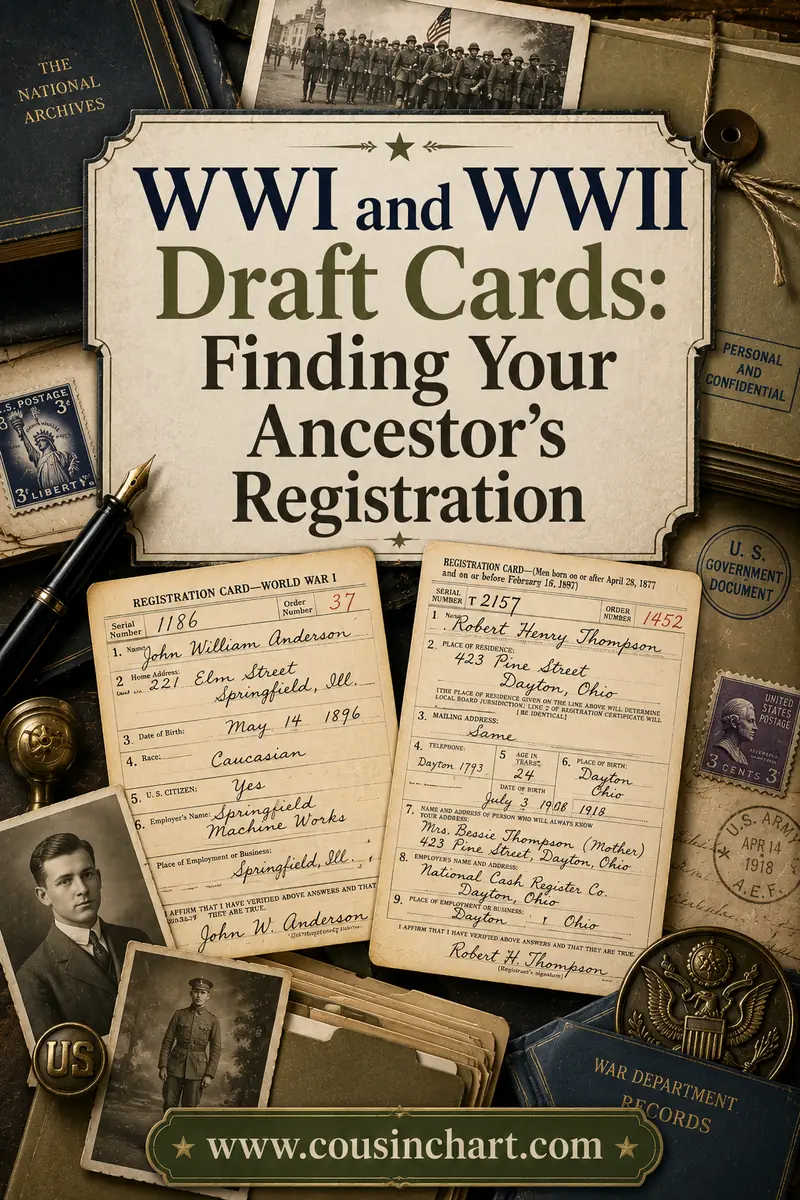
| WWI/WWII draft cards | Home address for men of draft age | FamilySearch |
| Vital records | Residence at birth/marriage/death | FamilySearch indexes, county offices |
| Newspapers | Addresses in obituaries, announcements | Chronicling America |
| Naturalization petitions | Address at filing | FamilySearch, National Archives |
| Family papers | Envelopes, postcards, photo captions | Your own boxes |
City directories deserve special praise: most cities published them annually, so you can watch a family move year by year between censuses. If you have WWI or WWII draft cards for the family's men, you already have addresses for the 1920, 1940, and 1950 census windows.
Step 2: Convert the address to an ED
Go to stevemorse.org and open the Unified Census ED Finder (it covers 1880–1950). Enter the census year, state, city, street, and — for big cities — a cross street. The tool returns the ED number, sometimes two or three candidates when the address sat near a boundary. It's free, fast, and maintained by volunteers who have mapped city blocks to districts so you don't have to.
For rural addresses, skip the street: identify the township, precinct, or district from land or tax records, then match it to an ED using the ED descriptions on the National Archives site.
Step 3: Browse the pages
- 1950: pick state → county → ED at 1950census.archives.gov and read, free, no account.
- 1940: browse by ED on archives.gov or in FamilySearch's 1940 image collection.
- 1880–1930: FamilySearch's census collections let you browse images by locality and ED with a free account.
An urban ED is typically 20–40 pages. Scan the street-name column (left edge) until your street appears, then follow house numbers. Read slowly — you're about to meet the neighbors.
Worked example
Say family lore puts your great-grandparents at "something Maple Street, Dayton, Ohio" around 1930, but no index search finds them. The 1931 Dayton city directory (free on the Internet Archive) lists Herman Schuetz, machinist, 214 Maple St. — there's the spelling problem already; you'd been searching "Sheets." The One-Step ED finder says 214 Maple St. falls in ED 57-42 for the 1930 census. Browsing that ED on FamilySearch, you find the household on sheet 11A, indexed as "Schutz." Four children you didn't know about, grandmother's parents next door.
Two minutes with the free CousinChart calculator sorts out what those next-door relatives make everyone to you — and the walk back through 1920 and earlier censuses now starts from a verified spelling.
Tips that save hours
- Always get a cross street for city addresses. EDs split long streets; the cross street picks the right district on the first try.
- House numbers changed. Cities renumbered streets, especially around 1900–1930. Sanborn fire insurance maps (free at the Library of Congress) resolve "old 214 vs. new 214."
- Check adjacent EDs. Boundary addresses land in the neighboring district often enough to make this a standard second move.
- Read the whole page anyway. Even when you came for one household, note the neighbors — extended families clustered, and a "boarder" two doors down is sometimes a cousin.
- Work forward too. Once 1940's column 17 gives you a 1935 address, you can browse for the family's earlier home — the technique chains across decades, from the 1940 census to the 1950 census.
The same trick works beyond the census
Once you think in addresses, other record sets open up the same way:
- City directories become a timeline. Run the family through every annual directory between two censuses and you'll catch the year they moved, the year a widow appears alone, the year an adult son gets his own listing — events the ten-year census rhythm hides. Directories also list churches, schools, and undertakers by neighborhood, predicting where the family's baptisms and funerals were recorded.
- Draft boards were geographic. Knowing the address tells you which local board a man registered with, which speeds up locating WWI and WWII draft cards when name searches stall.
- Parish and school records follow the map. Urban Catholic families almost always used the parish within walking distance; the address picks the parish, and the parish registers give you baptisms the state never recorded.
- Voter lists and tax rolls are address-ordered. Where they survive, they're effectively annual mini-censuses — and nobody's indexed most of them, so address is the only way in.
The general principle: names get misspelled, but geography doesn't lie. Whenever an index fails you, ask "where exactly were they?" and go read the place.
FAQ
Can I search the census by address for free?
Yes, end to end. City directories (Internet Archive, libraries) supply the address, the Steve Morse One-Step site converts it to an enumeration district free, and the National Archives and FamilySearch let you browse the census pages for that district free.
What is a census enumeration district?
The area one census taker was assigned — a few city blocks or a rural township. Censuses from 1880 onward are filed by ED, and district boundaries were redrawn each decade, so an address's ED in 1930 usually differs from its ED in 1940.
Which census years can be searched by address?
The method works for 1880 through 1950, the years with enumeration districts and surviving schedules. (Most of the 1890 census burned, and censuses before 1880 need the rural approach: identify the township or district and browse it.)
What if my ancestors lived on a farm with no address?
Use the rural version: establish the township, precinct, or militia district from land, tax, or vital records, find the matching ED description, and browse the whole district. Rural EDs are short, and farm families are quick to spot because households repeat the same surnames.
Why isn't my family in the census index at all?
They almost always are — under a spelling you haven't guessed. Enumerators wrote names phonetically and indexers transcribed the result. Address browsing finds the household regardless, and then you learn the spelling to search in other records.
Stop searching names. Start reading streets.
Address searching turns "they're not in the census" into "found them, plus the in-laws next door" more reliably than any other trick in genealogy. Directory, ED finder, browse — three free steps. And when the page you find is crowded with boarders, in-laws, and mystery nephews, the free CousinChart relationship calculator will tell you exactly how each of them connects to you.