How to Find Military Service Records Free
You can find most of an ancestor's military paper trail free: draft registration cards (free images on FamilySearch), service and pension records (held by the National Archives, searchable and requestable), burial records (the VA's free National Gravesite Locator), and war-specific indexes like the National Park Service's free Civil War database. Commercial sites such as Fold3 and Ancestry digitize many of the same files for convenience — useful, never mandatory.
One hard fact shapes all 20th-century searches, so it goes first: the 1973 fire at the National Personnel Records Center in St. Louis destroyed roughly 16–18 million official personnel files — about 80% of Army records for personnel discharged 1912–1960, and about 75% of Air Force records for 1947–1964 (surnames Hubbard through Z). Millions of records survive, and burned files can often be partially reconstructed — but if a WWI or WWII Army file "can't be found," that fire is usually why. This guide covers what exists war by war, and how to get it free. When the records reveal how a soldier connects to you, the free relationship calculator on our homepage does the kinship math.
Which record should I search? Tap your ancestor’s war or situation and see the right record — free source first.
Tap a button above to get a starting point.
Map how you're related to them →The four record types that matter
Military genealogy sorts into four piles, each with a different home:
| Record type | What it contains | Where (free) |
|---|---|---|
| Draft registrations | Address, birth date, employer, next of kin | FamilySearch images |
| Service records | Enlistment, units, promotions, discharge | NARA (request or digitized) |
| Pension/benefit files | Family proof: marriages, children, affidavits | NARA; indexes on FamilySearch, HeritageQuest |
| Burial records | Dates, branch, cemetery | VA Gravesite Locator, Find a Grave |
The counterintuitive tip veterans of this research all give: pension files beat service records for family history. A service record proves he served; a pension file proves who his wife and children were — because the government demanded marriage certificates, birth dates, and sworn family testimony before paying.
Draft cards: the easiest win
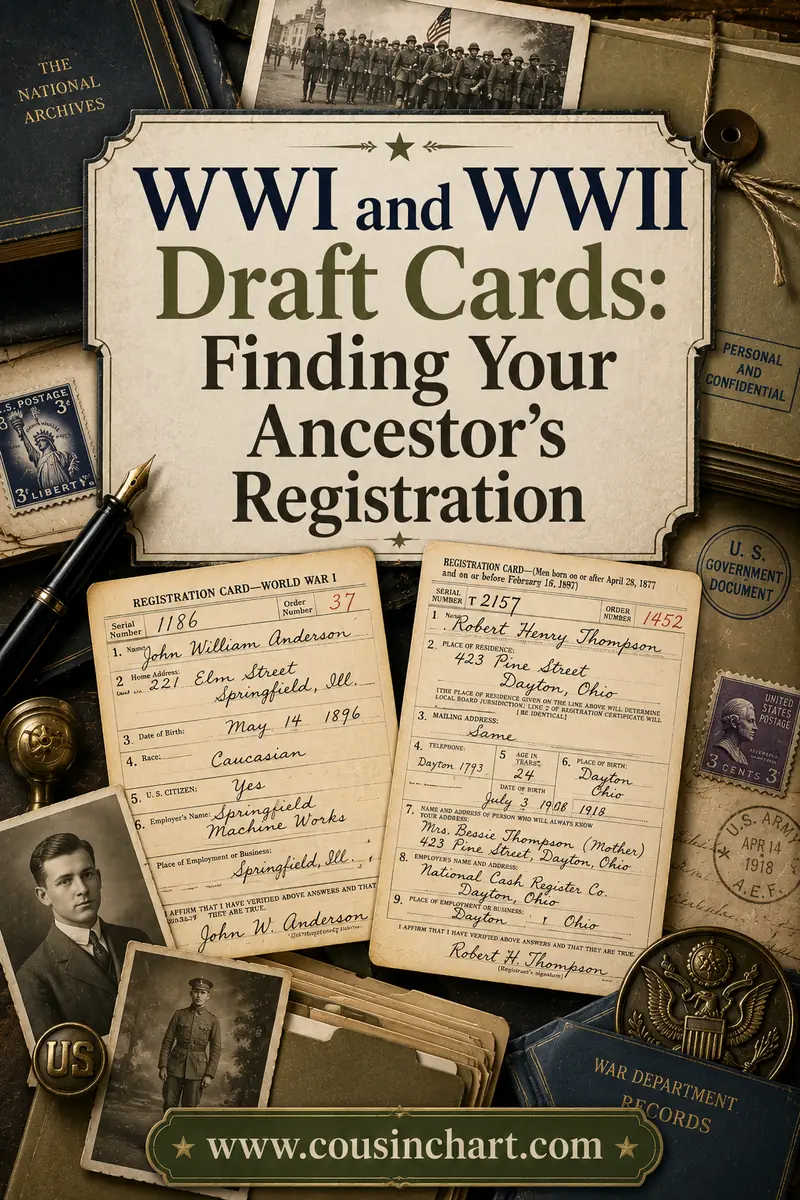
Start here for any man of draft age in the World Wars. Registration was near-universal (most registrants never served — the card proves existence, not service, which is exactly what genealogists want):
- WWI: three registrations, 1917–1918, about 24 million men born roughly 1872–1900.
- WWII: multiple registrations from 1940, including the famous 1942 "Old Man's Draft" of men born 1877–1897.
Cards give address, exact birth date and place, employer, nearest relative, physical description, and a signature. All free on FamilySearch — never pay for draft cards. Full details in our WWI and WWII draft cards guide.
Service records: NARA is the source
For 20th-century service (WWI onward), Official Military Personnel Files live at the National Personnel Records Center in St. Louis. Requesting is free for archival files:
- Go to the National Archives veterans' records portal and use eVetRecs, or mail Standard Form 180.
- Provide name, branch, approximate service dates, and service number if known.
- Know the access rules: files become archival — fully public — 62 years after separation. Before that, the veteran and next of kin get full access; others get limited releasable details.
- Basic responses are free; thick file reproductions can carry copy fees they'll quote first.
For 19th-century and earlier service (Revolution through Spanish-American War), the records are Compiled Military Service Records — card abstracts of muster rolls — at NARA in Washington, heavily digitized on Fold3 (paid; free at many libraries and FamilySearch Centers) with free indexes on FamilySearch.
About that fire
The July 12, 1973 NPRC fire destroyed the only copies of millions of files — no duplicates existed, and there were no comprehensive indexes of what burned. NARA's preservation team reconstructs affected files on request from auxiliary sources: final pay vouchers, unit morning reports, VA claims, and state records. So a "fire-related" response is the start of a slower path, not a dead end. Discharge papers also often exist locally — many veterans recorded their DD-214 or discharge at the county courthouse, and states kept bonus and service registers.
Pensions and the deep past
- Civil War: the crown jewels of American military genealogy — Union pension applications with widows' affidavits, children's birth dates, and marriage proofs. Free index on FamilySearch; files at NARA; images heavily on Fold3. Confederate pensions were paid by Southern states — check state archives. Full strategy in our Civil War ancestors guide.
- Revolutionary War: pension and bounty-land application files (about 80,000) are packed with first-person testimony from the 1820s–1840s. Free via HeritageQuest at most public libraries; see our Revolutionary War guide.
- War of 1812, Mexican War, Spanish-American War: pension indexes on FamilySearch free; files at NARA.
Burial and remembrance records
The VA National Gravesite Locator searches national cemeteries and many state veterans cemeteries free — instant dates and branch. Cross-check Find a Grave for photos, and the American Battle Monuments Commission's free database for those buried or memorialized overseas after the World Wars. Headstone application records (1925–1963), free on FamilySearch, are a sleeper source: families applying for veteran headstones supplied service details.
Don't know if they served? Let the census tell you
Free census columns flag veterans: 1840 listed Revolutionary War pensioners by name and age; 1910 asked survivors of the Union or Confederate army or navy; 1930 asked veteran status and which war; 1950's sample lines asked WWII service. Spot the flag, then chase the war-specific records. (Every census is free — see our census guide.)
Worked example: rebuilding a burned WWII Army file
Here's the reconstruction path in practice. Say your grandfather, Frank Kowal, served in the Army in WWII, and St. Louis reports his file was lost in the fire. You can still rebuild most of his service story free:
- His WWII draft card (free on FamilySearch) fixes the civilian baseline: exact birth date and place, home address, employer, and the name of the person who'd always know his whereabouts — usually his wife or mother, which is family evidence in itself.
- The WWII Army Enlistment Records database at the National Archives' AAD site (aad.archives.gov, free) is the step most people miss. Some nine million enlistments from 1938–1946 were preserved on punch cards that escaped the fire, and Frank's entry gives his Army serial number, enlistment date and place, civilian occupation, education, and marital status. (The data was machine-transcribed, so expect the occasional garbled entry — search flexibly.)
- That serial number supercharges the NPRC request. With it, staff can pull his final pay voucher — which survives separately and shows his discharge date and unit at separation — and walk the unit's morning reports to trace where he was, month by month.
- The county courthouse back home likely holds his recorded discharge paper. Veterans were urged to record their discharge with the county recorder to protect benefit claims, and thousands did — a recorded discharge lists unit, dates, decorations, and battles.
- His headstone application or VA gravesite entry closes the loop with service dates and unit, free.
None of that replaces the lost file page-for-page, but stacked together it recovers the story: when he went in, where he trained, what unit he fought with, and when he came home.
The sleeper sources: records made outside the military
Some of the richest military evidence was never held by the military at all, which means the 1973 fire never touched it:
- State bonus and service records. Many states paid WWI (and some WWII) veterans a cash bonus, and the application files — with service details, discharge data, and sometimes family information — sit in state archives, often indexed free online.
- Unit histories and regimental books. Regiments published their own histories, with rosters, photos, and casualty lists. Thousands are digitized free on the Internet Archive and HathiTrust — search the unit name once you know it.
- County honor rolls and "gold star" books. After both World Wars, counties and states published memorial volumes listing local servicemen, frequently with portraits and short biographies. Free on the Internet Archive and at USGenWeb county pages.
- Veterans' organizations. Grand Army of the Republic post records (Union Civil War veterans), and later American Legion and VFW post rosters, document membership, deaths, and burials — local historical societies usually hold them.
- Hometown newspapers. Enlistment announcements, "letters from the front" columns, wound reports, and homecoming notices — a small-town paper often covered a local soldier's whole war in real time. Chronicling America and state digital newspaper programs are free.
When a federal file is thin or burned, this civilian layer is regularly where the details actually come from.
Quick reference: the first free search for each war
When you just want the fastest starting point, this is it:
| War | First free search | Why |
|---|---|---|
| Revolutionary War | Pension index (FamilySearch/HeritageQuest) | Richest family testimony |
| War of 1812 | Pension index on FamilySearch | Names widow and marriage |
| Civil War (Union) | NPS Soldiers and Sailors Database | Confirms name + regiment fast |
| Civil War (Confederate) | NPS database, then state pension index | Pensions are state-held |
| Spanish-American War | FamilySearch pension index | Small war, good coverage |
| WWI | Draft card on FamilySearch | Nearly every man 1872–1900 |
| WWII (Army) | Draft card + AAD enlistment database | Serial number survives the fire |
| WWII (Navy/USMC) | Draft card, then NPRC request | Files unburned and full |
| Korea/Vietnam | eVetRecs request | Privacy rules, not fire, set limits |
FAQ
Are military service records free to access?
Largely, yes. Draft cards are free on FamilySearch, requesting personnel files from the National Archives is free (copy fees possible for large files), pension indexes are free, and the VA gravesite search is free. Paid sites like Fold3 sell convenience — digitized images at home — not exclusive ownership.
What was destroyed in the 1973 St. Louis fire?
Roughly 16–18 million Official Military Personnel Files: about 80% of Army personnel records for those discharged November 1912–January 1960, and about 75% of Air Force records for September 1947–January 1964, surnames Hubbard through Z. Navy, Marine Corps, and Coast Guard files were not affected, and burned Army files can often be partially reconstructed.
How do I request my grandfather's WWII records?
Use eVetRecs on the National Archives site or mail Standard Form 180 to the National Personnel Records Center, with his name, branch, and approximate service dates. Files 62+ years past separation are archival and open to anyone; expect the fire caveat for Army files.
Which military records tell me the most about the family?
Pension files, by a mile. To claim benefits, widows and veterans had to prove marriages, name children with birth dates, and gather sworn statements from relatives and comrades — a Civil War widow's pension file can run 100+ pages of family evidence.
Did everyone who registered for the draft serve?
No — registration was a legal obligation for whole age ranges of men, most of whom were never called. That's what makes draft cards so useful: they document tens of millions of civilians (address, birth date, employer, kin) regardless of service.
What is a service number and why does everyone ask for it?
It's the unique identifier the military assigned each member before Social Security numbers took over (Army/Air Force switched in 1969, Navy/Marines in 1972). Requests with a service number get matched faster and more accurately. Find it on discharge papers, the free AAD enlistment database for WWII Army, headstone applications, or a recorded county discharge.
My ancestor was in the Navy or Marines — does the fire matter?
No. The 1973 fire destroyed Army and Air Force files only; Navy, Marine Corps, and Coast Guard personnel records survived intact. Request them the same way — eVetRecs or SF-180 — and expect a fuller file. Navy muster rolls, many free on FamilySearch, also track sailors ship by ship.
How do I figure out my relationship to a soldier ancestor?
Trace the descent from him to you, then let the free relationship calculator name it — "my great-great-grandfather's brother" resolves to the right term (and it'll tell you his descendants today are your third cousins' generation) in one click.
From a name to a service story
Military records research runs on a simple sequence: draft card or census flag first (free), service confirmation second (NARA), pension file third (the family gold). The fire took much, but far less than families fear, and what survives is astonishingly personal — a signature, a height, a widow pleading her case. Find your soldier, then map exactly how their line runs down to you with the free CousinChart relationship calculator.